More from the Blue Jays

Nest complete, the blue jays spend hours on end in the wax myrtles. They defend their honeymoon suite with harsh calls and indignant attacks–innocent warblers fare no better than foraging crows. Rabbits aren’t allowed to graze in the yard, and the merest quiver of a squirrel whisker raises apocalyptic alarm.

Between these bouts of aggression, the lovers perch together and mumble softly to each other. They feed each other, public displays of “affection” that make me wonder about their behavioral chemistries. How does a body cope with such abrupt changes? They interrupt bonding with outbreaks of tumultuous fury, then switch back to bonding, over and over again in the course of a day. In the span of a minute, sometimes. The physiologic stress must be enormous, and yet it seems to work for them. How?

Blue Jay Nests

As a child, I both loved and dreaded blue jays. Beautiful and fierce, they are a permanent fixture in my summer memories. (See this poem.)

Last year, a pair of blue jays nested in our wax myrtle. They built on the far side of our fence, right over the sidewalk. It was a precarious choice, and I wasn’t too surprised when the nest failed.

Today, a new nest is taking shape. This time they chose the neighbor’s pear tree, a safer and more defensible position. They are using twigs from our wax myrtle, which makes for some fun photos, but I’m content to have them in someone else’s yard. They are, after all, quarrelsome birds.

Okay, that part about being content is a lie. I’m jealous. Maybe the babies will spend some time in our yard, as they learn to fly…

Inspiration and Happy Accidents

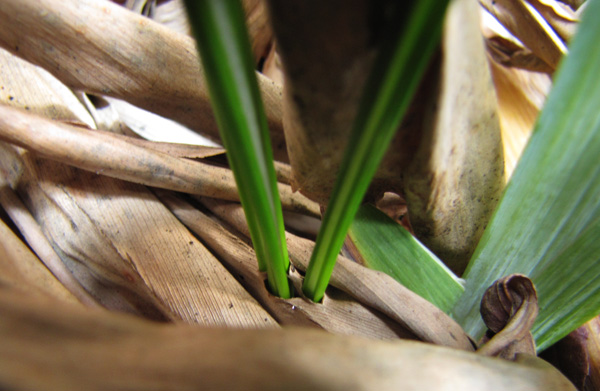
This crocus is a bit late because it had to penetrate the husks of last year’s ginger lilies. Most of my poems happen like this, sprouting in the dark. Pale, nebulous tendrils of urgency. A few die in this phase, too weak to persevere. Others toughen in time, burrowing through sheaves of revision. They emerge with varying degrees of definition and emphasis. The best ones bloom.

One of my recent poems followed a much different course.

A few days ago, I watched part of a program about ancient gods. The segment dealt with Medusa. Later in the day, unable to get Medusa off my mind, I googled her. I chose the first link, which was Wikipedia. Then I clicked another link, and another, and another, straying through topics that eventually had nothing to do with Medusa. I tired of links before I tired of reading, and my mouse wandered into a cache of poetry bookmarks. I soon landed on the vox poetica prompts page.*

The current prompt reverberated for me. Until that moment, my rambling Medusa research had yielded only a vague field of oscillating ideas. The photo collapsed it into a poem particle, which coalesced, with very little input on my part, into “Ceto, in Decline, Calls Out to Medusa”. It’s the rarest type of poem, in my world. One that writes itself and requires only fidgety revisions to clarify meaning and capitalize on sound. (It will remain posted on the prompts page until the prompt changes.)

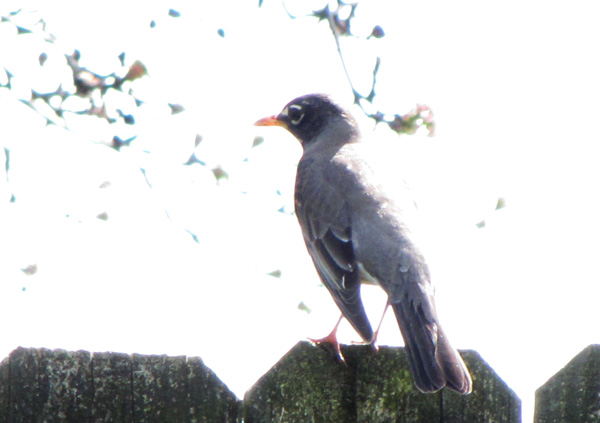
I’m always delighted by creations, like the Medusa poem, that occur as random accidents. Like this robin photo, which was a mistake, a miscalculation of light that produced an image I could never have planned. I’m happy to live in such a world, where serendipity matters.
* If you aren’t familiar with vox poetica, I recommend setting aside some time to explore. Publisher Annmarie Lockhart is a tireless advocate for poetry and poets. Her website is a treasure. There’s a new poem every day, an archived poemblog, links to her blog talk radio show, and a number of different ways to contribute. If you write poetry, why not submit something?

Spring Action

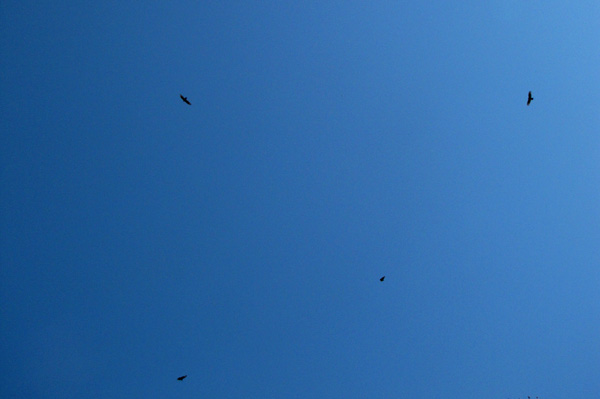
There’s so much going on that it’s hard to know where to look. If I focus my camera on the vultures wheeling overhead, I miss the carpenter bees zooming underfoot. There are crane flies mating and irises blooming and new visitations of wonder in every corner of the yard.

This slideshow requires JavaScript.

Photo Failure, Tufted Titmouse

I’ve been hearing a tufted titmouse call for weeks. These birds have a loud, clear call that carries. (You can hear a sample here.) I find it hard to guess how far away the bird is, when I hear one calling, but it always seems to be across the road or in a neighbor’s yard or a few streets over.

Today one visited our yard, hopping through the pear tree as it sang. I desperately wanted a picture of this little bird and managed to catch several frames of it. None of them are quite right. The top photos are my best shots of the day, but I never did get “the” picture.

The following are a few of my failures. They are like many of my writing failures, suffering from poor focus, flat light, or awkward angles. But, unlike my writing, I can’t save these photos. They are missed opportunities with no chance of salvage. I can’t edit them into success.

I hope to remember these photos the next time I sigh over a stubborn phrase, resenting the work of revision.