Review: At Age Twenty

At Age Twenty by Maxwell Baumbach
(unbound CONTENT, 2012)

Maxwell Baumbach’s poems are perceptive, ambitious, and unapologetic. They are also wryly aware that age seldom listens to youth with the kind of respect these poems yearn for.

the god is………..you
this is your….reality
your………….world (“Kaleidoscopes (an experimental sestina)” pg 20)

but the world does not cease
leaving its oversized handprints on my back
shoving me
onward (“My Fifth Birthday” pg 64)

While I usually prefer more complexity of sound, there’s plenty of music here. It’s a raw music of line breaks and candor: “I am your / zip lock lover” (“Zip Lock Lover” pg 25), “your eyes are gods / they make me believe that I am / capable…” (“the gods in your eyes” pg 28), and “no one kills themselves / on their own” (“Lemmings” pg 69).

There’s chaos and gratitude. Despair, sarcasm, and humor. The world is vulnerable and absurd. Brakes fail, Harry Caray sings through a seventh-inning stretch, and pro wrestlers soar and fall. Orion has a belt but no pants.

Some of these poems are terse fragments of dialogue, others are expansive recollections. They drop F-bombs, have a few drinks, and fall in love. Bruises and broken hearts are part of the journey, as are breathtaking insights.

I couldn’t help seeing the future in this book, nestled inside one of my favorite poems from the collection:

Sphere Within a Sphere

I saw a sculpture
in Ireland
of the new world
emerging from the old one

it is not the
now rusting gold
or the curvature
of the spheres
that made it so wondrous

but rather
that this sculpture
will be perpetually relevant

(reprinted with the author’s permission)

The new world is, indeed, emerging from the old.

Review: Amytis Leaves Her Garden

Amytis Leaves Her Garden by Karen Kelsay
(White Violet Press, 2012)

I confess to feeling intimidated as I approached this book. I am a long-time fan of the author’s online journal Victorian Violet Press, which is now closed, and I regularly submitted my poetry there. Our roles are established: I am a poet with no poetry credentials (other than my brief list of publications) and she is an editor. I submit. She reads and evaluates. I find the idea of reversing those roles unsettling.

Also, this book reveals embarrassing gaps in my knowledge. Who is/was Amytis? Easily answered by an internet search. But, more importantly, formal poetry? The majority of these poems are formal poetry, which I haven’t studied since high school. My preference, in both reading and writing, is free verse. So who am I to tackle this mysterious collection of formal poems? With my limited experience and non-existent credentials, what can I add to the conversation about Amytis Leaves Her Garden?

Then I started reading. I jotted down a few notes. And a few more notes. I read the whole thing again, flipping back and forth between poems, pen in hand. Now I have eleven pages of notes. With eleven pages of notes, perhaps I have something to add to the conversation after all. But it’s not a review. What I have is an argument for reading outside of comfort zones.

Formal or not, the poems in Amytis Leaves Her Garden are relentlessly beautiful. The first line sets the tone: “It’s always in the violet hour you call…”. (“Winter Lullaby” pg 11) Winter and dusk linger near every poem. Amytis is not leaving her garden, the garden is leaving her.

The book travels back and forth between fields and seashores, between childhood memories and adult responsibilities, between myth and reality.

…If I could wrap myself
around your limbs and carry you like nectar
cupped inside my hands–I’d drink your pain. (“Aurora Speaks to Tithonus” pg 32)

I wondered if their love had ever been
alive, or if their crazy, violent bouts
had killed it off–until the illness came. (“Outlooks” pg 40)

Time is fraught with grief, but also a maturing acceptance of change.

I’ve come to wrap long vines around my breasts
and smear wet clay upon my dress. To weep. (“At Sunset By the Oak” pg 26)

Your gauze-like scent clings to the walls, despair
and giddy memories return. I swear,
I hear a gull and jetty bell’s refrain.
They both dissolve like sand hills in the rain. (“Divining a Lost Summer” pg 45)

These poems are mesmerizing. Rhyme and meter are a tidy bonus, but not the primary allure. Whenever I try to name their forms, I succumb to the lure of imagery. When I try to pin down meter, I lose myself in metaphors.

Does my lack of appreciation for formal poetry rob me of a more profound connection? Probably so. A reader familiar with formal poetry would likely choose a different set of lines to illustrate a different understanding. But Amytis Leaves Her Garden did not hold me at arm’s length, demanding I study the intricacies of sonnets before entering its world.

My journey with Amytis Leaves Her Garden reflects my larger journey with poetry. I approached it with misgivings, circled a while in indecision, sampled and retreated, returned for a closer look, and finally waded in. Next time I’m tempted by a book that seems too difficult for me, I won’t be so hesitant to explore.

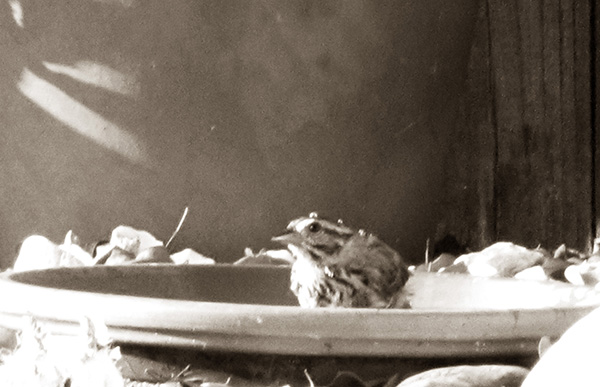
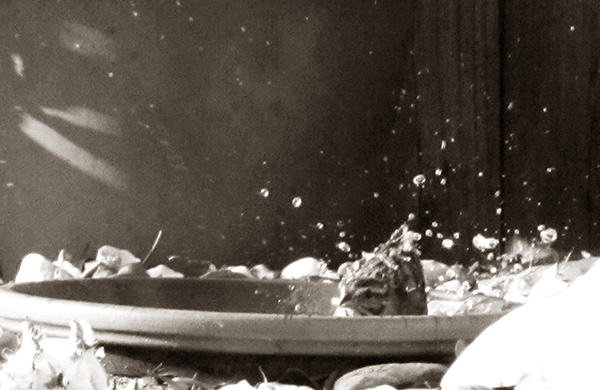
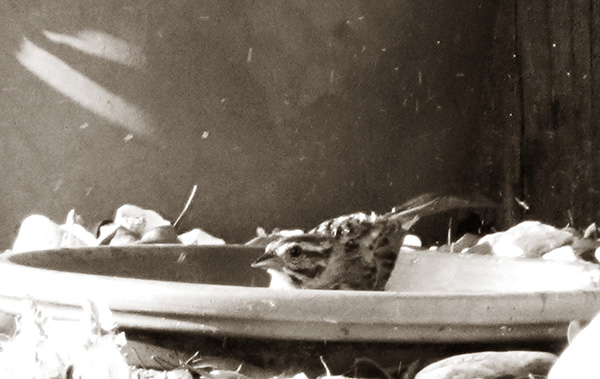
Sparrow August 12

Sparrow August 12

Sparrow August 12

Sparrow August 12

Amazon link and sample poems:

Verb Choice in Fiction

I recently ran across an article titled “Falsifying memories” at The Guardian’s Neurophilosophy blog. I read the article in my usual half-distracted manner until a sentence caught my full attention and prompted me to start over. The second time through, I read much more carefully. Here’s the sentence:

[Elizabeth] Loftus started her career investigating semantic memory – how word meanings are stored in the brain – and somewhat ironically, it is the meaning of words that seems to lie at the heart of the matter. (1)

For me, this sentence hinted at fascinating possibilities. The article doesn’t expand on the semantic memory work, so I started clicking links to find out more. One of the links led me to a longer profile by the same author, published in Nature. There I found this marvelous set of paragraphs:

…Loftus won funding in 1974 for a proposal to study witness accounts of accidents, and she soon published the first of several influential studies revealing the limitations of eyewitness testimony1. She showed people film clips of car accidents and asked them to estimate the speed of the cars. The wording of the questions, she found, had a profound effect on the estimates. People who were asked, “How fast were the cars going when they smashed into each other?” gave higher estimates on average than those with whom the verb ‘hit’ was used. And those who were told that the cars had ‘contacted’ each other gave the lowest estimates.

Those asked about cars smashing into one another were more than twice as likely as others to report seeing broken glass when asked about the accident a week later, even though there was none in the video. “I realized that these questions were conveying information,” says Loftus. “I began to think of it as a process of memory contamination, and we eventually called it the misinformation effect.” (2)

[Citation within the text of the first paragraph:  1. Loftus, E. F. & Palmer, J. C. J. Verb. Learn. Verb. Behav. 13, 585–589 (1974).]

It seems frivolous to lift the findings of such important research out of their context and apply them to fiction writing, but I couldn’t help drawing a connection. Consider the varying responses to the words smashed, hit, and contacted, and imagine writing about a car accident. Detailed descriptions of speed and broken glass become redundant if the car is smashed.

Every self-help writing book and article talks about verb choice, and it seems there is more to the recommendation than I previously understood. Perhaps tendrils of memory contamination are key elements of fiction. After all, my favorite fictional worlds are so vibrant that I almost remember being in them. And as a writer, I want my work to be memorable.

At the time I found these articles, I was re-reading The Hobbit. Few books live in my memory as vividly as The Hobbit. The words, as much as the story, create its charm.

Here’s a paragraph from the first chapter:

If you have ever seen a dragon in a pinch, you will realize that this was only poetical exaggeration applied to any hobbit, even to Old Took’s great-granduncle Bullroarer, who was so huge (for a hobbit) that he could ride a horse. He charged the ranks of the goblins of Mount Gram in the Battle of the Green Fields, and knocked their king Golfimbul’s head clean off with a wooden club. It sailed a hundred yards through the air and went down a rabbit hole, and in this way the battle was won and the game of Golf invented at the same moment. (3)

In this paragraph, “charged,” “knocked,” and “sailed” carry the scene for me. The peak phrases are evocative, but they are also interesting rhythmically.  In particular, note how the string of airy vowels in “It sailed a hundred yards through the air” stops hard against the consonants of “went down.” It’s poetry, as much as verb choice, which is a digression from my topic. I’ll save my raptures about poetic prose for a later post.

The Hobbit is a trove of effective verb choice, in part because its unique and interesting verbs are used in moderation. They stand out because they are relatively infrequent. They would be less interesting, and less effective, if every verb in every sentence was just as interesting. The other verbs in the above paragraph–have seen, will realize, applied, was, etc.–are elegant in their simplicity.

When I edit my writing, I dedicate an entire revision run-though to verb selection. I scrutinize every verb in every sentence, and try to improve them all. But perhaps my focus has been too tight. I lacked moderation, so my writing lacked rhythm. In the future I want to choose my moments. Concentrate more on the structure of my stories, and how sentences reinforce that structure, and less on the structure of individual sentences. Because I want my stories to be memorable, not my sentences.

References

1. Costandi, Mo. “Falsifying memories.” @Neurophilosophy. The Guardian. 16 August 2013. Web. 24 August 2013.

2. Costandi, Moheb. “Evidence-based justice: Corrupted memory” Nature Vol. 500, Issue 7462. (15 August 2013) 268-270. Web. 24 August 2013.

3. Tolkien, J.R.R. The Hobbit. Rev. ed. New York: Ballantine Books, 1977. 30. Print.

Blue Moon August 20

Blue Moon, August 20, 2013

I mention writing in many of my posts, but I seldom discuss the mechanics of writing that are important to me. So this post is a departure from my theme. I hope to make more departures, in the future, and write more about writing. 
Dragons

Like most of my enduring interests, this one started with a book.

The Dragon's Handbook

I don’t remember exactly when The Dragon’s Handbook came to me, though I have vague memories of tugging on Mother’s purse in a used book store, begging for “this one.” Because of its odd shape, the book never fit comfortably on a shelf with my other books. So I propped it against my mirror and treated it more like a piece of art than a book, making it an integral part of my room’s decor.

While The Dragon’s Handbook held some of my favorite illustrations, my favorite stories featured horses and dogs. The Black Stallion series, 101 Dalmations, and Lad: a Dog. King of the Wind, Lassie Come Home, and Where the Red Fern Grows.

Then I found The White Dragon on a library shelf. Its cover featured a much fiercer dragon than Barbara Rinkoff’s Culhane, and I was suddenly ready for fiercer stories. I read Anne McCaffrey’s entire Pern series, and, from then on, I devoured any book with a dragon in its pages.

Books 1

The horses crowded closer together and shared their shelves with dragons. Today, dragons lurk in every corner of my office.

Dragon 3

Dragon 2

Dragon 1

I suppose this might explain why my favorite flowers are snapdragons.

Snapdragon April 1

Snapdragon April 1

And why I take so many pictures of dragonflies.

New Dragonfly 4s

Halloween Pennant

It certainly explains why my first complete manuscript is a literary fantasy. There’s a dragon, of course, but there are also hounds and horses. Because I couldn’t resist combining my two loves: my younger preference for stories about animals (especially stories that made me cry) and my teenage quest for adventure and magic and peril…

Dragon Oct 24

Botanical Garden Oct 24

Review: While You Blue-step

While You Blue-step by Mary Belardi Erickson
(Aldrich Publishing, 2012)

The poems in While You Blue-step examine the verge between nature and man. Some images are ordinary while others are strange. Swallows nest in metal culverts, butterflies and weeds invade a trash heap, minnows swim under railroad crossings, and a lone pelican lands beside a barn. Trains rattle across many of the pages and water flows throughout.

Like water, the book seeps and eddies from one poem to the next. The connections aren’t always obvious, but there is a general sense of movement. Of momentum without acceleration. By the end of the book, I felt as if time had passed and wisdom had been gained, even though I had not been aware of either process.

For me, the author’s voice is subtle, almost plain. But there are intriguing complexities in these poems, which depend more on meaning than music:

“Life swallowing you       like the whale did Jonah.”    (“Whaling Song”, pg 9)

“you fling pebbles
as if equating impact with answer
in a lifetime of making all blues
a wishing pool.”    (“A stone plunks”, pg 14)

“Winter takes off its gloves and cold
snaps its fingers like a magician
giving his audience an icy look.”    (“Cold Snaps”, pg 44)

While You Blue-step is not a book to be read once and returned to the shelf. My copy will undoubtedly end up creased and scarred, written-in and highlighted. Unmistakable signs of respect.

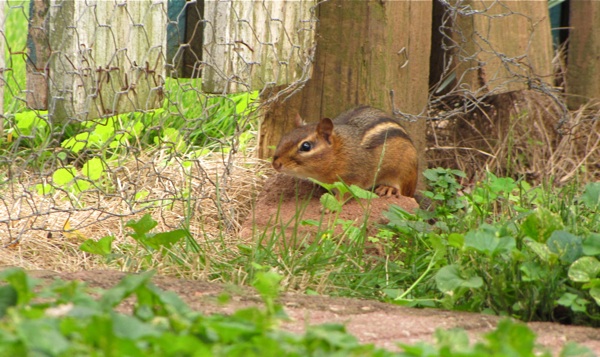
After Mother’s car accident, I stayed in her house a few months, in Huntsville, Alabama. While You Blue-step reminded me of those months. Chipmunks lived under an old shed in her back yard, and train whistles woke me with their unfamiliar cries in the night. Then there were months of emptiness and grief, after Mother died, and I’m only just now reaching the point where the world is familiar again. I am like the leaf on pages 18 and 19:

“touching ground means finding
waters, yourself flowing from time
to time.”    (“As a leaf”)