2012 Hampton Roads Writers Conference, Part Two

One of the last things I did, before leaving for the conference, was bring in the mail. The top envelope in the box was one of my submission SASEs, which could only be a rejection. Since better than seventy percent of my submissions result in rejection, it was a safe assumption. The envelope contained my very first photography rejection.

As I drove to the conference, I mulled my usual regrets. Did I miss something in the submission guidelines? Did I choose wrong, as I selected what to send? (The photos in this post are some of the ones I considered, but decided against.) And, the biggest question of all, what was I thinking? Why did I ever imagine that my work was good enough for publication?

I’ve been submitting poetry since 2003. Nine years in, I’ve accumulated a drawer full of rejections and a folder’s worth of acceptances. My rejection-regret processing time is down to a little over an hour, so I reached the “it’s okay and I’ll try again” stage before check-in time at the conference. Even so, it wasn’t the best way to start my weekend.

The first night offered a choice between three sessions. I opted for “Mastering the ten-minute agent pitch” by Molly Jaffa of Folio Literary Management. Anyone who has ever considered submitting their work to an agent should hear this talk. Before, I had vague ideas of how I wanted to present my book. After, I had a firm outline and growing confidence that I was on the right track.

Friday and Saturday’s schedules included talks about poetry, fiction, and non-fiction. My favorite sessions focused on marketing and editing:

  • “A Day in the Life of a Literary Agent” by Molly Jaffa
  • “Getting Published … and Maybe Even Paid (for your poetry)” by editor and publisher Annmarie Lockhart
  • “Buffing and Polishing” by author John DeDakis

I learned from every speaker, but the daily first-ten-lines critique sessions were the most interesting part of the conference. The critique panel consisted of agents Molly Jaffa, Rachael Dugas, and Brooks Sherman, along with authors Rick Mofina and Patricia Hermes. Earlier in the summer, conference registrants had been invited to submit the first ten lines of their works-in-progress. These submissions were projected in the auditorium (with the authors’ information removed), read aloud, and discussed by the panel. Points of interest included formatting, character development, point of view, word choice, and placing your work within the proper genre. In each submission I recognized problems from my own work, and I left each session with new ideas about how to strengthen my writing.

By Saturday evening, my mind was full to overflowing. I was happy to come home and eager to start applying all that I had learned. Which brings me back to “what was I thinking?” I was thinking this: I prefer a drawer full of rejections to a computer hard drive packed with poems and stories and photos that I never bothered to edit and submit.

Now, it’s time to get back to work.

A note from the yard and part one of my report from the 2012 Hampton Roads Writers Conference

My first day back from the writing conference is sunny and cool, a perfect day to spend in the yard. I had planned to run straight to my office this morning, but the day is too beautiful to ignore.

Each bed of ginger lilies began the summer with several small praying mantises. Now each harbors a single large praying mantis. I don’t know if the survivors killed their competitors or forced them out. Perhaps they shift territories from day to day and I never find the same individual more than once. But it seems logical, to me, that the one above (photographed on September 7th) lives full-time in the small ginger lily bed, while the one below (photographed today) conquered the larger, corner bed.

However it works, I’m hoping there will be praying mantis egg cases by winter.

Report from the 2012 Hampton Roads Writers Conference, Part One

In the past three years, many of my fellow poets and writers have attended the Hampton Roads Writers conference. I decided to see it for myself this year.

The conference opened Thursday evening and ran through Saturday. Presenters included literary agents, journalists, professors, editors, publishers, and a wide range of authors. All three agents held ten-minute pitch sessions and participated in panel discussions during which they critiqued a series of first-ten-line submissions. The conference also offered three free writing contests (fiction, non-fiction, and poetry) with mid-summer deadlines.

My poem “On Fossil Links That Cannot Speak” placed second in The Barbara Dunn Hartin Memorial Poetry Prize. Barbara Dunn Hartin was a longtime member of the Albright Poets and a dear friend. When her son called my name yesterday, I floated to the front of the room through a fog of tears, speechless and overwhelmed. The certificate shook in my hands as I heard her laughter in the room’s echoes and saw her sparkling eyes in every face. It was a magical conclusion for the conference.

(Except it wasn’t quite the end. After my award, two other Albright Poets won prizes for their creative non-fiction!)

Monarch or Viceroy?

Since monarch butterflies and viceroy butterflies are both rare in the yard, I haven’t had much practice identifying them. So when a gusty headwind forced this butterfly to perch on the deck this morning, I labelled the photos “Monarch” without paying much attention to the details. After a bit of research, I changed the label to viceroy. The broad stripe that crosses the hindwing’s network of other stripes seems to be the key.

What do you think? Monarch or viceroy?

Rabbit Update and a Publication Note

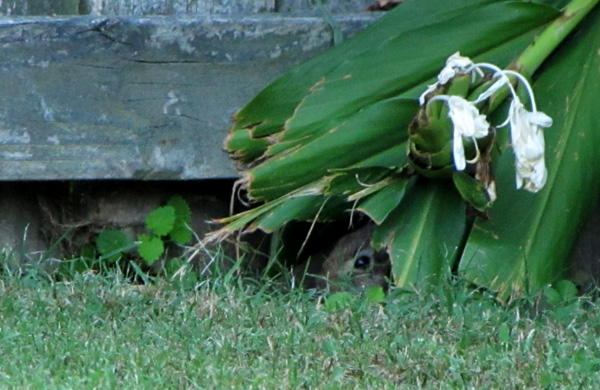
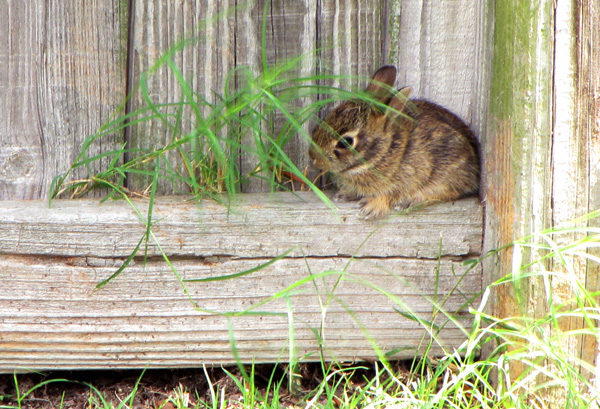
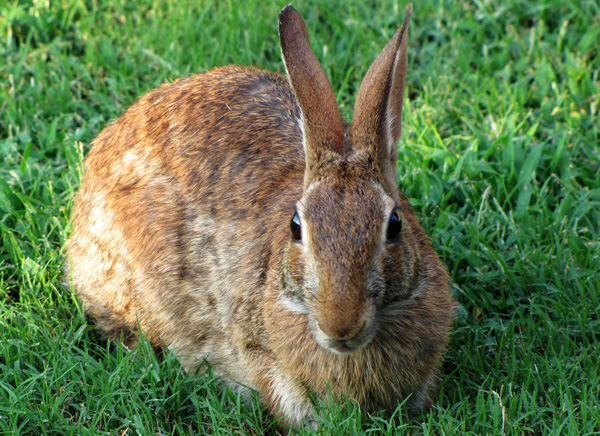
The rabbits now spend their days exploring the shed and deck and irises, stretching their boundaries more and more as they grow. But they aren’t so mature that they are willing to skip a meal with their mother. They predictably return to the ginger lilies each evening, where she meets them after dark.

Even though they still nurse, they have become competent grazers. It’s fun to watch them experiment with the yard’s various weeds and flowers.

Publication Note:  My poem “Ink” appeared at vox poetica earlier this month. It’s now posted on the poemblog.

The Rabbits Lose Their Nest

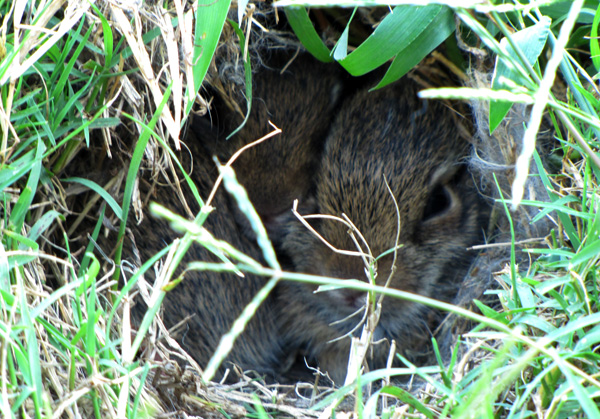
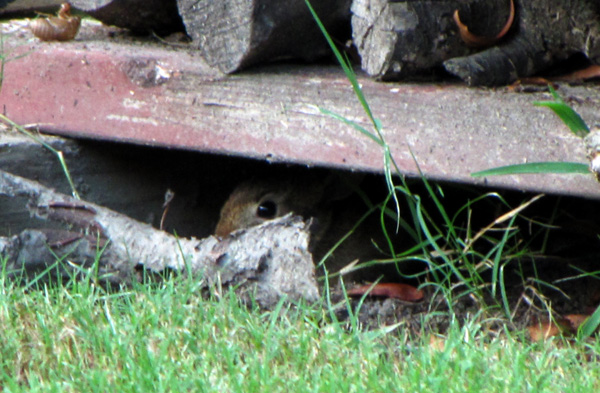
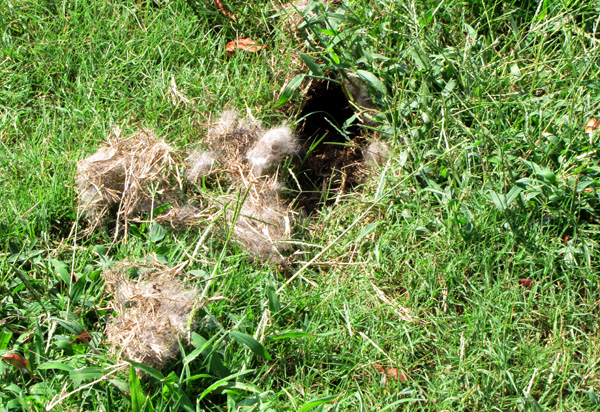
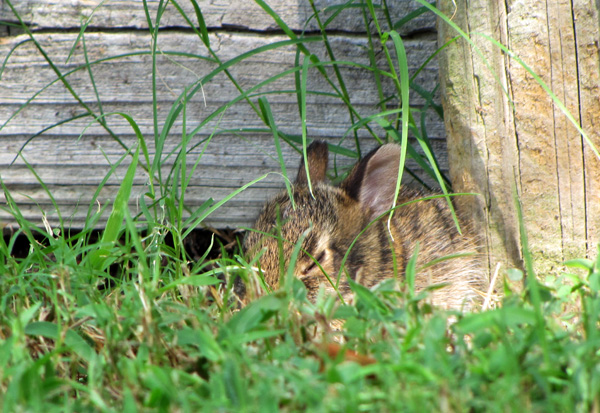
This is the last image I have of the rabbits in their nest. At the time I took this picture, near nightfall on September 7th, there were three babies visible in the nest and a fourth hiding under the woodpile. Later that night, an unknown predator destroyed the nest and took two of the young rabbits.

What was it? Is there a way to name the hunger that crossed our fence in the dark? And what would I gain, in giving it a name?

The next day was one of uncertainty. How many had survived? One of them stayed visible all day, exposed and exhausted. I feared that it’s inexperience would lure another predator into the yard.

As it turns out, two of the baby rabbits survived. I have no way to know whether or not the rabbits grieve for their loss. All I know is that they go on. They sleep and graze, grow and explore. They live.

I’m sad about the lost rabbits, but less so than I might have been in the past. It’s a matter of perspective, and today’s date eclipses the yard’s small tragedies. Eleven years ago, I spent a week in front of my television, paralyzed with horror.

I felt, then, as if I would never again know joy. As if all of my future hours should be spent remembering and mourning. Except the world continued to turn and I couldn’t sustain my grief. Paper and ashes stopped falling from the sky. Piles of rubble disappeared. Names and stories quit flooding my dreams at night and swirled into the slow current of memory. Today I am able to sit quietly beside those memories and study a calmer reflection, one less distorted by ripples of fear. And tomorrow, when the Earth’s rotation delivers another new day, I’ll stand in the weedy expanse of my yard and take another picture of rabbits. Because all of my future hours should not be spent remembering and mourning. They should be spent living.