Focusing on Mallards. Part I: The Flight Muscles

While the yard didn’t have its very own Mallard nest, this year, we had regular visits from a hen who nested in the neighbor’s yard. Throughout April, the hen stopped in to graze and have a bath in the dragonfly pond. Then, on the morning of April 30, she brought along her brood of nine.

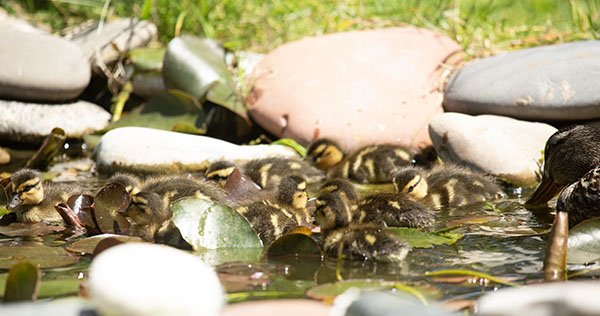
Photo of a Mallard hen standing beside our dragonfly pond. Almost hidden in her shadow are nine ducklings, huddled for a nap after a busy excursion in the pond.
A Mallard hen (far right) swims with her nine ducklings in our dragonfly pond on April 30, 2024. The hen is mostly in shadow, her head in silhouette as she forages with her brood.

Where I started this multi-part post, and why

Spring often brings Mallards to our yard. March after March, April after April, May after May, pairs of Mallards wander in for a nap or a drink or a meal. Last spring, one pair stayed to nest. This year, there was the next-door nest.
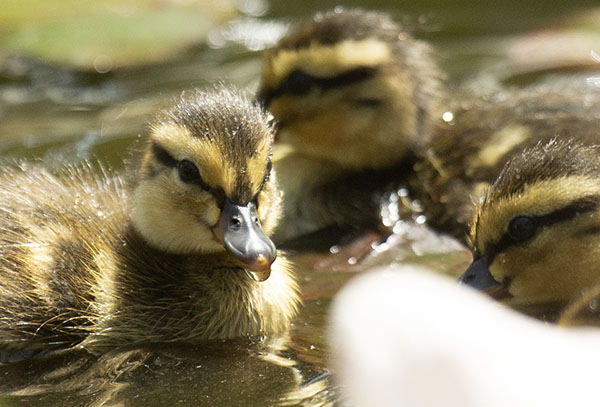
Photo of three downy, day-old Mallards swimming in our dragonfly pond. One duckling faces the camera lens, a drop of water hanging under its bill. The light pink remnant of its egg tooth is visible.

Watching the next-door hen sit her nest day after day, watching her amble into our yard to bathe and eat, I wondered about her flight muscles. All told, with about a month on the nest and maybe two months more until her ducklings can fly, she’s grounded for three months. That’s a quarter of her year. What happens to her vital flight muscles during that time? Are stretching and flap-bathing enough to keep a Mallard’s muscles in flight condition?

As I’ve noted before, I can’t resist a bit of research…
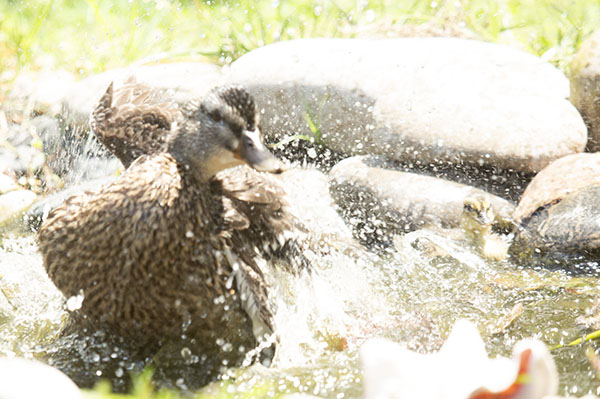
Photo of the Mallard hen enjoying a vigorous bath in our dragonfly pond on April 30, 2024. Here, her head, chest, and wings are lifted out of the water as she flaps furiously against the surface, churning the water into sprays. One of her ducklings (far right) is just visible through the splashes.
Photo of the Mallard hen, still indulging in her vigorous bath. She has moved to the other end of the small pond as she continues to splash with her wings. A duckling watches from the foreground (lower left), safely anchored on the surrounding rocks.
Another photo of the Mallard hen, still bathing. Here she is leaning into her bath, wings clapping against the water hard enough to throw spray under her feathers.
Yet another photo of the Mallard hen, here nearing the end of her bath. She is standing tall in the water facing the camera, wings extended behind her, showing the white feathers on the underside of her wings.
Photo of the Mallard hen stretching her wings after enjoying a splashy bath. She is standing tall in the water, facing away from the camera, both wings at full extension. The tops of her wings are visible, complete with patches of deep blue feathers on each wing.

I haven’t found any research into the changes (or lack of changes) in the flight muscles of nesting Mallard hens. That doesn’t mean this research isn’t out there. I simply haven’t found it. (I’m still searching.) But I did find a lot about flight muscles, and an article about flight muscle changes in molting, captive barnacle geese. (I’ll get to the geese in a later post.)

I’ll start with anatomy, because that always seems a reasonable place to start.

Unless you’re a duckling, then maybe start with the duck version of situational awareness. The world is a dangerous place for Mallards.
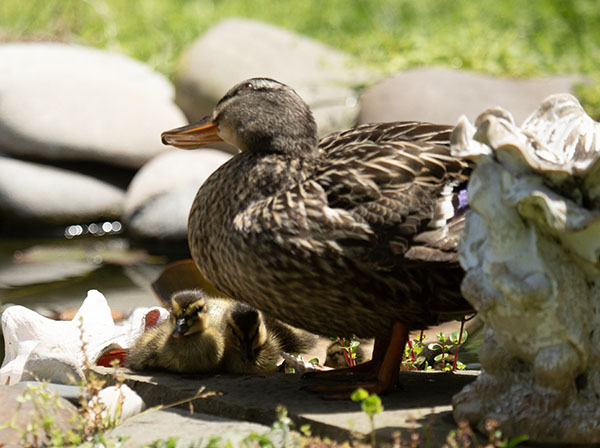
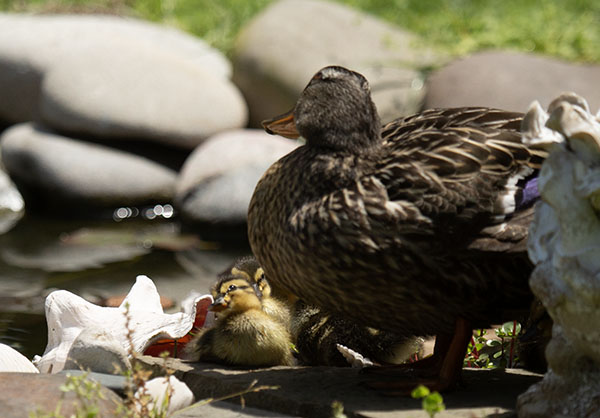
Photo of the Mallard hen teaching her ducklings to look overhead for danger. Whenever a crow or hawk flew over, she tilted one eye toward the sky (as seen in this photo) and gave a sharp quack. The ducklings froze in place, when they heard that quack, and they soon began to mimic her skywatching behavior.
Photo of the Mallard hen teaching her ducklings to look overhead for danger. Here, one of the babies is copying its mother's tilt of head, one eye turned to the sky.
Photo of the Mallard hen teaching her ducklings to look overhead for danger. Here, one of the babies is copying its mother’s tilt of head, one eye turned to the sky.
Photo taken the next day, May 1, 2024, after the Mallard hen and her brood returned from spending their first night on the big water. They basked and bathed in our little water for one last calm day, but were not completely free of danger. Here, the hen has flattened herself in the grass at the pond's edge, her wide and wary eye skyward, while a Bald Eagle passed high overhead. This was her most extreme reaction, while I was watching, but it was the ducklings' least attentive response. A few of them glanced upward, but they didn't freeze in place. Instead they continued to fidget and stretch in preparation for a nap. I wondered if they couldn't see the eagle, as it was too high for my camera to find with autofocus.
Photo taken the next day, May 1, 2024, after the Mallard hen and her brood returned from spending their first night on the big water. They basked and bathed in our little water for one last calm day, but were not completely free of danger. Here, the hen has flattened herself in the grass at the pond’s edge, her wide and wary eye skyward, while a Bald Eagle passed high overhead. This was her most extreme reaction, while I was watching, but it was the ducklings’ least attentive response. A few of them glanced upward, but they didn’t freeze in place. Instead they continued to fidget and stretch in preparation for a nap. I wondered if they couldn’t see the eagle, as it was too high for my camera to find with autofocus.

Flight muscles in birds

Bird flight is powered by chest muscles. Each wing needs one muscle to raise the wing and another muscle to lower the wing. Two wings, two muscles per wing, four muscles in total. All in the chest.

Pretend your arms are wings. Now try mimicking flight. Can you feel your chest and back muscles moving? Now imagine you are a bird. All that flying, with only chest muscles at work.

Huh?

Birds have one upstroke muscle per wing…

Photo of the Mallard hen stretching her wings. In this photo, both wings are raised, meaning the upstroke muscles for each wing are contracting (shortening) while the downstroke muscles are relaxing (lengthening).
Photo of the Mallard hen stretching her wings. In this photo, both wings are raised, meaning the upstroke muscles are contracting (shortening) while the downstroke muscles are relaxing (lengthening).

…and one downstroke muscle per wing…

Photo of the Mallard hen, stretching her wings. Here she is shifting from a completed downstroke into an upstroke. The downstroke muscles are beginning to relax and lengthen, while the upstroke muscles are beginning to contract and shorten. Her wings and flight feathers are positioned to minimize air resistance on the upstroke.

…groups of smaller muscles coordinate fine movements of flight feathers and joint angles, but power for flight lies in the muscles of the chest. The downstroke and upstroke muscles stretch, one on top of the other, between the sternum (the breastbone) and the humerus (the first and largest wing bone). One downstroke muscle and one upstroke muscle on the left side of the chest, for the left wing. One downstroke muscle and one upstroke muscle on the right side of the chest, for the right wing. If you eat poultry, these muscles are the breast meat.

Photo of the Mallard hen watching over her brood as they settle for a nap after an excursion in our dragonfly pond. I'm not here to preach against meat-eating, or against hunting. Both are part of the world, and both have been part of my world. But baby duck cuteness is part of why I am happier, here in my middle years, as a herbivore.
Photo of the Mallard hen watching over her brood as they settle for a nap after an excursion in our dragonfly pond. I’m not here to preach against meat-eating, or against hunting. Both are part of the world, and both have been part of my world. But baby duck cuteness is part of why I am happier, here in my middle years, as a herbivore.

Birds’ outermost chest muscles, the ones closest under the skin, are the downstroke muscles. They’re called the right and left pectoralis. They connect the sternum to the humerus on each side. When contracted, or shortened, these muscles pull the wings down. This anatomy is as straightforward as muscular anatomy gets. Sternum to humerus. When the muscles contract, they pull each humerus toward the sternum and the wings go down. A simple mechanism for a simple downstroke.

Flight anatomy gets its magic in the other flight muscles, the upstroke muscles. They’re called the right and left supracoracoideus. These muscles, nestled beneath the right and left pectoralis, also connect the sternum to humerus. But each upstroke muscle condenses into a tendon, as it nears its associated shoulder, and threads through a triosseal canal. A “three bone canal”. This canal lets each tendon emerge behind and over its associated shoulder, essentially passing from chest to back, before attaching to the top of the humerus.

This anatomical upstroke slight-of-hand, accomplished via the shoulder’s “three bone canal”, allows a pair of chest muscles to function like a pair of back muscles. When the upstroke muscles contract, or shorten, they pull the humerus away from the sternum so the wing goes up. An elegant mechanism for a simple upstroke.

Photo, from May 1, 2024, of the Mallard hen taking another vigorous bath in the dragonfly pond. Her ducklings (right foreground) bob on rough water and scatter to avoid being swamped as she churns up waves and spray with her strong wings. All of her wing power rests in her chest muscles.

If you think of a mechanical pulley system, the upstroke tendon would be the rope that runs over the wheel, while shoulder bones would be the wheel. Contracting, or shortening, the upstroke muscle is like pulling down on your end of the rope. The tendon slides over the bones, like the rope sliding over the wheel, and the wing (or the load you are lifting) rises up.

Presto.

The following video makes it much clearer (animation of the supracoracoideus and pectoralis starts at 3:59 and ends at 4:36).

Embedded YouTube video from medical illustrator Kelly Kage. A thesis video about the mechanics of bird flight, the video begins by describing skeletal anatomy, then moves into an animation of flight muscles at about three minutes and fifty seconds. Animation of the supracoracoideus and pectoralis begins at about 3:59 and ends about a minute later, at around 4:36. The entire video is nine-and-a-half minutes long. (I recommend the entire video, when you have time. The animations and narration are excellent.)

Bird flight isn’t exactly magic, but it’s mighty magical.

Why am I so fascinated?

An earlier version of myself, somewhere in my early twenties, taught a single semester of Introductory Zoology lab to undergraduates. (I was technically a graduate student at the time, but only because I needed two graduate courses to complete my prerequisites for veterinary school. I had no intention of finishing a Master’s degree.)

My most vivid memory, from my (thankfully) brief stint as a lab instructor, is the supracoracoideus exercise. I remember the uncanny slip of knowledge and knowing gliding across each other. The cognitive dissonance of trying to imagine a pair of flight muscles on my own chest.

Flex a chest muscle, and the wing goes down. Flex a different chest muscle, and the wing goes up.

Wing down. Wing up.

Chest. Chest.

Photo of a two-day old mallard duckling exercising its wing muscles. Here, with wings raised, the upstroke muscles in its chest are contracting while the downstroke muscles in its chest are relaxed. Photo taken May 1, 2024.
Photo of a two-day-old Mallard duckling exercising its wing muscles. In this frame, the wings are early in the downstroke phase, meaning the little bird's downstroke muscles are beginning to contract while the upstroke muscles are beginning to relax.
Photo of a two-day-old Mallard duckling exercising its wing muscles. In this frame, the wings are early in the downstroke phase, meaning the little bird’s downstroke muscles are beginning to contract while the upstroke muscles are beginning to relax.

[Full disclosure: I was a bad teacher. I was both stupid and ignorant. I feared my human empathy, so I had conditioned myself to ignore the body language, verbal cues, and emotions of people around me. And I never thought to apply imagination to the teaching guide. I never thought to have my students move their own arms and feel their own muscles, then try to imagine the upstroke as a chest muscle, instead of a back muscle. As a tension through the shoulder while a tendon slides. If this post ever reaches any of my unfortunate students, I want to thank them for their patience and attention. They showed up, week after week. They showed up and they tried to learn what they needed, despite being burdened with an incompetent lab instructor. I know an apology is not enough. Even so, I’m sorry.]
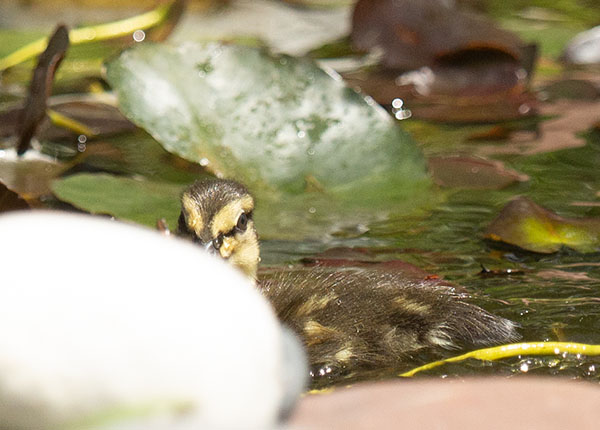
Photo of a two-day-old Mallard duckling swimming in our dragonfly pond. The duckling is gazing at the camera lens from behind a rock. The facial markings of a Mallard duckling, with dark eye stripes over yellow down, make the babies look grumpy from this angle. I imagine my students felt grumpy, and likely overwhelmed, after each of my class sessions. I would have felt angry and betrayed, had I been my own student.

The muscular choreography of bird flight is nothing like what I had imagined and mimicked, as a child. Not pushing my arms down with chest muscles and pulling them up with back muscles. Not a rowing cycle, over and over. Every time I pretended my arms were wings, my chest and back muscles cooperated. But for birds, it’s all chest. Chest muscles down and chest muscles up.

Photo of the Mallard hen with her brood scattered about her. In this photo, some of the ducklings are sleeping, some are fidgeting, and some are practicing preening. The hen is watching me and my camera with her head turned to one side, one eye focused directly on me. I can't help but imagine an internal monologue for her. "What is wrong with this human? Why is she so nosy? Should I be afraid?"
Photo of the Mallard hen with her brood scattered about her. In this photo, some of the ducklings are sleeping, some are fidgeting, and some are practicing preening. The hen is watching me and my camera with her head turned to one side, one eye focused directly on me. I can’t help but imagine an internal monologue for her. “What is wrong with this human? Why is she so nosy? Should I be afraid?”

Even today, despite my long familiarity with bird anatomy, I struggle to imagine how flight must feel. When I read about science fiction and fantasy creatures with wings, especially dragons, I usually forget to wonder about the musculature that powers fictional flight. But, in moments when I do pause to wonder, my imagination becomes richer.

A preview of Part II: More about Mallards and their flight muscles

So here is a duckling, with its clever wings and wing muscles, destined for flight. How it proceeds, how it uses those wings and wing muscles, determines how bulky the wing muscles must be. Or, do I have it backward? Do the wing muscles, with their relative bulks, determine how the duckling must use its wings? As with much, when it comes to physiology, the answer is a loop. The relative bulk of wing muscles influences how a duck might use its wings, and the ways a duck uses its wings influences the relative bulk of its muscles. Part II will have more about flight muscles, more about Mallards, and more photos of these ridiculously cute ducklings.
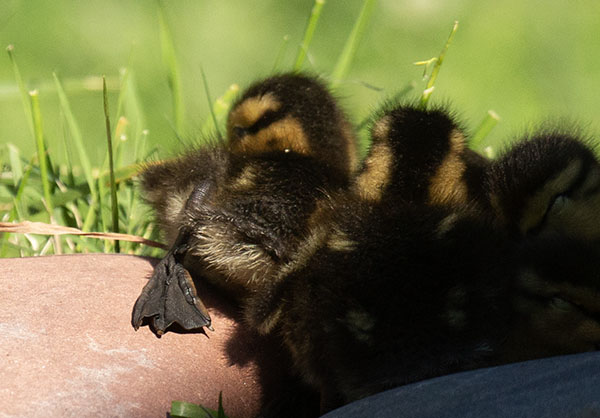
Photo of sleepy Mallard ducklings, one with a webbed foot stretched into the sunlight. If you are still reading, thank you.

The following links lead to articles and posts that are more important and more interesting that my Mallard musings:

Alien life is no joke by Adam Frank at Aeon

No one buys books by Elle Griffin at The Elysian

Scalzi on film: The Godzilla Beeper by John Scalzi at Uncanny

Back in 2015, I knowingly blew up my life by Pamela Gray at Star Strider (hat tip to Science for Everyone)

What is it like to be a crab? by Kristin Andrews at Aeon

Moving beyond ontological (worldview) supremacy: Indigenous insights and a recovery guide for settler-colonial scientists by Coen Hird, Dominique M. David-Chavez, Shanny Spang Gion, and Vincent van Uitregt at Journal of Experimental Biology

Necrosecurity, Immunosupremacy, and Survivorship in the Political Imagination of COVID-19 by Martha Lincoln at Open Anthropological Research

In a New England pond, toxic algae is disrupting tribal heritage by Eve Zuckoff at CAI

2 thoughts on “Focusing on Mallards. Part I: The Flight Muscles

  1. Jean Ryan's avatar Jean Ryan May 22, 2024 / 4:57 PM

    Your posts, as always, are surprising and illuminating.

Leave a reply

This site uses Akismet to reduce spam. Learn how your comment data is processed.