Focusing on Mallards Part VII: Game informants, game police, and the end of the game market

“Be it further enacted by the Authority aforesaid, That the several Towns in the Province shall have Power, and they are hereby directed…to chose and appoint two meet Persons whose Care and Duty it shall be to inform of all Breaches of this Act, and to take Care that the Violaters thereof be duly prosecuted and punished…” (Massachusetts General Court, 1739, p. 688).

Content Warning: This multi-part blog post contains references to hunting, agriculture, and research practices of killing birds and other wildlife. If you decide not to read on, I respect and admire your choice.
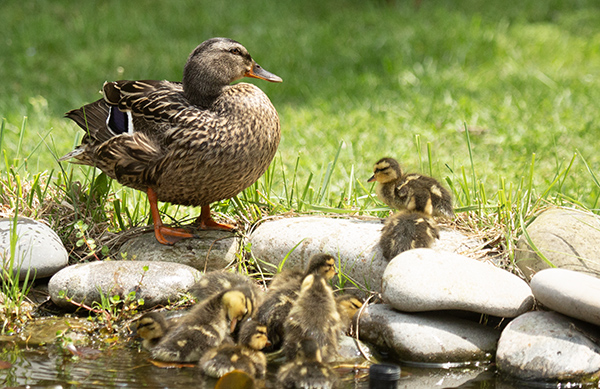
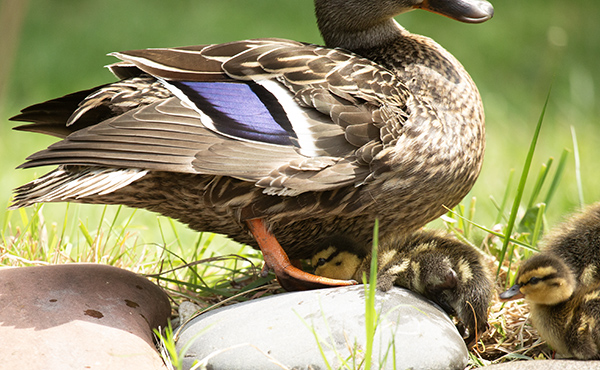
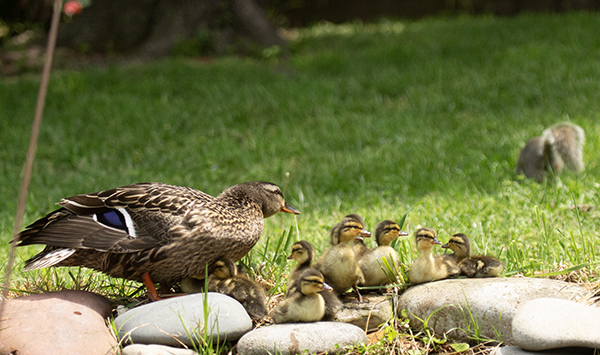
Photograph of a Mallard hen standing beside a small backyard pond. She is standing on one of the large, smooth river stones that border the pond. Her eleven ducklings (they're difficult to count, in this photo) had not yet mastered climbing on the stones. Two ducklings have reached a resting point, but the other nine are jammed together, scrambling for purchase, knocking each other aside, and climbing on top of each other as they struggle for footholds.
Photo from the Mallard archive. In this photo, a Mallard hen waits on the stone border of our dragonfly pond as her days-old ducklings scramble out of the water.

[This post picks up where the last left off. For recaps and links to the rest of the series, please visit my Mallard page.]

Dibs on the Deer

Game legislation, in the pre-revolutionary colonies, started with deer.

With deer in Massachusetts. In 1739.

As wave after wave of European immigrants divvied up the Atlantic coast of North America, the political and social habits of aristocracy proved difficult to shake. Colonists may have envisioned a democratic continental future, in which the people (the invading people, that is) owned the continent’s resources, but pre-revolutionary lawmakers hoarded up resources according to Europe’s aristocratic precedent.

In Massachusetts, in 1739, that meant hoarding up the deer.
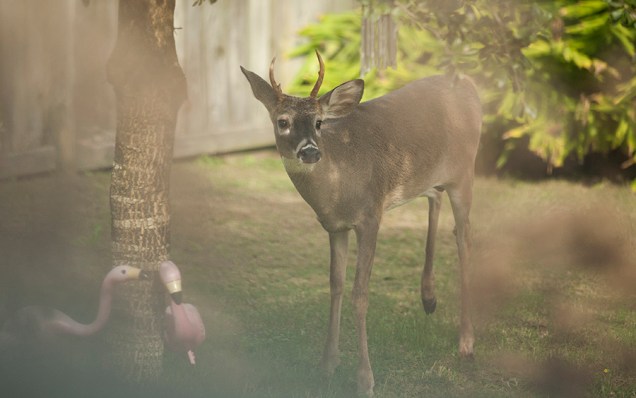
Photograph of a young white-tailed deer standing under a set of wind chimes that were hanging in a small live-oak tree in our privacy-fenced back yard. The deer was photographed through the browning blooms of Joe Pye Weed, which appear as vague clouds and patches obscuring the foreground. The brown-furred deer has long skinny legs with long black hooves. His small antlers are slightly curved, each antler is a single tine approximately 6–8 inches long, and each antler has a single visible bump along the shaft (bumps that would, in an older stag, branch off into secondary tines). He has prominent white markings around his dark nose, and the fur around his eyes and under his chin is paler than the rest of his body. Here, his stance is tense. He has one back foot raised off the ground; his large ears are angled, one forward and one backward, for situational awareness; and his eyes are opened wide. His white sclera, (the "whites of his eyes") are not visible, but the rings of lighter fur around his eyes mimic scleral flashes, making his expression appear anxious. A pair of plastic pink yard flamingos are leaning against the tree's trunk, and, in the background, a dense stand of ginger lilies are beginning to droop as their blooming season comes to a close. The yard is mown short, and the grass is patchy with weeds.
A few years ago, this spike-antlered white-tailed deer trapped himself in our cul-de-sac during rut season. I blogged about him here. Today, nearly three centuries after Massachusetts’s 1739 legislation, white-tailed deer in the US are monitored year-round and harvest limits are fine-tuned, in some states, on a herd-by-herd basis.

The wordily convoluted law quoted as an opening epigraph, above, was filed as “An act in addition to an act entitled, An act for the better preservation and increase of deer within this Province”.1 The new-and-improved 1739 edition aimed to halt the decline of deer populations by reinforcing seasonal hunting restrictions: “Whereas the penalties already provided in and by an act pass’d in the tenth year of the reign of King William the Third…have proved ineffectual to answer the good ends in said Act proposed…” (Massachusetts General Court, 1739, p. 687).

Starting on December 10th of 1739, deer were off the hunting menu. Deer season would reopen on August 1st, 1740, and the schedule would repeat indefinitely. From August 2nd to December 9th, annually, the citizens of Massachusetts could enjoy late autumn/early winter’s open season on deer. But during the rest of the year, deer meat and deer hides were forbidden harvests. Anyone caught with fresh meat or hides (or said to be in possession of such, by any two informants) would be prosecuted.

To enforce this seasonal hunting ban, the revised act required each town to appoint two official informants to monitor and prosecute (persecute?) deer hunters, with expansion of the informant network written into the statute: “…appoint one or two meet persons in every such new plantation wherein ten or more families are settled, to inform against and prosecute the Violaters of this Act” (p. 688).

Should any of the appointed informants decline the position, and/or decline to swear the informant’s oath, anyone could sue them for the sum of £5 (p. 688). (According to an online conversion calculator, that’s a fine roughly equivalent to $1500, in 2026 US dollars.) As the statute does not specify a one-time fine, I envision a line of friends and coworkers demanding payment from some poor soul who slept through the meeting, didn’t know they had been nominated and elected, and couldn’t bring themselves to sign on as an informant.

Oaths aside, informants generated their own wages. Anyone convicted2 of killing the king’s province’s deer owed £10 per deer, divided between the informant and “His Majesty for the Support of this Government” (p. 687). When a convicted hunter couldn’t pay the fine, they faced jail for 30 days or forced labor for two months.

All of this means that Massachusetts’s 1739 deer informants had the statutory power to persecute (prosecute) deer hunters. To drive the colony’s deer hunters first into poverty and then into slavery.

Aside: The Robin Hood Perspective

I grew up on a steady diet of Robin Hood.3 As a fan of the trope, all of this 1739 fuss about the king’s deer resonates.
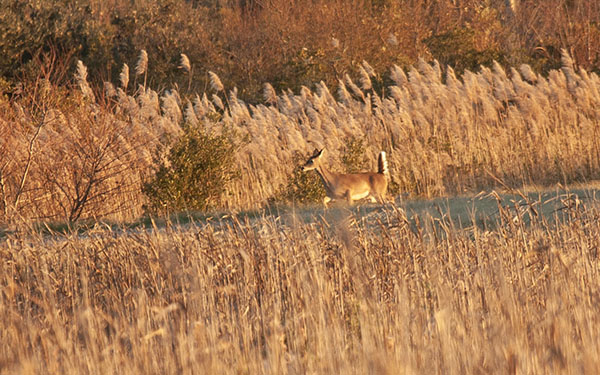
Photograph of a white-tailed deer that has just crossed a well-tended path in Back Bay Wildlife Refuge, in Virginia Beach, VA. The deer's coat is reddish-brown, lightening to pale tan under her abdomen and chin. (I assume she is a doe, as she has no antlers. Such assumptions are not always correct.) Her body language— erect tail, backward focused ears, and quick stride—indicate alertness. The photo's foreground and background are the deep brown and orange tones of winter dormancy, thick with tall grasses (including seagrasses) and winter-bare shrubs.
As a side-effect of spending most of my years in the southeastern US, my memory-file for “deer” is filled with white-tailed deer. So is my memory-montage of all the various Sherwood Forests I visited, in my childhood reading. Actual deer, in Sherwood Forest, are both larger and smaller than North America’s white-tailed deer.

I have lingering nostalgia for Robin McKinley’s reluctant hero in The Outlaws of Sherwood:

There had been outlaws around Nottingham and in Sherwood before, but this sounded like something new—outlaws who believed in king and country, and good English law; who merely rebelled against the heavy hand of tyranny (1988, Chapter Four, para. 15).

And for Peter Beagle’s gruff anti-Marian in The Last Unicorn:

Close by a familiar voice said, ‘Leaving us so early, magician? The men will be sorry they missed you.’ He turned and saw Molly Grue leaning against a tree. Dress and dirty hair tattered alike, bare feet bleeding and beslimed, she gave him a bat’s grin. ‘Surprise,’ she said. ‘It’s Maid Marian.’ (1968, p. 82)

Awash in Robin Hood, I’m pre-disposed to favor pure-hearted bandits living in the woods. To expect corruption among government officials charged with imprisoning and enslaving the pure-hearted bandits. Reverse tropes, in which bandits are greedy and officials pure-hearted, simply don’t resonate. I can’t recall any among my best-loved childhood books.

Robin Hood taught me skepticism for a system in which police generate their own salaries through imposing fines and confiscating property. Especially when the system polices those who have less power, less security, and less food.4

My skepticism will be apparent throughout this installment. It’s likely apparent in everything I write and everything I do.

This is the strength of fairy tales and myths and legends. Here in my middle years, all these many Robin Hoods float on the surface of my memories, jostling and reinforcing each other. Resonating.

As with my previous installment, caveat lector.
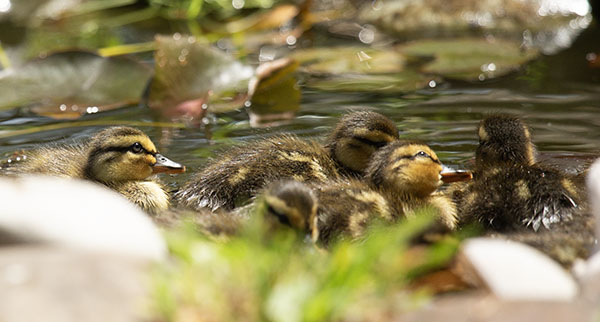
Photograph showing five downy Mallard ducklings swimming in our small dragonfly pond in the spring of 2024. One duckling has its head tipped sideways, one eye turned to the sky in response to an alarm call from its mother (who was standing just to one side, out-of-frame, when this photo was taken).
At what stage do Mallards become aware that humans are their most voracious predators? Looking skyward, for airborne predators, was an early lesson for this particular brood of ducklings. But they trusted me enough to allow these photos.

Policing the Hunt in the 1800s

Skipping ahead to the post-revolutionary colonies, game legislations gained popularity and momentum throughout the 1800s.5 As game legislation ballooned into a regulatory industry, bureaucratic vacuum energy organized into committees, commissions, and agencies. Various departments staked claims in wildlife as a regulated resource: game and fisheries departments, of course, but also agriculture, public lands, education, and commerce.

Wrangling with ways to police and enforce game laws, legislatures were forced to wrangle, also, with funding. So many interests. So much legislation.
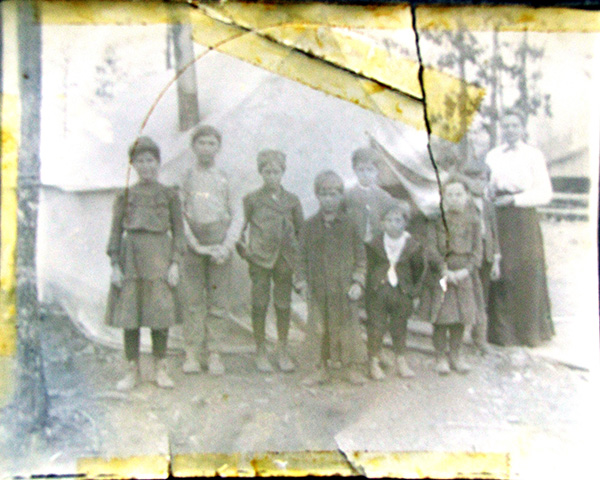
A faded black-and-white photograph of a group of children gathered in an outdoor setting front of what appears to be a tent. A chaperone in a long skirt and pale blouse stands with the children. The eight children are wearing clothes of various functional styles, including knee-length skirts, pants of full-length and knee-length, and shirts with full-length sleeves. Many are wearing coats and all are wearing work-style boots. One child, in the front row, has a more formal-appearing outfit, including a white shirt with dark pants and a dark coat fastened at a single point across the torso. The bare ground and thin evergreen trees (background), with a smudge of what appears to be winter-bare trees in the farthest background, suggests cold weather. The photo is torn in places, with yellow-tinged tape marks across the tears and along the edges.
How do any of us learn about the world, about dangers above and ahead? I’ve imagined a story in which this poorly-preserved photo from the family archive shows a school group in front of a makeshift tent-classroom, and in which these children have been freed from their chores for a few hours. I’ve imagined a background of poverty, or something much like it, for these children and their families. Perhaps I’ve imagined too much? Or too little? The nearest certainties I have are the setting (most likely somewhere between Ohio and Nebraska) and the timeframe (c. 1880—1900).

“In many States it has been found well-nigh impossible to secure legislation providing for the appropriation of money, no matter how little, for the preservation of game. The sentiment to which this condition is due still prevails in a large part of this country, particularly in the South. The creation of new offices, with salaries attached, is regarded with great jealousy and disfavor”6 (Williams, 1907, p. 34).
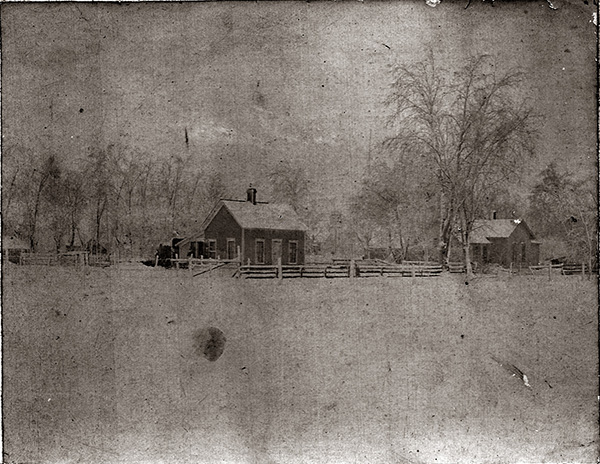
A grainy, blurred, and very faded black-and-white image of a pair of houses in a snowy setting. The houses are situation far back from the camera across a snowy field. They are encircled by a split-rail fence and winter-bare trees with snow-laden branches. The closest house appears to be somewhere between two and four rooms, with a prominent chimney in the center of the steeply peaked roof. The background house looks to have more rooms, with perhaps an addition-style room on one side. With written histories back to the 1860s, we know that the family lived as a multi-generational unit: a Civil War veteran patriarch (volunteer Ohio cavalry), his son and daughter-in-law, and their eventual six children (the youngest of which was my grandmother).
Photo from the family archive. This is one of the ancestral homes, photographed in 1892. The record isn’t clear about this property, whether it was in Ohio, Illinois, Iowa, Nebraska, or some other state less prominent in the family lore. Wherever it was, it looks fairly idyllic for a young husband and wife starting a family. Even so, it didn’t last long. By 1901, they were settled in Limestone County, Alabama, where they would live out the rest of their years.

Non-random examples: Incentivizing informants on both coasts

In funding game police, early statutes in California and Virginia resorted to borrowing (unknowingly?) from Massachusetts’s 1739 system. They legislated kickbacks for informants.7

In 1841, Virginia paid informants a half-share of fines collected from non-residents caught hunting waterfowl below the head of the tidewater (General Assembly of Virginia, 1841, pp. 88–89). As each fine was $100, informers could expect a payout of $50 per prosecution—a purchasing power of somewhere around $2000 in today’s (2026) economy.
Motion-blurred photograph of a small Bufflehead duck flying along a narrow channel of water. The duck is captured mid-flap, wing tips nearly touching the water. The water is murky green, mid-channel, and reflects winter-pale stands of grasses along the edge.
Virginia’s rich waterways, particularly below the tidewater (technically, the farthest extent of waters that change height and/or volume as the tide moves in and out), are havens for waterfowl.

About a decade later, in 1852, California informants were eligible for half-shares of fines. California fines were lower ($50) but were not limited to prosecuting non-residents (California Legislature, 1852, p. 134). The 1852 statute protected quail, mallards, and wood ducks and shut down the game markets for these birds during closed seasons. This statute put market hunters and market peddlers under extra surveillance. Informants didn’t need to slog out into the wild, to catch hunters in the act of shooting or collecting birds. They could simply stay in town and wait for sellers to open shop.

Who could resist the lure of an informant payday equivalent to $1000 or $2000, in today’s money?

My faith in humanity feels that almost everyone would resist such a lure, if their starving neighbors resorted to shooting mallards. My skepticism argues otherwise.
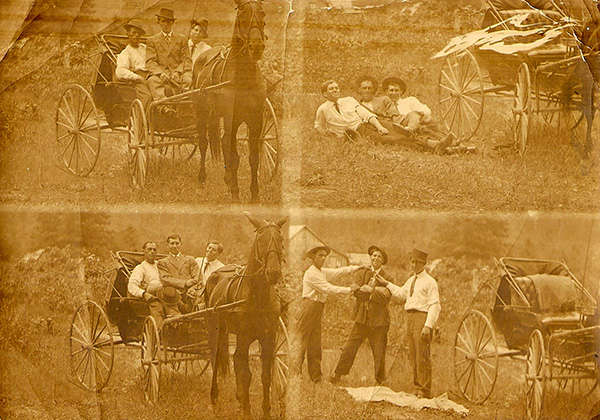
Sepia-toned photo series from the family archive, probably dating to the late 1910s or early 1920s. The photographer cleverly overlapped four images onto a single print. Each of the four images shows three men posing with a horse-drawn buggy. In two images, the men are seated in the buggy. In one image, the men are lounging in a row beside the buggy and one man has thrown his leg across the legs of the other two. In the final image, the men are standing together, two holding and pointing to the man in the middle, as if accosting him, and all three are laughing. In each image, one man is wearing a full suit of some middle-tone color, including a tie, vest, and jacket, over a white shirt; one man is wearing mid-toned pants, a white shirt, and suspenders; and the third man is wearing mid-toned pants, a white shirt, and a tie. The buggy has four delicate-looking long-spoked wheels, tufted upholstery, and a folded-back convertible cover. The horse is tall and rangy and is standing still in its harness and bridle. (The bridle looks tight, to me, and the horse's elevated head posture suggests the presence of a tight check rein.)
The leisure apparent in this quadruple-exposure image from the family archive (c. 1920?), along with the camaraderie, puts me in a familiar double-bind. I’m grateful that the image exists, and I’m aware of the flawed power distributions (past and present) that went into its creation and preservation. Would these men have chosen to profit from informing on their neighbors? Or would they have fed their neighbors? Whatever choices they made, over the courses of their lives, I expect they justified those choices from the various rhetorics of their various times. It’s the entire ongoing problem, over and over again.

Aside: About those debtors’ prisons

“The only punishment authorized under many of the older game statutes was a fine, and if the defendant was impecunious he escaped punishment altogether. A very considerable portion of offenders against the game laws are of this class, and experience has demonstrated that to secure obedience the alternative corrective, imprisonment, must be allowed; otherwise many violations go unpunished” (Williams, 1907, p. 74).

That quotation comes from a 1907 bulletin written by a member of the US Department of Agriculture’s Biologic Survey. My current self sees the cruelty in this logic—the cruelty and wickedness of debtors’ prisons. But as a young adult, despite all my Robin Hood reading and my own family’s orbital decay, I lacked such perspective. Young-adult-me would have nodded her agreement on the question of punishment.

On matters of the carrot vs. the stick, I had been raised by the stick and believed in the effectiveness of sticks. I had no personal experience with carrots.
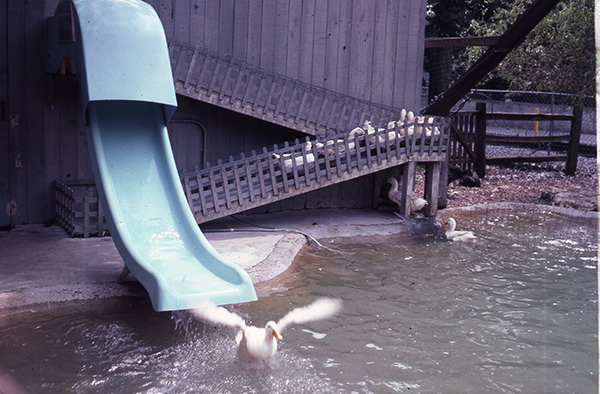
Scanned image of a color slide from the family archive. Shown here, a group of domestic white ducks are climbing a fenced wooden switch-back ramp up the side of a wooden building. The ramp leads to a blue plastic slide that drops into a pond. One duck has just come off the slide, wings extended, and is splashing into the pond.
The ducks-on-a-slide show at Opryland was one of my favorite spectacles, during our annual summertime pilgrimages. While I want to claim that the ducks didn’t mind the slide, the hesitant traffic on the ramp argues otherwise.

Which cycles back, again, to resonances. In all of this reading through legislative and legal literatures from the late 1800s and early 1900s, I keep finding echoes of my own youthful voice. Perhaps such resonance is part of my perseveration.

Perhaps I keep reading because the resonance keeps ringing, calling me deeper and further into this particular branch of the Mallard Mine.

Perhaps I’m hoping that the metaphor will hold up. That the legislative and legal literatures of the US will grow to understand, as I have, the wisdom of carrots and the anxious futility of sticks. Perhaps I’m hoping that US policy will mature into a reality in which feeding hungry Mallard hunters is more productive than jailing them. In which feeding hungry families is preferable, on every level, to fining them, confiscating their belongings, and selling off their property for the enrichment of government-appointed police.

Which brings me to Maryland’s Board of Special Police, legislated into existence in 1880 for the express purpose of protecting waterfowl.

The Ducking Police

“The said Board of Special Police and its deputies shall have power to arrest, with or without warrant, upon their own view, or upon credible information, all persons violating any provisions of said original act, or any of its supplements, and to carry such person or persons before any justice of the peace…”. (Maryland General Assembly, 1880, p. 159)

The said Board of Special Police, later dubbed the Ducking Police, protected waterfowl on the Susquehanna Flats and on the waters of the Chesapeake Bay north of the Turkey Point lighthouse. (North, also, of a vaguely defined point 1/2 mile north of Spesutia Island.)

Maryland placed a notable statutory check on members of the Ducking Police—each appointee was required to register a bond with the clerk of their respective Circuit Court. The Ducking Police swore to be faithful to their duties, under threat of a $1000 penalty. (This penalty would run somewhere in the range of $30,000 worth of purchasing power, in today’s economy.) The statute required appointees to provide proof, to the clerks of their Court, that they could pay such a penalty (Maryland General Assembly, 1880, p. 160). Written as a rein on corruption, the most immediate effect of this requirement was to limit the recruitment pool to hunters wealthy enough, already, to post such a bond.

In payment for their faithful service, members of the Ducking Police shared an end-of-the-year jackpot made up of license fees collected from residents registering to hunt in Cecil and Harford counties, including boat licensing fees, and of fines collected from prosecutions.
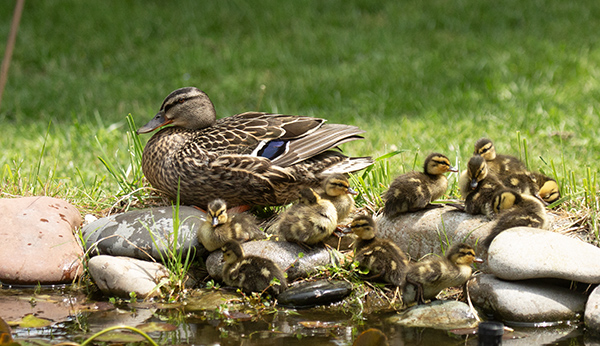
Photo from the Mallard archive, 2025. Shown here, a female Mallard perches on the stone border of our small backyard dragonfly pond. Her eleven ducklings have climbed out of the water behind her. Most of the ducklings are searching for a resting spot on the rocks, while some have already settled in and are grooming their down in preparation for an after-swim nap.
What are the chances that Mallards were a species of emphasis, for the Ducking Police? Logic argues they must have been, given their prominence in North American waterfowl hunting, but numerous other species were and are common on the Susquehanna flats.

In 1880, the fledgling Ducking Police had a single assignment: arrest anyone caught with ducks in their possession during the close season (April 1–October 31). Being caught with a duck during close season was “prima facie” evidence of a violation (Maryland General Assembly, 1880, p. 160). Courts were given wide discretion regarding fines, which could range anywhere between $5 and $100, and the collected fines went straight into the Ducking Police jackpot.

What are the chances that this system was immune to corruption?

The jackpot grew sweeter over time. By 1888, fines of $50–100 could be imposed for hunting at night, hunting during close season (April 1–October 31), shooting from a boat within 1/4 mile of shore, using a “big gun” (one that couldn’t be fired from the shoulder), or hunting from an unlicensed sneak boat or sink box (these $50–100 fines for unlicensed watercraft functioned as instant kickbacks, and collected fines were immediately distributed: 1/2 to the arresting officer and 1/2 to the attesting informers) (Maryland General Assembly, 1888, pp. 1382–1384).

Even bigger bonuses came with catching harvest thieves, who were subject to confiscation of their hunting equipment. Pick up some other hunter’s bird, lose your boat and guns and ammo to the Ducking Police. All proceeds from the sale of confiscated equipment went to the arresting officer. (Maryland General Assembly, 1888, pp. 1382–1384)

By 1916, fines had grown to $100–500, and new revenue streams came from regulations around engine exhausts and noise. Confiscations increased, as well, with property seizure rolled into almost every arrest. Proceeds from sales of confiscated equipment were divided between the informers and the arresting officers, though 1/2 of the proceeds from a small subset of these sales went into the county school funds. (Maryland General Assembly, 1916, pp. 1525–1536)
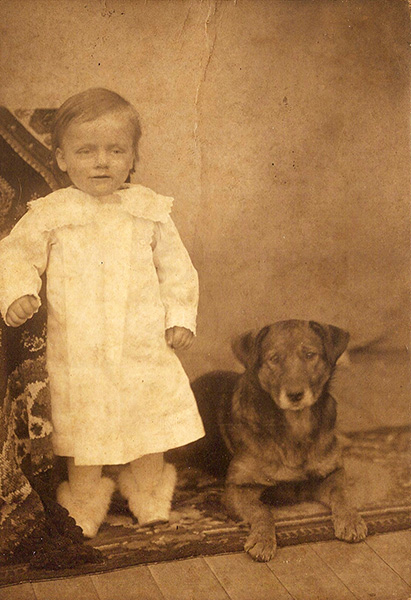
Sepia-toned photograph of a toddler in a delicately stitched white dress, standing next to an alert, mid-sized dog. The toddler's short hair is combed to one side, and their white-stockinged feet are clad in very fluffy white-furred shoes. A thick-woven rug or tapestry is draped over a support, which the toddler is leaning against, and runs across the floor. The dog is lying down, head up and looking at the camera. The dog has button ears and short-ish legs, a thick medium-length coat, and enough gray around the muzzle to suggest aging. I would guess the dog's lineage to be a terrier-type mixed with a herding-type.
One of the few children in the family archive with a name: Steele Hamilton. I don’t know how or why this child, with such furry shoes and such an appealing dog, landed in the family archive. I hope those shoes and that good dog indicate a happy childhood and well-funded schools.

Maryland’s 1916 legislations coincided with an era of federal takeover, as far as migratory waterfowl were concerned. While this federal intervention may have had little or no bearing on changes within the Board of Ducking Police, there’s notable timeline overlap. By 1920, the federal takeover was all-but complete, and by 1927 the Ducking Police jackpot had dwindled to a fixed stipend of $400 per hunting season (Maryland General Assembly, 1927, p. 612).

Finally, in 1941, Maryland dissolved the Board of Ducking Police (Maryland General Assembly, 1941, p. 326).

No more game informants

I can’t pinpoint an accurate timeframe for the end of regulatory informant-policing of game. Nonetheless, the practice did end. At least, statutorily.

But the eventual demise of informant-policing (of game) in the US is a mixed-bag sort of win:

“It was never a success in this country, most men preferring to see the laws violated rather than appear as prosecuting witnesses against their fellow-citizens. Aside from sentiment, such a course was often hazardous to the property and even the life of an informer” (Williams, 1907, p. 75).

So informing was both ethically objectionable and potentially hazardous.

I wanted to spend at least one paragraph unpacking my thoughts, here, but each attempt circled and contradicted and wheezed off into a muddy muddle. Which is a fairly accurate depiction of my self-growth process. I circle and contradict and wheeze around in the mud for unpredictable periods of time, searching for clarity. Sometimes I write poems in the mud. (Poetry is a blurry lens, anyway.) Given the depth of the mud, in this particular pond, I’ll be here a while.

Dabbling.
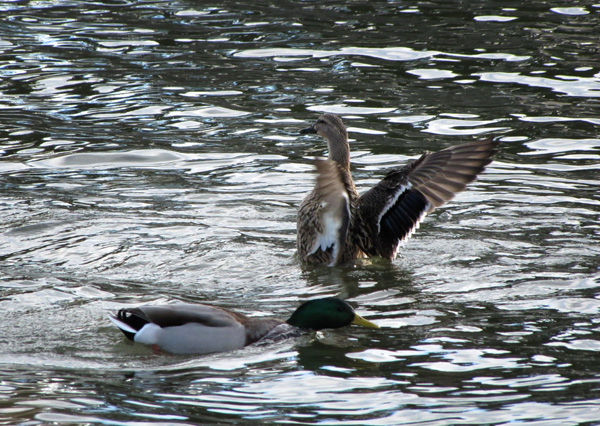
Photograph of a pair of Mallards on a wind-rumpled pond. The female Mallard is almost fully upright in the water, stretching her wings, while the male Mallard is partly submerged, captured as he surfaced from a down-turned bit of dabbling.
Mallards are dabblers, not divers. They muddle about in shallow waters, foraging in sediments without ever committing to a fully submerged dive for food. The distinction is literal, among ducks, and conveniently metaphorical for poets and writers.

In the meantime, I’ll circle back to the 1880s. Where court cases document the final years of the meat-and-feathers markets.

Driving the markets underground: One toe over the (commerce) line

The subtext of game legislations, in the mid- and late-1800s, was the ongoing power struggle between market hunters and sport hunters. (See the previous post, Part VI, for an overview of the market vs. sport dynamic.) From the start, sport hunters held a decisive advantage—access to legislative power.
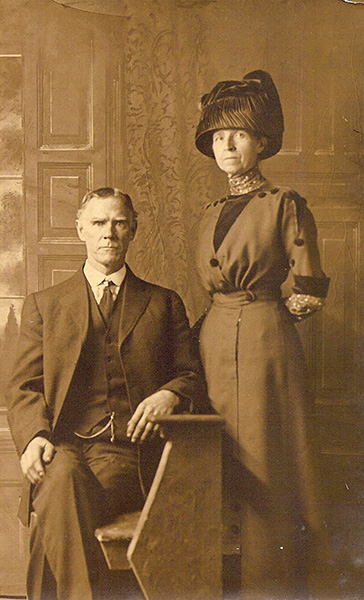
Sepia-toned studio photograph of a man and woman, photographed in Nashville, TN, probably during the decades around 1900. The man is seated on something resembling a church pew, and the woman is standing behind him. Both have stern, unsmiling expressions. Both appear to be middle-aged: the man's thick eyebrows are fading to gray and the woman's face is slightly lined. The man is wearing a dark suit over a white shirt, with a prominently visible pocket watch chain. The woman is wearing a mid-toned full-length dress with velvet-appearing cuffs and buttons. She has a shiny neckpiece that covers her entire neck, chin to collar, as well as a tall, heavy-seeming hat that matches the velvet-type trim on her dress. The belt of her dress is cinched tight, suggesting a corset underneath. The  background/backdrop is a mixture of wood with carved, inset panels and a woven tapestry-type curtain.
This stern duo, photographed in Nashville, TN, live in an ambiguous place in the family archive. I don’t know who they are, or how they were connected to my ancestors, or even the exact branch of ancestry. All I know is that they look intimidating. I expect they had access to the levers of power.

Often men of wealth and leisure, sport hunters in and around state legislatures lobbied for game regulations that hindered market hunters. Folding their arguments into early frameworks for wildlife conservation, sport hunters pointed to rapid species declines that were evident across the North American continent.

Rapid declines in game species affected market hunters, too, forcing them farther and farther afield to practice their profession. Farther, in this case, meant across state lines. Which meant interstate commerce. Which proved to be the decisive legislative lever.

These quail aren’t in Kansas anymore: Chicago, 1880

On January 14, 1880, a Chicago merchant named James Magner purchased a box of quail (144 birds) from a seller on South Water Street. Magner ran a game market at 76 Adams Street and had at least two more boxes of quail already in stock, including birds imported from Kansas in December and purchased direct (in Leavenworth, Kansas) on January 10th.

On January 15th, Magner sold at least one unopened box (144 birds) and somewhere between 60 and 100 birds out of his opened-box stock. (I had trouble following the totals, because math, but the totals weren’t the crime. The date was the crime.)

After a court in Cook County convicted Magner of close-season quail possession, he appealed to the circuit court. And, after the circuit court upheld the conviction, Magner appealed to the Illinois State Supreme Court, which is where the record is most visible today: James Magner v. The People of the State of Illinois. Filed at Ottawa February 3, 1881.

Illinois’s updated game statutes (1879) set a January 1–October 1 close season for quail and grouse. Close season for hunting; close season for buying and selling. In other words, in 1879, Illinois shut down quail markets—from January to October, no one could buy or sell quail in Illinois. No one could have quail in their possession.

Magner and other game merchants would have felt the financial sting, set to lose about $200,000 per year if the game market closed altogether (p. 326). (Keeping up my habit of translating these numbers into today’s money, that’s more than $6 million ($6M) in 2026 purchasing power.)

Magner’s state-level appeal, destined for failure, rested on two arguments:

  1. “It seems absurd to hold that the inhibition against the purchase and sale of game imported from the State of New York or Kansas is a protection to the game of this State” (Magner v. The People, 1881, p. 326), and
  2. the act “…is in violation of that provision of the constitution of the United States which confers upon Congress the power to regulate commerce among the several States” (Magner v. The People, 1881, p. 327).

In ruling for the State, the court countered Magner’s first argument with prevention logic: “…we think it obvious that the prohibition of all possession and sales of such wild fowls or birds during the prohibited seasons would tend to their protection, in excluding the opportunity for the evasion of such law by clandestinely taking them, when secretly killed or captured here, beyond the State and afterwards bringing them into the State for sale, or by other subterfuges and evasions” (Magner v. The People, 1881, p. 331).

The court’s counter for Magner’s interstate commerce argument followed a complex legal thread anchored in England. The thread starts with a reference to Sir William Blackstone’s Commentaries on the Laws of England and winds through precedents in Massachusetts, Indiana, New York, and Vermont, to establish a foundation of State ownership of game (pp. 333–334):

“Stated in other language, to hunt and kill game, is a boon or privilege granted, either expressly or impliedly, by the sovereign authority—not a right inhering in each individual; and, consequently, nothing is taken away from the individual when he is denied the privilege, at stated seasons, of hunting and killing game. It is, perhaps, accurate to say that the ownership of the sovereign authority is in trust for all the people of the State, and hence, by implication, it is the duty of the legislature to enact such laws as will best preserve the subject of the trust and secure its beneficial use, in the future, to the people of the State. But in any view, the question of individual enjoyment is one of public policy, and not of private right” (p. 334).

From there the court’s thready argument knots tight on Welton v. State of Missouri, an 1876 U.S. Supreme Court case about license taxes for vendors in Missouri, which noted, “The fact that Congress has not seen fit to prescribe any specific rules to govern inter-State commerce does not affect the question. Its inaction on this subject, when considered with reference to its legislation with respect to foreign commerce, is equivalent to a declaration that inter-State commerce shall be free and untrammelled” (p. 282). In other words, the federal government might have constitutional authority over interstate commerce, but, since Congress had never acted on that authority, the default status of non-regulated interstate commerce applied.

The thread spools on, turning new knots at case law involving steamboats, fuel mixtures, and suppression of liquor markets. Hitched, at last, to this handful of unstable rulings, the opinion in Magner v. The People states, “There can not be a constitutional right to transport property which can not legally be brought into existence” (p. 336).

Mic drop? No such thing, in legal literature…

The smoldering net (these quail were most likely netted, so there aren’t any smoking guns) was stashed in Kansas law. Magner’s quail weren’t legally harvested, in the first place. As products of illegal hunting, they never fit the definition of “commerce”. They were illegal goods in Kansas, shipped and transported illegally into Illinois.

After citing all that case law, the entire thread of logic was irrelevant. None of the stickier arguments around commerce even applied, because the birds weren’t commerce.

What they actually were, if they weren’t commerce, isn’t specified. This becomes important in later case law, though, for the case at hand, the important point was settled. The quail weren’t commerce, the interstate commerce clause wasn’t relevant, and Magner needed to pay his fines.

Chicago’s game markets had been put on notice. So had all of the other game markets, in all of the other states.
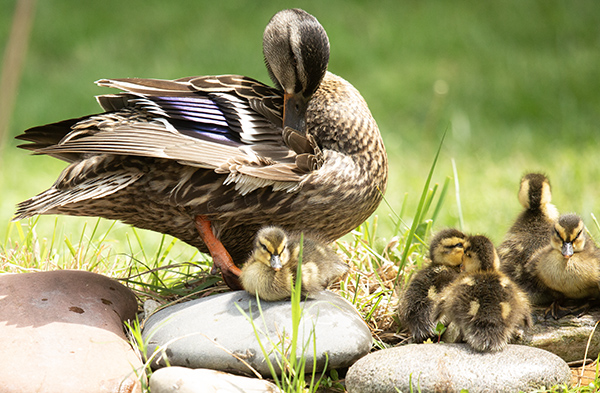
Photograph from spring, 2025, of a female Mallard with her brood of days-old ducklings. Here, the female is standing on the stone border of our dragonfly pond, preening her feathers. Five of her ducklings are visible in this photo, four gathered on the stones in front of her, getting ready to sleep, and one hunkered close to her, also ready to sleep.
These Mallards, photographed in 2025, know nothing of game hunters and game markets. Even so, that doesn’t equate to safety. The hours they spent in our little dragonfly pond were likely the safest hours of their lives.

To be continued…

The next post (or two or three) will get deeper into the final era of game markets, complete with game smugglers. Also, federal interventions and the beginnings of the North American model of wildlife conservation.


Notes

1. In quoting this act, I edited for readability. If you follow the link to the online copy of the text, you’ll find an elaborate collage of fonts and special characters. I tried, initially, a more faithful reproduction, but it made my eyes ache. Here’s an example:

WHEREAS the Penalties already provided in and by an Act paſs’d in the Tenth Year of the Reign of King WILLIAM the Third, entitled, An Act for the better Preſervation and Increaſe of Deer within this Proviǹce, have proved ineffectual to anſwer the good Ends in ſaid Act propoſed…”.

My eyes, not to mention my OCD brain, doth protest.

Mostly italics, salted with capitals, peppered with the archaic long s (that’s the one that looks like an f: “ſ”), and spiced with an un-reproducible (with my limited tech skills) c–t ligature—it’s just too much.

Even so, I felt a twinge of regret, reducing the recipe to blog blandness. And a tiny urge to write a time-travel story about an 18th century typesetter who finds fame, in 2025, as a font programmer. Because my OCD, which was part of my reason for editing in the first place, is still fuming that I couldn’t find a way to include that dratted c–t ligature in this footnote. (Click here to return to your regularly scheduled paragraph.)

2. Acceptable proof of guilt included being caught with deer, with meat from deer, or with fresh hides. For offenders who off-loaded carcasses and hides before getting caught, testimony from two credible witnesses regarding two separate events within the last two months would suffice. All of these pairings, in this statute, make my OCD itch—two informants per town or settlement, two witnesses testifying to two infractions over a two month period…it’s at least two twos too many. (Click here to return to your regularly scheduled paragraph.)

3. Robin Hood tropes breach the barriers between history and fiction. Between the reference section and the fantasy shelves. That’s part of why I indulge in this kind of aside. When these entities come into conversation with each other, the result is often chaos. But sometimes, every so often, radiant patterns emerge. A signal in the blog noise that makes writing and reading blogs worthwhile. (Click here to return to your regularly scheduled paragraph.)

4. My personal definition of power, of privilege, is the ability to live in predictably benign surroundings. To wake, most mornings, expecting another ordinary day. Another ordinary meal. Another set of ordinary tasks. Living in predictably benign surroundings equates to impact resistance. To rotational inertia. To a daily expectation that the world will spin on, benignly. Even under stress conditions, the world spins on. Benignly. The force required to perturb the system into non-benign behavior is roughly proportional to the power and privilege at hand. (Click here to return to your regularly scheduled paragraph.)

5. My excavations in the various state literatures reveal a tempting timeline pattern. During this period of time, game legislations spread in rates reminiscent of epidemiology. Almost as if certain pieces of legislation, such as outlawing punt guns or requiring non-resident hunters to pay for licenses, were a kind of contagion. This epidemic characteristic of legislations in the unsettled era of pre- and post-civil war times has likely been noted and thoroughly explored by scholars of law. (?) Or maybe my education gave me an epidemiology hammer, so every nuance I observe takes the shape of a nail. (Click here to return to your regularly scheduled paragraph.)

6. I want to acknowledge a glaring omission in my Mallard timeline—the entirety of the US Civil War. The Mallard story passes through the Civil War, of course, but I am not the right person to tell that part of history. I am not equipped to avoid all of the pitfalls and wrong turns in the Confederate branches of the Mallard mine. To be a reliable narrator surrounded by unreliable texts. Instead, I’m taking a coward’s deliberate leap over those years. Even so, lingering divisions between northern and southern states rise up throughout the legislative literatures of post-Civil War years. Such as in the excerpt that prompted this footnote. I’m including some of the indicators of ongoing division, in this series, in case some better-suited writer should wish to pick up those threads and go where I dared not. (Click here to return to your regularly scheduled paragraph.)

7. My aversion to such incentives was not shared by the US Department of Agriculture’s Biological Survey. At least, not in 1907. Thus the following: “In 1858 the example of Maine was followed in New Hampshire by the passage of a law authorizing the selectmen or municipal authorities to appoint fish wardens. The compensation of these officers consisted of one-half of the fines resulting from prosecutions instituted by them, an incentive to vigilance still employed in many states” (Williams, p. 12).

That said, the writer later criticized states that paid officers’ solely through incentives: “The meager compensation resulting from the percentage of fines secured sometimes allowed deputy wardens is hardly sufficient to enlist the services of active men…” (Williams, p. 26).

And even later: “In the early history of the movement for game protection the only provision considered feasible for payment of officers charged with the duty of enforcing game laws was an allowance of whole or part of the fines. A system maintained on such an unsatisfactory and unstable basis, however, accomplished almost nothing, and the advocates of better protection set about to devise a more satisfactory means” (Williams, p. 24). (Click here to return to your regularly scheduled paragraph.)

Bonus Earworm: If you are of a certain generation, you already have a song stuck in your head after reading the final section of this post. If you are younger and haven’t encountered this particular earworm, here’s the YouTube link for Brewer & Shipley’s “One Toke Over the Line”.


References

Beagle, P. S. (1968). The last unicorn. Ballantine Books, Inc.

California Legislature (1852). The Statutes of California, passed at the third session of the Legislature, begun on the fifth day of January, 1852, and ended on the fourth day of May, 1852, at the cities of Vallejo and Sacramento. G. K. Fitch & Co., and V. E. Geiger & Co., State Printers. https://babel.hathitrust.org/cgi/pt?id=uc1.b4159816&seq=143&q1=mallard

General Assembly of Virginia (1841). Acts of the General Assembly of Virginia passed at the session commencing 1st December 1840, and ending 22d March 1841, in the sixty-fifth year of the Commonwealth. Samuel Shepherd, Printer to the Commonwealth. https://babel.hathitrust.org/cgi/pt?id=osu.32437123258960&seq=92&q1=fowl

Magner v. The People, 97 Ill. 320 (1881). https://www.courtlistener.com/opinion/7057357/magner-v-people/pdf/

Maryland General Assembly (1880). Laws of the state of Maryland made and passed at a session of the General Assembly begun and held at the city of Annapolis on the seventh day of January, 1880, and ended on the sixth day of April, 1880. Wm. T. Inglehart & Co., State Printers. https://msa.maryland.gov/megafile/msa/speccol/sc2900/sc2908/000001/000395/html/am395–1.html

Maryland General Assembly (1888). The Maryland Code, Public and local laws: Volume 1. King Bros., Printers and Publishers. https://msa.maryland.gov/megafile/msa/speccol/sc2900/sc2908/000001/000390/html/am390p–1.html

Maryland General Assembly (1916). Laws of the state of Maryland made and passed at the session of the General Assembly made and held at the city of Annapolis of the fifth day of January, 1916, and ended on the third day of April, 1916. King Bros., State Printers. https://msa.maryland.gov/megafile/msa/speccol/sc2900/sc2908/000001/000534/html/am534–1.html

Maryland General Assembly (1927). Laws of the state of Maryland made and passed at the session of the General Assembly made and held at the city of Annapolis on the fifth day of January and ending on the fourth day of April, 1927. King Bros., Inc., State Printers https://msa.maryland.gov/megafile/msa/speccol/sc2900/sc2908/000001/000569/html/am569–1.html

Maryland General Assembly (1941). Laws of the state of Maryland made and passed at the session of the General Assembly begun and held at the city of Annapolis on the first day of January, 1941, and ending on the thirty-first day of March, 1941. King Bros., Inc., State Printers https://msa.maryland.gov/megafile/msa/speccol/sc2900/sc2908/000001/000582/html/am582–1.html

Massachusetts General Court (1739). Acts and laws passed by the Great and General Court of Assembly of His Majesty’s province of the Massachussetts-Bay in New-England, begun and held at Boston, upon Wednesday the thirtieth day of May, 1739. John Draper, Printer to His Excellency the Governour and Council. https://archive.org/details/bim_eighteenth-century_acts-and-laws-passed-by-_massachusetts_1739_0/page/n1/mode/2up?q=deer

McKinley, R. (1988). The outlaws of Sherwood. [Kindle version]. Open Road Integrated Media. https://www.amazon.com/Outlaws-Sherwood-Robin-McKinley-ebook/dp/B00OGWASB4/ref=tmm_kin_swatch_0

Welton v. The State of Missouri, 91 U.S. 275 (1876). https://www.govinfo.gov/content/pkg/USREPORTS-91/pdf/USREPORTS-91-275.pdf

Williams, R. W. (1907). Game commissioners and wardens: Their appointment, powers, and duties. Government Printing Office. https://babel.hathitrust.org/cgi/pt?id=ufl1.ark:/13960/t43r22q5t&seq=15

Focusing on Mallards Part VI: States claim the game

‘When you have killed all your own birds, Mr. Bingley,’ said her mother, ‘I beg you will come here, and shoot as many as you please on Mr. Bennet’s manor. I am sure he will be vastly happy to oblige you, and will save all the best of the covies for you.’ –from Pride and Prejudice by Jane Austen

Content Warning

This multi-part blog post contains references to hunting, agriculture, and research practices of killing birds. This particular installment references various methods and means of Mallard hunting, past and present. If you decide not to read on, I respect and admire your choice.

Photograph from a recent spring nesting in the yard. In this photo, a Mallard hen is leading her day-old ducklings from their nest in the irises bordering the dragonfly pond. The hen is balanced on a large rock, downy nest-fluff sticking to her feet. The ducklings are following in a huddled flock, clinging together for safety.
Photo from the Mallard archive. Here, a Mallard hen and her ducklings are leaving their nest for a family swim in the dragonfly pond.

Limiting (and limited) expectations

It was easy to position my own context for these posts (see Part IV). But all of my (deleted) attempts to contextualize Mallards in pre-1800s North America have been as flawed as my knowledge.

It’s a given that there are records outside of the Mallard archive, outside of the Mallard mine, that explain how and why North America’s waterfowl maintained flagrant abundance within and around the continent’s early nations. But I don’t have a discourse for these records.

In the end, after all of my reading, I am not equipped to know North America’s pre-colonial Mallards, much less describe them. They are, for me, a personal singularity. An infinite intangible that disturbs my erratic journey.

In other words, I’m only telling one facet of the Mallard story: the part written by and for Europe’s descendants.

Caveat lector.

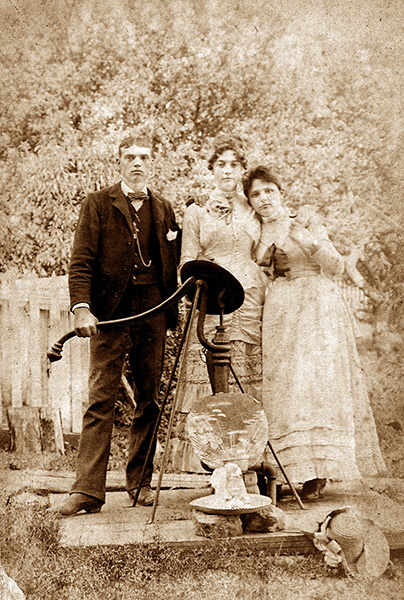
Sepia-toned photograph of three young adults posing beside a pump-handled well in what appears to be a fenced yard. All are wearing formal-appearing attire—two wearing layered and ruffled dresses and one wearing a suit with a prominent pocket-watch chain. A beribboned hat is on the ground in front of the well.
Photograph from the family archive, Iowa, 1881. The trio in this photo were younger than Iowa (granted statehood in 1846) but not a lifetime younger.

In medias res

When I last left the Mallards, in the opening decades of the 1900s, their populations were collapsing. For the moment, I’m leaving them suspended in free-fall.

This post circles back to the 1800s. Back to an era of unchecked habitat destruction and overhunting. Back to the transition years, when state lawmakers claimed title over wildlife and began to legislatively dismantle game markets.

“Wetland utilization in North America provides a classic case of conflict in resource management. The disadvantages of marshes and ponds for the individual farmer encourage their drainage and conversion to cropland. At the same time, these wetlands provide vital habitat for migratory waterfowl, a principle wildlife resource…” (Pospahala, Anderson, & Henney, 1974, pp. 5–6).

Sepia-toned postcard image of a wetland setting in South Dakota. A smallish body of seemingly stagnant water is bordered by dense brush and shrubs.
Photo postcard from the family archive, South Dakota, c. 1900.

“We, who cannot live without wild ducks, must first of all acknowledge two facts: 1. We are the minority; 2. The majority regards any land which is too wet to plow, but unsuitable for swimming or water boating, as useless” (Anderson, 1953, p. 122).

Sepia-toned image of a large body of water with a distant silhouette of truss bridge. The photo's horizon is slightly tilted, the bridge has six visible segments, and a jointed corner of wood is visible in the upper right corner of the frame.
Photo from the family archive, location unknown, c. 1900. A large body of water with a truss bridge in distant silhouette.

These were never the King’s ducks

After fleeing systems in which wildlife belonged to the aristocracy, the English and French colonists in North America drafted new rules. In the colonies, wildlife would belong to the citizens. To the People. (Not, however, to the People who already lived in North America. Only to those who staked their various flags along eastern coastlines and cascaded westward.1)

“The explorations of these settlers were driven by the incredible wealth of North America’s renewable natural resources—and by an unfettered opportunity to exploit it” (Organ, Mahoney, & Geist, 2010, p. 23).

Photograph of a Mallard hen perched on a stone that is part of the border of our dragonfly pond. One of her days-old ducklings is scrambling up the stone's slope, trying to reach the safe and familiar comfort of her protection. Two other ducklings are in line, waiting to test their own climbing skills.
Photo from the Mallard archive, of a Mallard hen standing on one of the stones that border our dragonfly pond. Here, the hen was taking a break from teaching her ducklings to swim and forage.

Who killed (kills) the People’s birds?

During the glut years of the 1800s, US hunters took to the field in three different pursuits: subsistence hunting, sport hunting, and market hunting.

As subsistence hunters took (take) only what they need for survival, their impact on bird populations was (and still is) minimal. But sport hunters, in the 1800s, tended to binge. Each adventure piled up the carcasses:

“The geese were flying all day, thousands upon thousands of them. We killed 163 that day. We had a farm wagon with extra side boards for carrying eighty bushels of wheat. Our kill nearly filled that wagon box. I know that night when we drove back to Dawson, which I think was eight miles distant, we were cold and wet and we all stuck our legs down in the geese and the warmth of their bodies kept us comfortable” (Mershon, 1923, pp. 117–118).

Sepia-toned photo of a horse harnessed to a cart (carriage? buggy?) driven by a man in a suit and hat, complete with thick gloves that have a star emblem on the wide cuff. A cluster of two-story houses make up the background.
Photo from the family archive, location unknown, c. 1900. Not a wagon, I know, but still a reminder that personal transportation in the 1800s was single-digit horsepower.

After each binge, sport hunters returned to their families and their varied professions.

Unless the binge was their profession.

The Meat and Feathers Market

Between 1820 and 1860, America’s cities blossomed from a thin seeding of only 5% of the population to a significant 20% demographic. “Markets for wildlife arose to feed these urban masses and to festoon a new class of wealthy elites with feathers and fur” (Organ, Mahoney, & Geist, 2010, p. 23).

Market hunters earned a living harvesting the wildlife that lived in unclaimed (or claimed and unsupervised) wild places. The siren song of profit penetrated every field, marsh, and wooded acre, tempting hunters to abandon the traditional and self-imposed restraints that defined hunting as a sport.

“A momentary question goes through your mind. ‘Shall I give them the first barrel on the water?’ It is dismissed almost as soon, for early I have been taught it is not the way of the sportsman. Give the birds a chance is the rule. Yet I can not help hoping they will be well bunched and I can get more than one with the first barrel and hope for another with my second. Well, sometimes it works one way and sometimes another. Either way it’s the life worth living” (Mershon, 1923, p. 76).

Giving the birds a chance, for the market hunter, was a profit gamble.

Sepia-toned portrait of two young adults seated at a table. Both are posed with a hand of cards, as if playing poker. Both are wearing suits, though they have taken off their jackets. Both are wearing hats. One is smoking a pipe. The gambler on the right is showing an ace to the camera, held below the level of the table. Paper money, larger than today's bills, is hanging over the edge of the table.
Photo from the family archive, location unknown, c. 1900. Photographer’s stamp: “W. C. Bryant Artistic.”

It was highly likely that a hunter the next county over would happily shoot all the birds on all the waters, rules be damned.

The market wanted meat and feathers, so meat and feathers the market would have.

Sepia-toned portrait, c. 1900, of two young adults wearing hats decked out in feathers. Their coats have big fancy collars, one of thick fur and the other of feathers.
Photo from the family archive, location unknown, c. 1900. Time has taken their names, but their faces and feathers remain.

Any hunter willing to renounce the title of “sportsman” could cash in.

What would you have done?

Endless demand v. limited supply

Around cities and towns, market hunters drained the wildlife from marshes and woodlands and fields. And as nearby wildlife dwindled, sportsmen were forced further afield for their binges.

Postcard photograph stamped "Photographed by H. J. Linton" and hand-labelled "East Main St., Lexington, O". A small, single-section truss bridge crosses a brook, several two-story houses line the road beyond the bridge, and utility poles break the horizon.
Photo postcard from the family archive; East Main St., Lexington, Ohio; c. 1900. The photographer’s stamp, HJ Linton, suggests the image was snapped by a relative on some distant branch of a grandmother’s family tree.

“Conflict soon arose between market hunters, who gained fortune on dead wildlife, and the new breed of hunters who placed value on live wildlife and the sporting pursuit of it” (Organ, Mahoney, & Geist, 2010, p. 24).

By the late 1800s, some of the birds had been hunted to extinction.

“The first bird I ever killed on the wing was a wild pigeon. They frequented the Saginaw valley in thousands from early spring until after the harvest. I had been taken with my uncle and father pigeon shooting many times to pick up birds. It was no trick for them to get seventy-five or a hundred birds before breakfast, and soon after I was given my 16-gauge double barrel gun I was taken out to shoot pigeons. The flocks were dense, as I now recall, so it was not a difficult feat to bring one down, and at the very first discharge a pigeon from my shot came fluttering to the ground. I grabbed it and admired it and was satisfied for that morning to have it my entire bag, and proudly took it home to show my mother. It was not long before I was going pigeon shooting regularly every morning, for the flight began at daylight and was generally over by seven o’clock. Then I would get my breakfast and be off to school. My pigeon shooting continued every spring until about 1880, when it was gone forever” (Mershon, 1923, p. 3).

Sepia-toned photo of a group of twenty-seven children, teens, young adults, and adults—seemingly assembled for a school photo. All of the children in the front row are barefoot, most are wearing long-sleeved shirts and coveralls or long-sleeved dresses with large ruffled collars. Two children in the front row are holding hats on their lap, one has a hat hooked over one knee, while yet another hat has been tossed to the side and waits, upside down, to be reclaimed. Some of the younger children have neatly parted hair pulled back in (probably) a braid, others have very short hair that is either too short to style or barely long enough to support styling to one side or the other. The teens and young adults with long hair have puffy updos with a few prominent ribbons, while those with short hair have a suggestion of bangs swept to the side. A dog has joined the first row of students.
Photo from the family archive, location unknown, c. 1890(?). I wonder if the author of the previous passage went to school barefoot, with his hound to keep him company?

“No ordinary destruction”

In the sport v. market skirmishes, sport hunters always had the upper hand. Reputation and tradition amplified their voices.

“Furthermore I will prove by sundry reasons in this little prologue, that the life of no man that useth gentle game and disport be less displeasable unto God than the life of a perfect and skillful hunter, or from which more good cometh. …he shall go and drink and lie in his bed in fair fresh clothes, and shall sleep well and steadfastly all the night without any evil thought of any sins, wherefore I say that hunters go into Paradise when they die, and live in this world more joyfully than any other men” (Edward, Second Duke of York, 1406–1413/1909, pp. 4, 11).

“It is stated that in their migrations northward, the waterfowl often reach the lake in the spring, while it is still covered with ice, and that while huddled in great numbers in the mouths of streams and other open places, they are slaughtered indiscriminately, and that while too poor and unfit for eating. It is also represented that they are killed and wounded in great numbers by the swivel or punt gun, which is a small cannon fixed to a boat, and that by these practices they are driven from their usual feeding grounds and places of resort. It is the well known habit of waterfowl to follow the same line and stop at the same points in their migrations, and such a serious disturbance at this great half-way station, may eventually result in their seeking other quarters. To prevent this it is asked that the killing of waterfowl in the spring be prohibited altogether in certain counties, and that the use of the punt gun be absolutely forbidden. The petitions upon this subject have been so numerous, and the petitioners so respectable, that there evidently must exist good cause for complaint, and their request should be granted. The use of the punt gun along the sea board has been made illegal for like reason, and if it is necessary there, it is still more so here” (Collins, 1860, p. 388).

“The ‘game hog’ is an animal on two legs that is disappearing. May he soon become extinct! The ‘game hog’ formerly had himself photographed surrounded by the fruits of a day’s ‘sport,’ and regarded the photograph as imperfect unless he had a hundred dead ducks, grouse, or geese around him. To-day a true sportsman would be ashamed to be pictured in connection with a larger number of fowls than a decent share for an American gunner, having due regard to the preservation of game for the future” (Lacey, 1900, pp. 4871–4872).

Grainy and faded grayscale portrait of a toddler. The child is standing on an upholstered footrest and is wearing knee breeches, a short jacket with long sleeves, a rounded hat with a small rolled brim, and rumpled boots. One arm rests on a curtain-draped prop. Another heavy drape hangs in the background. Time has robbed the image of most facial features, leaving only the child's dark eyes staring into the lens.
Photo from the family archive; unnamed child (likely surname Linton); Elmore, Ohio; c. 1890. In my internal filing system, this image lives in the “haunted children” file.

Haunted by pigeons

A single piece of market-favorable legislation murmurs from the archival cacophony: an 1848 Massachusetts statute that prohibited anyone from frightening passenger pigeons out of netting-beds, under threat of a $10 fine and compensation for damages (General Court of Massachusetts, 1848, p. 650).

It should be no surprise that this particular law is audible to search engines. After all, passenger pigeon extinction is a holotype cautionary tale that should linger.

A faded, folded, and foxed photo from February 1, 1887. The child's image has almost completely faded. Loose curly hair, a long-sleeved jacket buttoned at the neck, and what might be a pleated waistline for a dress. Hands folded in lap. Serious eyes peer out over the photo's broken fold.
Photo from the family archive; unnamed child (likely surname Craig); Columbia, TN; February 1, 1887. Another haunted child.

Ohio bids farewell to their big game, but assumes the pigeons will never die

In 1857, as the Ohio legislature sought to revise their “Act to Prevent the killing of Birds and other Game” (Ohio General Assembly, 1857, pp. 107–108), legislators requested assistance from the state’s Board of Agriculture.

The resulting work, published as a select committee report in 1860, wrote off Ohio’s big game as a lost cause: “Ohio has no waste land. It is all useful for agricultural purposes—if not for tillage, at least for pasturage. It has no sterile wastes, marshes, or mountain ranges where the larger game can find permanent security. The deer, the bear, the wolf, and such like animals will soon be gone, and laws that relate to them a dead letter” (Collins, p. 382).

Sepia-toned photo of taken from inside a fenced field that looks recently cut to stubble. In the background three massive, multi-story, wood buildings with steeply framed roofs are surrounded by a field so flat and uniform that it looks like water. A very distant treeline marks the horizon.
Photo from the family archive; The Steele Farm; Cedar Rapids, Iowa; c. 1900.

Wild turkeys, prairie hens, and pheasants were in the same sunken boat. Excepting a few isolated flocks in isolated localities, no protections could save them. Even so, sportsmen wanted the legislature to regulate hunting, so hunting should be regulated. Ohio’s lingering populations of deer, turkey, prairie hens, and pheasants should be granted undisturbed breeding seasons (Collins, 1860, p. 384).

Seasonal protections were recommended for game birds that could adapt to progress—quail, meadow-larks2, kill-deer, doves, flickers, woodcock, and wood ducks (Collins, 1860, pp. 385-387)—as well as for waterfowl around Sandusky Bay (Collins, 1860, p. 389).

The multitudes of warblers, finches, and flycatchers were safe without protection. At least, being small, shy, and drab, they were safe enough. The food-and-feathers market didn’t covet such birds. Besides, providing bird-by-bird protections would require parsing dozens of common and scientific names (Collins, 1860, pp. 383-384).

Sepia-toned portrait, c. 1900, of a young man wearing what looks to me like a scratchy wool suit. His dark hat is garnished with a stiff sail of white primary feathers.
Photo from the family archive, location unknown, c. 1900. The photo was in my great aunt’s album, but was addressed to my grandmother.

Woodpeckers, blue jays, and blackbirds, the kind of birds that damaged agriculture when they ate crops but protected agriculture when they ate insects, could be left to the chances and whims of circumstance (Collins, 1860, p. 384).

The report singled out two game species as immune from overhunting (in Ohio) and in need of no protection: the snipe and the passenger pigeon.

Snipe were mere passers-through, fleeting visitors so well-camouflaged and difficult to flush from wet spring landscapes that only “practiced” sportsmen could hope for success (Collins, 1860, p. 387). During brief April sojourns, snipe were “good sport and a choice morsel for the table”, but “yearly numbers cannot be materially lessened by the gun” (Collins, 1860, p. 387).

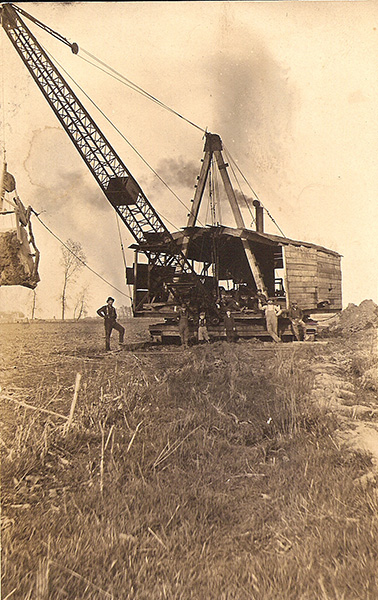
Sepia-toned photograph of a steam crane and six workers in a field in Iowa, c. 1900. The field has been cut to stubble. The steam crane is belching smoke, and the crane's body looks like a wooden building on a massive wood platform. Mounds of bare dirt are visible in the background. The workers are lined up in front of the crane, posing for the photo. A few bare trees are on the horizon, suggesting a winter setting.
Photo from the family archive, Iowa, c. 1900. I don’t know what kind of progress was underway, with this steam crane, but I doubt it involved wetland restoration.

And passenger pigeons?

“The passenger pigeon needs no protection. Wonderfully prolific, having the vast forests of the North as its breeding grounds, traveling hundreds of miles in search of food, it is here to-day and elsewhere to-morrow, and no ordinary destruction can lessen them, or be missed from the myriads that are yearly produced” (Collins, 1860, p. 387).

Forty years later, passenger pigeons were extinct in Ohio3 and functionally extinct everywhere else. It was, indeed, no ordinary destruction.

“Property of the State”

“Section I. That all the game and fish, except fish in private ponds, found in the limits of this State, be and the same is hereby declared to be the property of the State, and the hunting, killing, and catching of same is declared to be a privilege” (Arkansas General Assembly, 1889, p. 173).

Photograph of a female Mallard threatening a squirrel that had ventured too close to her brood of days-old ducklings. The hen is standing over her brood, all gathered on the stone border of our dragonfly pond. The hen's stance is tense, head low and neck coiled, ready to strike at the squirrel should it venture closer. The squirrel's back is turned to the ducks, seemingly unaware that it has disturbed the scene.
Photo from the Mallard archive, of a female Mallard threatening a squirrel that had ventured too close to her brood of days-old ducklings. Mallard hens usually ignore the antics of squirrels in the yard, but new mothers are a different story.

“Section 4650, Wisconsin statutes of 1898 is hereby amended to read as follows: The ownership of and the title to all fish and game in the State of Wisconsin is hereby declared to be in the state, and no fish or game shall be caught, taken or killed in any manner or at any time, or had in possession except the person so catching, taking, killing, or having in possession shall consent that the title to said fish and game shall be and remain in the State of Wisconsin for the purpose of regulating and controlling the use and disposition of the same after such catching, taking or killing. The catching, taking, killing or having in possession of fish or game at any time, or in any manner, or by any person, shall be deemed a consent of said person that the title of the state shall be and remain in the state for said purpose of regulating the use and disposition of the same, and said possession shall be consent to such title in the state whether said fish or game were taken within or without this state” (Wisconsin General Assembly, 1899, pp. 576–577).

Sepia-toned photo of a young woman wearing a pale dress with a fur collar. Her dark hat is tipped to a jaunty angle and is decorated with (maybe?) feathers, flowers, or ribbon. (The decoration fades into the background, so it is difficult to say exactly what has been attached to the hat.) The woman's head is slightly tipped, she is looking off to the side, and her lips are not quite smiling.
Photo from the family archive, location unknown, c. 1900. Her expression captures my bemusement, on trying to follow Wisconsin’s the “shall be and remain” syntax.

Such legislative grabs by Arkansas and Wisconsin, asserted during the closing years of the 1800s, didn’t materialize out of thin air.

State legislatures had been controlling the game within their borders since the 1820s, and courts had upheld a variety of statutes.

Let the alewives migrate

One of the earliest challenges to game laws came in Maine, after members of a town’s fish committee destroyed a dam on private property. On May 3, 1839, the fish committee took action on behalf of alewives, a type of herring.

Charles Peables had maintained a dam on his portion of Alewive Brook, in Cape Elizabeth, for some 12 previous years, diverting the water to power his mill. In May of 1839, local Fish Committee members Hannaford and Davis demanded that Peables open his dam and let the alewives pass.

When Peables declined, the Fish Committee disabled the dam in question. Litigation followed, and the Supreme Judicial Court of Maine eventually ruled for Peables, citing a technicality: Hannaford and Davis had acted early.

As the statute required the brook to be open May 5–June 5, Peables should have been able to run his mill straight up to the stroke of midnight on May 5. As long as the alewives could migrate upstream on May 6, Peables was not in violation of the statute (Peables v. Hannaford, 1841, 106).

Had Hannaford and Davis waited until May 6, they could have destroyed the dam at their leisure, and Peables could not have stopped them.

Peables v. Hannaford set a precedent, at state levels, for the states’ authority (embodied in local officers) to regulate game on private property.

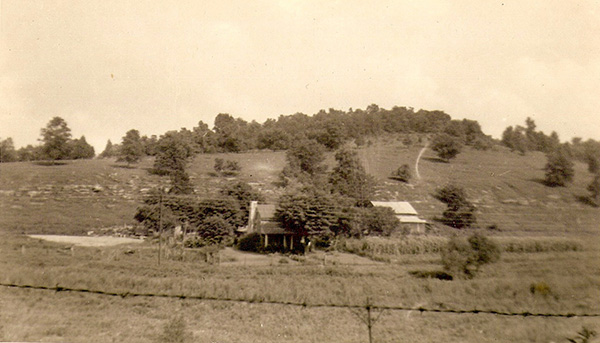
Sepia-toned photo of a house and barn at the foot of a hill, surrounded by a large empty field. The house is set within a cluster of trees, while the field has been cleared for (probably) pasture usage. A line of large rocks and boulders runs along the hill's lower slope, and a thick tree line obscures the top of the hill. A utility pole and utility lines run through the field in front of the house, and a single strand of barbed wire stretches between the camera and the farm.
Photo from the family archive, unknown location, c. 1920(?). The barbed wire running across the foreground would be a distinct “no trespassing” indicator, in the rural area of my childhood.

“We see nothing unconstitutional in the Act”

On July 8, 1874, David S. Randolph served two dressed and cooked prairie chickens to diners in his St. Louis restaurant. According to a Missouri statute, these were the wrong birds in the wrong season.

Even though Randolph could prove that he had purchased the birds in Kansas, where July hunting was legal, he was cited and fined $9. Which would be about $250, today. Randolph appealed, but the Missouri Court of Appeals upheld the fines:

“We see nothing unconstitutional in the act. The game law would be nugatory if, during the prohibited season, game could be imported from the neighboring States. It would be impossible to show, in most instances, where the game was caught. The State of Missouri has as much right to preserve its game as it has to preserve the health of its citizens, and may prohibit the exhibition for sale, within the State, of provisions out of season, without any violation of the Constitution of the United States. So far as we know, this right has never been disputed, and its exercise by the absolute prohibition of the having in possession, or sale, of game within the State limits, during certain period of the year, is no more an illegal attempt to regulate commerce between the States than would be a city ordinance against selling oysters in July” (Missouri v. Randolph, 1876, p. 15).

Did you catch it?

Sepia-toned postcard photo of my great-aunt Birdie as a toddler. She is standing up, one hand balanced on a blanket-draped prop. Her ankle-length dress is a dark material with heavy-looking gathers at the collar and a bright band of (probably embroidered) zig-zags around the hem and cuff. Her eyes are very wide as she looks at a spot just to one side of the lens. Under her image, print on the card reads "The Park Gallery, Chas. Eberhardt, Artist, 20th Street, Rock Island, Ill." Handwritten on the back of the card was "To GrandMa from Birdie Dec 7 1894".
Photo from the family archive; my great-aunt Birdie; Rock Island, Illinois; December 7, 1894.

In knotting up the import loophole, Missouri had stepped ever so softly on the interstate commerce boundary. And the appeals court didn’t mind.

Sepia-toned photo taken inside a hat store, probably in the 1920s. The long narrow room has shelving, tables, and glass-front cupboards that were probably display cases. A table in the middle of the frame is stocked with a variety of hats, decorated mostly with ribbons. A group of adults are posed together, two wearing formal-appearing suits, one wearing a dark ankle-length skirt and white long-sleeved shirt, one wearing a dark ankle-length dress, and one wearing a calf-length skirt, pale shirt, a long coat, and calf-high (at least) boots. I suspect, but am far from certain, that the one wearing the daringly short skirt (calf-length) is my great aunt Birdie. In the background, a shopper wearing a pale calf-length dress is browsing.
Photo from the family archive; location unknown, c. 1920(?). Great-aunt Birdie worked in millinery. I suspect (though I am far from certain) that Birdie is on the far left, in this photo.

‘…the congress shall have power to regulate commerce among the several states…’

When a somewhat related case landed before the Kansas judiciary, in 1877, the commerce question heated up.

On November 8, 1876, an agent for the carrier Adams Express Company received a package for transport—a shipment of four prairie chickens that had recently been killed. The agent, C. A. Saunders, delivered the birds to Chicago, and received a $10 fine (plus court costs) for his efforts.

Kansas had recently adopted the kind of boilerplate “no possession, no import, no export” law that was popular at the time. In Kansas, the wording had been adjusted to prohibit all import and export of game or birds, independent of season.

During open season in Kansas, in 1876, it was legal to possess prairie chickens that had been legally killed, as long as they had been killed within the state. During closed season, it was illegal to possess them at all. And it was illegal to import or export them, ever.

No matter the season, no one could move prairie chickens across the state lines.

Legislatively, this act seemed loophole-free. During open season, prairie chickens were fair game. Hunt them, eat them, sell them anywhere within the state of Kansas. All perfectly legal. But don’t ship them out of state. Don’t buy them out of state and bring them into Kansas. And during closed seasons, prairie chickens were entirely off-limits. Don’t kill them or have them anywhere in your possession.

The single exception written into this law involved shipments of prairie chickens that happened to pass through Kansas on their way to and from other states. Carriers handling such shipments were safe during their journey through the state.

Sepia-toned photo of a wooden train depot. Stairs in the background lead up to a platform protected by an elaborately-braced awning. A set of windows (rather like a bay window) protrude from the building near the foot of the stairs. The five people in the image are wearing suits and dresses. Two are inside, leaning out through the station windows, and three are outside, leaning against the building. The woman on the far left is one of my great grandmothers, Dora. My great grandfather was an engineer on the line that ran through Elora, TN.
Photo from the family archive; L to R (per my mother’s notes) Dora Craig, Edd Strong (Elora Agent), Wilburn Craig, Mrs. Strong, Vint Hamilton; Columbia side depot, Elora, TN; c. 1901. Dora was one of my great grandmothers.

The appellate judges for Saunders’s case glided straight past a series of technicalities regarding the title and wording of the act. They didn’t need to rule on those matters, because a larger issue took precedence:

“Section 8 of article 1 of the federal constitution provides among other things that, ‘the congress shall have power * * * [sic] to regulate commerce with foreign nations, among the several states, and with the Indian tribes.’ Ever since the adoption of this provision, the judges of the supreme court of the United States seem to have been groping their way cautiously, but darkly, in endeavoring to ascertain its exact meaning, and the full scope of its operation. They have many times construed it, but as yet have hardly fixed its boundaries, or its limitations. They have no doubt generally construed it correctly, but some of their decisions with reference thereto seem to be conflicting and contradictory, and scarcely one of such decisions has been made without a dissenting opinion from one or more of the judges. We think however that amidst all their conflicts and wanderings they have finally settled, among other things, that no state can pass a law (whether congress has already acted upon the subject or not,) which will directly interfere with the free transportation, from one state to another, or through a state, of anything which is or may be a subject of inter-state commerce. …For instance, a law which prohibits the catching and killing of prairie chickens, may be valid, although it may indirectly prevent the transportation of such chickens from the state to any other state; but a law which allows prairie chickens to be caught and killed, and thereby to become the subject of traffic and commerce, and at the same time directly [emphasis in original] prohibits their transportation from the state to any other state, is unconstitutional and void” (Kansas v. Saunders, 1877, pp. 129–130).

This means game is commerce, right? And that the Kansas legislature had stepped a little too far over the interstate commerce boundary. Right?

It meant, at any rate, that Saunders didn’t have to pay his fine.

Photo of a Mallard hen trying to get a short rest behind the grass-and-stone border of the dragonfly pond. The hen's eye is wide and her expression is tense, despite her pre-sleep posture of tucked head and neck. They aren't visible at all in the photo, but all eleven of her ducklings were gathered beneath her, as if back in the nest. The ducklings were safe from the hungry eyes of predators, but they weren't comfortable enough to sleep soundly. Their constant fretting and shifting was keeping the hen awake.
Photo from the Mallard archive. Here, the hen has gathered her ducklings beneath her for a nap. The ducklings were squirming and fidgeting, so the hen was having trouble getting comfortable.

Preview of Part VII: More court cases, more decisions, and federal lawmakers patch the interstate commerce bug

The next post dives into game smuggling and game police. If you are starting to wonder if I’ve gotten game laws mixed up with prohibition laws, I haven’t, though there are certainly familiar elements.

Hold on to your feathered hats.

Sepia-toned photo of a young woman wearing a pale, short-sleeved blouse and a dark skirt. (The short sleeves, alone, are remarkable, as long sleeves are far more common in the archive.) She is holding a small bouquet of flowers, and her hat is elaborately decorated with feathers and what looks like a large tiara. She's wearing at least one necklace of beads or gemstones and several rings. Her expression, for me, is a difficult combination of stern eyes with a hint of smile.
Photo from the family archive; location unknown, c. 1890(?). There’s a lot going on with that hat, but, for me, her eyes are the real story. I can’t read that expression, and somehow she makes me feel like I should stop trying to.

Also in the next installment, the courts decide that birds and game aren’t commerce, after all.


A note about previous previews: The schedule has changed, so the previews aren’t accurate

Even the most casual readers will have noted, by now, that this project is constantly expanding. Previews included in previous posts have been preempted and put off, as my reading has taken unexpected turns (I do love a good tangent).

My notes sprawl through four full composition books.

I will likely get to all of the topics introduced in previous previews, but not in order. I’ve given myself permission to keep exploring the Mallard mine, as long as my interest holds, and to keep chasing the tangents. My challenge, now, is to convince readers to keep exploring, as well.

Image of a Mallard hen and her eleven ducklings (which are difficult to count, in this photo) swimming the in a small backyard pond. The pond is bordered by large worn river rocks, with grass and weeds behind and between the rocks. The spout of a pond filter/fountain is visible, and a few reddish-orange water lily leaves float on the surface. (The water lily leaves only turn green after emerging into sunshine.) The ducklings are fluffy with down and have brown and yellow markings. The hen's feathers range from light tan to dark brown with light edging. She is staring into the lens, keeping an eye on me in case I venture too close.
Photo from the Mallard archive. Here, a Mallard hen keeps watch as her ducklings explore the dragonfly pond.

If you’re still with me, Thank You!


Footnotes

1. This particular piece of the Mallard story, part of the pre-1800s history of North America’s colonization, is beyond both my tangent-tolerance (for these blog posts) and my philosophy/history horizon. Even so, an excerpt from a book assigned in a technical writing course resonates:

“Among the many arguments that Locke made in the Two Treatises is one that justifies appropriating lands from indigenous peoples where they are living in a state of nature. According to this argument, settlers who cultivate and improve the land—thereby rendering the ‘greatest conveniences’ from it—will have rights to the property:

“‘God gave the world to man in common; but since he gave it them for their benefit and the greatest conveniences of life they were capable to draw from it, it cannot be supposed he meant it should always remain common and uncultivated. He gave it to the use of the industrious and rational—and labour was to be his title to it (Second Treatise 137).’

“…British settlers under Locke’s rationale could claim property rights because they took resources from the land. These resources could be used to create a favorable balance of trade for England, where Board of Trade member Locke saw excessive imports as a source of unstable coinage practices” (Longo, 2000, pp. 51–52).

Mallards were one of the resources that colonists took and took and took. (Click here to return to your regularly scheduled paragraph.)

2. In 1885, while collecting in Canada, Robert Miller Christy wrote a love-note to Meadowlarks:

“I have often thought what a capital thing it would be to introduce the Meadow Lark in to England. So far as plumage and song are concerned, it would rank among our brightest-coloured and most admired songsters; while its hardy nature would allow of its remaining with us the whole year round, as indeed it often does in Ontario and other districts farther south than Manitoba. Perfectly harmless and accustomed to grassy countries, it would quickly become naturalised in our meadows, where it would find an abundance of insect-food, and would doubtless soon increase sufficiently in numbers to serve, if need be, as a game- and food-bird, as it largely does in the United States. No other songster that I ever heard equals this bird in the sweetness and mellowness of its notes” (p. 125). (Click here to return to your regularly scheduled paragraph.)

3. Ironically, Ohio’s deer rebounded. After being sentenced to local extinction, in 1860, deer found ways to survive in Ohio. And then conservation efforts across the 1900s helped deer to flourish. In the 2024–2025 hunting season, Ohio hunters bagged 238,137 white-tailed deer (Ohio Department of Natural Resources, 2025, para. 1). (Click here to return to your regularly scheduled paragraph.)


References

Anderson, J. M. (1953). Duck clubs furnish living space. In J. B. Trefethen (Ed.), Transactions of the eighteenth North American wildlife conference (pp. 122–129). Wildlife Management Institute. https://wildlifemanagement.institute/conference/transactions/1953

Arkansas General Assembly (1889). Acts and resolutions of the General Assembly of the State of Arkansas: passed at the session held at the capital, which began on Monday, January 13th, and adjourned on Wednesday, April 3rd, 1889. Press Printing Co. https://babel.hathitrust.org/cgi/pt?id=nyp.33433009076492&seq=193

Christy, R. M. (1885). Notes on the birds of Manitoba. In J.E. Harting (Ed.), The Zoologist, 3rd series, Vol. IX. No. 100 (pp. 121-133). John van Voorst, Paternoster Row. https://ia801303.us.archive.org/27/items/Zoologist85lond/zoologist85lond.pdf

Collins, W. O. (1860). Report of Senate Select Committee, upon Senate Bill No. 12, ‘For the protection of birds and game.’ In Fifteenth annual report of the Ohio State Board of Agriculture with an abstract of the proceedings of the county Agricultural Societies to the General Assembly of Ohio for the year 1860 (pp. 381-390). Richard Nevins, State Printer. https://babel.hathitrust.org/cgi/pt?id=mdp.39015038792258&seq=549

Edward, Second Duke of York (1909). The master of game: The oldest English book on hunting. (W. A. Baillie-Grohman & F. Baillie-Grohman, Eds.). Duffield and Company. https://archive.org/details/TheMasterOfGame/page/n7/mode/2up (Original work published 1406–1413).

General Court of Massachusetts (1848). Acts and resolves passed by the General Court of Massachusetts in the years 1846, 1847, 1848; Together with the rolls and messages. Dutton & Wentworth, Printers to the Commonwealth. https://archive.org/details/actsresolvespass184648mass/page/n5/mode/2up

Kansas v. Saunders, 19 Kan. 127 (1877). https://www.courtlistener.com/opinion/7934084/state-v-saunders/pdf/

Lacey, J. (1900). Enlarging the powers of the Department of Agriculture. In Congressional Record, House of Representatives, Monday, April 30, 1900 (pp. 4858–4980). The Government Printing Office. https://www.congress.gov/bound-congressional-record/1900/04/30/33/house-section/article/4858–4980

Longo, B. (2000). Spurious coin: A history of science, management, and technical writing. State University of New York Press. https://www.jstor.org/stable/jj.18254358

Mershon, W. B. (1923). Recollections of My Fifty-years Hunting and Fishing. The Stratford Co., Boston. https://archive.org/details/recollectionsofm00mers_0

Missouri v. Randolph, 1 Mo. App. 15 (1876). https://www.plainsite.org/opinions/279xdv9rm/state-v-randolph/

Ohio Department of Natural Resources (February 4, 2025). Ohio’s final 2024–25 deer harvest report. Ohio Department of Natural Resources. https://ohiodnr.gov/discover-and-learn/safety-conservation/about-ODNR/news/ohios-final-2024-25-deer-harvest-report

Ohio General Assembly (1857). Acts of a general nature and local laws and joint resolutions passed by the Fifty-second General Assembly of the State of Ohio: At its second session begun and held in the city of Columbus, January 5, 1857 and in the fifty-fifth year of said state: Volume LIV. Richard Nevins, State Printer. https://books.google.com/books?id=S1lOAQAAIAAJ&pg=PA107#v=onepage&q&f=false

Organ, J. F., Mahoney, S. P., & Geist, V. (2010). Born in the hands of hunters: The North American model of wildlife conservation. The Wildlife Professional, 4(3), 22–27. https://www.researchgate.net/publication/267749137_Born_in_the_hands_of_hunters_the_North_American_Model_of_Wildlife_Conservation

Peables v. Hannaford, 18 Me. 106 (1841). https://www.courtlistener.com/opinion/5108727/peables-v-hannaford.pdf

Pospahala, R. S., Anderson, D. R., & Henney, C. J. (1974). Resource Publication 115: Population ecology of the Mallard II. Breeding habitat conditions, size of the breeding populations, and production indices. U. S. Department of the Interior, Fish and Wildlife Service, Bureau of Sport Fisheries and Wildlife. https://nwrc.contentdm.oclc.org/digital/collection/p16473coll29/id/10213/rec/1

Wisconsin General Assembly (1899). The laws of Wisconsin, joint resolutions and memorials passed at the biennial session of the Legislature, 1899. Democratic Printing Co., State Printer. https://babel.hathitrust.org/cgi/pt?id=wu.89096040076&seq=7