The Ginger Lilies (arachnophobia alert!)

I don’t remember when the ginger lilies arrived. Years and years ago, long enough that I can’t remember what the yard looked like without them.

We started with eighteen bulbs, which I naively planted in pots because I didn’t know what a ginger lily was. I only knew that Mother had fallen in love with a vase of cut blooms given to her by a friend. She said the flowers smelled like warm cookies and looked a little like large, exotic orchids.

Mother’s friend gave us a box of beautiful pink-tinged bulbs, which I divided into three pots. Then I waited for spring to deliver a crop of cookie-scented flowers.

Instead of flowers, I got something that resembled corn. Each lovely bulb produced a green spike that quickly shot up into a leaf-wrapped stalk, taller and taller as summer wore on. In May they were knee high. In June they reached my hip. By August, they were head high with stalks as thick as chair legs. I had to brace their pots against the fence and support their weight with stakes.

Finally, September brought flowers, which were every bit as fragrant as promised. Less than half of the plants were able to bloom, constricted as they were in the pots, but it was enough to make me a life-long fan.

In November, my husband and I broke the pots with a hammer, because the bulbs had grown so tightly packed that we couldn’t get them out any other way. We cleared three beds in the yard, divided the tangled bulbs, and covered them with deep layers of mulch. After an anxious winter, we raked away the mulch and found dozens of spikes sprouting in all three beds. And so began years of delight…

Frost in the Forecast

For me, winter starts when I cut the ginger lilies.

So today, even though it was warm enough to open the windows, winter arrived in the yard. Our forecast calls for temperatures near freezing Saturday night, and I didn’t want to risk losing any of the bulbs to frost.

As I worked my way through the tangle of stalks, I recovered three chimes that had broken off of a wind chime and two birdhouses that had fallen during one of the recent storms. Somehow, repairing the wind chime made me feel a little less guilty about the lingering scent of unfinished blooms.

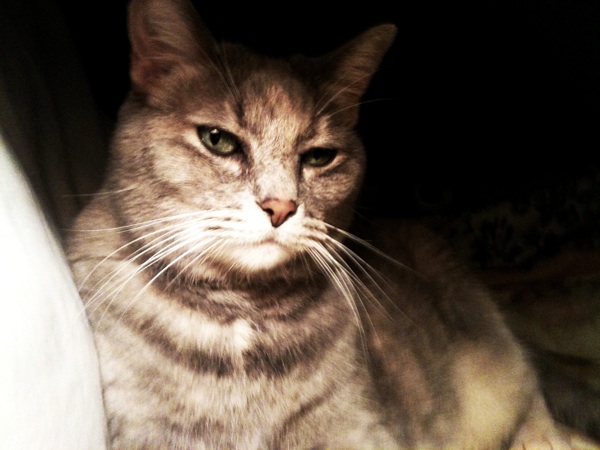
The cats followed my progress, moving from window to window as I moved from bed to bed.

(Please excuse Vanna’s sour expression. She was trying to ignore the fact that there is room for two cats on that perch. Fortunately, a flock of robins arrived shortly after this picture was taken, providing a distraction from the uncomfortable standoff.)

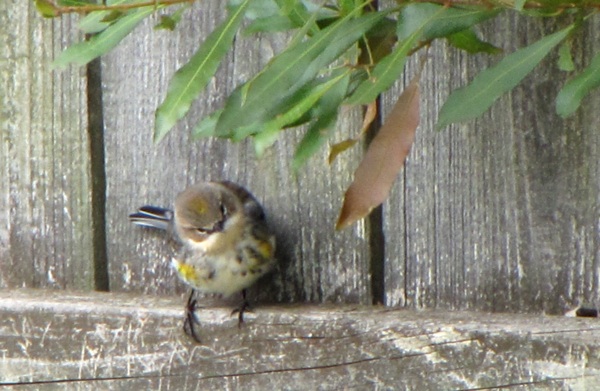
The robins were soon joined by several warblers and a pair of hungry squirrels.

Today’s strangest sighting was this very disheveled red admiral butterfly. It seemed to be heading south, perhaps following the opposite path of spring’s massive red admiral migration.

Wherever it was going, I hope it gets there safely. And I hope it was able to pause, for a moment, and enjoy tonight’s beautiful sunset.

Another Warbler Photo

A sudden gust of wind forced one of the warblers to make an emergency landing on the fence this morning. He stayed there a while, fluffing his feathers and preening. His behavior reminded me of our cats, who cover any awkward step or fall with a bout of elaborate grooming, as if to say, “I meant to do that. Now, a little privacy? As you can see, I’m bathing…”

Leaves

The pear tree is reluctant to release its leaves this year. Even so, hints of red and yellow are creeping in. More and more with each cold front.

By contrast, our Japanese maple seems eager for winter. About a week ago, it’s leaves flared brilliantly red. Then they turned brown and brittle at the edges. Then they fell, almost all of them within a single day.

Now rafts of maple leaves float in the irises and drift across the porch. They scratch against the door and whisk inside with every trip to the mailbox or errand at the store. They whisper that winter is near, despite the pear tree’s curious delay.

Review: While You Blue-step

While You Blue-step by Mary Belardi Erickson
(Aldrich Publishing, 2012)

The poems in While You Blue-step examine the verge between nature and man. Some images are ordinary while others are strange. Swallows nest in metal culverts, butterflies and weeds invade a trash heap, minnows swim under railroad crossings, and a lone pelican lands beside a barn. Trains rattle across many of the pages and water flows throughout.

Like water, the book seeps and eddies from one poem to the next. The connections aren’t always obvious, but there is a general sense of movement. Of momentum without acceleration. By the end of the book, I felt as if time had passed and wisdom had been gained, even though I had not been aware of either process.

For me, the author’s voice is subtle, almost plain. But there are intriguing complexities in these poems, which depend more on meaning than music:

“Life swallowing you       like the whale did Jonah.”    (“Whaling Song”, pg 9)

“you fling pebbles
as if equating impact with answer
in a lifetime of making all blues
a wishing pool.”    (“A stone plunks”, pg 14)

“Winter takes off its gloves and cold
snaps its fingers like a magician
giving his audience an icy look.”    (“Cold Snaps”, pg 44)

While You Blue-step is not a book to be read once and returned to the shelf. My copy will undoubtedly end up creased and scarred, written-in and highlighted. Unmistakable signs of respect.

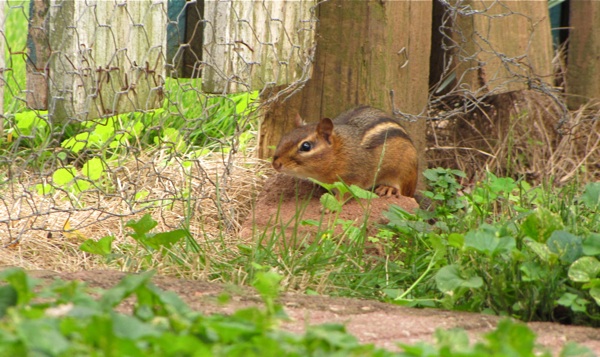
After Mother’s car accident, I stayed in her house a few months, in Huntsville, Alabama. While You Blue-step reminded me of those months. Chipmunks lived under an old shed in her back yard, and train whistles woke me with their unfamiliar cries in the night. Then there were months of emptiness and grief, after Mother died, and I’m only just now reaching the point where the world is familiar again. I am like the leaf on pages 18 and 19:

“touching ground means finding
waters, yourself flowing from time
to time.”    (“As a leaf”)