Focusing on Mallards Part V: Hunting by the Numbers

Content Warning: This multi-part blog post contains references to hunting, agriculture, and research practices of killing birds. This installment contains a photograph of a duck hunter with his kills—a pair of dead Mallards. If you choose not to read on, I respect and admire your choice.
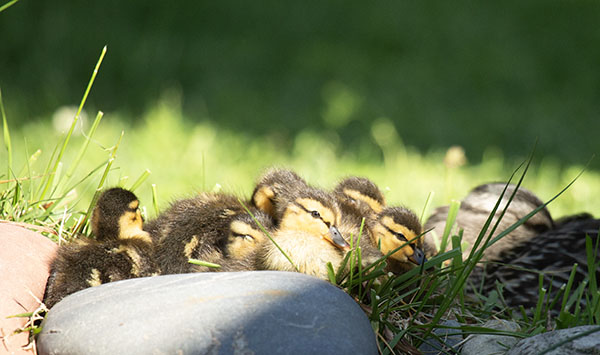
Photograph of a brood of Mallard ducklings huddled for a nap in the sunshine. The downy ducklings are yellow and brown with prominent eye stripes. Their mother is sleeping behind them, beak tucked under her wing feathers. Her feathers are shades of tan and gray, and she also has a prominent eye stripe. All are gathered on the stone border surrounding our dragonfly pond.
Photograph of a huddle of Mallard ducklings resting in the sunshine on the stone border of our dragonfly pond. Their mother is just behind them (right of frame).

Like most of my blog journeys, this long perseveration on Mallards started with questions about a visitor in the yard: What happens to a Mallard hen’s flight muscles while she is nesting? If she spends a flightless month on the nest, then two more flightless months escorting her flightless ducklings, how does she keep her muscles in flying condition?

A Mallard hen stretches her wings after a splashy bath in a small backyard dragonfly pond. She is standing tall in the water, facing the camera, wings extended behind her. Her feathers are mostly speckled and striped shades of brown with bright white coloration on the underside of her wing feathers. A round, floating solar-powered fountain is spending up a small spray of water (left). An array of water plants are growing in the pond, including water lilies. Tall irises and grasses grow around the pond's river-stone border, filling the background with greenery.
Photo of the Mallard hen who inspired this blog series. In this photo, she is standing tall in the dragonfly pond, facing the camera as she flaps vigorously after a splashy bath.

A prolonged literature search produced partial answers. And raised more questions.

In the end, a research paper out of North Dakota (Krapu, 1981) confirmed that wild Mallard hens lose significant body weight during nesting, including most of their fat reserves. But the researchers did not measure or comment on flight muscles.

Beyond that 1981 anchor point, my flight muscle question lies abandoned, waiting for another researcher or reader to pick it up. Until then, I’m content with Part III‘s conclusion: Only the Mallards know.

Photo of a Mallard hen standing in a shallow spot in the dragonfly pond. Her brood of ducklings are gathered beside her. The hen's feathers are shiny and sleek, speckled brown and tan. The ducklings are downy with brown and yellow markings. Both hen and ducklings have the prominent dark eye stripe common to Mallards. In the background, large smooth river stones are stacked loosely around the pond's border. A pair of conch shells are visible, incorporated into the border.
Photo of a different Mallard hen, one who visited in the spring of this year (2025), resting in the dragonfly pond with her ducklings. She was wary of me and my camera and taught her ducklings to be wary as well. This is how wild Mallard ducklings learn to be wild Mallards. Usually. Later in this series I will introduce some exceptions.

Caught in tangles of tangents

I can’t resist tangents. They are how my world expands. And how my mind works, OCD and all. So here I am, more than a year later, still exploring this labyrinthine idea web of Mallards and Mallard literature.

But this particular perseveration, my Mallard fixation, runs deeper than most of my blog ideas. In fact, it runs straight into a mire of social and psychological issues that I am poorly equipped to navigate. So here I remain. Grappling for words and wisdom in the Mallard archives. Because much of what motivates me to care about this world, much of what motivates me to read and write, is also in the Mallard archives.

Sharp black-and-white image scanned from a slide. The image dates to the 1970s, and shows me as a pre-adolescent. I am squatting behind a smallish round wire cage, which has a leather carrying strap. I am holding onto the wires of the cage and peering into the distance. My body language and facial expression suggest that I am misbehaving and trying not to get caught. Inside the cage, a speckled white and gray duck is panting or vocalizing, beak open. The duck is too large for the cramped cage.
Photograph of me in some awkward childhood era, caught coveting a duck at some fair or other event. I was attempting to stay small and inconspicuous behind the big fancy duck, so that Mother wouldn’t catch me coveting.

In all of the decades between the anxious moment captured, above, and my present seat at the blog table, I’ve lived in the tensions between mine and not-mine. Between the coop and the wetlands. Between the self-protective urge to stay small and inconspicuous and the inescapable longing for expansive connections.

I expect most readers live in the same tensions. It’s part of being human. It is, perhaps, part of being Mallard, as well.

Photo of five Mallard ducklings climbing onto the border of the dragonfly pond while their mother watches from the water. Four of the ducklings are immediately visible, center frame, but the fifth is partially hidden behind a clump of short grass. The ducklings are downy with yellow and brown markings. One has tiny water droplets clinging to its head and neck.
Photo of five ducklings climbing out of the dragonfly pond while their mother keeps watch from her position in the water. The fifth duckling is small and inconspicuous, hidden behind a tuft of grass on the right.

Out of my comfort zone

These Mallard posts have turned into foundation work for a policy argument.

(Spoiler alert: I am not crafting an argument against hunting.)

Policy arguments are not my norm and most definitely are not my creative strength. But I’m wading in.

I’m wading in without a map or floatation device, hoping for the kind of synergy that sometimes makes words more wise than their author. Hoping for fewer small and inconspicuous silences.

Photo of a Mallard duckling peering over the stone border of the dragonfly pond. This photo was taken at ground level, so the duckling's head is only partially visible over the stones, concentrating focus on the duckling's eye. A second duckling's rounded back, fluffy with down, appears to the far right of the frame.
Photo of a duckling peeking over the border of the dragonfly pond. The duckling has downy markings of yellow and brown and has the exaggerated forehead and eye proportions of infant cuteness.

I grew up around poultry, both wild and domestic. I also grew up around guns and hunting. Through all my many long years, I have accepted, unquestioning, most of the arguments in favor of hunting as both a sport and a science-backed approach to wildlife management and conservation.

I still accept some of these arguments. But I’m developing deep resistance to others. Resistance based on all of this reading about the history and practices of Mallard hunting and conservation.

(Let me repeat that spoiler: I am not crafting an argument against hunting.)
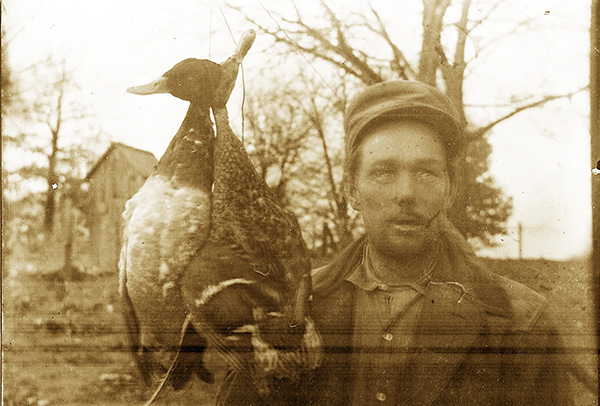
Blurry sepia-toned photo of a man standing beside two dead Mallards, which are hanging from a string or wire so that they are at head-height. The man is wearing a brimmed hat, a buttoned-up shirt with a rumpled collar, and a padded coat that appears to be made of canvas or similar material. The Mallards are male and female, judging by their plumage, and one of the female's wings hangs in way that suggests the wing was broken when she was shot. The outdoor scene shows trees that have lost their leaves for winter and a very small wooden outbuilding with a tin roof. The outbuilding looks to me like an outhouse or smoke shed.
Photo of an unknown man posing with two dead Mallards. One of the Mallards is in male plumage, the other in female plumage. I found this photo, which likely dates from the 1920s or 30s, in an album belonging to a great aunt. Based on labelling of a companion photo, the man’s name was Harry Kenyon. I don’t know how or why he ended up in Aunt Birdie’s album.

I’m not comfortable arguing policy, which means there will be throat clearing and wandering off-topic. I am, after all, a blogger. Not a lobbyist. A poet, not a lawmaker. I seldom demand rhetorical precision of myself, in my creative work. Which is part of why I enjoy blogging. Rhetorical precision is for the classroom and office, not the blog.

But there are upsides to making this argument in blog form. There’s freedom from structure and stricture. My hybrid interweaving of literature review and memoir is choice, not style guide. More importantly, there’s no peer review. I am my own editor and publisher, so I’m allowed to make overt appeals to emotion. Including photos and videos of ducklings.

These photo and videos are my unsubtle attempt to convince readers that ducks are stakeholders in policy discussions about waterfowl hunting.

Photo of a Mallard hen leading her ducklings out of the dragonfly pond. All are standing on a section of flagstone set level into the yard. In the background are a coiled green hose and an orange, plastic, five-gallon bucket stamped with white lettering reading "Let's do this" in all-caps. The Mallard hen is maybe a foot tall and has mostly brown feathers edged with tan, except for a patch of blue edged with black and white on her wing. The ducklings are maybe three or four inches tall and have downy feathers with yellow and brown markings. There are seven ducklings readily visible, though they are difficult to count due to how they are crowded together. (In all, this hen had eleven ducklings.)
Photo of a Mallard hen and her ducklings exiting the dragonfly pond in spring, 2025. In the background, a bright orange bucket is stamped with the big-box slogan “Let’s do this”.

Sport hunting is a profitable mine, and Mallards are a form of ore

Unlike many of my blog topics, Mallard hunting isn’t a rabbit hole. It’s a multi-level, vastly profitable mine regulated by international treaties and cooperative relationships between state and federal agencies.

Everything in the Mallard mine is complicated by tradition and money and land.

This isn’t about the flight muscles

I introduced a few ideas about the capitalism behind the science curtain in Part II. And where Mallards are concerned, science isn’t the only interested party. Mallard hunting (and farming) is not an independent storefront on the town square. This is big business and big money, so big policy questions come into play.

Who owns wildlife, on public and private lands? Who gets to decide how wildlife is exploited, on public and private lands? When is wildlife no longer wild? (Keep inserting “on public and private lands”, as the questions roll on…) What are the roles and aims of conservation work? Who gets to own and discharge firearms? Why and how are tradition and research guiding individual and community decision making, when it comes to hunting?

This isn’t about flight muscles.

Except, isn’t it?

Mallards are poultry. And once Mallards are defined as poultry, once flight muscles are defined as breast meat, Mallard hunting is only about the flight muscles. Wild Mallards are protein harvested by shotgun.

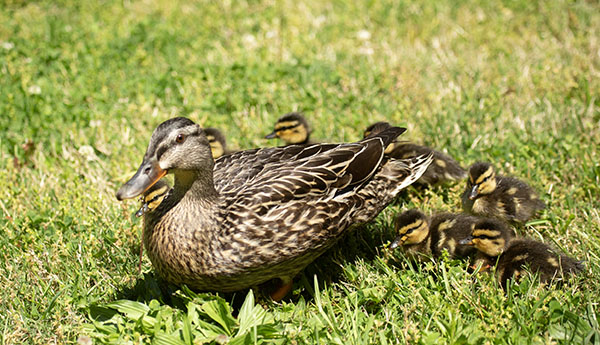
Photo of a Mallard hen grazing through a helping of wild bird seed that I scattered into the grass (and weeds) just beside the dragonfly pond. Her eleven ducklings are either watching her eat or beginning to wander back toward the pond. 
They sampled the seed but didn't eat much.
Photo of a Mallard hen eating bird seed. She is surrounded by her eleven ducklings. The ducklings sampled the seed but were unimpressed.

Just how big is this business?

A 2006 survey from the US Fish & Wildlife Service (USFWS) found that “…waterfowl hunters represented 10 percent of all hunters, 7 percent of all hunting-related expenditures, and 6 percent of all hunting equipment expenditures” (Carver, 2008, pg. 3).

Here’s the waterfowl hunting numbers for 2006 (derived from Carver, 2008, Table 1, p. 4):

Number of US hunters (ducks)1,147,000
Number of US hunters (geese)700,000
Number of US hunters (all waterfowl)1,306,000
Reported US trip expenditures (waterfowl)$493,987,000
Reported US equipment expenditures (waterfowl)$406,298,000
Total US spending (waterfowl)$900,285,000

Those zeros are not a typo. That’s over nine hundred million dollars spent, in 2006, on hunting ducks, geese, and other waterfowl. While more than half of those dollars went to the travel industry, some four hundred million dollars were non-travel purchases, including “rifles, shotguns, other firearms, ammunition, telescopic sights, decoys, hunting dogs and associated costs. Also included are auxiliary equipment such as camping equipments, binoculars, special hunting clothing, processing and taxidermy costs. Due to small sample sizes, special equipment purchases such as boats, campers, trucks, and cabins are excluded…” (Carver, 2008, Table 1, pg. 4).

The author of this report adjusted the economic impact of waterfowl hunting through input–output modeling, to estimate how this spending radiates through the economy: “The trip expenditures of $494 million by waterfowl hunters generated $1.2 billion in total output while equipment expenditures of $406 million generated $1.1 billion in total output in the United States” (Carver, 2008, pg. 10).

So it’s fair to say that waterfowl hunting is a multi-billion dollar industry, in the US. That’s multi-billion per year. And Mallard hunting is a massive chunk of that industry. “Hunter reports indicate that mallards made up about 43% (5.5 million annually) of the ducks taken before 1960, when mallard regulations were less restrictive; the Duck Wing Survey indicates that mallards have made up 33% of the harvest (3.6 million annually) since 1960″ (Martin & Carney, 1977, p. IX).
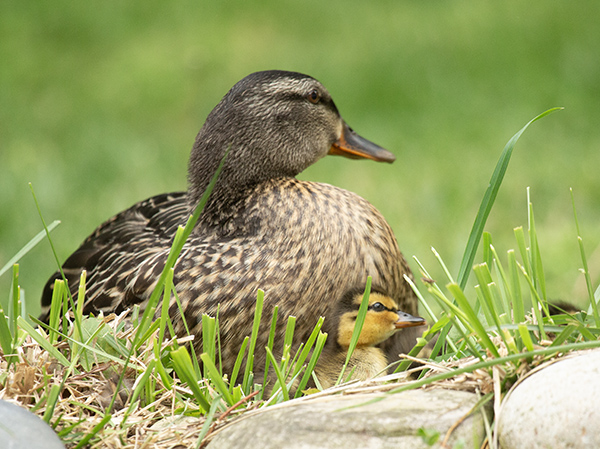
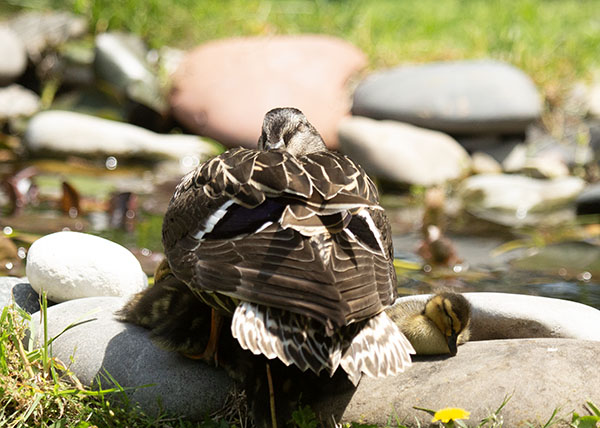
Photo of a Mallard hen settling for a rest beside the dragonfly pond. In this phot0, most of her ducklings were hidden beneath her, tucked into the feathers of her chest and abdomen. One duckling has not settled, yet, and is standing just under her neck, looking around. Another duckling is barely visible to the right of frame, mostly hidden by a tuft of short, cut grass.
Photo of a Mallard hen settling for a nap with her ducklings beside the dragonfly pond in spring, 2025. Tucked beneath her chest, one duckling has raised its head to look around.

Given the money spent on hunting ducks, geese, and other waterfowl, it’s not a surprise that “…waterfowl hunting is positively correlated with income. That is, as household income increases, the percentage of waterfowl hunters for each group also increases. Income is also positively correlated with the participation rate of all hunters. However, all hunters do not tend to be as affluent as waterfowl hunters” (Carver, 2008, pg. 6).

This is not subsistence hunting. For the majority of duck hunters in the US, suspension of duck season would not equate to food insecurity. Yes, many hunters eat the ducks they kill. But they would still be able to eat, even if they killed no ducks.

How many Mallards are there, anyway?

Efforts to count the continent’s ducks began as early as the 1940s, when researchers tramped out into the marshes for hand counts. Then pilots joined the work, providing population estimates (and species distributions) for flocks spotted during aerial flyovers. Hunter surveys, requesting that hunters report how many and what kinds of ducks have been killed in the season, add a final dimension of data. At the confluence of these ongoing data streams, USFWS calculates Mallard “abundance”, which isn’t exactly a population count but is close enough for my purposes.

As of 1974, “The estimated size of the continental mallard population in May has ranged from a high of 14.4 million in 1958 to a low of 7.1 million in 1965. Generally, the mallard population began to decline after the 1958 peak until 1962, and remained below 10 million birds until 1970. The decline and consequent low level of the mallard population between 1959 and 1969 generally coincides with a period of poor habitat conditions on the major breeding grounds” (Pospahala, Anderson, & Henney, p. 49).

Over more recent decades (from 1992–2024) the “mid-continent” stock of US Mallards has ranged between 6.2 million and 11.9 million (USFWS, 2024, p. 12). (There are management purposes at work, in this focus on “mid-continent” Mallards, which I will get to later.)

Photo of a Mallard hen standing in a shallow place in the dragonfly pond. Her ducklings are gathered in the water, beside her. Her head is tipped slightly to her left, right eye angled toward the sky in search of aerial predators. Anthropomorphized, her head angle and expression look questioning.
Photo of a Mallard hen and her ducklings in the dragonfly pond, taking a brief break from their wanderings in the spring of 2025.

In 2024, Mallard abundance in the US registered some 6.6 million. In 2023, about 6.1 million (USFWS, 2024, p. iii).

With recent numbers hovering near the low end of the 1992–2024 Mallard abundance range, and below the lowest 1960s numbers, it seems that the Mallard glass is currently half-empty. But if accounts from the late 1800s and early 1900s are accurate, the North American Mallard glass has been half-empty for over a century. (Drop a pin in this claim. There will be evidence later.)

Where do North American Mallards come from, and where do they go?

Continental Mallard production can vary wildly over a very short span of years. For example, 1957 produced a count of 22.1 million Mallard “young”, but 1961 saw only 5.9 million (Anderson, 1975, p. 33). Granted, it’s difficult to count Mallard young, but there was undoubtedly a major decline between 1957 and 1961.

By the 1970s, it was clear that Mallard production was related to the number of ponds in Mallards’ breeding grounds. (Here is where that focus on mid-continent Mallards starts to become important, as the largest and most productive breeding grounds are in the north and central portions of North America, in “prairie pothole” country.) And, prior to 1960, the number of ponds steadily declined everywhere. But habitat was never the only factor.

Nesting season and shooting season

The existence of a “long-term average” population number for Mallards, of around 7.9 million (USFWS, 2024, p. iii), flattens into stasis a seasonally dynamic population. Spring and summer are boom and winnow seasons. Some 75% of Mallard mortality occurs in first-year ducks, either in the nest or during the weeks immediately after hatching, before young birds learn to fly (Anderson, 1975, p. IX). Then fall and winter bring the hunter’s guns.

“…it may be predicted that about 60 out of every 100 mallards flying south along the Mississippi Flyway will be hit by shot” (Bellrose, 1953, p. 358-359).
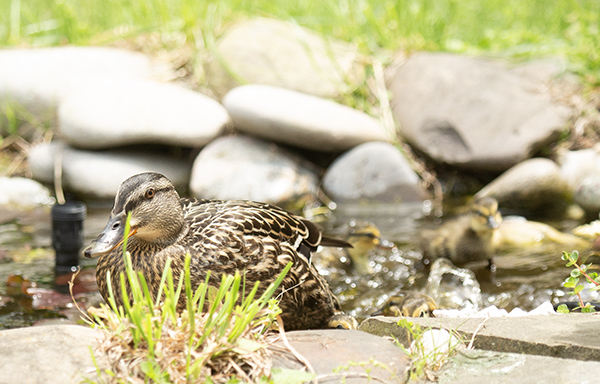
Photo of a Mallard hen just stepping up onto the stone border of the dragonfly pond. In the background, splashes and sprays of water fill the air, churned up by her recent splashy bath and the excited actions of her ducklings.
Photo of a Mallard hen getting ready to climb out of the dragonfly pond. Behind her, ducklings are splashing and playing in the water.

After Mallards survive their first summer, death by shotgun accounts for a significant percentage of overall Mallard mortality. Of the adult males that die each year, about 50% die by shotgun (Anderson, 1975, p. 24). The percentages are slightly lower for females (40%) and first-year Mallards (45%) (Anderson, 1975, p. 24).

Given all these shotguns, and all of the other Mallard hazards out there, the majority of Mallards that survive their first summer do not live more than two adult winters (Anderson, 1975, p. IX). That doesn’t mean that a three-year-old Mallard is an old Mallard, only that it is a lucky Mallard. Even luckier Mallards have lived as long as 13 years in the wild (a few female Mallards), and one particularly charmed male Mallard survived 18 years (Anderson, 1975, p. 26).

Harvest by shotgun

In the US, prior to 1960 hunters bagged some 5.5 million Mallards every year (Martin & Carney, 1977, p. IX). It’s worth repeating that number: 5.5 million Mallards. Every year.

After hunting regulations were tightened in 1960, the Mallard kill dropped to about 3.6 million per year (Martin & Carney, 1977, p. IX). Such numbers fluctuate, of course, and have dropped somewhat further since the 1970s. But hunting still claims millions of Mallards, each year. USFWS estimated a Mallard harvest of 2,042,668 birds, in 2022 (USFWS, 2023, Table 1E, p. 25).

Up through the 1970s, close to a quarter of the entire North American Mallard population was killed by hunters, every year (Anderson & Burnham, 1976, p. 40).

Based on the numbers previously cited for 2022 (2,042,668 Mallards killed by hunters) and 2023 (estimated population of 6.1 million), it seems that perhaps one-third of the US Mallard population continues to die by shotgun every year.

Overkill?

Only a few paragraphs ago, the USFWS estimated a 2024 Mallard population of 6.6 million. In 2024, a pre-1960 harvest (during years when harvests averaged 5.5 million ducks per year) would have obliterated the US population of Mallards.

In fact, the pre-1960s binges, on top of widespread habitat destruction, dealt multiple near-obliteration blows to North American Mallards. Starting early in the 1900s, hunters and researchers agreed that something needed to be done to save the Mallards. At least, they agreed that something needed to be done to save Mallard hunting.

The first (documented) North American Mallard bottleneck, circa 1920

Prior to the 1900s, hunters spoke of North America’s duck populations in awe-tinged phrases.

“It is about the finest country you could imagine in the wildest flights of fancy; Ducks getting up under your feet at every yard; Hawks, Goatsuckers, Prairie Chickens, and small birds in all directions… I shot a Teal and a splendid Shoveller drake for the pot. I can fancy I hear you exclaiming against the barbarism of eating such a bird; but I am getting daily accustomed to birds which are considered rare in England, and regard them now from a more utilitarian point of view” (Wood, 1885, p. 225).

“During this autumnal movement the number of ducks frequenting the lakes and ponds throughout Manitoba is prodigious. I shall not soon forget the hundreds I saw on the innumerable ponds between Rapid City and the Oak River, whilst on an excursion towards Fort Ellice, in the middle of October, 1883. Yet those I saw must have been as nothing compared with the abundance to be seen in some other places. A friend who had several days’ shooting at Totogon, near the south end of Lake Manitoba, about the end of September, describes the ducks as being so numerous that only the terms ‘acres’ and ‘millions’ could adequately express their abundance. The majority were Mallards, Anas boscas…” (Christy, 1885, p. 133).

By the 1920s, Mallards populations had declined to a notable low:

“The duck marshes on the Saginaw River no longer teem with water fowl. In early September and before the first frost the cackle of the Carolina rail is on every hand. These little birds—the Sora, seem as plentiful as ever, so I have not given up the marshes of the Saginaw entirely, but once or twice in the early part of September I get out the old canoe and with Alphonse to paddle or push, I take the trip through several miles of the Cheboyganning rice beds and usually get what the law allows of rail shooting, but in making all of this distance through acres and acres of rice, one or two ducks is all I see in place of the thousands of old” (Mershon, 1923, p. 73).

And this is where I leave the Mallards, for now. A poor remnant of a once thriving species, scarce and growing scarcer into the 1920s. In the next post, help arrives.
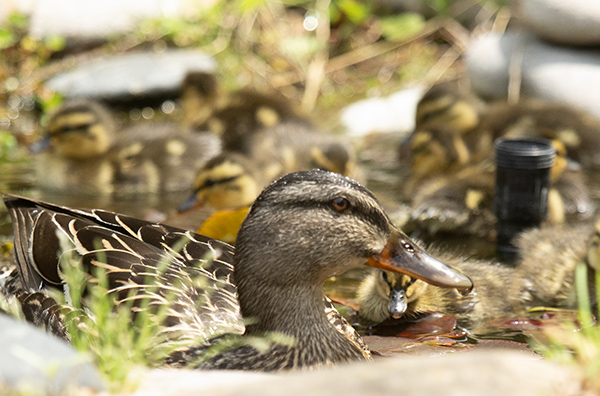
Photo of a Mallard hen and her ducklings in the dragonfly pond. Taken along ground level, the photo shows the hen's head and neck and back, with a blurred foreground of stone blocking the rest of her. Framed under the arch of her neck and chin, one of her ducklings is in sharp focus, facing the camera.
Photo of a Mallard hen and her ducklings exploring the dragonfly pond in spring, 2025. Here the hen is in the foreground and one of her ducklings is framed by her silhouette.

A housekeeping note (or, rather, a territory-keeping note)

Throughout this post, I’ve switched back and forth between talking about North American Mallards and US Mallards without much fanfare. Doesn’t it sound presumptuous? It’s almost as if I have forgotten that there are other countries on the continent. (Doesn’t it sound familiar?)

But from here on out, I’ll need to take more care. Because, starting in the early 1900s, lawmakers and researchers divvied up North America’s Mallards. There were, and still are, jurisdictions and flyways. More importantly, genetic work has identified two discreet and rarely-intermixing populations of Mallards, an eastern gene group and a western gene group (Lavretsky, Janzen, & McCracken, 2019). And my particular policy argument involves eastern Mallards, alone.

Preview of Part VI: The US judicial branch decides who owns the Mallards that visit US lands, and funding arrives for conservation

As long as there were plenty of Mallards, everywhere, distinctions between North American and US Mallards were moot. But as Mallard populations dwindled, hunters came into conflict over who got to shoot the Mallards that remained. And with increasing scarcity came increasing value, along with politicians to squabble over resource ownership.

The problem was (and still is, to a certain extent) that Mallards have always migrated according to their own maps, which existed long before humans decided that land could be owned. Given that the North American Mallard mine spans three (or more) countries, including most of the states in each country, and that Mallards are valuable ore, who owns the profit? Who gets to harvest this particular protein, and how should they be allowed to market it?

North American Mallards as a species have continued breeding and migrating, and US Mallards as a resource have continued falling into hunters’ bags, but the species and resource exist on two seemingly separate planes.

Oliver Wendell Holmes summed it up succinctly, in a landmark case that upheld the 1918 Migratory Bird Treaty: “The whole foundation of the State’s rights is the presence within their jurisdiction of birds that yesterday had not arrived, tomorrow may be in another State and in a week a thousand miles away” (Missouri v. Holland, 1920, para. 6).
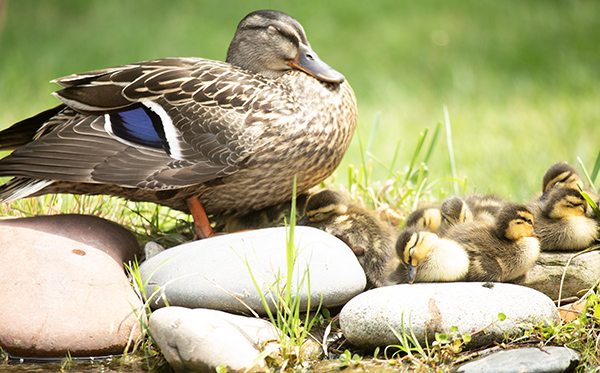
Photo of a Mallard hen drifting off to sleep while still standing. She is perched on the sunlit, stony border of our dragonfly pond. Her brood of ducklings are scattered under and in front of her, most in different sleep poses. One duckling is still awake, though visibly drowsy with half-closed eyes. Another duckling is barely balanced on the edge of a rounded, smooth stone, and appears on the verge of falling off backwards. Yet another duckling has nodded off with its neck bent and the tip of its beak just touching the sun-warmed rock.
Photo of a Mallard hen resting (asleep while standing up) on the stone border of the dragonfly pond in spring, 2025. Her ducklings are napping in a loose cuddle-heap, sprawled from just under her chest to almost a foot away. Some of the ducklings are slumped awkwardly in sleep, exhausted from their first hours off the nest, while others are fidgeting for a more comfortable position.

References

Anderson, D.R. (1975). Population ecology of the Mallard: V. Temporal and geographic estimates of survival, recovery, and harvest rates. Resource Publication 125. U.S. Department of the Interior, Fish and Wildlife Service. https://nwrc.contentdm.oclc.org/digital/collection/p16473coll29/id/4786

Anderson, D. R., & Burnham, K. P. (1976). Population ecology of the Mallard. VI: The effect of exploitation on survival. Resource Publication 128. U. S. Department of Interior, Fish and Wildlife Service. https://nwrc.contentdm.oclc.org/digital/collection/p16473coll29/id/4899

Bellrose, F. C. (1953). A preliminary evaluation of cripple losses in waterfowl. In James B. Trefethen (Ed.) Transactions of the Eighteenth North American Wildlife and Natural Resources Conference (pp. 337-360). The Wildlife Management Institute. https://wildlifemanagement.institute/conference/transactions/1953

Carver, E. (2008). Economic impact of waterfowl hunting in the United States: Addendum to the 2006 national survey of fishing, hunting, and wildlife-associated recreation. U. S. Fish and Wildlife Services. https://www.fws.gov/sites/default/files/documents/2024-04/1153.pdf

Christy, R. M. (1885). Notes on the birds of Manitoba. The Zoologist: A Monthly Journal of Natural History, 3rd Series, IX(100). https://ia801303.us.archive.org/27/items/zoologist85lond/zoologist85lond.pdf

Gillham, C. E. (1947). Wildfowling can be saved. In Ethel M. Quee (Ed.), Transactions of the Twelfth North American Wildlife and Natural Resources Conference (pp. 47-52). The Wildlife Management Institute. https://wildlifemanagement.institute/conference/transactions/1947

Krapu, G. L. (1981) The role of nutrient reserves in Mallard reproduction. The Auk 98, 29-38. doi: 10.1093/auk/98.1.29

Lavretsky, P., Janzen, T., & McCracken, K. G. (2019). Identifying hybrids and the genomics of hybridization: Mallards and American Black Ducks of Eastern North America. Ecology and Evolution (9), 3470–3490. DOI: 10.1002/ece3.4981 https://onlinelibrary.wiley.com/doi/full/10.1002/ece3.4981

Martin, E.M., & Carney, S.M. (1977). Population ecology of the Mallard: IV. A review of duck hunting regulations, activity, and success with special reference to the Mallard. Resource Publication 130. U.S. Fish and Wildlife Service. https://pubs.usgs.gov/unnumbered/5230112/report.pdf

Mershon, W. B. (1923). Recollections of My Fifty Years Hunting and Fishing. The Stratford Company. https://archive.org/details/recollectionsofm00mers_0

Missouri v. Holland, 252 U.S. 416. (1920). https://www.law.cornell.edu/supremecourt/text/252/416

Organ, J. F., Mahoney, S. P., & Geist, V. (2010). Born in the hands of hunters: The North American model of wildlife conservation. The Wildlife Professional 4(3), 22-27. https://www.researchgate.net/publication/267749137_Born_in_the_hands_of_hunters_the_North_American_Model_of_Wildlife_Conservation

Pospahala, R. S., Anderson, D. R., & Henney, C. J. (1974). Population ecology of the mallard. II: Breeding and habitat conditions, size of the breeding populations, and production indices. Resource Publication 115. U.S. Department of Interior, Fish and Wildlife Service, Bureau of Sport Fisheries and Wildlife. https://nwrc.contentdm.oclc.org/digital/collection/p16473coll29/id/10213/rec/1

USFWS (2023). Migratory Bird Hunting Activity and Harvest during the 2021–2022 and 2022–2023 Hunting Seasons. USFWS. https://www.fws.gov/sites/default/files/documents/migratory-bird-hunting-activity-and-harvest-report-2021-to-2022-and-2022-to-2023.pdf

USFWS (2024). Waterfowl Population Status, 2024. US Department of the Interior. https://www.fws.gov/sites/default/files/documents/2024-08/waterfowl-population-status-report-2024.pdf

Wood, T. B. (1885). Notes on the zoology of Manitoba. The Zoologist: A Monthly Journal of Natural History, 3rd Series, IX(100). https://ia801303.us.archive.org/27/items/zoologist85lond/zoologist85lond.pdf

Focusing on Mallards, Part II

Content warning: This blog post contains references to the hunting, agriculture, and research practices of killing birds. If you choose not to read on, I respect and admire your choice.

Part of my purpose in writing this Mallard series is to highlight the price that has been paid (and continues to be paid) for the knowledge we have about Mallards and other birds. I might have constructed these posts, as a younger writer, without acknowledging the deaths behind the data. But as I’ve aged, I’ve grown more aware of the cost of knowledge.

In this photo, the Mallard hen who inspired this series of blog posts swims with her brood of day-old ducklings in our dragonfly pond.
In this photo, the Mallard hen who inspired this series of blog posts swims with her brood of day-old ducklings in our dragonfly pond. The ducklings are gathered around a grassy seed head that the hen tugged down to within their reach. The hen nested in our neighbor’s yard, during spring 2024, and brought her brood to the dragonfly pond the morning after they hatched and again the next day. I wondered, during and after her long inactivity on the nest, if she experienced the kind of changes in muscle mass that I might experience if I spent most of a month in bed. I didn’t find a good answer for that question, but I found adjacent answers to adjacent questions. Enough adjacent questions and answers for this multi-part blog post.

What I mean by “knowledge”

It’s one thing, for me, to observe our yard and its visitors. To slip away from human concerns and simply watch. To sate myself with wonder. These hours shift my perspective. They build new connections between old memories. I sometimes emerge with splintered metaphors to sand and patch and paint. Sometimes with fine-grained phrases that liven up a drab idea. On the rarest and best days, I emerge with blueprints for new knowledge.

Observation and wonder are one thing. But knowledge is an entirely different state.

Separate and distinct from the metaphysical implications of knowing, my definition of knowledge is an inventory of education and experience. The nouns of my past and the context in which I encountered them, indexed by subject and era. A cross-referenced heap of biology, shuffled around the edges with chemistry. A shelf of style guides and writing advice. A few notebooks of math, physics, and cosmology. A faded box of recipes, crochet patterns, and needlework hints. Stacks of genre reading. Great aisles of emptiness where business, economics, and law failed to catch my interest.

I was recently asked to list my areas of expertise. I wanted to respond that I have none. I am a worksite traced with utility locator flags, not a finished library. I might claim my main parlor, biology, but even there the framework is incomplete. And, to align the metaphor with my theme, construction materials are expensive.

For many long decades I failed to appreciate the cost of knowledge, with its scaffolds of data. In this post, I’ve chosen to pull back the curtain I so blithely ignored as a young science student. Much of what I find behind that curtain forces me to stock those great empty aisles of business, economics, and law. Because the dimly-lit ledger of science history, written mostly by rich old white men, seldom accounts for cost. But every so often, jotted in the margins or tucked between the pages, the writers left remnants of their invoices.

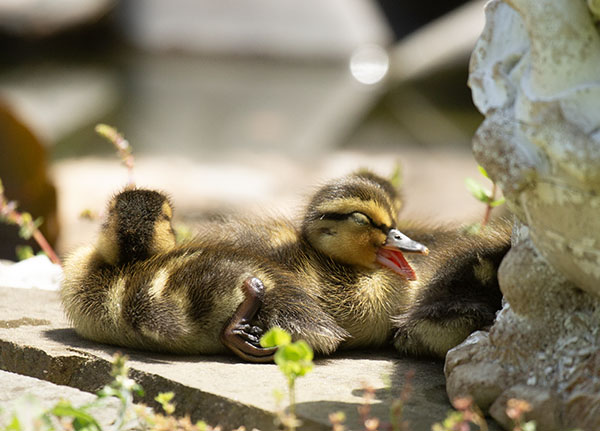
In this photo, sleepy Mallard ducklings bask on a sun-warmed rock beside our dragonfly pond. One of the ducklings is yawning. From many perspectives, these ducklings are resources to be managed and controlled. For me, here in my middle years, these ducklings are downy singularities of wonder and charm far more valuable than mere resources.

The capitalism behind the curtain

During my brief foray in the humanities silo, I chafed over intense criticisms of science and science writing. But I couldn’t deny the foundational weakness. Science motored along for centuries, impervious to criticism, fueled by colonialism and capitalism. For the most part, it still does.

What would it look like, if science and science writing discarded the curtain and directly acknowledged the capitalism? The colonialism? Not just here and there, but in every published report? If the ledger was complete and brightly lit?

I don’t expect a humanities-approved (and strengthened) science literature would look like anything I can imagine. I am neither scientist nor science writer. What’s more, my little graduate certificate in professional writing is not a stamp of humanities approval. So I can’t answer the questions that followed me home from the humanities silo.

But I am an avid science consumer. As such, the word cost is not chosen lightly. Whenever I look behind the curtain of knowledge, no matter the era or discipline, I find the busy (and visible) hands of capitalism.

As ubiquitous as hunger, questions are free for anyone who has the energy and time to ask them. But answers? Answers are capital. They are expensive. And, weighed in the hands of capitalism, answers are expected to reap a profit.

What happens when answers are not synonymous with capital gain? When hunger lingers or multiplies because the investment outweighs the return? In very short order, the hands of capitalism divert resources and time toward less costly questions and more profitable answers. Or, at least, toward questions perceived to be less costly and answers anticipated to be more profitable. The question I should have been asking for years, the question I am asking now, is this: Whose perceptions and anticipations control the resources?

In this photo, a day-old duckling stretches upward to sample a mostly bald dandelion head. During their brief time in the yard, the ducklings stripped all the seeds from all the dandelions within several feet of the pond. I don't know if they ate the seeds or merely pulled them off as part of their exploration process
In this photo, a day-old duckling stretches upward to sample a mostly bald dandelion head. During their brief time in the yard, the ducklings stripped all the seeds from all the dandelions within several feet of the pond. I don’t know if they ate the seeds or merely pulled them off as part of their exploration process.

Some practicalities about Mallards and other waterfowl

Historically, Mallards had value (and have value, still) because they were and are hunted and farmed. When it comes to funding research, and to collecting data for research, hunted and farmed species are valuable, easy resources. “Valuable” in the capitalist sense of being actual capital, but also in the academic sense of data. “Easy” because these species live and die in larger, more accessible numbers than similar species that are neither hunted nor farmed.

Hunted waterfowl (and other game birds) live and die in their large numbers within easy reach of researchers. I can’t write a path around the pragmatism of this system, but I am increasingly uncomfortable with such pragmatism.

As capital, a Mallard’s value is tethered to its food and sport potential. Driven by this food and sport value, research funding adds further value to a Mallard. Each bird is data. Whether hunted, farmed, or recorded into a set of measurements, a Mallard’s value peaks with its death. (Perhaps this is true of every individual, of every species, but I’ll leave that notion for a later post.)

What of this spring’s next-yard hen, with her downy brood? When I perceive them as more than units of capital, when I anticipate their ongoing existence as more than a value that peaks when they die, my ability (and desire) to control them as resources wanes. For me, this feels like a good and useful adjustment of my perceived and anticipated place in the world.

The older I get, the less comfortable I am with capitalism and its pragmatisms. Far from being an agriculture, research, or policy pragmatist, I want the next-door hen and her offspring to have an embodied value separate from their muscle mass and plumage. I want empathy to count. My still and quiet moments in the yard. The silly antics of ducklings in a dragonfly pond. The charm of infant proportions and curious hungers. I want to measure value as a sense of shared life, a shared world, and shared safety or peril.

Photo of the next-yard Mallard hen sleeping at the edge of the dragonfly pond. She is asleep standing up, the equivalent of a duck cat-nap, beak tucked under the feathers of her wing. Her babies are nestled in her shadow, all except one duckling that has edged out onto the warm rocks in the warm sunlight.

Aside: the literature’s euphemisms for “kill”

According to Google’s default dictionary, the word euphemism is derived from the Greek roots eu-, meaning “well”, and -phēmē, meaning “speaking”. I was taught, somewhere in my education, to translate euphemism as good word. But in my more recent years I have come to view euphemisms as veiled words. Intentional deflections. Syntactical high ground for writers (and researchers?) who wish to describe expanses of quicksand without getting mired. I sympathize with the impulse to build polite nomenclatures. To write around shock words and trauma words. But we’re all in the quicksand, no matter what we write.

(Remember the opening content warning? I do understand the need, the profound and pressing need, to protect victims of shock and trauma from experiencing further shock and trauma. This is why I embrace the practice of content warnings. The remainder of this blog post contains frequent references to the research, agriculture, and hunting practices of killing birds. If you choose not to read on, I respect and admire your choice.)

Policy, agriculture, and hunting literatures shy from the words kill and slaughter. “Kill” is rather imprecise, I suppose, for research literature. And “slaughter” is a bloody word, even with its Merriam-Webster finesse—“the butchering of livestock for meat”. In that sense, I acknowledge that “slaughter” is imprecise, as well. The birds (including Mallards) that populate policy, agriculture, and hunting literatures are resources. They are capital and data, not meat. Does it matter how we describe their deaths? (Yes! Of course it does.)

In the literatures, birds (including Mallards) are hunted, shot, collected, harvested, culled, sacrificed, and euthanized. Dead birds are examined, necropsied, and sampled. Wings are placed in the mail.

For this post and its subsequent parts (I’m not certain how many parts there will be), I’m choosing the word slaughter. Because I added up the numbers behind the data. The research numbers in the tiny subset of articles referenced here run into the thousands. The hunting numbers, hundreds of thousands per year. I feel the word slaughter fits.

The rest of my multi-part Mallard post draws heavily from work done by and for the research, agriculture, and hunting industries. Birds died for these questions and answers. For better or for worse, this is the world we have shaped for Mallards and their avian kin.

In this photo, a day-old Mallard duckling sleeps in a patch of clover and grass at the foot of one of the stones lining our dragonfly pond. The duckling is slumped forward, having nodded off after slipping down from the stone where most of its siblings were sleeping. Other siblings have slipped off of the stone, too, and are nodding off in a stair-step heap behind the sleeping duckling.

The research numbers

The following section, which deals with variations in the relative sizes of flight muscles, leans heavily on an article by D. C. Deeming, PhD.: “Allometry of the pectoral flight muscles in birds: Flight style is related to variability in the mass of the supracoracoideus muscle.” Deeming’s article pulled data from three primary sources: two tracts (1961 and 1962) from the Smithsonian Miscellaneous Collections and a 2016 survey out of Romania.

  1. Greenewalt, C. H. (1962). Dimensional relationships for flying animals. Smithsonian Miscellaneous Collections 144(2).
    • Greenewalt collated pectoral muscle weights from a 1922 French publication: Magnan, A. (1922). Les caractéristiques des oiseaux suivant le mode de vol. Annales des sciences naturelles, Series 10, Volume 5, 125-334. (Yes, that is the same Antoine Magnan responsible for the urban legend that bees should be mathematically incapable of flight.) Magnan’s work used captive birds and, as Greenewalt cited, “…those which appear to be in bad health were discarded” (Greenewalt, 40). Some 228 birds, representing about 223 species, were slaughtered for this data. (I’m hedging my numbers because counting=math=possibility of error.)
  2. Hartman, Frank A. (1961). Locomotor mechanisms of birds. Smithsonian Miscellaneous Collections 143(1).
    • Hartman’s tract drew from more ambitious work that took place in Florida, Maine, Ohio, and Panama. Birds were “collected” (or, even more euphemistically, “obtained”) from January to March, mostly before 11 AM (p. 3). The method of collection isn’t specified, nor the method of slaughter, though the authors specify that birds and their dissected muscles were weighed in “fresh condition” (p. 2). The pages and pages of data (pp. 38-91) represent more than 360 species. Individual numbers range from 1 (i.e., a solitary Bicolored Hawk of unknown sex and a single male Ruddy-capped Nightingale Thrush) to 50 or more (i.e., 55 House Sparrows, 51 White-breasted Nuthatches, 52 Rufous-tailed Hummingbirds, 50 Smooth-billed Anis, and 103 Brown Pelicans). In total, more than 6000 birds. (Again, hedging because math.)
  3. Vágási, C. I., Pap, P. L., Vincze, O., Osváth, G., Erritzøe, J., & Møller, A. P. (2016). Morphological adaptations to migration in birds. Evolutionary Biology 43, 48-59.
    • Vágási et al. captured and banded live birds in Romania, but also “[c]arcasses from natural deaths (e.g. road kill, building collision, electrocution, starvation) were collected in Romania and Denmark for taxidermy” (p. 50). The authors clarify, “Numerous bird specimens were brought frozen to JE, more than 95% of them being found dead and the remaining were shot by hunters” (p. 51). The dataset, here, includes some 115 species. Sample sizes ranged from single individuals (i.e., one Grey Wagtail , one Peregrine Falcon, and one Whinchat) to more than 100 (i.e., 824 House Sparrows, 228 Eurasian Blackbirds, and 193 Eurasian Sparrowhawks). In total, more than 3800 birds. (This article models a practical and effective approach to science without fresh slaughter, primarily sourcing data from carcasses submitted for the study. Granted, “natural deaths” from road kill, building collision, and electrocution are hardly “natural”, but I appreciate the distinction between carcass repurposing and the slaughter of otherwise healthy birds for research purposes.)

So Deeming gleaned data from more than 10,000 birds, without listing a single slaughter in the Materials and Methods section. This is both efficient science and inefficient communication. The actual numbers were curtained off, in at least one case, two sources deep and a century back. I applaud the reuse of data, but I resent the legwork required to find the birds within the data.

I expect that most of The Journal of Zoology‘s readers feel no need to find the birds. After all, the article’s intended audiences hold greater and deeper knowledge of birds, wings, and flight than I bring to the moment. The author and intended audiences would likely characterize my stroll down the numbers rabbit-hole as a tangent prompted by unrealistic purposes and fueled by OCD. But, was it?

What is the capital, here? Or rather, which capital is more valuable? The answers and knowledge, so satisfactory to my passing curiosity? The data and findings, so neatly packaged for future reference? Or the birds themselves, so fleetingly alive?

Ask a different me, in a different era, and my response to these questions would change. But, for now, my heart yearns toward the birds so fitted for flight as to seem almost magical, winging through yards and migrating over landscapes and dabbling with their downy chicks in dragonfly ponds.

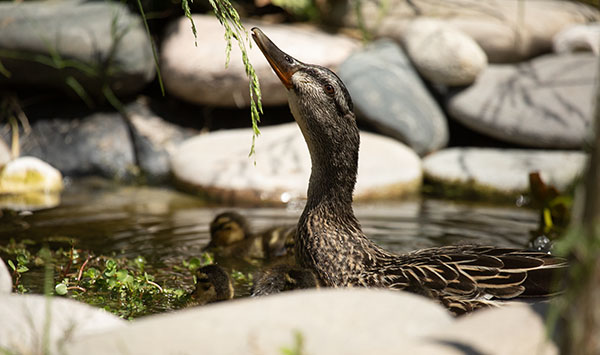
In this photo, the Mallard hen reaches up to strip seeds from an overhanging, overgrown, and unknown species of grass that was growing around the foot of the dragonfly pond. The hen is floating in the pond surrounded by her day-old brood.
Here, the Mallard hen has pulled the overhanging grass down toward her day-old ducklings. One of the ducklings is looking up from its place floating in front of her in the dragonfly pond, waiting for her to pull the grass low enough for the ducklings to sample the seeds.

Variation in the relative masses/sizes of flight muscles

(For specifics of flight muscle anatomy, see Part I of this post. In short, two muscles power bird flight: the large pectoralis muscle, which powers a wing’s downstroke, and the smaller supracoracoideus muscle, which powers a wing’s upstroke. Both muscles stretch across birds’ chests, from wing to sternum. If you eat poultry, these flight muscles are the breast meat.)

An average bird with average flying habits pushes down against air with its downstroke muscle, wing extended and feathers angled to maximize (or to finesse) the lift. How much force is needed depends on the birds’ weight and acceleration. Is it a heavy-bodied duck or a sleek-framed crow? At a minimum, the downstroke muscle is massive enough to lift the bird’s weight against gravity and accelerate according to the bird’s habits. Imagine the initial heaves of a Mallard taking flight. The lazy hop-launch of a crow. Which bird has bulkier downstroke muscles?

Back to the average bird with average flying habits, downstroke accomplished. Now it tucks and rotates its wings, to minimize air resistance for the upstroke.

Push (PUSH) down. Tuck. Pull (pull) up. Flap. Flap.

Large downstroke muscle, for the heavy work of lifting body weight against gravity. Much smaller upstroke muscle, lifting only the weight and feather-drag of tucked and rotated wings against air. Whether Mallard or crow, the upstroke muscle does less work. (Read on for exceptions, because there are always exceptions.)

In average birds with average wings, downstroke muscles are between 8 and 13 times larger than upstroke muscles (Deeming, “Discussion”, para. 1). So much pushing, so little pulling.

But what about not-average birds? What about birds with exceptional flight habits? What about flightless birds?

Some birds need to pull (PULL) as they raise their wings. They need a mightier upstroke muscle. Penguins, auks, and many other diving birds use their wings under water. No matter how much they tuck and rotate, water isn’t air. There’s more drag. These birds’ upstroke muscles are large, both in proportion to their downstroke muscles and in proportion to their body sizes. Their downstroke muscles are still the largest flight muscle, but only about 1 to 3 times larger than the upsized upstroke muscle. No more of those 8 and 13 numbers (Deeming, “Discussion”, para. 2).

Hummingbirds, which actually rotate and invert their wings during the upstroke, generate lift in both phases of the flap: push (PUSH) and pull (PULL). Surprisingly, to me, pigeons also generate lift in the upstroke, via a trick of the wing tip to change their wing shape. Both hummingbirds and pigeons measure in the same range as diving birds that swim with their wings; their downstroke muscles are only 1 to 3 times larger than their upstroke muscles (Deeming, “Discussion”, para. 2 & para. 5).

More special conditions occur for flightless birds, such as Rheas, and for owls and hawks. More special distributions of muscle. The Deeming article is packed with details.

I didn’t mean to write this much. But I’m fascinated. And I have OCD. It’s a dangerous combination, where tangents are concerned. But in the next part of this post, I’ll move on to flight muscle changes during a bird’s life cycle, as there is plenty of evidence regarding changes in flight muscle mass during molt.

Photo of a Mallard hen walking through the mown grass and weeds that make up our back yard. She is followed by her day-old brood of nine. Here, they were beginning their first stroll away from our tame-ish yard, toward the big waters running through our Tidewater area.
Photo of the Mallard hen walking through the mown grass and weeds that make up our back yard. She is followed by her day-old brood of nine. Here, they were beginning their first stroll away from our tame-ish yard, toward the big waters running through our Tidewater area.

Publication Announcement!

If you’re still here, I very much appreciate your time and attention. And, while I do feel a pang of irony as I promote my own writing while complaining about capitalism, my second poetry collection is now available!

Alchemy (Kelsay Books, 2024)

Photo of the front cover of Alchemy, which features trinkets and jewelry (many passed down from my mother) arranged on a cloth background. Each broach, bracelet, pendant, earring, and trinket illustrates a theme or topic from the poetry. Featured in the center, a Noah's ark pin and a globe-and-animals pin are connected by an antique miniature watch on a chain. Other items show mammals, birds, insects, fish, reptiles, amphibians, plants, and a fossilized seashell. Text on the cover reads "Alchemy, poems, Rae Spencer".
Photo of the front cover of Alchemy, which features trinkets and jewelry (many passed down from my mother) arranged on a cloth background. Each broach, bracelet, pendant, earring, and trinket illustrates a theme or topic from the poetry. Featured in the center, a Noah’s ark pin and a globe-and-animals pin are connected by an antique miniature watch on a chain. Other items show mammals, birds, insects, fish, reptiles, amphibians, plants, and a fossilized seashell. Text on the cover reads “Alchemy, poems, Rae Spencer”.

Alchemy is a different kind of collection than my previous Watershed. The poems in Alchemy are arranged in five sections after the style of academic articles: Introduction, Methodologies, Results, Discussion, and Conclusion. The poems celebrate my fascination with science and the history of science, but also express my yearning for the kind of metaphysical knowing I referenced earlier in this post. I hope readers feel their own celebrations and yearnings, as they read. Alchemy is available in paperback ($20) from Kelsay Books and in paperback ($20) or Kindle ebook ($9.99) from Amazon.


References

Deeming, D. C. (2023). Allometry of the pectoral flight muscles in birds: Flight style is related to variability in the mass of the supracoracoideus muscle. Journal of Zoology 319(4), 264-273. https://doi.org/10.1111/jzo.13043

Greenewalt, C. H. (1962). Dimensional relationships for flying animals. Smithsonian Miscellaneous Collections Vol 144(2).

Hartman, F. A. (1961). Locomotor mechanisms of birds. Smithsonian Miscellaneous Collections Vol 143(1).

Vágási, C. I., Pap, P. L., Vincze, O., Osváth, G., Erritzøe, J., & Møller, A. P. (2016). Morphological adaptations to migration in birds. Evolutionary Biology 43, 48-59. https://doi.1007/s11692-015-9349-0