Focusing on Mallards Part VII: Game informants, game police, and the end of the game market

“Be it further enacted by the Authority aforesaid, That the several Towns in the Province shall have Power, and they are hereby directed…to chose and appoint two meet Persons whose Care and Duty it shall be to inform of all Breaches of this Act, and to take Care that the Violaters thereof be duly prosecuted and punished…” (Massachusetts General Court, 1739, p. 688).

Content Warning: This multi-part blog post contains references to hunting, agriculture, and research practices of killing birds and other wildlife. If you decide not to read on, I respect and admire your choice.
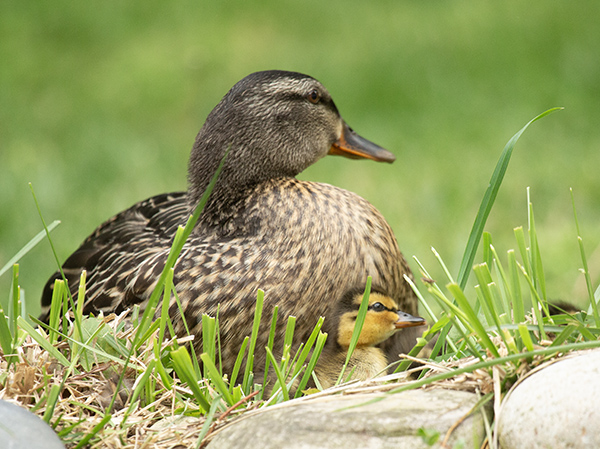
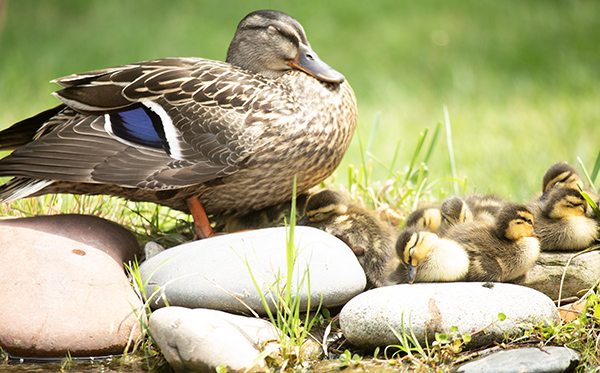
Photograph of a Mallard hen standing beside a small backyard pond. She is standing on one of the large, smooth river stones that border the pond. Her eleven ducklings (they're difficult to count, in this photo) had not yet mastered climbing on the stones. Two ducklings have reached a resting point, but the other nine are jammed together, scrambling for purchase, knocking each other aside, and climbing on top of each other as they struggle for footholds.
Photo from the Mallard archive. In this photo, a Mallard hen waits on the stone border of our dragonfly pond as her days-old ducklings scramble out of the water.

[This post picks up where the last left off. For recaps and links to the rest of the series, please visit my Mallard page.]

Dibs on the Deer

Game legislation, in the pre-revolutionary colonies, started with deer.

With deer in Massachusetts. In 1739.

As wave after wave of European immigrants divvied up the Atlantic coast of North America, the political and social habits of aristocracy proved difficult to shake. Colonists may have envisioned a democratic continental future, in which the people (the invading people, that is) owned the continent’s resources, but pre-revolutionary lawmakers hoarded up resources according to Europe’s aristocratic precedent.

In Massachusetts, in 1739, that meant hoarding up the deer.
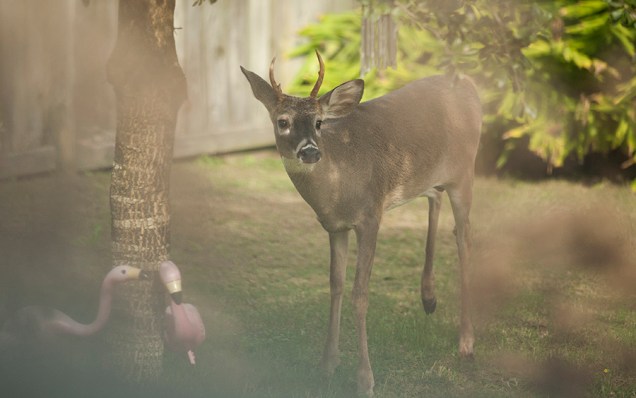
Photograph of a young white-tailed deer standing under a set of wind chimes that were hanging in a small live-oak tree in our privacy-fenced back yard. The deer was photographed through the browning blooms of Joe Pye Weed, which appear as vague clouds and patches obscuring the foreground. The brown-furred deer has long skinny legs with long black hooves. His small antlers are slightly curved, each antler is a single tine approximately 6–8 inches long, and each antler has a single visible bump along the shaft (bumps that would, in an older stag, branch off into secondary tines). He has prominent white markings around his dark nose, and the fur around his eyes and under his chin is paler than the rest of his body. Here, his stance is tense. He has one back foot raised off the ground; his large ears are angled, one forward and one backward, for situational awareness; and his eyes are opened wide. His white sclera, (the "whites of his eyes") are not visible, but the rings of lighter fur around his eyes mimic scleral flashes, making his expression appear anxious. A pair of plastic pink yard flamingos are leaning against the tree's trunk, and, in the background, a dense stand of ginger lilies are beginning to droop as their blooming season comes to a close. The yard is mown short, and the grass is patchy with weeds.
A few years ago, this spike-antlered white-tailed deer trapped himself in our cul-de-sac during rut season. I blogged about him here. Today, nearly three centuries after Massachusetts’s 1739 legislation, white-tailed deer in the US are monitored year-round and harvest limits are fine-tuned, in some states, on a herd-by-herd basis.

The wordily convoluted law quoted as an opening epigraph, above, was filed as “An act in addition to an act entitled, An act for the better preservation and increase of deer within this Province”.1 The new-and-improved 1739 edition aimed to halt the decline of deer populations by reinforcing seasonal hunting restrictions: “Whereas the penalties already provided in and by an act pass’d in the tenth year of the reign of King William the Third…have proved ineffectual to answer the good ends in said Act proposed…” (Massachusetts General Court, 1739, p. 687).

Starting on December 10th of 1739, deer were off the hunting menu. Deer season would reopen on August 1st, 1740, and the schedule would repeat indefinitely. From August 2nd to December 9th, annually, the citizens of Massachusetts could enjoy late autumn/early winter’s open season on deer. But during the rest of the year, deer meat and deer hides were forbidden harvests. Anyone caught with fresh meat or hides (or said to be in possession of such, by any two informants) would be prosecuted.

To enforce this seasonal hunting ban, the revised act required each town to appoint two official informants to monitor and prosecute (persecute?) deer hunters, with expansion of the informant network written into the statute: “…appoint one or two meet persons in every such new plantation wherein ten or more families are settled, to inform against and prosecute the Violaters of this Act” (p. 688).

Should any of the appointed informants decline the position, and/or decline to swear the informant’s oath, anyone could sue them for the sum of £5 (p. 688). (According to an online conversion calculator, that’s a fine roughly equivalent to $1500, in 2026 US dollars.) As the statute does not specify a one-time fine, I envision a line of friends and coworkers demanding payment from some poor soul who slept through the meeting, didn’t know they had been nominated and elected, and couldn’t bring themselves to sign on as an informant.

Oaths aside, informants generated their own wages. Anyone convicted2 of killing the king’s province’s deer owed £10 per deer, divided between the informant and “His Majesty for the Support of this Government” (p. 687). When a convicted hunter couldn’t pay the fine, they faced jail for 30 days or forced labor for two months.

All of this means that Massachusetts’s 1739 deer informants had the statutory power to persecute (prosecute) deer hunters. To drive the colony’s deer hunters first into poverty and then into slavery.

Aside: The Robin Hood Perspective

I grew up on a steady diet of Robin Hood.3 As a fan of the trope, all of this 1739 fuss about the king’s deer resonates.
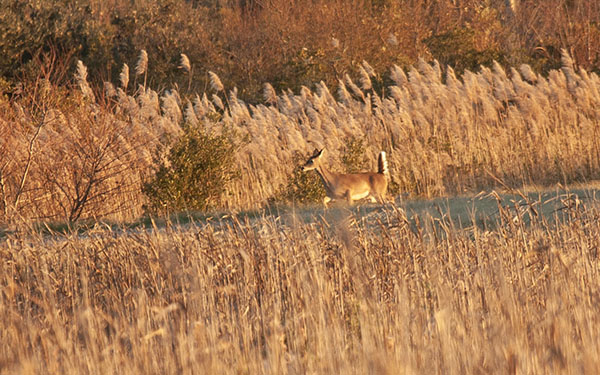
Photograph of a white-tailed deer that has just crossed a well-tended path in Back Bay Wildlife Refuge, in Virginia Beach, VA. The deer's coat is reddish-brown, lightening to pale tan under her abdomen and chin. (I assume she is a doe, as she has no antlers. Such assumptions are not always correct.) Her body language— erect tail, backward focused ears, and quick stride—indicate alertness. The photo's foreground and background are the deep brown and orange tones of winter dormancy, thick with tall grasses (including seagrasses) and winter-bare shrubs.
As a side-effect of spending most of my years in the southeastern US, my memory-file for “deer” is filled with white-tailed deer. So is my memory-montage of all the various Sherwood Forests I visited, in my childhood reading. Actual deer, in Sherwood Forest, are both larger and smaller than North America’s white-tailed deer.

I have lingering nostalgia for Robin McKinley’s reluctant hero in The Outlaws of Sherwood:

There had been outlaws around Nottingham and in Sherwood before, but this sounded like something new—outlaws who believed in king and country, and good English law; who merely rebelled against the heavy hand of tyranny (1988, Chapter Four, para. 15).

And for Peter Beagle’s gruff anti-Marian in The Last Unicorn:

Close by a familiar voice said, ‘Leaving us so early, magician? The men will be sorry they missed you.’ He turned and saw Molly Grue leaning against a tree. Dress and dirty hair tattered alike, bare feet bleeding and beslimed, she gave him a bat’s grin. ‘Surprise,’ she said. ‘It’s Maid Marian.’ (1968, p. 82)

Awash in Robin Hood, I’m pre-disposed to favor pure-hearted bandits living in the woods. To expect corruption among government officials charged with imprisoning and enslaving the pure-hearted bandits. Reverse tropes, in which bandits are greedy and officials pure-hearted, simply don’t resonate. I can’t recall any among my best-loved childhood books.

Robin Hood taught me skepticism for a system in which police generate their own salaries through imposing fines and confiscating property. Especially when the system polices those who have less power, less security, and less food.4

My skepticism will be apparent throughout this installment. It’s likely apparent in everything I write and everything I do.

This is the strength of fairy tales and myths and legends. Here in my middle years, all these many Robin Hoods float on the surface of my memories, jostling and reinforcing each other. Resonating.

As with my previous installment, caveat lector.
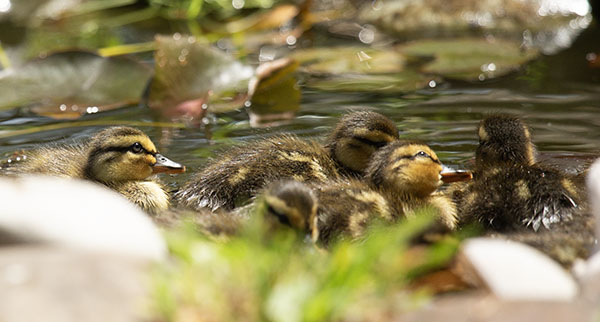
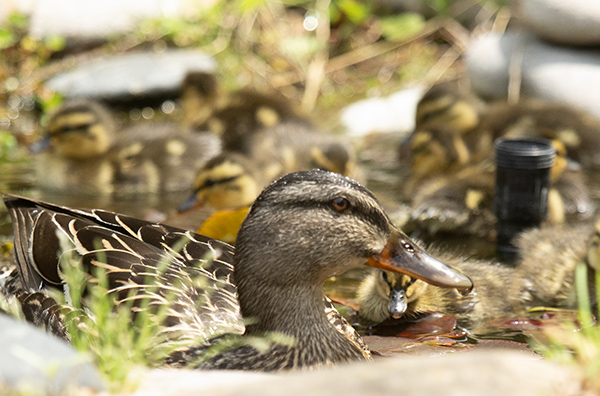
Photograph showing five downy Mallard ducklings swimming in our small dragonfly pond in the spring of 2024. One duckling has its head tipped sideways, one eye turned to the sky in response to an alarm call from its mother (who was standing just to one side, out-of-frame, when this photo was taken).
At what stage do Mallards become aware that humans are their most voracious predators? Looking skyward, for airborne predators, was an early lesson for this particular brood of ducklings. But they trusted me enough to allow these photos.

Policing the Hunt in the 1800s

Skipping ahead to the post-revolutionary colonies, game legislations gained popularity and momentum throughout the 1800s.5 As game legislation ballooned into a regulatory industry, bureaucratic vacuum energy organized into committees, commissions, and agencies. Various departments staked claims in wildlife as a regulated resource: game and fisheries departments, of course, but also agriculture, public lands, education, and commerce.

Wrangling with ways to police and enforce game laws, legislatures were forced to wrangle, also, with funding. So many interests. So much legislation.
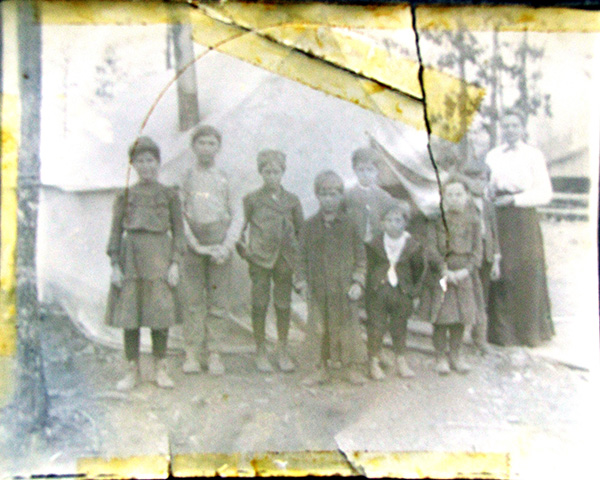
A faded black-and-white photograph of a group of children gathered in an outdoor setting front of what appears to be a tent. A chaperone in a long skirt and pale blouse stands with the children. The eight children are wearing clothes of various functional styles, including knee-length skirts, pants of full-length and knee-length, and shirts with full-length sleeves. Many are wearing coats and all are wearing work-style boots. One child, in the front row, has a more formal-appearing outfit, including a white shirt with dark pants and a dark coat fastened at a single point across the torso. The bare ground and thin evergreen trees (background), with a smudge of what appears to be winter-bare trees in the farthest background, suggests cold weather. The photo is torn in places, with yellow-tinged tape marks across the tears and along the edges.
How do any of us learn about the world, about dangers above and ahead? I’ve imagined a story in which this poorly-preserved photo from the family archive shows a school group in front of a makeshift tent-classroom, and in which these children have been freed from their chores for a few hours. I’ve imagined a background of poverty, or something much like it, for these children and their families. Perhaps I’ve imagined too much? Or too little? The nearest certainties I have are the setting (most likely somewhere between Ohio and Nebraska) and the timeframe (c. 1880—1900).

“In many States it has been found well-nigh impossible to secure legislation providing for the appropriation of money, no matter how little, for the preservation of game. The sentiment to which this condition is due still prevails in a large part of this country, particularly in the South. The creation of new offices, with salaries attached, is regarded with great jealousy and disfavor”6 (Williams, 1907, p. 34).
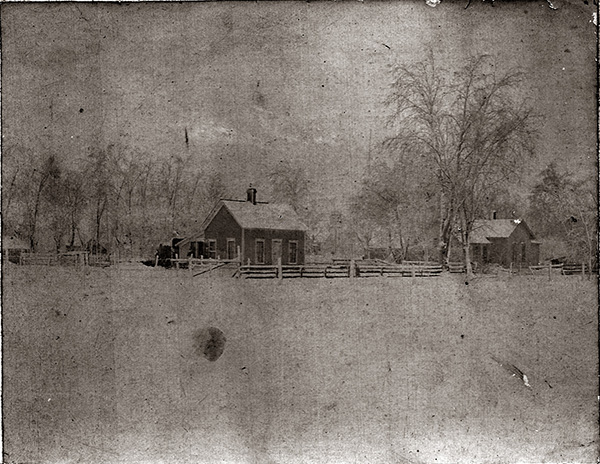
A grainy, blurred, and very faded black-and-white image of a pair of houses in a snowy setting. The houses are situation far back from the camera across a snowy field. They are encircled by a split-rail fence and winter-bare trees with snow-laden branches. The closest house appears to be somewhere between two and four rooms, with a prominent chimney in the center of the steeply peaked roof. The background house looks to have more rooms, with perhaps an addition-style room on one side. With written histories back to the 1860s, we know that the family lived as a multi-generational unit: a Civil War veteran patriarch (volunteer Ohio cavalry), his son and daughter-in-law, and their eventual six children (the youngest of which was my grandmother).
Photo from the family archive. This is one of the ancestral homes, photographed in 1892. The record isn’t clear about this property, whether it was in Ohio, Illinois, Iowa, Nebraska, or some other state less prominent in the family lore. Wherever it was, it looks fairly idyllic for a young husband and wife starting a family. Even so, it didn’t last long. By 1901, they were settled in Limestone County, Alabama, where they would live out the rest of their years.

Non-random examples: Incentivizing informants on both coasts

In funding game police, early statutes in California and Virginia resorted to borrowing (unknowingly?) from Massachusetts’s 1739 system. They legislated kickbacks for informants.7

In 1841, Virginia paid informants a half-share of fines collected from non-residents caught hunting waterfowl below the head of the tidewater (General Assembly of Virginia, 1841, pp. 88–89). As each fine was $100, informers could expect a payout of $50 per prosecution—a purchasing power of somewhere around $2000 in today’s (2026) economy.
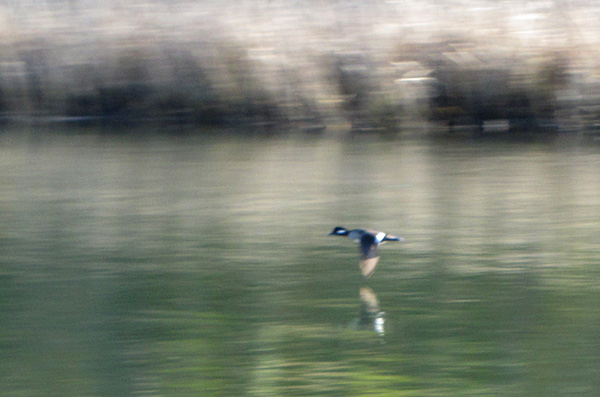
Motion-blurred photograph of a small Bufflehead duck flying along a narrow channel of water. The duck is captured mid-flap, wing tips nearly touching the water. The water is murky green, mid-channel, and reflects winter-pale stands of grasses along the edge.
Virginia’s rich waterways, particularly below the tidewater (technically, the farthest extent of waters that change height and/or volume as the tide moves in and out), are havens for waterfowl.

About a decade later, in 1852, California informants were eligible for half-shares of fines. California fines were lower ($50) but were not limited to prosecuting non-residents (California Legislature, 1852, p. 134). The 1852 statute protected quail, mallards, and wood ducks and shut down the game markets for these birds during closed seasons. This statute put market hunters and market peddlers under extra surveillance. Informants didn’t need to slog out into the wild, to catch hunters in the act of shooting or collecting birds. They could simply stay in town and wait for sellers to open shop.

Who could resist the lure of an informant payday equivalent to $1000 or $2000, in today’s money?

My faith in humanity feels that almost everyone would resist such a lure, if their starving neighbors resorted to shooting mallards. My skepticism argues otherwise.
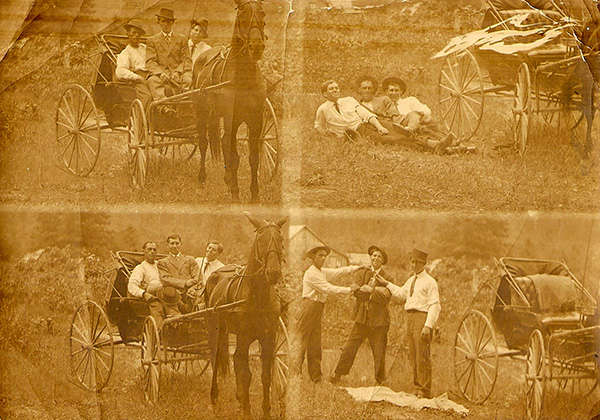
Sepia-toned photo series from the family archive, probably dating to the late 1910s or early 1920s. The photographer cleverly overlapped four images onto a single print. Each of the four images shows three men posing with a horse-drawn buggy. In two images, the men are seated in the buggy. In one image, the men are lounging in a row beside the buggy and one man has thrown his leg across the legs of the other two. In the final image, the men are standing together, two holding and pointing to the man in the middle, as if accosting him, and all three are laughing. In each image, one man is wearing a full suit of some middle-tone color, including a tie, vest, and jacket, over a white shirt; one man is wearing mid-toned pants, a white shirt, and suspenders; and the third man is wearing mid-toned pants, a white shirt, and a tie. The buggy has four delicate-looking long-spoked wheels, tufted upholstery, and a folded-back convertible cover. The horse is tall and rangy and is standing still in its harness and bridle. (The bridle looks tight, to me, and the horse's elevated head posture suggests the presence of a tight check rein.)
The leisure apparent in this quadruple-exposure image from the family archive (c. 1920?), along with the camaraderie, puts me in a familiar double-bind. I’m grateful that the image exists, and I’m aware of the flawed power distributions (past and present) that went into its creation and preservation. Would these men have chosen to profit from informing on their neighbors? Or would they have fed their neighbors? Whatever choices they made, over the courses of their lives, I expect they justified those choices from the various rhetorics of their various times. It’s the entire ongoing problem, over and over again.

Aside: About those debtors’ prisons

“The only punishment authorized under many of the older game statutes was a fine, and if the defendant was impecunious he escaped punishment altogether. A very considerable portion of offenders against the game laws are of this class, and experience has demonstrated that to secure obedience the alternative corrective, imprisonment, must be allowed; otherwise many violations go unpunished” (Williams, 1907, p. 74).

That quotation comes from a 1907 bulletin written by a member of the US Department of Agriculture’s Biologic Survey. My current self sees the cruelty in this logic—the cruelty and wickedness of debtors’ prisons. But as a young adult, despite all my Robin Hood reading and my own family’s orbital decay, I lacked such perspective. Young-adult-me would have nodded her agreement on the question of punishment.

On matters of the carrot vs. the stick, I had been raised by the stick and believed in the effectiveness of sticks. I had no personal experience with carrots.
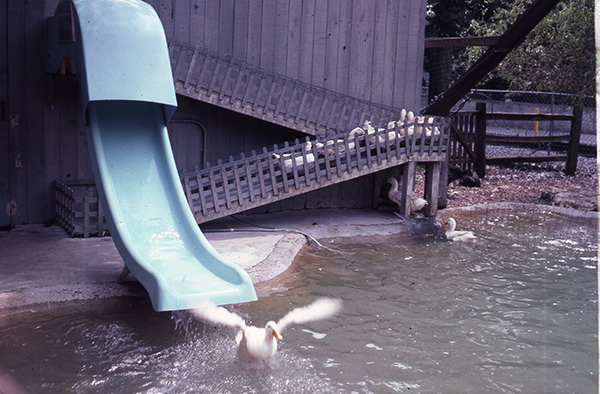
Scanned image of a color slide from the family archive. Shown here, a group of domestic white ducks are climbing a fenced wooden switch-back ramp up the side of a wooden building. The ramp leads to a blue plastic slide that drops into a pond. One duck has just come off the slide, wings extended, and is splashing into the pond.
The ducks-on-a-slide show at Opryland was one of my favorite spectacles, during our annual summertime pilgrimages. While I want to claim that the ducks didn’t mind the slide, the hesitant traffic on the ramp argues otherwise.

Which cycles back, again, to resonances. In all of this reading through legislative and legal literatures from the late 1800s and early 1900s, I keep finding echoes of my own youthful voice. Perhaps such resonance is part of my perseveration.

Perhaps I keep reading because the resonance keeps ringing, calling me deeper and further into this particular branch of the Mallard Mine.

Perhaps I’m hoping that the metaphor will hold up. That the legislative and legal literatures of the US will grow to understand, as I have, the wisdom of carrots and the anxious futility of sticks. Perhaps I’m hoping that US policy will mature into a reality in which feeding hungry Mallard hunters is more productive than jailing them. In which feeding hungry families is preferable, on every level, to fining them, confiscating their belongings, and selling off their property for the enrichment of government-appointed police.

Which brings me to Maryland’s Board of Special Police, legislated into existence in 1880 for the express purpose of protecting waterfowl.

The Ducking Police

“The said Board of Special Police and its deputies shall have power to arrest, with or without warrant, upon their own view, or upon credible information, all persons violating any provisions of said original act, or any of its supplements, and to carry such person or persons before any justice of the peace…”. (Maryland General Assembly, 1880, p. 159)

The said Board of Special Police, later dubbed the Ducking Police, protected waterfowl on the Susquehanna Flats and on the waters of the Chesapeake Bay north of the Turkey Point lighthouse. (North, also, of a vaguely defined point 1/2 mile north of Spesutia Island.)

Maryland placed a notable statutory check on members of the Ducking Police—each appointee was required to register a bond with the clerk of their respective Circuit Court. The Ducking Police swore to be faithful to their duties, under threat of a $1000 penalty. (This penalty would run somewhere in the range of $30,000 worth of purchasing power, in today’s economy.) The statute required appointees to provide proof, to the clerks of their Court, that they could pay such a penalty (Maryland General Assembly, 1880, p. 160). Written as a rein on corruption, the most immediate effect of this requirement was to limit the recruitment pool to hunters wealthy enough, already, to post such a bond.

In payment for their faithful service, members of the Ducking Police shared an end-of-the-year jackpot made up of license fees collected from residents registering to hunt in Cecil and Harford counties, including boat licensing fees, and of fines collected from prosecutions.
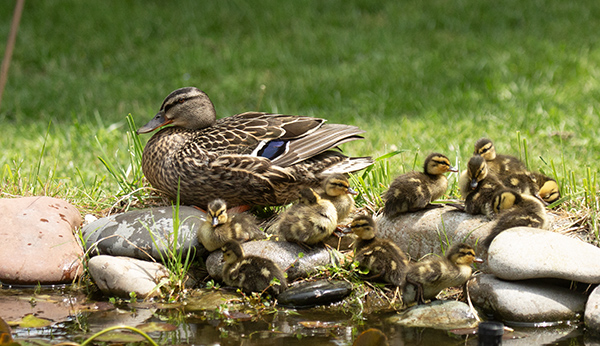
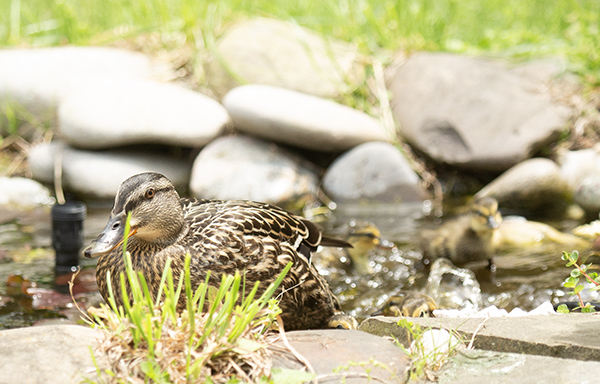
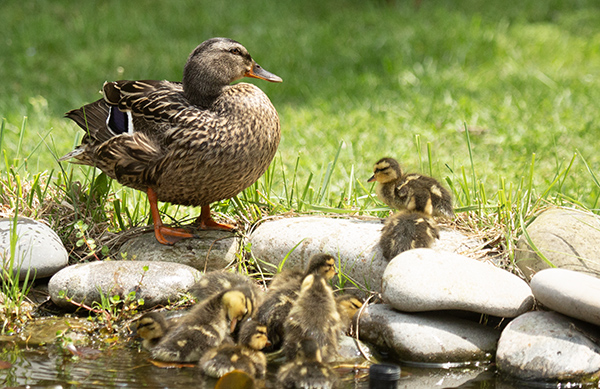
Photo from the Mallard archive, 2025. Shown here, a female Mallard perches on the stone border of our small backyard dragonfly pond. Her eleven ducklings have climbed out of the water behind her. Most of the ducklings are searching for a resting spot on the rocks, while some have already settled in and are grooming their down in preparation for an after-swim nap.
What are the chances that Mallards were a species of emphasis, for the Ducking Police? Logic argues they must have been, given their prominence in North American waterfowl hunting, but numerous other species were and are common on the Susquehanna flats.

In 1880, the fledgling Ducking Police had a single assignment: arrest anyone caught with ducks in their possession during the close season (April 1–October 31). Being caught with a duck during close season was “prima facie” evidence of a violation (Maryland General Assembly, 1880, p. 160). Courts were given wide discretion regarding fines, which could range anywhere between $5 and $100, and the collected fines went straight into the Ducking Police jackpot.

What are the chances that this system was immune to corruption?

The jackpot grew sweeter over time. By 1888, fines of $50–100 could be imposed for hunting at night, hunting during close season (April 1–October 31), shooting from a boat within 1/4 mile of shore, using a “big gun” (one that couldn’t be fired from the shoulder), or hunting from an unlicensed sneak boat or sink box (these $50–100 fines for unlicensed watercraft functioned as instant kickbacks, and collected fines were immediately distributed: 1/2 to the arresting officer and 1/2 to the attesting informers) (Maryland General Assembly, 1888, pp. 1382–1384).

Even bigger bonuses came with catching harvest thieves, who were subject to confiscation of their hunting equipment. Pick up some other hunter’s bird, lose your boat and guns and ammo to the Ducking Police. All proceeds from the sale of confiscated equipment went to the arresting officer. (Maryland General Assembly, 1888, pp. 1382–1384)

By 1916, fines had grown to $100–500, and new revenue streams came from regulations around engine exhausts and noise. Confiscations increased, as well, with property seizure rolled into almost every arrest. Proceeds from sales of confiscated equipment were divided between the informers and the arresting officers, though 1/2 of the proceeds from a small subset of these sales went into the county school funds. (Maryland General Assembly, 1916, pp. 1525–1536)
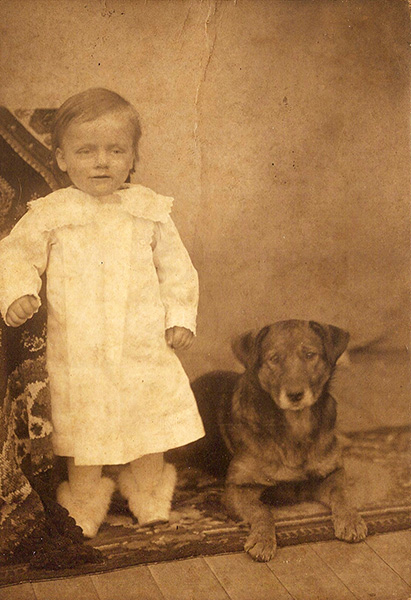
Sepia-toned photograph of a toddler in a delicately stitched white dress, standing next to an alert, mid-sized dog. The toddler's short hair is combed to one side, and their white-stockinged feet are clad in very fluffy white-furred shoes. A thick-woven rug or tapestry is draped over a support, which the toddler is leaning against, and runs across the floor. The dog is lying down, head up and looking at the camera. The dog has button ears and short-ish legs, a thick medium-length coat, and enough gray around the muzzle to suggest aging. I would guess the dog's lineage to be a terrier-type mixed with a herding-type.
One of the few children in the family archive with a name: Steele Hamilton. I don’t know how or why this child, with such furry shoes and such an appealing dog, landed in the family archive. I hope those shoes and that good dog indicate a happy childhood and well-funded schools.

Maryland’s 1916 legislations coincided with an era of federal takeover, as far as migratory waterfowl were concerned. While this federal intervention may have had little or no bearing on changes within the Board of Ducking Police, there’s notable timeline overlap. By 1920, the federal takeover was all-but complete, and by 1927 the Ducking Police jackpot had dwindled to a fixed stipend of $400 per hunting season (Maryland General Assembly, 1927, p. 612).

Finally, in 1941, Maryland dissolved the Board of Ducking Police (Maryland General Assembly, 1941, p. 326).

No more game informants

I can’t pinpoint an accurate timeframe for the end of regulatory informant-policing of game. Nonetheless, the practice did end. At least, statutorily.

But the eventual demise of informant-policing (of game) in the US is a mixed-bag sort of win:

“It was never a success in this country, most men preferring to see the laws violated rather than appear as prosecuting witnesses against their fellow-citizens. Aside from sentiment, such a course was often hazardous to the property and even the life of an informer” (Williams, 1907, p. 75).

So informing was both ethically objectionable and potentially hazardous.

I wanted to spend at least one paragraph unpacking my thoughts, here, but each attempt circled and contradicted and wheezed off into a muddy muddle. Which is a fairly accurate depiction of my self-growth process. I circle and contradict and wheeze around in the mud for unpredictable periods of time, searching for clarity. Sometimes I write poems in the mud. (Poetry is a blurry lens, anyway.) Given the depth of the mud, in this particular pond, I’ll be here a while.

Dabbling.
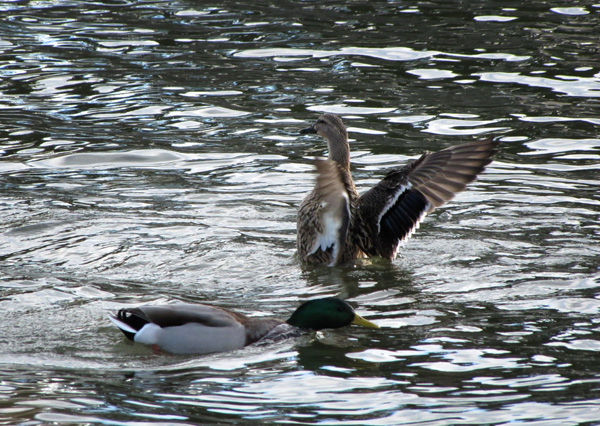
Photograph of a pair of Mallards on a wind-rumpled pond. The female Mallard is almost fully upright in the water, stretching her wings, while the male Mallard is partly submerged, captured as he surfaced from a down-turned bit of dabbling.
Mallards are dabblers, not divers. They muddle about in shallow waters, foraging in sediments without ever committing to a fully submerged dive for food. The distinction is literal, among ducks, and conveniently metaphorical for poets and writers.

In the meantime, I’ll circle back to the 1880s. Where court cases document the final years of the meat-and-feathers markets.

Driving the markets underground: One toe over the (commerce) line

The subtext of game legislations, in the mid- and late-1800s, was the ongoing power struggle between market hunters and sport hunters. (See the previous post, Part VI, for an overview of the market vs. sport dynamic.) From the start, sport hunters held a decisive advantage—access to legislative power.
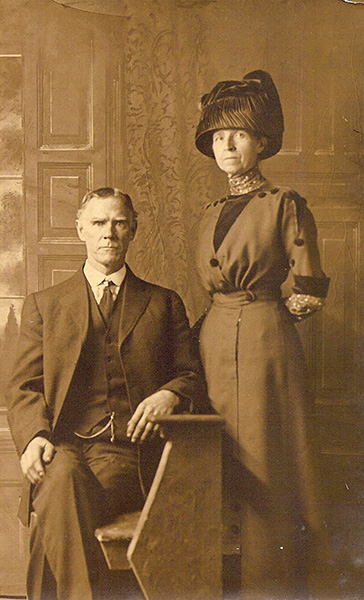
Sepia-toned studio photograph of a man and woman, photographed in Nashville, TN, probably during the decades around 1900. The man is seated on something resembling a church pew, and the woman is standing behind him. Both have stern, unsmiling expressions. Both appear to be middle-aged: the man's thick eyebrows are fading to gray and the woman's face is slightly lined. The man is wearing a dark suit over a white shirt, with a prominently visible pocket watch chain. The woman is wearing a mid-toned full-length dress with velvet-appearing cuffs and buttons. She has a shiny neckpiece that covers her entire neck, chin to collar, as well as a tall, heavy-seeming hat that matches the velvet-type trim on her dress. The belt of her dress is cinched tight, suggesting a corset underneath. The  background/backdrop is a mixture of wood with carved, inset panels and a woven tapestry-type curtain.
This stern duo, photographed in Nashville, TN, live in an ambiguous place in the family archive. I don’t know who they are, or how they were connected to my ancestors, or even the exact branch of ancestry. All I know is that they look intimidating. I expect they had access to the levers of power.

Often men of wealth and leisure, sport hunters in and around state legislatures lobbied for game regulations that hindered market hunters. Folding their arguments into early frameworks for wildlife conservation, sport hunters pointed to rapid species declines that were evident across the North American continent.

Rapid declines in game species affected market hunters, too, forcing them farther and farther afield to practice their profession. Farther, in this case, meant across state lines. Which meant interstate commerce. Which proved to be the decisive legislative lever.

These quail aren’t in Kansas anymore: Chicago, 1880

On January 14, 1880, a Chicago merchant named James Magner purchased a box of quail (144 birds) from a seller on South Water Street. Magner ran a game market at 76 Adams Street and had at least two more boxes of quail already in stock, including birds imported from Kansas in December and purchased direct (in Leavenworth, Kansas) on January 10th.

On January 15th, Magner sold at least one unopened box (144 birds) and somewhere between 60 and 100 birds out of his opened-box stock. (I had trouble following the totals, because math, but the totals weren’t the crime. The date was the crime.)

After a court in Cook County convicted Magner of close-season quail possession, he appealed to the circuit court. And, after the circuit court upheld the conviction, Magner appealed to the Illinois State Supreme Court, which is where the record is most visible today: James Magner v. The People of the State of Illinois. Filed at Ottawa February 3, 1881.

Illinois’s updated game statutes (1879) set a January 1–October 1 close season for quail and grouse. Close season for hunting; close season for buying and selling. In other words, in 1879, Illinois shut down quail markets—from January to October, no one could buy or sell quail in Illinois. No one could have quail in their possession.

Magner and other game merchants would have felt the financial sting, set to lose about $200,000 per year if the game market closed altogether (p. 326). (Keeping up my habit of translating these numbers into today’s money, that’s more than $6 million ($6M) in 2026 purchasing power.)

Magner’s state-level appeal, destined for failure, rested on two arguments:

  1. “It seems absurd to hold that the inhibition against the purchase and sale of game imported from the State of New York or Kansas is a protection to the game of this State” (Magner v. The People, 1881, p. 326), and
  2. the act “…is in violation of that provision of the constitution of the United States which confers upon Congress the power to regulate commerce among the several States” (Magner v. The People, 1881, p. 327).

In ruling for the State, the court countered Magner’s first argument with prevention logic: “…we think it obvious that the prohibition of all possession and sales of such wild fowls or birds during the prohibited seasons would tend to their protection, in excluding the opportunity for the evasion of such law by clandestinely taking them, when secretly killed or captured here, beyond the State and afterwards bringing them into the State for sale, or by other subterfuges and evasions” (Magner v. The People, 1881, p. 331).

The court’s counter for Magner’s interstate commerce argument followed a complex legal thread anchored in England. The thread starts with a reference to Sir William Blackstone’s Commentaries on the Laws of England and winds through precedents in Massachusetts, Indiana, New York, and Vermont, to establish a foundation of State ownership of game (pp. 333–334):

“Stated in other language, to hunt and kill game, is a boon or privilege granted, either expressly or impliedly, by the sovereign authority—not a right inhering in each individual; and, consequently, nothing is taken away from the individual when he is denied the privilege, at stated seasons, of hunting and killing game. It is, perhaps, accurate to say that the ownership of the sovereign authority is in trust for all the people of the State, and hence, by implication, it is the duty of the legislature to enact such laws as will best preserve the subject of the trust and secure its beneficial use, in the future, to the people of the State. But in any view, the question of individual enjoyment is one of public policy, and not of private right” (p. 334).

From there the court’s thready argument knots tight on Welton v. State of Missouri, an 1876 U.S. Supreme Court case about license taxes for vendors in Missouri, which noted, “The fact that Congress has not seen fit to prescribe any specific rules to govern inter-State commerce does not affect the question. Its inaction on this subject, when considered with reference to its legislation with respect to foreign commerce, is equivalent to a declaration that inter-State commerce shall be free and untrammelled” (p. 282). In other words, the federal government might have constitutional authority over interstate commerce, but, since Congress had never acted on that authority, the default status of non-regulated interstate commerce applied.

The thread spools on, turning new knots at case law involving steamboats, fuel mixtures, and suppression of liquor markets. Hitched, at last, to this handful of unstable rulings, the opinion in Magner v. The People states, “There can not be a constitutional right to transport property which can not legally be brought into existence” (p. 336).

Mic drop? No such thing, in legal literature…

The smoldering net (these quail were most likely netted, so there aren’t any smoking guns) was stashed in Kansas law. Magner’s quail weren’t legally harvested, in the first place. As products of illegal hunting, they never fit the definition of “commerce”. They were illegal goods in Kansas, shipped and transported illegally into Illinois.

After citing all that case law, the entire thread of logic was irrelevant. None of the stickier arguments around commerce even applied, because the birds weren’t commerce.

What they actually were, if they weren’t commerce, isn’t specified. This becomes important in later case law, though, for the case at hand, the important point was settled. The quail weren’t commerce, the interstate commerce clause wasn’t relevant, and Magner needed to pay his fines.

Chicago’s game markets had been put on notice. So had all of the other game markets, in all of the other states.
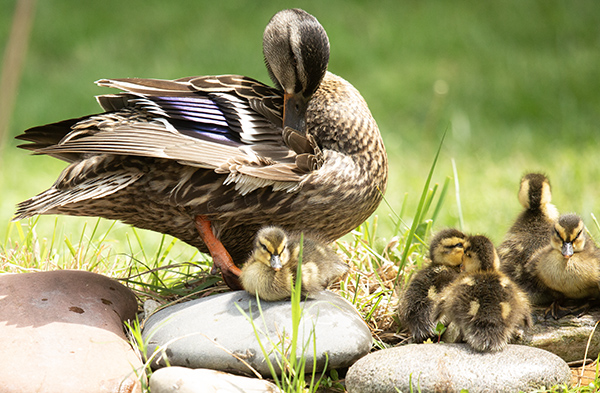
Photograph from spring, 2025, of a female Mallard with her brood of days-old ducklings. Here, the female is standing on the stone border of our dragonfly pond, preening her feathers. Five of her ducklings are visible in this photo, four gathered on the stones in front of her, getting ready to sleep, and one hunkered close to her, also ready to sleep.
These Mallards, photographed in 2025, know nothing of game hunters and game markets. Even so, that doesn’t equate to safety. The hours they spent in our little dragonfly pond were likely the safest hours of their lives.

To be continued…

The next post (or two or three) will get deeper into the final era of game markets, complete with game smugglers. Also, federal interventions and the beginnings of the North American model of wildlife conservation.


Notes

1. In quoting this act, I edited for readability. If you follow the link to the online copy of the text, you’ll find an elaborate collage of fonts and special characters. I tried, initially, a more faithful reproduction, but it made my eyes ache. Here’s an example:

WHEREAS the Penalties already provided in and by an Act paſs’d in the Tenth Year of the Reign of King WILLIAM the Third, entitled, An Act for the better Preſervation and Increaſe of Deer within this Proviǹce, have proved ineffectual to anſwer the good Ends in ſaid Act propoſed…”.

My eyes, not to mention my OCD brain, doth protest.

Mostly italics, salted with capitals, peppered with the archaic long s (that’s the one that looks like an f: “ſ”), and spiced with an un-reproducible (with my limited tech skills) c–t ligature—it’s just too much.

Even so, I felt a twinge of regret, reducing the recipe to blog blandness. And a tiny urge to write a time-travel story about an 18th century typesetter who finds fame, in 2025, as a font programmer. Because my OCD, which was part of my reason for editing in the first place, is still fuming that I couldn’t find a way to include that dratted c–t ligature in this footnote. (Click here to return to your regularly scheduled paragraph.)

2. Acceptable proof of guilt included being caught with deer, with meat from deer, or with fresh hides. For offenders who off-loaded carcasses and hides before getting caught, testimony from two credible witnesses regarding two separate events within the last two months would suffice. All of these pairings, in this statute, make my OCD itch—two informants per town or settlement, two witnesses testifying to two infractions over a two month period…it’s at least two twos too many. (Click here to return to your regularly scheduled paragraph.)

3. Robin Hood tropes breach the barriers between history and fiction. Between the reference section and the fantasy shelves. That’s part of why I indulge in this kind of aside. When these entities come into conversation with each other, the result is often chaos. But sometimes, every so often, radiant patterns emerge. A signal in the blog noise that makes writing and reading blogs worthwhile. (Click here to return to your regularly scheduled paragraph.)

4. My personal definition of power, of privilege, is the ability to live in predictably benign surroundings. To wake, most mornings, expecting another ordinary day. Another ordinary meal. Another set of ordinary tasks. Living in predictably benign surroundings equates to impact resistance. To rotational inertia. To a daily expectation that the world will spin on, benignly. Even under stress conditions, the world spins on. Benignly. The force required to perturb the system into non-benign behavior is roughly proportional to the power and privilege at hand. (Click here to return to your regularly scheduled paragraph.)

5. My excavations in the various state literatures reveal a tempting timeline pattern. During this period of time, game legislations spread in rates reminiscent of epidemiology. Almost as if certain pieces of legislation, such as outlawing punt guns or requiring non-resident hunters to pay for licenses, were a kind of contagion. This epidemic characteristic of legislations in the unsettled era of pre- and post-civil war times has likely been noted and thoroughly explored by scholars of law. (?) Or maybe my education gave me an epidemiology hammer, so every nuance I observe takes the shape of a nail. (Click here to return to your regularly scheduled paragraph.)

6. I want to acknowledge a glaring omission in my Mallard timeline—the entirety of the US Civil War. The Mallard story passes through the Civil War, of course, but I am not the right person to tell that part of history. I am not equipped to avoid all of the pitfalls and wrong turns in the Confederate branches of the Mallard mine. To be a reliable narrator surrounded by unreliable texts. Instead, I’m taking a coward’s deliberate leap over those years. Even so, lingering divisions between northern and southern states rise up throughout the legislative literatures of post-Civil War years. Such as in the excerpt that prompted this footnote. I’m including some of the indicators of ongoing division, in this series, in case some better-suited writer should wish to pick up those threads and go where I dared not. (Click here to return to your regularly scheduled paragraph.)

7. My aversion to such incentives was not shared by the US Department of Agriculture’s Biological Survey. At least, not in 1907. Thus the following: “In 1858 the example of Maine was followed in New Hampshire by the passage of a law authorizing the selectmen or municipal authorities to appoint fish wardens. The compensation of these officers consisted of one-half of the fines resulting from prosecutions instituted by them, an incentive to vigilance still employed in many states” (Williams, p. 12).

That said, the writer later criticized states that paid officers’ solely through incentives: “The meager compensation resulting from the percentage of fines secured sometimes allowed deputy wardens is hardly sufficient to enlist the services of active men…” (Williams, p. 26).

And even later: “In the early history of the movement for game protection the only provision considered feasible for payment of officers charged with the duty of enforcing game laws was an allowance of whole or part of the fines. A system maintained on such an unsatisfactory and unstable basis, however, accomplished almost nothing, and the advocates of better protection set about to devise a more satisfactory means” (Williams, p. 24). (Click here to return to your regularly scheduled paragraph.)

Bonus Earworm: If you are of a certain generation, you already have a song stuck in your head after reading the final section of this post. If you are younger and haven’t encountered this particular earworm, here’s the YouTube link for Brewer & Shipley’s “One Toke Over the Line”.


References

Beagle, P. S. (1968). The last unicorn. Ballantine Books, Inc.

California Legislature (1852). The Statutes of California, passed at the third session of the Legislature, begun on the fifth day of January, 1852, and ended on the fourth day of May, 1852, at the cities of Vallejo and Sacramento. G. K. Fitch & Co., and V. E. Geiger & Co., State Printers. https://babel.hathitrust.org/cgi/pt?id=uc1.b4159816&seq=143&q1=mallard

General Assembly of Virginia (1841). Acts of the General Assembly of Virginia passed at the session commencing 1st December 1840, and ending 22d March 1841, in the sixty-fifth year of the Commonwealth. Samuel Shepherd, Printer to the Commonwealth. https://babel.hathitrust.org/cgi/pt?id=osu.32437123258960&seq=92&q1=fowl

Magner v. The People, 97 Ill. 320 (1881). https://www.courtlistener.com/opinion/7057357/magner-v-people/pdf/

Maryland General Assembly (1880). Laws of the state of Maryland made and passed at a session of the General Assembly begun and held at the city of Annapolis on the seventh day of January, 1880, and ended on the sixth day of April, 1880. Wm. T. Inglehart & Co., State Printers. https://msa.maryland.gov/megafile/msa/speccol/sc2900/sc2908/000001/000395/html/am395–1.html

Maryland General Assembly (1888). The Maryland Code, Public and local laws: Volume 1. King Bros., Printers and Publishers. https://msa.maryland.gov/megafile/msa/speccol/sc2900/sc2908/000001/000390/html/am390p–1.html

Maryland General Assembly (1916). Laws of the state of Maryland made and passed at the session of the General Assembly made and held at the city of Annapolis of the fifth day of January, 1916, and ended on the third day of April, 1916. King Bros., State Printers. https://msa.maryland.gov/megafile/msa/speccol/sc2900/sc2908/000001/000534/html/am534–1.html

Maryland General Assembly (1927). Laws of the state of Maryland made and passed at the session of the General Assembly made and held at the city of Annapolis on the fifth day of January and ending on the fourth day of April, 1927. King Bros., Inc., State Printers https://msa.maryland.gov/megafile/msa/speccol/sc2900/sc2908/000001/000569/html/am569–1.html

Maryland General Assembly (1941). Laws of the state of Maryland made and passed at the session of the General Assembly begun and held at the city of Annapolis on the first day of January, 1941, and ending on the thirty-first day of March, 1941. King Bros., Inc., State Printers https://msa.maryland.gov/megafile/msa/speccol/sc2900/sc2908/000001/000582/html/am582–1.html

Massachusetts General Court (1739). Acts and laws passed by the Great and General Court of Assembly of His Majesty’s province of the Massachussetts-Bay in New-England, begun and held at Boston, upon Wednesday the thirtieth day of May, 1739. John Draper, Printer to His Excellency the Governour and Council. https://archive.org/details/bim_eighteenth-century_acts-and-laws-passed-by-_massachusetts_1739_0/page/n1/mode/2up?q=deer

McKinley, R. (1988). The outlaws of Sherwood. [Kindle version]. Open Road Integrated Media. https://www.amazon.com/Outlaws-Sherwood-Robin-McKinley-ebook/dp/B00OGWASB4/ref=tmm_kin_swatch_0

Welton v. The State of Missouri, 91 U.S. 275 (1876). https://www.govinfo.gov/content/pkg/USREPORTS-91/pdf/USREPORTS-91-275.pdf

Williams, R. W. (1907). Game commissioners and wardens: Their appointment, powers, and duties. Government Printing Office. https://babel.hathitrust.org/cgi/pt?id=ufl1.ark:/13960/t43r22q5t&seq=15
Focusing on Mallards Part V: Hunting by the Numbers

Content Warning: This multi-part blog post contains references to hunting, agriculture, and research practices of killing birds. This installment contains a photograph of a duck hunter with his kills—a pair of dead Mallards. If you choose not to read on, I respect and admire your choice.

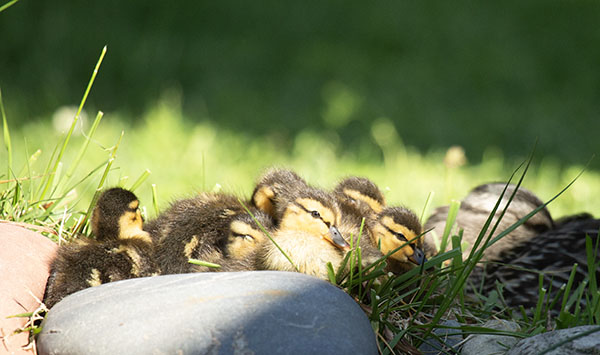
Photograph of a brood of Mallard ducklings huddled for a nap in the sunshine. The downy ducklings are yellow and brown with prominent eye stripes. Their mother is sleeping behind them, beak tucked under her wing feathers. Her feathers are shades of tan and gray, and she also has a prominent eye stripe. All are gathered on the stone border surrounding our dragonfly pond.
Photograph of a huddle of Mallard ducklings resting in the sunshine on the stone border of our dragonfly pond. Their mother is just behind them (right of frame).

Like most of my blog journeys, this long perseveration on Mallards started with questions about a visitor in the yard: What happens to a Mallard hen’s flight muscles while she is nesting? If she spends a flightless month on the nest, then two more flightless months escorting her flightless ducklings, how does she keep her muscles in flying condition?

A Mallard hen stretches her wings after a splashy bath in a small backyard dragonfly pond. She is standing tall in the water, facing the camera, wings extended behind her. Her feathers are mostly speckled and striped shades of brown with bright white coloration on the underside of her wing feathers. A round, floating solar-powered fountain is spending up a small spray of water (left). An array of water plants are growing in the pond, including water lilies. Tall irises and grasses grow around the pond's river-stone border, filling the background with greenery.
Photo of the Mallard hen who inspired this blog series. In this photo, she is standing tall in the dragonfly pond, facing the camera as she flaps vigorously after a splashy bath.

A prolonged literature search produced partial answers. And raised more questions.

In the end, a research paper out of North Dakota (Krapu, 1981) confirmed that wild Mallard hens lose significant body weight during nesting, including most of their fat reserves. But the researchers did not measure or comment on flight muscles.

Beyond that 1981 anchor point, my flight muscle question lies abandoned, waiting for another researcher or reader to pick it up. Until then, I’m content with Part III‘s conclusion: Only the Mallards know.

Photo of a Mallard hen standing in a shallow spot in the dragonfly pond. Her brood of ducklings are gathered beside her. The hen's feathers are shiny and sleek, speckled brown and tan. The ducklings are downy with brown and yellow markings. Both hen and ducklings have the prominent dark eye stripe common to Mallards. In the background, large smooth river stones are stacked loosely around the pond's border. A pair of conch shells are visible, incorporated into the border.
Photo of a different Mallard hen, one who visited in the spring of this year (2025), resting in the dragonfly pond with her ducklings. She was wary of me and my camera and taught her ducklings to be wary as well. This is how wild Mallard ducklings learn to be wild Mallards. Usually. Later in this series I will introduce some exceptions.

Caught in tangles of tangents

I can’t resist tangents. They are how my world expands. And how my mind works, OCD and all. So here I am, more than a year later, still exploring this labyrinthine idea web of Mallards and Mallard literature.

But this particular perseveration, my Mallard fixation, runs deeper than most of my blog ideas. In fact, it runs straight into a mire of social and psychological issues that I am poorly equipped to navigate. So here I remain. Grappling for words and wisdom in the Mallard archives. Because much of what motivates me to care about this world, much of what motivates me to read and write, is also in the Mallard archives.

Sharp black-and-white image scanned from a slide. The image dates to the 1970s, and shows me as a pre-adolescent. I am squatting behind a smallish round wire cage, which has a leather carrying strap. I am holding onto the wires of the cage and peering into the distance. My body language and facial expression suggest that I am misbehaving and trying not to get caught. Inside the cage, a speckled white and gray duck is panting or vocalizing, beak open. The duck is too large for the cramped cage.
Photograph of me in some awkward childhood era, caught coveting a duck at some fair or other event. I was attempting to stay small and inconspicuous behind the big fancy duck, so that Mother wouldn’t catch me coveting.

In all of the decades between the anxious moment captured, above, and my present seat at the blog table, I’ve lived in the tensions between mine and not-mine. Between the coop and the wetlands. Between the self-protective urge to stay small and inconspicuous and the inescapable longing for expansive connections.

I expect most readers live in the same tensions. It’s part of being human. It is, perhaps, part of being Mallard, as well.

Photo of five Mallard ducklings climbing onto the border of the dragonfly pond while their mother watches from the water. Four of the ducklings are immediately visible, center frame, but the fifth is partially hidden behind a clump of short grass. The ducklings are downy with yellow and brown markings. One has tiny water droplets clinging to its head and neck.
Photo of five ducklings climbing out of the dragonfly pond while their mother keeps watch from her position in the water. The fifth duckling is small and inconspicuous, hidden behind a tuft of grass on the right.

Out of my comfort zone

These Mallard posts have turned into foundation work for a policy argument.

(Spoiler alert: I am not crafting an argument against hunting.)

Policy arguments are not my norm and most definitely are not my creative strength. But I’m wading in.

I’m wading in without a map or floatation device, hoping for the kind of synergy that sometimes makes words more wise than their author. Hoping for fewer small and inconspicuous silences.

Photo of a Mallard duckling peering over the stone border of the dragonfly pond. This photo was taken at ground level, so the duckling's head is only partially visible over the stones, concentrating focus on the duckling's eye. A second duckling's rounded back, fluffy with down, appears to the far right of the frame.
Photo of a duckling peeking over the border of the dragonfly pond. The duckling has downy markings of yellow and brown and has the exaggerated forehead and eye proportions of infant cuteness.

I grew up around poultry, both wild and domestic. I also grew up around guns and hunting. Through all my many long years, I have accepted, unquestioning, most of the arguments in favor of hunting as both a sport and a science-backed approach to wildlife management and conservation.

I still accept some of these arguments. But I’m developing deep resistance to others. Resistance based on all of this reading about the history and practices of Mallard hunting and conservation.

(Let me repeat that spoiler: I am not crafting an argument against hunting.)

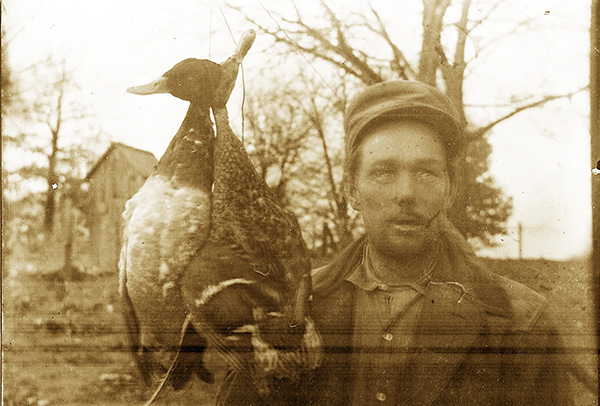
Blurry sepia-toned photo of a man standing beside two dead Mallards, which are hanging from a string or wire so that they are at head-height. The man is wearing a brimmed hat, a buttoned-up shirt with a rumpled collar, and a padded coat that appears to be made of canvas or similar material. The Mallards are male and female, judging by their plumage, and one of the female's wings hangs in way that suggests the wing was broken when she was shot. The outdoor scene shows trees that have lost their leaves for winter and a very small wooden outbuilding with a tin roof. The outbuilding looks to me like an outhouse or smoke shed.
Photo of an unknown man posing with two dead Mallards. One of the Mallards is in male plumage, the other in female plumage. I found this photo, which likely dates from the 1920s or 30s, in an album belonging to a great aunt. Based on labelling of a companion photo, the man’s name was Harry Kenyon. I don’t know how or why he ended up in Aunt Birdie’s album.

I’m not comfortable arguing policy, which means there will be throat clearing and wandering off-topic. I am, after all, a blogger. Not a lobbyist. A poet, not a lawmaker. I seldom demand rhetorical precision of myself, in my creative work. Which is part of why I enjoy blogging. Rhetorical precision is for the classroom and office, not the blog.

But there are upsides to making this argument in blog form. There’s freedom from structure and stricture. My hybrid interweaving of literature review and memoir is choice, not style guide. More importantly, there’s no peer review. I am my own editor and publisher, so I’m allowed to make overt appeals to emotion. Including photos and videos of ducklings.

These photo and videos are my unsubtle attempt to convince readers that ducks are stakeholders in policy discussions about waterfowl hunting.

Photo of a Mallard hen leading her ducklings out of the dragonfly pond. All are standing on a section of flagstone set level into the yard. In the background are a coiled green hose and an orange, plastic, five-gallon bucket stamped with white lettering reading "Let's do this" in all-caps. The Mallard hen is maybe a foot tall and has mostly brown feathers edged with tan, except for a patch of blue edged with black and white on her wing. The ducklings are maybe three or four inches tall and have downy feathers with yellow and brown markings. There are seven ducklings readily visible, though they are difficult to count due to how they are crowded together. (In all, this hen had eleven ducklings.)
Photo of a Mallard hen and her ducklings exiting the dragonfly pond in spring, 2025. In the background, a bright orange bucket is stamped with the big-box slogan “Let’s do this”.

Sport hunting is a profitable mine, and Mallards are a form of ore

Unlike many of my blog topics, Mallard hunting isn’t a rabbit hole. It’s a multi-level, vastly profitable mine regulated by international treaties and cooperative relationships between state and federal agencies.

Everything in the Mallard mine is complicated by tradition and money and land.

This isn’t about the flight muscles

I introduced a few ideas about the capitalism behind the science curtain in Part II. And where Mallards are concerned, science isn’t the only interested party. Mallard hunting (and farming) is not an independent storefront on the town square. This is big business and big money, so big policy questions come into play.

Who owns wildlife, on public and private lands? Who gets to decide how wildlife is exploited, on public and private lands? When is wildlife no longer wild? (Keep inserting “on public and private lands”, as the questions roll on…) What are the roles and aims of conservation work? Who gets to own and discharge firearms? Why and how are tradition and research guiding individual and community decision making, when it comes to hunting?

This isn’t about flight muscles.

Except, isn’t it?

Mallards are poultry. And once Mallards are defined as poultry, once flight muscles are defined as breast meat, Mallard hunting is only about the flight muscles. Wild Mallards are protein harvested by shotgun.

Photo of a Mallard hen grazing through a helping of wild bird seed that I scattered into the grass (and weeds) just beside the dragonfly pond. Her eleven ducklings are either watching her eat or beginning to wander back toward the pond. 
They sampled the seed but didn't eat much.
Photo of a Mallard hen eating bird seed. She is surrounded by her eleven ducklings. The ducklings sampled the seed but were unimpressed.

Just how big is this business?

A 2006 survey from the US Fish & Wildlife Service (USFWS) found that “…waterfowl hunters represented 10 percent of all hunters, 7 percent of all hunting-related expenditures, and 6 percent of all hunting equipment expenditures” (Carver, 2008, pg. 3).

Here’s the waterfowl hunting numbers for 2006 (derived from Carver, 2008, Table 1, p. 4):

Number of US hunters (ducks)1,147,000
Number of US hunters (geese)700,000
Number of US hunters (all waterfowl)1,306,000
Reported US trip expenditures (waterfowl)$493,987,000
Reported US equipment expenditures (waterfowl)$406,298,000
Total US spending (waterfowl)$900,285,000

Those zeros are not a typo. That’s over nine hundred million dollars spent, in 2006, on hunting ducks, geese, and other waterfowl. While more than half of those dollars went to the travel industry, some four hundred million dollars were non-travel purchases, including “rifles, shotguns, other firearms, ammunition, telescopic sights, decoys, hunting dogs and associated costs. Also included are auxiliary equipment such as camping equipments, binoculars, special hunting clothing, processing and taxidermy costs. Due to small sample sizes, special equipment purchases such as boats, campers, trucks, and cabins are excluded…” (Carver, 2008, Table 1, pg. 4).

The author of this report adjusted the economic impact of waterfowl hunting through input–output modeling, to estimate how this spending radiates through the economy: “The trip expenditures of $494 million by waterfowl hunters generated $1.2 billion in total output while equipment expenditures of $406 million generated $1.1 billion in total output in the United States” (Carver, 2008, pg. 10).

So it’s fair to say that waterfowl hunting is a multi-billion dollar industry, in the US. That’s multi-billion per year. And Mallard hunting is a massive chunk of that industry. “Hunter reports indicate that mallards made up about 43% (5.5 million annually) of the ducks taken before 1960, when mallard regulations were less restrictive; the Duck Wing Survey indicates that mallards have made up 33% of the harvest (3.6 million annually) since 1960″ (Martin & Carney, 1977, p. IX).

Photo of a Mallard hen settling for a rest beside the dragonfly pond. In this phot0, most of her ducklings were hidden beneath her, tucked into the feathers of her chest and abdomen. One duckling has not settled, yet, and is standing just under her neck, looking around. Another duckling is barely visible to the right of frame, mostly hidden by a tuft of short, cut grass.
Photo of a Mallard hen settling for a nap with her ducklings beside the dragonfly pond in spring, 2025. Tucked beneath her chest, one duckling has raised its head to look around.

Given the money spent on hunting ducks, geese, and other waterfowl, it’s not a surprise that “…waterfowl hunting is positively correlated with income. That is, as household income increases, the percentage of waterfowl hunters for each group also increases. Income is also positively correlated with the participation rate of all hunters. However, all hunters do not tend to be as affluent as waterfowl hunters” (Carver, 2008, pg. 6).

This is not subsistence hunting. For the majority of duck hunters in the US, suspension of duck season would not equate to food insecurity. Yes, many hunters eat the ducks they kill. But they would still be able to eat, even if they killed no ducks.

How many Mallards are there, anyway?

Efforts to count the continent’s ducks began as early as the 1940s, when researchers tramped out into the marshes for hand counts. Then pilots joined the work, providing population estimates (and species distributions) for flocks spotted during aerial flyovers. Hunter surveys, requesting that hunters report how many and what kinds of ducks have been killed in the season, add a final dimension of data. At the confluence of these ongoing data streams, USFWS calculates Mallard “abundance”, which isn’t exactly a population count but is close enough for my purposes.

As of 1974, “The estimated size of the continental mallard population in May has ranged from a high of 14.4 million in 1958 to a low of 7.1 million in 1965. Generally, the mallard population began to decline after the 1958 peak until 1962, and remained below 10 million birds until 1970. The decline and consequent low level of the mallard population between 1959 and 1969 generally coincides with a period of poor habitat conditions on the major breeding grounds” (Pospahala, Anderson, & Henney, p. 49).

Over more recent decades (from 1992–2024) the “mid-continent” stock of US Mallards has ranged between 6.2 million and 11.9 million (USFWS, 2024, p. 12). (There are management purposes at work, in this focus on “mid-continent” Mallards, which I will get to later.)

Photo of a Mallard hen standing in a shallow place in the dragonfly pond. Her ducklings are gathered in the water, beside her. Her head is tipped slightly to her left, right eye angled toward the sky in search of aerial predators. Anthropomorphized, her head angle and expression look questioning.
Photo of a Mallard hen and her ducklings in the dragonfly pond, taking a brief break from their wanderings in the spring of 2025.

In 2024, Mallard abundance in the US registered some 6.6 million. In 2023, about 6.1 million (USFWS, 2024, p. iii).

With recent numbers hovering near the low end of the 1992–2024 Mallard abundance range, and below the lowest 1960s numbers, it seems that the Mallard glass is currently half-empty. But if accounts from the late 1800s and early 1900s are accurate, the North American Mallard glass has been half-empty for over a century. (Drop a pin in this claim. There will be evidence later.)

Where do North American Mallards come from, and where do they go?

Continental Mallard production can vary wildly over a very short span of years. For example, 1957 produced a count of 22.1 million Mallard “young”, but 1961 saw only 5.9 million (Anderson, 1975, p. 33). Granted, it’s difficult to count Mallard young, but there was undoubtedly a major decline between 1957 and 1961.

By the 1970s, it was clear that Mallard production was related to the number of ponds in Mallards’ breeding grounds. (Here is where that focus on mid-continent Mallards starts to become important, as the largest and most productive breeding grounds are in the north and central portions of North America, in “prairie pothole” country.) And, prior to 1960, the number of ponds steadily declined everywhere. But habitat was never the only factor.

Nesting season and shooting season

The existence of a “long-term average” population number for Mallards, of around 7.9 million (USFWS, 2024, p. iii), flattens into stasis a seasonally dynamic population. Spring and summer are boom and winnow seasons. Some 75% of Mallard mortality occurs in first-year ducks, either in the nest or during the weeks immediately after hatching, before young birds learn to fly (Anderson, 1975, p. IX). Then fall and winter bring the hunter’s guns.

“…it may be predicted that about 60 out of every 100 mallards flying south along the Mississippi Flyway will be hit by shot” (Bellrose, 1953, p. 358-359).

Photo of a Mallard hen just stepping up onto the stone border of the dragonfly pond. In the background, splashes and sprays of water fill the air, churned up by her recent splashy bath and the excited actions of her ducklings.
Photo of a Mallard hen getting ready to climb out of the dragonfly pond. Behind her, ducklings are splashing and playing in the water.

After Mallards survive their first summer, death by shotgun accounts for a significant percentage of overall Mallard mortality. Of the adult males that die each year, about 50% die by shotgun (Anderson, 1975, p. 24). The percentages are slightly lower for females (40%) and first-year Mallards (45%) (Anderson, 1975, p. 24).

Given all these shotguns, and all of the other Mallard hazards out there, the majority of Mallards that survive their first summer do not live more than two adult winters (Anderson, 1975, p. IX). That doesn’t mean that a three-year-old Mallard is an old Mallard, only that it is a lucky Mallard. Even luckier Mallards have lived as long as 13 years in the wild (a few female Mallards), and one particularly charmed male Mallard survived 18 years (Anderson, 1975, p. 26).

Harvest by shotgun

In the US, prior to 1960 hunters bagged some 5.5 million Mallards every year (Martin & Carney, 1977, p. IX). It’s worth repeating that number: 5.5 million Mallards. Every year.

After hunting regulations were tightened in 1960, the Mallard kill dropped to about 3.6 million per year (Martin & Carney, 1977, p. IX). Such numbers fluctuate, of course, and have dropped somewhat further since the 1970s. But hunting still claims millions of Mallards, each year. USFWS estimated a Mallard harvest of 2,042,668 birds, in 2022 (USFWS, 2023, Table 1E, p. 25).

Up through the 1970s, close to a quarter of the entire North American Mallard population was killed by hunters, every year (Anderson & Burnham, 1976, p. 40).

Based on the numbers previously cited for 2022 (2,042,668 Mallards killed by hunters) and 2023 (estimated population of 6.1 million), it seems that perhaps one-third of the US Mallard population continues to die by shotgun every year.

Overkill?

Only a few paragraphs ago, the USFWS estimated a 2024 Mallard population of 6.6 million. In 2024, a pre-1960 harvest (during years when harvests averaged 5.5 million ducks per year) would have obliterated the US population of Mallards.

In fact, the pre-1960s binges, on top of widespread habitat destruction, dealt multiple near-obliteration blows to North American Mallards. Starting early in the 1900s, hunters and researchers agreed that something needed to be done to save the Mallards. At least, they agreed that something needed to be done to save Mallard hunting.

The first (documented) North American Mallard bottleneck, circa 1920

Prior to the 1900s, hunters spoke of North America’s duck populations in awe-tinged phrases.

“It is about the finest country you could imagine in the wildest flights of fancy; Ducks getting up under your feet at every yard; Hawks, Goatsuckers, Prairie Chickens, and small birds in all directions… I shot a Teal and a splendid Shoveller drake for the pot. I can fancy I hear you exclaiming against the barbarism of eating such a bird; but I am getting daily accustomed to birds which are considered rare in England, and regard them now from a more utilitarian point of view” (Wood, 1885, p. 225).

“During this autumnal movement the number of ducks frequenting the lakes and ponds throughout Manitoba is prodigious. I shall not soon forget the hundreds I saw on the innumerable ponds between Rapid City and the Oak River, whilst on an excursion towards Fort Ellice, in the middle of October, 1883. Yet those I saw must have been as nothing compared with the abundance to be seen in some other places. A friend who had several days’ shooting at Totogon, near the south end of Lake Manitoba, about the end of September, describes the ducks as being so numerous that only the terms ‘acres’ and ‘millions’ could adequately express their abundance. The majority were Mallards, Anas boscas…” (Christy, 1885, p. 133).

By the 1920s, Mallards populations had declined to a notable low:

“The duck marshes on the Saginaw River no longer teem with water fowl. In early September and before the first frost the cackle of the Carolina rail is on every hand. These little birds—the Sora, seem as plentiful as ever, so I have not given up the marshes of the Saginaw entirely, but once or twice in the early part of September I get out the old canoe and with Alphonse to paddle or push, I take the trip through several miles of the Cheboyganning rice beds and usually get what the law allows of rail shooting, but in making all of this distance through acres and acres of rice, one or two ducks is all I see in place of the thousands of old” (Mershon, 1923, p. 73).

And this is where I leave the Mallards, for now. A poor remnant of a once thriving species, scarce and growing scarcer into the 1920s. In the next post, help arrives.

Photo of a Mallard hen and her ducklings in the dragonfly pond. Taken along ground level, the photo shows the hen's head and neck and back, with a blurred foreground of stone blocking the rest of her. Framed under the arch of her neck and chin, one of her ducklings is in sharp focus, facing the camera.
Photo of a Mallard hen and her ducklings exploring the dragonfly pond in spring, 2025. Here the hen is in the foreground and one of her ducklings is framed by her silhouette.

A housekeeping note (or, rather, a territory-keeping note)

Throughout this post, I’ve switched back and forth between talking about North American Mallards and US Mallards without much fanfare. Doesn’t it sound presumptuous? It’s almost as if I have forgotten that there are other countries on the continent. (Doesn’t it sound familiar?)

But from here on out, I’ll need to take more care. Because, starting in the early 1900s, lawmakers and researchers divvied up North America’s Mallards. There were, and still are, jurisdictions and flyways. More importantly, genetic work has identified two discreet and rarely-intermixing populations of Mallards, an eastern gene group and a western gene group (Lavretsky, Janzen, & McCracken, 2019). And my particular policy argument involves eastern Mallards, alone.

Preview of Part VI: The US judicial branch decides who owns the Mallards that visit US lands, and funding arrives for conservation

As long as there were plenty of Mallards, everywhere, distinctions between North American and US Mallards were moot. But as Mallard populations dwindled, hunters came into conflict over who got to shoot the Mallards that remained. And with increasing scarcity came increasing value, along with politicians to squabble over resource ownership.

The problem was (and still is, to a certain extent) that Mallards have always migrated according to their own maps, which existed long before humans decided that land could be owned. Given that the North American Mallard mine spans three (or more) countries, including most of the states in each country, and that Mallards are valuable ore, who owns the profit? Who gets to harvest this particular protein, and how should they be allowed to market it?

North American Mallards as a species have continued breeding and migrating, and US Mallards as a resource have continued falling into hunters’ bags, but the species and resource exist on two seemingly separate planes.

Oliver Wendell Holmes summed it up succinctly, in a landmark case that upheld the 1918 Migratory Bird Treaty: “The whole foundation of the State’s rights is the presence within their jurisdiction of birds that yesterday had not arrived, tomorrow may be in another State and in a week a thousand miles away” (Missouri v. Holland, 1920, para. 6).

Photo of a Mallard hen drifting off to sleep while still standing. She is perched on the sunlit, stony border of our dragonfly pond. Her brood of ducklings are scattered under and in front of her, most in different sleep poses. One duckling is still awake, though visibly drowsy with half-closed eyes. Another duckling is barely balanced on the edge of a rounded, smooth stone, and appears on the verge of falling off backwards. Yet another duckling has nodded off with its neck bent and the tip of its beak just touching the sun-warmed rock.
Photo of a Mallard hen resting (asleep while standing up) on the stone border of the dragonfly pond in spring, 2025. Her ducklings are napping in a loose cuddle-heap, sprawled from just under her chest to almost a foot away. Some of the ducklings are slumped awkwardly in sleep, exhausted from their first hours off the nest, while others are fidgeting for a more comfortable position.

References

Anderson, D.R. (1975). Population ecology of the Mallard: V. Temporal and geographic estimates of survival, recovery, and harvest rates. Resource Publication 125. U.S. Department of the Interior, Fish and Wildlife Service. https://nwrc.contentdm.oclc.org/digital/collection/p16473coll29/id/4786

Anderson, D. R., & Burnham, K. P. (1976). Population ecology of the Mallard. VI: The effect of exploitation on survival. Resource Publication 128. U. S. Department of Interior, Fish and Wildlife Service. https://nwrc.contentdm.oclc.org/digital/collection/p16473coll29/id/4899

Bellrose, F. C. (1953). A preliminary evaluation of cripple losses in waterfowl. In James B. Trefethen (Ed.) Transactions of the Eighteenth North American Wildlife and Natural Resources Conference (pp. 337-360). The Wildlife Management Institute. https://wildlifemanagement.institute/conference/transactions/1953

Carver, E. (2008). Economic impact of waterfowl hunting in the United States: Addendum to the 2006 national survey of fishing, hunting, and wildlife-associated recreation. U. S. Fish and Wildlife Services. https://www.fws.gov/sites/default/files/documents/2024-04/1153.pdf

Christy, R. M. (1885). Notes on the birds of Manitoba. The Zoologist: A Monthly Journal of Natural History, 3rd Series, IX(100). https://ia801303.us.archive.org/27/items/zoologist85lond/zoologist85lond.pdf

Gillham, C. E. (1947). Wildfowling can be saved. In Ethel M. Quee (Ed.), Transactions of the Twelfth North American Wildlife and Natural Resources Conference (pp. 47-52). The Wildlife Management Institute. https://wildlifemanagement.institute/conference/transactions/1947

Krapu, G. L. (1981) The role of nutrient reserves in Mallard reproduction. The Auk 98, 29-38. doi: 10.1093/auk/98.1.29

Lavretsky, P., Janzen, T., & McCracken, K. G. (2019). Identifying hybrids and the genomics of hybridization: Mallards and American Black Ducks of Eastern North America. Ecology and Evolution (9), 3470–3490. DOI: 10.1002/ece3.4981 https://onlinelibrary.wiley.com/doi/full/10.1002/ece3.4981

Martin, E.M., & Carney, S.M. (1977). Population ecology of the Mallard: IV. A review of duck hunting regulations, activity, and success with special reference to the Mallard. Resource Publication 130. U.S. Fish and Wildlife Service. https://pubs.usgs.gov/unnumbered/5230112/report.pdf

Mershon, W. B. (1923). Recollections of My Fifty Years Hunting and Fishing. The Stratford Company. https://archive.org/details/recollectionsofm00mers_0

Missouri v. Holland, 252 U.S. 416. (1920). https://www.law.cornell.edu/supremecourt/text/252/416

Organ, J. F., Mahoney, S. P., & Geist, V. (2010). Born in the hands of hunters: The North American model of wildlife conservation. The Wildlife Professional 4(3), 22-27. https://www.researchgate.net/publication/267749137_Born_in_the_hands_of_hunters_the_North_American_Model_of_Wildlife_Conservation

Pospahala, R. S., Anderson, D. R., & Henney, C. J. (1974). Population ecology of the mallard. II: Breeding and habitat conditions, size of the breeding populations, and production indices. Resource Publication 115. U.S. Department of Interior, Fish and Wildlife Service, Bureau of Sport Fisheries and Wildlife. https://nwrc.contentdm.oclc.org/digital/collection/p16473coll29/id/10213/rec/1

USFWS (2023). Migratory Bird Hunting Activity and Harvest during the 2021–2022 and 2022–2023 Hunting Seasons. USFWS. https://www.fws.gov/sites/default/files/documents/migratory-bird-hunting-activity-and-harvest-report-2021-to-2022-and-2022-to-2023.pdf

USFWS (2024). Waterfowl Population Status, 2024. US Department of the Interior. https://www.fws.gov/sites/default/files/documents/2024-08/waterfowl-population-status-report-2024.pdf

Wood, T. B. (1885). Notes on the zoology of Manitoba. The Zoologist: A Monthly Journal of Natural History, 3rd Series, IX(100). https://ia801303.us.archive.org/27/items/zoologist85lond/zoologist85lond.pdf