Focusing on Mallards Part VI: States claim the game

‘When you have killed all your own birds, Mr. Bingley,’ said her mother, ‘I beg you will come here, and shoot as many as you please on Mr. Bennet’s manor. I am sure he will be vastly happy to oblige you, and will save all the best of the covies for you.’ –from Pride and Prejudice by Jane Austen

Content Warning

This multi-part blog post contains references to hunting, agriculture, and research practices of killing birds. This particular installment references various methods and means of Mallard hunting, past and present. If you decide not to read on, I respect and admire your choice.

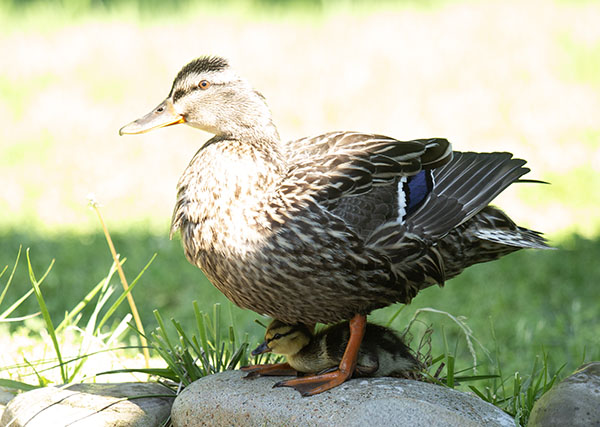
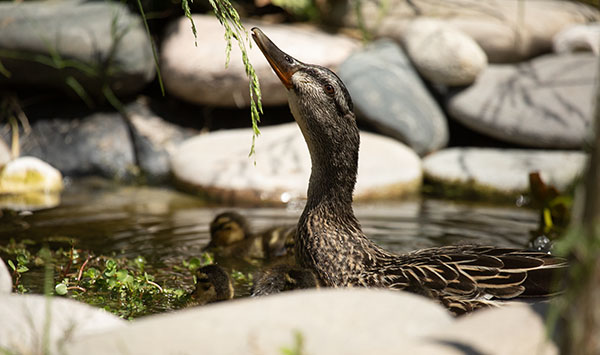
Photograph from a recent spring nesting in the yard. In this photo, a Mallard hen is leading her day-old ducklings from their nest in the irises bordering the dragonfly pond. The hen is balanced on a large rock, downy nest-fluff sticking to her feet. The ducklings are following in a huddled flock, clinging together for safety.
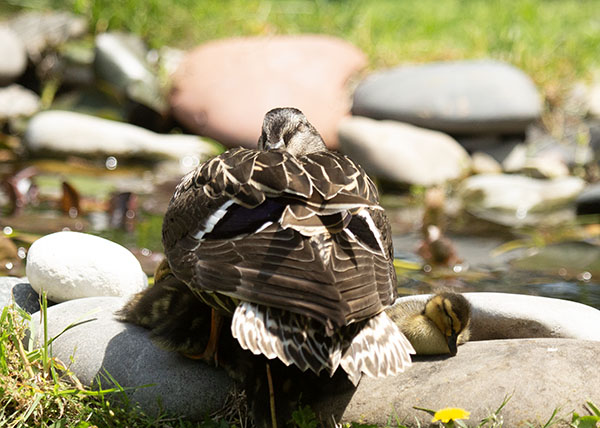
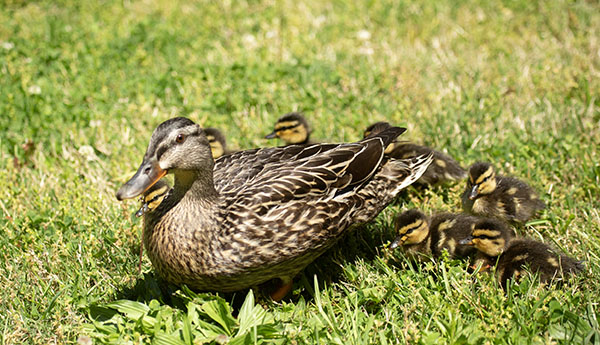
Photo from the Mallard archive. Here, a Mallard hen and her ducklings are leaving their nest for a family swim in the dragonfly pond.

Limiting (and limited) expectations

It was easy to position my own context for these posts (see Part IV). But all of my (deleted) attempts to contextualize Mallards in pre-1800s North America have been as flawed as my knowledge.

It’s a given that there are records outside of the Mallard archive, outside of the Mallard mine, that explain how and why North America’s waterfowl maintained flagrant abundance within and around the continent’s early nations. But I don’t have a discourse for these records.

In the end, after all of my reading, I am not equipped to know North America’s pre-colonial Mallards, much less describe them. They are, for me, a personal singularity. An infinite intangible that disturbs my erratic journey.

In other words, I’m only telling one facet of the Mallard story: the part written by and for Europe’s descendants.

Caveat lector.
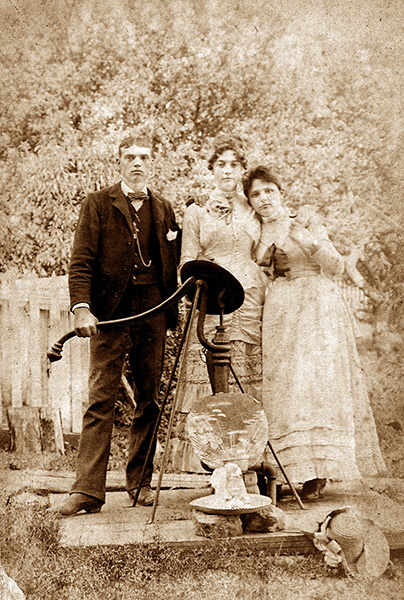
Sepia-toned photograph of three young adults posing beside a pump-handled well in what appears to be a fenced yard. All are wearing formal-appearing attire—two wearing layered and ruffled dresses and one wearing a suit with a prominent pocket-watch chain. A beribboned hat is on the ground in front of the well.
Photograph from the family archive, Iowa, 1881. The trio in this photo were younger than Iowa (granted statehood in 1846) but not a lifetime younger.

In medias res

When I last left the Mallards, in the opening decades of the 1900s, their populations were collapsing. For the moment, I’m leaving them suspended in free-fall.

This post circles back to the 1800s. Back to an era of unchecked habitat destruction and overhunting. Back to the transition years, when state lawmakers claimed title over wildlife and began to legislatively dismantle game markets.

“Wetland utilization in North America provides a classic case of conflict in resource management. The disadvantages of marshes and ponds for the individual farmer encourage their drainage and conversion to cropland. At the same time, these wetlands provide vital habitat for migratory waterfowl, a principle wildlife resource…” (Pospahala, Anderson, & Henney, 1974, pp. 5–6).

Sepia-toned postcard image of a wetland setting in South Dakota. A smallish body of seemingly stagnant water is bordered by dense brush and shrubs.
Photo postcard from the family archive, South Dakota, c. 1900.

“We, who cannot live without wild ducks, must first of all acknowledge two facts: 1. We are the minority; 2. The majority regards any land which is too wet to plow, but unsuitable for swimming or water boating, as useless” (Anderson, 1953, p. 122).
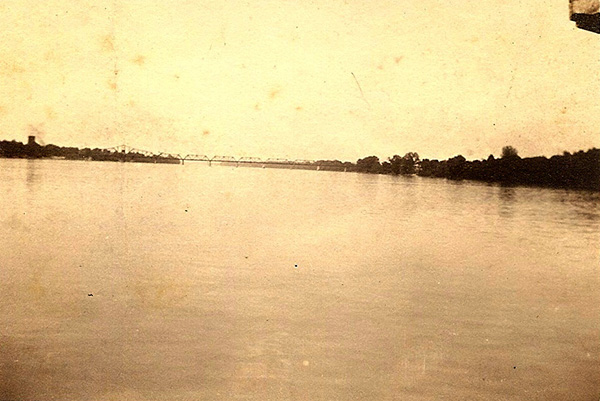
Sepia-toned image of a large body of water with a distant silhouette of truss bridge. The photo's horizon is slightly tilted, the bridge has six visible segments, and a jointed corner of wood is visible in the upper right corner of the frame.
Photo from the family archive, location unknown, c. 1900. A large body of water with a truss bridge in distant silhouette.

These were never the King’s ducks

After fleeing systems in which wildlife belonged to the aristocracy, the English and French colonists in North America drafted new rules. In the colonies, wildlife would belong to the citizens. To the People. (Not, however, to the People who already lived in North America. Only to those who staked their various flags along eastern coastlines and cascaded westward.1)

“The explorations of these settlers were driven by the incredible wealth of North America’s renewable natural resources—and by an unfettered opportunity to exploit it” (Organ, Mahoney, & Geist, 2010, p. 23).
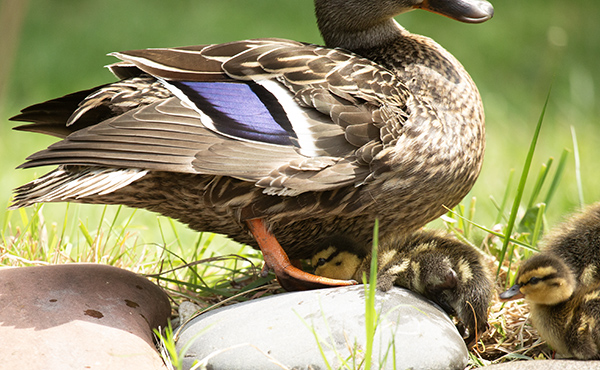
Photograph of a Mallard hen perched on a stone that is part of the border of our dragonfly pond. One of her days-old ducklings is scrambling up the stone's slope, trying to reach the safe and familiar comfort of her protection. Two other ducklings are in line, waiting to test their own climbing skills.
Photo from the Mallard archive, of a Mallard hen standing on one of the stones that border our dragonfly pond. Here, the hen was taking a break from teaching her ducklings to swim and forage.

Who killed (kills) the People’s birds?

During the glut years of the 1800s, US hunters took to the field in three different pursuits: subsistence hunting, sport hunting, and market hunting.

As subsistence hunters took (take) only what they need for survival, their impact on bird populations was (and still is) minimal. But sport hunters, in the 1800s, tended to binge. Each adventure piled up the carcasses:

“The geese were flying all day, thousands upon thousands of them. We killed 163 that day. We had a farm wagon with extra side boards for carrying eighty bushels of wheat. Our kill nearly filled that wagon box. I know that night when we drove back to Dawson, which I think was eight miles distant, we were cold and wet and we all stuck our legs down in the geese and the warmth of their bodies kept us comfortable” (Mershon, 1923, pp. 117–118).

Sepia-toned photo of a horse harnessed to a cart (carriage? buggy?) driven by a man in a suit and hat, complete with thick gloves that have a star emblem on the wide cuff. A cluster of two-story houses make up the background.
Photo from the family archive, location unknown, c. 1900. Not a wagon, I know, but still a reminder that personal transportation in the 1800s was single-digit horsepower.

After each binge, sport hunters returned to their families and their varied professions.

Unless the binge was their profession.

The Meat and Feathers Market

Between 1820 and 1860, America’s cities blossomed from a thin seeding of only 5% of the population to a significant 20% demographic. “Markets for wildlife arose to feed these urban masses and to festoon a new class of wealthy elites with feathers and fur” (Organ, Mahoney, & Geist, 2010, p. 23).

Market hunters earned a living harvesting the wildlife that lived in unclaimed (or claimed and unsupervised) wild places. The siren song of profit penetrated every field, marsh, and wooded acre, tempting hunters to abandon the traditional and self-imposed restraints that defined hunting as a sport.

“A momentary question goes through your mind. ‘Shall I give them the first barrel on the water?’ It is dismissed almost as soon, for early I have been taught it is not the way of the sportsman. Give the birds a chance is the rule. Yet I can not help hoping they will be well bunched and I can get more than one with the first barrel and hope for another with my second. Well, sometimes it works one way and sometimes another. Either way it’s the life worth living” (Mershon, 1923, p. 76).

Giving the birds a chance, for the market hunter, was a profit gamble.

Sepia-toned portrait of two young adults seated at a table. Both are posed with a hand of cards, as if playing poker. Both are wearing suits, though they have taken off their jackets. Both are wearing hats. One is smoking a pipe. The gambler on the right is showing an ace to the camera, held below the level of the table. Paper money, larger than today's bills, is hanging over the edge of the table.
Photo from the family archive, location unknown, c. 1900. Photographer’s stamp: “W. C. Bryant Artistic.”

It was highly likely that a hunter the next county over would happily shoot all the birds on all the waters, rules be damned.

The market wanted meat and feathers, so meat and feathers the market would have.

Sepia-toned portrait, c. 1900, of two young adults wearing hats decked out in feathers. Their coats have big fancy collars, one of thick fur and the other of feathers.
Photo from the family archive, location unknown, c. 1900. Time has taken their names, but their faces and feathers remain.

Any hunter willing to renounce the title of “sportsman” could cash in.

What would you have done?

Endless demand v. limited supply

Around cities and towns, market hunters drained the wildlife from marshes and woodlands and fields. And as nearby wildlife dwindled, sportsmen were forced further afield for their binges.
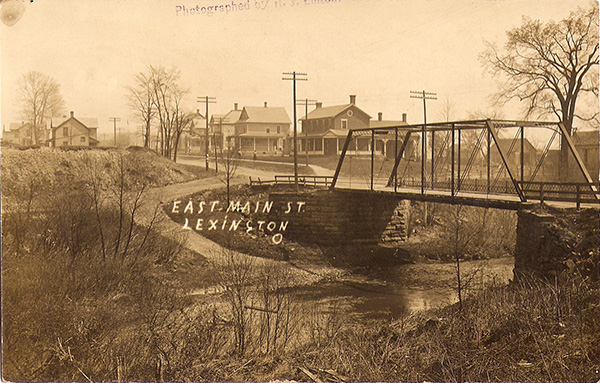
Postcard photograph stamped "Photographed by H. J. Linton" and hand-labelled "East Main St., Lexington, O". A small, single-section truss bridge crosses a brook, several two-story houses line the road beyond the bridge, and utility poles break the horizon.
Photo postcard from the family archive; East Main St., Lexington, Ohio; c. 1900. The photographer’s stamp, HJ Linton, suggests the image was snapped by a relative on some distant branch of a grandmother’s family tree.

“Conflict soon arose between market hunters, who gained fortune on dead wildlife, and the new breed of hunters who placed value on live wildlife and the sporting pursuit of it” (Organ, Mahoney, & Geist, 2010, p. 24).

By the late 1800s, some of the birds had been hunted to extinction.

“The first bird I ever killed on the wing was a wild pigeon. They frequented the Saginaw valley in thousands from early spring until after the harvest. I had been taken with my uncle and father pigeon shooting many times to pick up birds. It was no trick for them to get seventy-five or a hundred birds before breakfast, and soon after I was given my 16-gauge double barrel gun I was taken out to shoot pigeons. The flocks were dense, as I now recall, so it was not a difficult feat to bring one down, and at the very first discharge a pigeon from my shot came fluttering to the ground. I grabbed it and admired it and was satisfied for that morning to have it my entire bag, and proudly took it home to show my mother. It was not long before I was going pigeon shooting regularly every morning, for the flight began at daylight and was generally over by seven o’clock. Then I would get my breakfast and be off to school. My pigeon shooting continued every spring until about 1880, when it was gone forever” (Mershon, 1923, p. 3).

Sepia-toned photo of a group of twenty-seven children, teens, young adults, and adults—seemingly assembled for a school photo. All of the children in the front row are barefoot, most are wearing long-sleeved shirts and coveralls or long-sleeved dresses with large ruffled collars. Two children in the front row are holding hats on their lap, one has a hat hooked over one knee, while yet another hat has been tossed to the side and waits, upside down, to be reclaimed. Some of the younger children have neatly parted hair pulled back in (probably) a braid, others have very short hair that is either too short to style or barely long enough to support styling to one side or the other. The teens and young adults with long hair have puffy updos with a few prominent ribbons, while those with short hair have a suggestion of bangs swept to the side. A dog has joined the first row of students.
Photo from the family archive, location unknown, c. 1890(?). I wonder if the author of the previous passage went to school barefoot, with his hound to keep him company?

“No ordinary destruction”

In the sport v. market skirmishes, sport hunters always had the upper hand. Reputation and tradition amplified their voices.

“Furthermore I will prove by sundry reasons in this little prologue, that the life of no man that useth gentle game and disport be less displeasable unto God than the life of a perfect and skillful hunter, or from which more good cometh. …he shall go and drink and lie in his bed in fair fresh clothes, and shall sleep well and steadfastly all the night without any evil thought of any sins, wherefore I say that hunters go into Paradise when they die, and live in this world more joyfully than any other men” (Edward, Second Duke of York, 1406–1413/1909, pp. 4, 11).

“It is stated that in their migrations northward, the waterfowl often reach the lake in the spring, while it is still covered with ice, and that while huddled in great numbers in the mouths of streams and other open places, they are slaughtered indiscriminately, and that while too poor and unfit for eating. It is also represented that they are killed and wounded in great numbers by the swivel or punt gun, which is a small cannon fixed to a boat, and that by these practices they are driven from their usual feeding grounds and places of resort. It is the well known habit of waterfowl to follow the same line and stop at the same points in their migrations, and such a serious disturbance at this great half-way station, may eventually result in their seeking other quarters. To prevent this it is asked that the killing of waterfowl in the spring be prohibited altogether in certain counties, and that the use of the punt gun be absolutely forbidden. The petitions upon this subject have been so numerous, and the petitioners so respectable, that there evidently must exist good cause for complaint, and their request should be granted. The use of the punt gun along the sea board has been made illegal for like reason, and if it is necessary there, it is still more so here” (Collins, 1860, p. 388).

“The ‘game hog’ is an animal on two legs that is disappearing. May he soon become extinct! The ‘game hog’ formerly had himself photographed surrounded by the fruits of a day’s ‘sport,’ and regarded the photograph as imperfect unless he had a hundred dead ducks, grouse, or geese around him. To-day a true sportsman would be ashamed to be pictured in connection with a larger number of fowls than a decent share for an American gunner, having due regard to the preservation of game for the future” (Lacey, 1900, pp. 4871–4872).
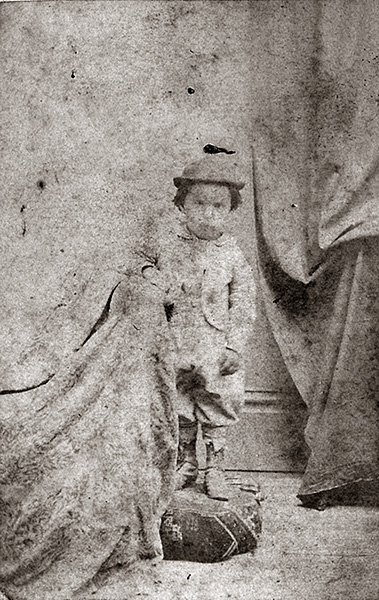
Grainy and faded grayscale portrait of a toddler. The child is standing on an upholstered footrest and is wearing knee breeches, a short jacket with long sleeves, a rounded hat with a small rolled brim, and rumpled boots. One arm rests on a curtain-draped prop. Another heavy drape hangs in the background. Time has robbed the image of most facial features, leaving only the child's dark eyes staring into the lens.
Photo from the family archive; unnamed child (likely surname Linton); Elmore, Ohio; c. 1890. In my internal filing system, this image lives in the “haunted children” file.

Haunted by pigeons

A single piece of market-favorable legislation murmurs from the archival cacophony: an 1848 Massachusetts statute that prohibited anyone from frightening passenger pigeons out of netting-beds, under threat of a $10 fine and compensation for damages (General Court of Massachusetts, 1848, p. 650).

It should be no surprise that this particular law is audible to search engines. After all, passenger pigeon extinction is a holotype cautionary tale that should linger.
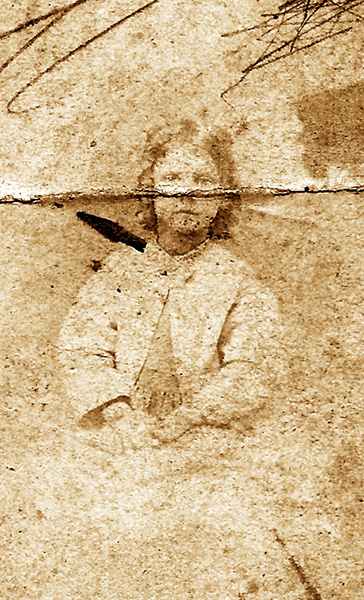
A faded, folded, and foxed photo from February 1, 1887. The child's image has almost completely faded. Loose curly hair, a long-sleeved jacket buttoned at the neck, and what might be a pleated waistline for a dress. Hands folded in lap. Serious eyes peer out over the photo's broken fold.
Photo from the family archive; unnamed child (likely surname Craig); Columbia, TN; February 1, 1887. Another haunted child.

Ohio bids farewell to their big game, but assumes the pigeons will never die

In 1857, as the Ohio legislature sought to revise their “Act to Prevent the killing of Birds and other Game” (Ohio General Assembly, 1857, pp. 107–108), legislators requested assistance from the state’s Board of Agriculture.

The resulting work, published as a select committee report in 1860, wrote off Ohio’s big game as a lost cause: “Ohio has no waste land. It is all useful for agricultural purposes—if not for tillage, at least for pasturage. It has no sterile wastes, marshes, or mountain ranges where the larger game can find permanent security. The deer, the bear, the wolf, and such like animals will soon be gone, and laws that relate to them a dead letter” (Collins, p. 382).

Sepia-toned photo of taken from inside a fenced field that looks recently cut to stubble. In the background three massive, multi-story, wood buildings with steeply framed roofs are surrounded by a field so flat and uniform that it looks like water. A very distant treeline marks the horizon.
Photo from the family archive; The Steele Farm; Cedar Rapids, Iowa; c. 1900.

Wild turkeys, prairie hens, and pheasants were in the same sunken boat. Excepting a few isolated flocks in isolated localities, no protections could save them. Even so, sportsmen wanted the legislature to regulate hunting, so hunting should be regulated. Ohio’s lingering populations of deer, turkey, prairie hens, and pheasants should be granted undisturbed breeding seasons (Collins, 1860, p. 384).

Seasonal protections were recommended for game birds that could adapt to progress—quail, meadow-larks2, kill-deer, doves, flickers, woodcock, and wood ducks (Collins, 1860, pp. 385-387)—as well as for waterfowl around Sandusky Bay (Collins, 1860, p. 389).

The multitudes of warblers, finches, and flycatchers were safe without protection. At least, being small, shy, and drab, they were safe enough. The food-and-feathers market didn’t covet such birds. Besides, providing bird-by-bird protections would require parsing dozens of common and scientific names (Collins, 1860, pp. 383-384).

Sepia-toned portrait, c. 1900, of a young man wearing what looks to me like a scratchy wool suit. His dark hat is garnished with a stiff sail of white primary feathers.
Photo from the family archive, location unknown, c. 1900. The photo was in my great aunt’s album, but was addressed to my grandmother.

Woodpeckers, blue jays, and blackbirds, the kind of birds that damaged agriculture when they ate crops but protected agriculture when they ate insects, could be left to the chances and whims of circumstance (Collins, 1860, p. 384).

The report singled out two game species as immune from overhunting (in Ohio) and in need of no protection: the snipe and the passenger pigeon.

Snipe were mere passers-through, fleeting visitors so well-camouflaged and difficult to flush from wet spring landscapes that only “practiced” sportsmen could hope for success (Collins, 1860, p. 387). During brief April sojourns, snipe were “good sport and a choice morsel for the table”, but “yearly numbers cannot be materially lessened by the gun” (Collins, 1860, p. 387).
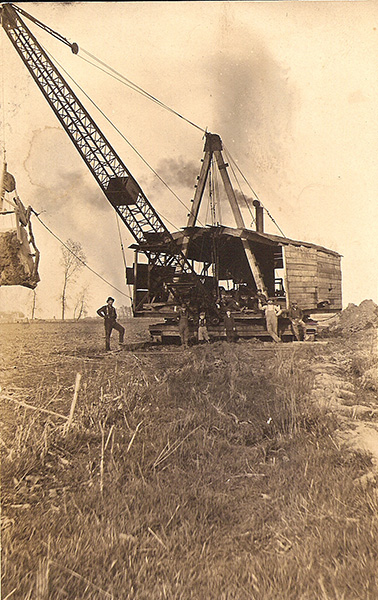
Sepia-toned photograph of a steam crane and six workers in a field in Iowa, c. 1900. The field has been cut to stubble. The steam crane is belching smoke, and the crane's body looks like a wooden building on a massive wood platform. Mounds of bare dirt are visible in the background. The workers are lined up in front of the crane, posing for the photo. A few bare trees are on the horizon, suggesting a winter setting.
Photo from the family archive, Iowa, c. 1900. I don’t know what kind of progress was underway, with this steam crane, but I doubt it involved wetland restoration.

And passenger pigeons?

“The passenger pigeon needs no protection. Wonderfully prolific, having the vast forests of the North as its breeding grounds, traveling hundreds of miles in search of food, it is here to-day and elsewhere to-morrow, and no ordinary destruction can lessen them, or be missed from the myriads that are yearly produced” (Collins, 1860, p. 387).

Forty years later, passenger pigeons were extinct in Ohio3 and functionally extinct everywhere else. It was, indeed, no ordinary destruction.

“Property of the State”

“Section I. That all the game and fish, except fish in private ponds, found in the limits of this State, be and the same is hereby declared to be the property of the State, and the hunting, killing, and catching of same is declared to be a privilege” (Arkansas General Assembly, 1889, p. 173).
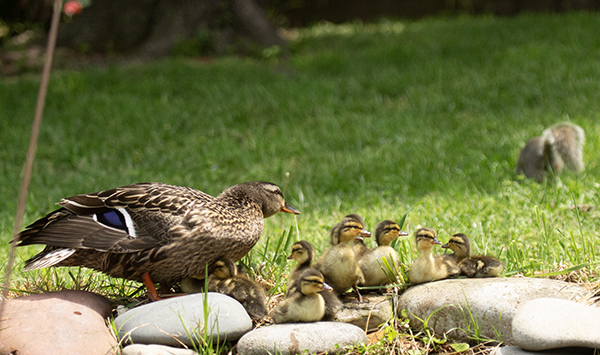
Photograph of a female Mallard threatening a squirrel that had ventured too close to her brood of days-old ducklings. The hen is standing over her brood, all gathered on the stone border of our dragonfly pond. The hen's stance is tense, head low and neck coiled, ready to strike at the squirrel should it venture closer. The squirrel's back is turned to the ducks, seemingly unaware that it has disturbed the scene.
Photo from the Mallard archive, of a female Mallard threatening a squirrel that had ventured too close to her brood of days-old ducklings. Mallard hens usually ignore the antics of squirrels in the yard, but new mothers are a different story.

“Section 4650, Wisconsin statutes of 1898 is hereby amended to read as follows: The ownership of and the title to all fish and game in the State of Wisconsin is hereby declared to be in the state, and no fish or game shall be caught, taken or killed in any manner or at any time, or had in possession except the person so catching, taking, killing, or having in possession shall consent that the title to said fish and game shall be and remain in the State of Wisconsin for the purpose of regulating and controlling the use and disposition of the same after such catching, taking or killing. The catching, taking, killing or having in possession of fish or game at any time, or in any manner, or by any person, shall be deemed a consent of said person that the title of the state shall be and remain in the state for said purpose of regulating the use and disposition of the same, and said possession shall be consent to such title in the state whether said fish or game were taken within or without this state” (Wisconsin General Assembly, 1899, pp. 576–577).

Sepia-toned photo of a young woman wearing a pale dress with a fur collar. Her dark hat is tipped to a jaunty angle and is decorated with (maybe?) feathers, flowers, or ribbon. (The decoration fades into the background, so it is difficult to say exactly what has been attached to the hat.) The woman's head is slightly tipped, she is looking off to the side, and her lips are not quite smiling.
Photo from the family archive, location unknown, c. 1900. Her expression captures my bemusement, on trying to follow Wisconsin’s the “shall be and remain” syntax.

Such legislative grabs by Arkansas and Wisconsin, asserted during the closing years of the 1800s, didn’t materialize out of thin air.

State legislatures had been controlling the game within their borders since the 1820s, and courts had upheld a variety of statutes.

Let the alewives migrate

One of the earliest challenges to game laws came in Maine, after members of a town’s fish committee destroyed a dam on private property. On May 3, 1839, the fish committee took action on behalf of alewives, a type of herring.

Charles Peables had maintained a dam on his portion of Alewive Brook, in Cape Elizabeth, for some 12 previous years, diverting the water to power his mill. In May of 1839, local Fish Committee members Hannaford and Davis demanded that Peables open his dam and let the alewives pass.

When Peables declined, the Fish Committee disabled the dam in question. Litigation followed, and the Supreme Judicial Court of Maine eventually ruled for Peables, citing a technicality: Hannaford and Davis had acted early.

As the statute required the brook to be open May 5–June 5, Peables should have been able to run his mill straight up to the stroke of midnight on May 5. As long as the alewives could migrate upstream on May 6, Peables was not in violation of the statute (Peables v. Hannaford, 1841, 106).

Had Hannaford and Davis waited until May 6, they could have destroyed the dam at their leisure, and Peables could not have stopped them.

Peables v. Hannaford set a precedent, at state levels, for the states’ authority (embodied in local officers) to regulate game on private property.
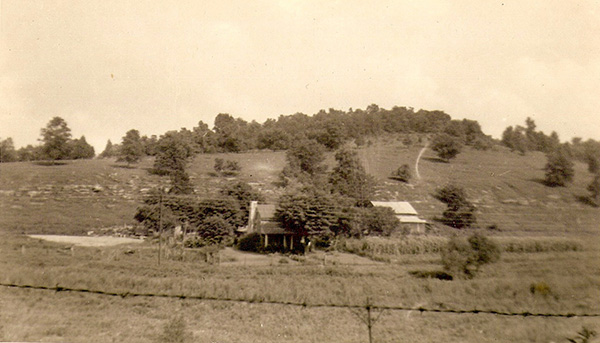
Sepia-toned photo of a house and barn at the foot of a hill, surrounded by a large empty field. The house is set within a cluster of trees, while the field has been cleared for (probably) pasture usage. A line of large rocks and boulders runs along the hill's lower slope, and a thick tree line obscures the top of the hill. A utility pole and utility lines run through the field in front of the house, and a single strand of barbed wire stretches between the camera and the farm.
Photo from the family archive, unknown location, c. 1920(?). The barbed wire running across the foreground would be a distinct “no trespassing” indicator, in the rural area of my childhood.

“We see nothing unconstitutional in the Act”

On July 8, 1874, David S. Randolph served two dressed and cooked prairie chickens to diners in his St. Louis restaurant. According to a Missouri statute, these were the wrong birds in the wrong season.

Even though Randolph could prove that he had purchased the birds in Kansas, where July hunting was legal, he was cited and fined $9. Which would be about $250, today. Randolph appealed, but the Missouri Court of Appeals upheld the fines:

“We see nothing unconstitutional in the act. The game law would be nugatory if, during the prohibited season, game could be imported from the neighboring States. It would be impossible to show, in most instances, where the game was caught. The State of Missouri has as much right to preserve its game as it has to preserve the health of its citizens, and may prohibit the exhibition for sale, within the State, of provisions out of season, without any violation of the Constitution of the United States. So far as we know, this right has never been disputed, and its exercise by the absolute prohibition of the having in possession, or sale, of game within the State limits, during certain period of the year, is no more an illegal attempt to regulate commerce between the States than would be a city ordinance against selling oysters in July” (Missouri v. Randolph, 1876, p. 15).

Did you catch it?

Sepia-toned postcard photo of my great-aunt Birdie as a toddler. She is standing up, one hand balanced on a blanket-draped prop. Her ankle-length dress is a dark material with heavy-looking gathers at the collar and a bright band of (probably embroidered) zig-zags around the hem and cuff. Her eyes are very wide as she looks at a spot just to one side of the lens. Under her image, print on the card reads "The Park Gallery, Chas. Eberhardt, Artist, 20th Street, Rock Island, Ill." Handwritten on the back of the card was "To GrandMa from Birdie Dec 7 1894".
Photo from the family archive; my great-aunt Birdie; Rock Island, Illinois; December 7, 1894.

In knotting up the import loophole, Missouri had stepped ever so softly on the interstate commerce boundary. And the appeals court didn’t mind.

Sepia-toned photo taken inside a hat store, probably in the 1920s. The long narrow room has shelving, tables, and glass-front cupboards that were probably display cases. A table in the middle of the frame is stocked with a variety of hats, decorated mostly with ribbons. A group of adults are posed together, two wearing formal-appearing suits, one wearing a dark ankle-length skirt and white long-sleeved shirt, one wearing a dark ankle-length dress, and one wearing a calf-length skirt, pale shirt, a long coat, and calf-high (at least) boots. I suspect, but am far from certain, that the one wearing the daringly short skirt (calf-length) is my great aunt Birdie. In the background, a shopper wearing a pale calf-length dress is browsing.
Photo from the family archive; location unknown, c. 1920(?). Great-aunt Birdie worked in millinery. I suspect (though I am far from certain) that Birdie is on the far left, in this photo.

‘…the congress shall have power to regulate commerce among the several states…’

When a somewhat related case landed before the Kansas judiciary, in 1877, the commerce question heated up.

On November 8, 1876, an agent for the carrier Adams Express Company received a package for transport—a shipment of four prairie chickens that had recently been killed. The agent, C. A. Saunders, delivered the birds to Chicago, and received a $10 fine (plus court costs) for his efforts.

Kansas had recently adopted the kind of boilerplate “no possession, no import, no export” law that was popular at the time. In Kansas, the wording had been adjusted to prohibit all import and export of game or birds, independent of season.

During open season in Kansas, in 1876, it was legal to possess prairie chickens that had been legally killed, as long as they had been killed within the state. During closed season, it was illegal to possess them at all. And it was illegal to import or export them, ever.

No matter the season, no one could move prairie chickens across the state lines.

Legislatively, this act seemed loophole-free. During open season, prairie chickens were fair game. Hunt them, eat them, sell them anywhere within the state of Kansas. All perfectly legal. But don’t ship them out of state. Don’t buy them out of state and bring them into Kansas. And during closed seasons, prairie chickens were entirely off-limits. Don’t kill them or have them anywhere in your possession.

The single exception written into this law involved shipments of prairie chickens that happened to pass through Kansas on their way to and from other states. Carriers handling such shipments were safe during their journey through the state.

Sepia-toned photo of a wooden train depot. Stairs in the background lead up to a platform protected by an elaborately-braced awning. A set of windows (rather like a bay window) protrude from the building near the foot of the stairs. The five people in the image are wearing suits and dresses. Two are inside, leaning out through the station windows, and three are outside, leaning against the building. The woman on the far left is one of my great grandmothers, Dora. My great grandfather was an engineer on the line that ran through Elora, TN.
Photo from the family archive; L to R (per my mother’s notes) Dora Craig, Edd Strong (Elora Agent), Wilburn Craig, Mrs. Strong, Vint Hamilton; Columbia side depot, Elora, TN; c. 1901. Dora was one of my great grandmothers.

The appellate judges for Saunders’s case glided straight past a series of technicalities regarding the title and wording of the act. They didn’t need to rule on those matters, because a larger issue took precedence:

“Section 8 of article 1 of the federal constitution provides among other things that, ‘the congress shall have power * * * [sic] to regulate commerce with foreign nations, among the several states, and with the Indian tribes.’ Ever since the adoption of this provision, the judges of the supreme court of the United States seem to have been groping their way cautiously, but darkly, in endeavoring to ascertain its exact meaning, and the full scope of its operation. They have many times construed it, but as yet have hardly fixed its boundaries, or its limitations. They have no doubt generally construed it correctly, but some of their decisions with reference thereto seem to be conflicting and contradictory, and scarcely one of such decisions has been made without a dissenting opinion from one or more of the judges. We think however that amidst all their conflicts and wanderings they have finally settled, among other things, that no state can pass a law (whether congress has already acted upon the subject or not,) which will directly interfere with the free transportation, from one state to another, or through a state, of anything which is or may be a subject of inter-state commerce. …For instance, a law which prohibits the catching and killing of prairie chickens, may be valid, although it may indirectly prevent the transportation of such chickens from the state to any other state; but a law which allows prairie chickens to be caught and killed, and thereby to become the subject of traffic and commerce, and at the same time directly [emphasis in original] prohibits their transportation from the state to any other state, is unconstitutional and void” (Kansas v. Saunders, 1877, pp. 129–130).

This means game is commerce, right? And that the Kansas legislature had stepped a little too far over the interstate commerce boundary. Right?

It meant, at any rate, that Saunders didn’t have to pay his fine.

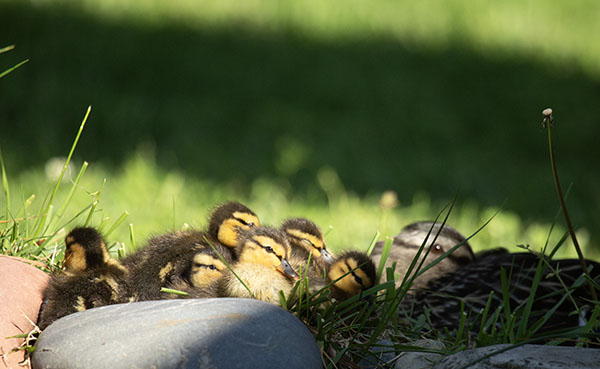
Photo of a Mallard hen trying to get a short rest behind the grass-and-stone border of the dragonfly pond. The hen's eye is wide and her expression is tense, despite her pre-sleep posture of tucked head and neck. They aren't visible at all in the photo, but all eleven of her ducklings were gathered beneath her, as if back in the nest. The ducklings were safe from the hungry eyes of predators, but they weren't comfortable enough to sleep soundly. Their constant fretting and shifting was keeping the hen awake.
Photo from the Mallard archive. Here, the hen has gathered her ducklings beneath her for a nap. The ducklings were squirming and fidgeting, so the hen was having trouble getting comfortable.

Preview of Part VII: More court cases, more decisions, and federal lawmakers patch the interstate commerce bug

The next post dives into game smuggling and game police. If you are starting to wonder if I’ve gotten game laws mixed up with prohibition laws, I haven’t, though there are certainly familiar elements.

Hold on to your feathered hats.

Sepia-toned photo of a young woman wearing a pale, short-sleeved blouse and a dark skirt. (The short sleeves, alone, are remarkable, as long sleeves are far more common in the archive.) She is holding a small bouquet of flowers, and her hat is elaborately decorated with feathers and what looks like a large tiara. She's wearing at least one necklace of beads or gemstones and several rings. Her expression, for me, is a difficult combination of stern eyes with a hint of smile.
Photo from the family archive; location unknown, c. 1890(?). There’s a lot going on with that hat, but, for me, her eyes are the real story. I can’t read that expression, and somehow she makes me feel like I should stop trying to.

Also in the next installment, the courts decide that birds and game aren’t commerce, after all.


A note about previous previews: The schedule has changed, so the previews aren’t accurate

Even the most casual readers will have noted, by now, that this project is constantly expanding. Previews included in previous posts have been preempted and put off, as my reading has taken unexpected turns (I do love a good tangent).

My notes sprawl through four full composition books.

I will likely get to all of the topics introduced in previous previews, but not in order. I’ve given myself permission to keep exploring the Mallard mine, as long as my interest holds, and to keep chasing the tangents. My challenge, now, is to convince readers to keep exploring, as well.

Image of a Mallard hen and her eleven ducklings (which are difficult to count, in this photo) swimming the in a small backyard pond. The pond is bordered by large worn river rocks, with grass and weeds behind and between the rocks. The spout of a pond filter/fountain is visible, and a few reddish-orange water lily leaves float on the surface. (The water lily leaves only turn green after emerging into sunshine.) The ducklings are fluffy with down and have brown and yellow markings. The hen's feathers range from light tan to dark brown with light edging. She is staring into the lens, keeping an eye on me in case I venture too close.
Photo from the Mallard archive. Here, a Mallard hen keeps watch as her ducklings explore the dragonfly pond.

If you’re still with me, Thank You!


Footnotes

1. This particular piece of the Mallard story, part of the pre-1800s history of North America’s colonization, is beyond both my tangent-tolerance (for these blog posts) and my philosophy/history horizon. Even so, an excerpt from a book assigned in a technical writing course resonates:

“Among the many arguments that Locke made in the Two Treatises is one that justifies appropriating lands from indigenous peoples where they are living in a state of nature. According to this argument, settlers who cultivate and improve the land—thereby rendering the ‘greatest conveniences’ from it—will have rights to the property:

“‘God gave the world to man in common; but since he gave it them for their benefit and the greatest conveniences of life they were capable to draw from it, it cannot be supposed he meant it should always remain common and uncultivated. He gave it to the use of the industrious and rational—and labour was to be his title to it (Second Treatise 137).’

“…British settlers under Locke’s rationale could claim property rights because they took resources from the land. These resources could be used to create a favorable balance of trade for England, where Board of Trade member Locke saw excessive imports as a source of unstable coinage practices” (Longo, 2000, pp. 51–52).

Mallards were one of the resources that colonists took and took and took. (Click here to return to your regularly scheduled paragraph.)

2. In 1885, while collecting in Canada, Robert Miller Christy wrote a love-note to Meadowlarks:

“I have often thought what a capital thing it would be to introduce the Meadow Lark in to England. So far as plumage and song are concerned, it would rank among our brightest-coloured and most admired songsters; while its hardy nature would allow of its remaining with us the whole year round, as indeed it often does in Ontario and other districts farther south than Manitoba. Perfectly harmless and accustomed to grassy countries, it would quickly become naturalised in our meadows, where it would find an abundance of insect-food, and would doubtless soon increase sufficiently in numbers to serve, if need be, as a game- and food-bird, as it largely does in the United States. No other songster that I ever heard equals this bird in the sweetness and mellowness of its notes” (p. 125). (Click here to return to your regularly scheduled paragraph.)

3. Ironically, Ohio’s deer rebounded. After being sentenced to local extinction, in 1860, deer found ways to survive in Ohio. And then conservation efforts across the 1900s helped deer to flourish. In the 2024–2025 hunting season, Ohio hunters bagged 238,137 white-tailed deer (Ohio Department of Natural Resources, 2025, para. 1). (Click here to return to your regularly scheduled paragraph.)


References

Anderson, J. M. (1953). Duck clubs furnish living space. In J. B. Trefethen (Ed.), Transactions of the eighteenth North American wildlife conference (pp. 122–129). Wildlife Management Institute. https://wildlifemanagement.institute/conference/transactions/1953

Arkansas General Assembly (1889). Acts and resolutions of the General Assembly of the State of Arkansas: passed at the session held at the capital, which began on Monday, January 13th, and adjourned on Wednesday, April 3rd, 1889. Press Printing Co. https://babel.hathitrust.org/cgi/pt?id=nyp.33433009076492&seq=193

Christy, R. M. (1885). Notes on the birds of Manitoba. In J.E. Harting (Ed.), The Zoologist, 3rd series, Vol. IX. No. 100 (pp. 121-133). John van Voorst, Paternoster Row. https://ia801303.us.archive.org/27/items/Zoologist85lond/zoologist85lond.pdf

Collins, W. O. (1860). Report of Senate Select Committee, upon Senate Bill No. 12, ‘For the protection of birds and game.’ In Fifteenth annual report of the Ohio State Board of Agriculture with an abstract of the proceedings of the county Agricultural Societies to the General Assembly of Ohio for the year 1860 (pp. 381-390). Richard Nevins, State Printer. https://babel.hathitrust.org/cgi/pt?id=mdp.39015038792258&seq=549

Edward, Second Duke of York (1909). The master of game: The oldest English book on hunting. (W. A. Baillie-Grohman & F. Baillie-Grohman, Eds.). Duffield and Company. https://archive.org/details/TheMasterOfGame/page/n7/mode/2up (Original work published 1406–1413).

General Court of Massachusetts (1848). Acts and resolves passed by the General Court of Massachusetts in the years 1846, 1847, 1848; Together with the rolls and messages. Dutton & Wentworth, Printers to the Commonwealth. https://archive.org/details/actsresolvespass184648mass/page/n5/mode/2up

Kansas v. Saunders, 19 Kan. 127 (1877). https://www.courtlistener.com/opinion/7934084/state-v-saunders/pdf/

Lacey, J. (1900). Enlarging the powers of the Department of Agriculture. In Congressional Record, House of Representatives, Monday, April 30, 1900 (pp. 4858–4980). The Government Printing Office. https://www.congress.gov/bound-congressional-record/1900/04/30/33/house-section/article/4858–4980

Longo, B. (2000). Spurious coin: A history of science, management, and technical writing. State University of New York Press. https://www.jstor.org/stable/jj.18254358

Mershon, W. B. (1923). Recollections of My Fifty-years Hunting and Fishing. The Stratford Co., Boston. https://archive.org/details/recollectionsofm00mers_0

Missouri v. Randolph, 1 Mo. App. 15 (1876). https://www.plainsite.org/opinions/279xdv9rm/state-v-randolph/

Ohio Department of Natural Resources (February 4, 2025). Ohio’s final 2024–25 deer harvest report. Ohio Department of Natural Resources. https://ohiodnr.gov/discover-and-learn/safety-conservation/about-ODNR/news/ohios-final-2024-25-deer-harvest-report

Ohio General Assembly (1857). Acts of a general nature and local laws and joint resolutions passed by the Fifty-second General Assembly of the State of Ohio: At its second session begun and held in the city of Columbus, January 5, 1857 and in the fifty-fifth year of said state: Volume LIV. Richard Nevins, State Printer. https://books.google.com/books?id=S1lOAQAAIAAJ&pg=PA107#v=onepage&q&f=false

Organ, J. F., Mahoney, S. P., & Geist, V. (2010). Born in the hands of hunters: The North American model of wildlife conservation. The Wildlife Professional, 4(3), 22–27. https://www.researchgate.net/publication/267749137_Born_in_the_hands_of_hunters_the_North_American_Model_of_Wildlife_Conservation

Peables v. Hannaford, 18 Me. 106 (1841). https://www.courtlistener.com/opinion/5108727/peables-v-hannaford.pdf

Pospahala, R. S., Anderson, D. R., & Henney, C. J. (1974). Resource Publication 115: Population ecology of the Mallard II. Breeding habitat conditions, size of the breeding populations, and production indices. U. S. Department of the Interior, Fish and Wildlife Service, Bureau of Sport Fisheries and Wildlife. https://nwrc.contentdm.oclc.org/digital/collection/p16473coll29/id/10213/rec/1

Wisconsin General Assembly (1899). The laws of Wisconsin, joint resolutions and memorials passed at the biennial session of the Legislature, 1899. Democratic Printing Co., State Printer. https://babel.hathitrust.org/cgi/pt?id=wu.89096040076&seq=7
Focusing on Mallards, Part III: Annual Changes in Flight Muscles

Content warning: This blog post contains references to the hunting, agriculture, and research practices of killing birds. If you choose not to read on, I respect and admire your choice.

This multi-part series of blog posts was inspired by a Mallard hen that nested in our neighbor’s yard this spring. After her eggs hatched, the next-yard hen brought her nine ducklings to the dragonfly pond, where we all spent two lovely mornings basking in the relative safety of our tame little yard.

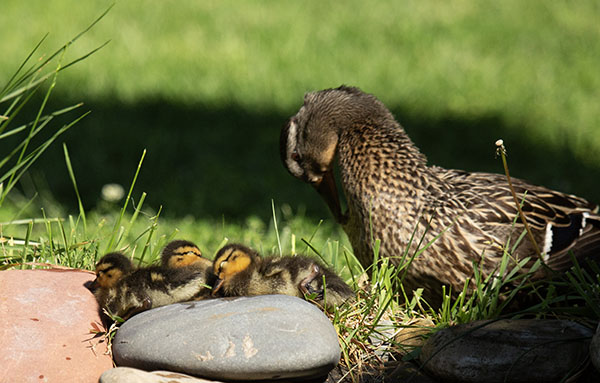
Photo of the next-yard hen and three of her ducklings. The ducklings are sleeping on the stone border of the dragonfly pond after a tiring swim, and the hen is standing in the grass behind them, preening her chest feathers.

As I watched the hen rest and bathe and forage with her ducklings, I developed an obsession with Mallard physiology. This hen had incubated her eggs for almost the entire prior month, weeks and weeks of inactivity broken only intermittently to forage in nearby yards.

What happened in her body during that month? Especially in her flight muscles? After all, if I spent a month in bed, my muscles would deteriorate. And with the hen facing another dangerous stretch of weeks and months shepherding her flightless brood (ducklings don’t fly until they’re about two months old), what else was going to happen in her flight muscles? After three months mostly grounded, how could she fly at all?

Given my penchant for literature searches, I started looking for answers. A half-hour later my keyword nets were empty. Either I was choosing the wrong keywords, or the search engine ocean was empty, as well. But the search engine ocean is not the only source of information out there. Some answers are older than the internet. (Literature search side-quest unlocked!)

Giving up on keyword nets, I defaulted to my personal version of a bootstrapped search. I read through related papers, cherry-picked references that seemed pertinent, found the non-paywalled references, read more, picked more, and continued on repeat. Uncounted iterations later, I’ve devoted more hours to the search than can be explained by interest, alone. My OCD has clearly joined the hunt. (Obsession upgrade unlocked!)

Setting aside mysteries of my own neural wiring and firing, I’ve learned a lot about waterfowl. And about waterfowl physiology. So much so that I’m tempted to call myself a physiology hobbyist. And, like any good hobbyist, my current passions manifest in my blog.

Photo of two Mallard ducklings napping in bright sunshine beside a small yard-art statue. Some intangible and irresistible brew of nostalgia, biophilia, protectiveness, and obsessiveness caught and kept my interest during and after my encounter with this brood of Mallards.

Recap of Parts I and II

In Part I of this post, I described the anatomy of a bird’s flight muscles and shared a bit of personal history that helps explain why I am so fascinated.

In Part II, I defined what I mean by “knowledge”, reflected on the capitalism behind the curtain, sketched out some practicalities about Mallards and other waterfowl, introduced the literature’s euphemisms for “kill” (and also explained my choice to use the word “slaughter”), dipped into background about research numbers and repurposed data, and presented some findings from the literature about variations in the relative masses/sizes of flight muscles.

Here, I’ve harvested from the literature a few articles about annual changes in flight muscle mass in captive Barnacle Geese, wild Great Crested Grebes, wild Red Knots, and wild Mallards.

Photograph of the next-yard Mallard hen standing on the rock border of our dragonfly pond. One of her ducklings is crouched beneath her, safely hidden from aerial predators.

Flight muscles and annual cycles

All research is a tangled path, but wildlife research is a centuries long, thicket-strewn snarl of overzealous collection work, Larmarkian and Darwinian scuffles, rogue variables, and funding biases. Most of the research I’m citing here looked at flight muscle changes associated with molt cycles.

In all of the geese, grebes, and knots that embodied the data reported in these articles, the masses of their flight muscles decreased as their flight feathers molted and increased again as the birds regained feathers and flight. For most of the researchers who interpreted this data, these cycles of atrophy (muscle loss) and hypertrophy (muscle gain) were evidence supporting or refuting (for the species in question) a pair of proposed hypotheses.

The use/disuse hypothesis

One simple and obvious (hypothesized) mechanism for muscle gain and loss is use/disuse. When birds fly, they exercise their flight muscles and gain (or maintain) flight muscle through the known benefits of exercise. When waterbirds molt and replace all their flight feathers in a single weeks-long event, they lose muscle during molt because they quit flying. When they begin flying again, muscle returns.

Because simple and obvious tends to prove out (if you’re waiting for the obligatory Occam’s razor reference, here it is), I quickly became a fan of this hypothesis.

The “endogenous trigger” hypothesis

The more complex and less obvious (hypothesized) mechanism is an “endogenous trigger”. Perhaps somewhere in a bird’s body, some tissue or organ follows time (or seasons). Perhaps when the time/season is right, this tissue or organ sends a molt signal to the flight muscles, and the flight muscles begin breaking down. Maybe all that protein is needed for feather production (feathers are, for the most part, protein). Maybe birds with less muscle and therefore lighter body weights will regain flight sooner. Maybe some complex combination of diet, exercise, and behavior before and during molt causes muscle change as a side-effect, not as a benefit.

As complex and less obvious tends to make good storytelling (especially the kind of serendipitous discovery and cautionary tale stories that science loves), I quickly became a fan of this hypothesis, too.

In this photo, the next-yard hen has just settled after a vigorous, splashy bath in the dragonfly pond. Her feathers are ruffled and beaded with water, the feathers of her face and head are soaked, and a single drenched duckling is half-submerged in the last wave churned up by her luxurious bath.

Barnacle geese in molt

In the 2000s, researchers from the United Kingdom followed a flock of captive geese before, during, and after molt (or moult, because the UK).

Portugal et al. (2009) started with 40 adult Barnacle geese that had been bred and raised in captivity. These birds never flew. Their flight feathers were trimmed to keep them grounded in their aviary. Starting in July and continuing through November, the researchers slaughtered (anesthetized, euthanized, and later dissected) four birds from the flock every two weeks, with more frequent slaughter of birds during peak molt.

In this flock of flightless geese, flight muscle mass decreased by more than 35% in the weeks before molt and during the first stages of molt. After the mid-molt minimum, flight muscles started recovering, increasing back to the pre-molt maximum as the geese shed their old flight feathers and grew new feathers.

The researchers achieved this “35%” measurement by comparing the combined and averaged flight muscle masses of the slaughtered birds, four birds at a time. So the first four birds (the earliest data) had a combined and averaged flight muscle mass that was 35% heavier than the dissected and weighed, combined and averaged flight muscles of the four birds slaughtered mid-molt.1

Setting aside (for the moment) the steady depopulation of this flock, there was a timing mismatch between the muscle and feather changes. Instead of flight muscle loss following feather loss (as a “use it or lose it” consequence of flightlessness), the flight muscle loss preceded feather loss.

But why was there muscle loss at all? These geese didn’t fly, so their grounded condition during molt was their default lifetime condition. How could use/disuse factor in, when there had never been use in the first place?

Behavior changed, too

These same Barnacle geese had been observed through the previous year’s molt. “Despite having constant access to food, the captive barnacle geese lost approximately 25% of their body mass during the wing moult in both years of the study” (Portugal et al., 2007, “Discussion”, para. 1). This is a substantial change in body weight for geese with unlimited access to food and water.

“Anticipatory, rather than responsive.”

So these 40 captive Barnacle geese experienced flight muscle loss prior to onset of feather loss, before their behaviors and metabolisms changed. And their flight muscles began recovering prior to feather regrowth, before the geese resumed normal behavior.

“Therefore, these muscle changes give potential for increased or decreased performance but do so in an anticipatory, rather than a responsive fashion” (Portugal et al., 2009, p. 2409).

That’s an unexpected conclusion. These geese were not experiencing a simple and obvious use/disuse effect. This was a complex and less obvious process. A science story waiting to be told. And uncovering evidence of the complexity cost (only?) 40 captive geese.2

What is the value of a few flocks of captive geese?

Returning to my Part II theme of capital, what is the most valuable capital in the paragraphs above? Portugal et al.’s data, which has racked up some 200 citations? The 2007 and 2009 publications, which have been viewed online some 5000 times?

Is the story I’ve borrowed for this post more valuable than the geese? After all, these were fully realized, fully alive adult geese. Portugal et al. noted that 31% of the flock were paired or attempting to breed (2009, p. 2407). They did not note if they slaughtered the pairs together. Would such a consideration soothe my empathy?

And, speaking of empathy…

At what point, if ever, did the behavior and stress-metabolism of the flock—so accustomed to safety, steady population density, and shared companionship—change in response to their sudden prey status and declining numbers?

In this photo, the female Mallard stands watch as two of her ducklings practice hopping in and out of the dragonfly pond. Both ducklings have their stubby wings partially extended. During their two mornings in the yard, the ducklings stretched their wings often, as if practicing flapping, but they also used their wings as tiny counterweights while they balanced on the tricky terrain of seashells and stones around the pond.

Other waterfowl in molt

Between 1978 and 1986, a researcher in the Netherlands (Theunis Piersma) collected the carcasses of 112 adult Great Crested Grebes that drowned in gill nets during the birds’ August–October molt (or moult, because the UK version of English) on Lake IJsselmeer in the Netherlands. Pairing data with observations of the birds’ activity levels before, during, and after molt, Piersma interpreted his findings as use/disuse. As a cycle in Great Crested Grebes in which forced flightlessness triggered disuse atrophy during molt, and return of wing function triggered muscle hypertrophy after molt. (Piersma, 1988) 3

In separate work involving captive Red Knots, reported in 1999 (Dietz et al.) and more in keeping with Portugal et al.’s geese, Piersma (as a co-author with Dietz et al.) concluded a different mechanism was at work. In this instance, the authors concluded that an “endogenous circannual process” (p. 2836) regulated flight muscle changes in Red Knots during molt.4

All of this is good and useful information for researchers interested in captive geese, wild grebes, and captive and wild knots. It is even good and useful information for someone like me, who is dabbling through waterfowl research in search of a simple answer to a complex question about Mallards. It shows different physiological processes at work in different species.

In other words, my Mallard answers can’t be intuited from goose, grebe, and knot research.

Photograph of the next-yard Mallard hen and her brood settling down for a sunlit nap beside the dragonfly pond. The hen (in the background) has tucked her bill under her wing feathers in a resting pose, but she still has one watchful eye on her ducklings. The ducklings are huddled together, some still awake, some already asleep, and some just in the process of nodding off.

So…the next-yard Mallard hen’s flight muscles?

Simple answers to complex questions are vanishingly rare in any field, but perhaps a complex answer can by synthesized? Have the simple and complex threads of other, related questions about Mallards crossed often enough to create a pattern? (Unnecessary spoiler alert: No such pattern is discerned here. Only more questions.)

And, is molting at all the same as nesting? (No. Obvs.)

I found a significant body of literature regarding flight muscle changes in Mallards during molt, but only a single flight muscle dataset for nesting Mallards in the wild. I expect ethical concerns explain much of the data imbalance. At least, I hope ethical concerns are a factor.

I prefer a world in which nesting and post-nesting hens, along with their eggs and ducklings and awkward teen-ducks, are safe from the traps and slaughter and scales of researchers. Their world is already dangerous enough.

Besides, even if everyone agreed on a single, simple mechanism for molt-related muscle loss and gain in Mallards, it’s unlikely that the consensus mechanism would also regulate muscle physiology during nesting. After all, molt and nesting share few behavioral, metabolic, or seasonal similarities. For the birds themselves, flightlessness may be the only common factor. And nesting flightlessness is, at least during the onset, choice—nesting hens can fly, they simply don’t fly often. Molt flightlessness is forced.

Mallards in molt

Venturing first into Poland, a 1990 article (Panek & Majewski) looked at Mallards in molt on the floodplain where the River Warta meets the Odra River in western Poland. During the time of the study, some 25,000 male Mallards gathered for molt, a population “many times greater than the number of local breeders” (p. 255). Molting Mallards (3,788 males; 341 females) were herded into net enclosures, weighed, examined, and banded, and then released. After periods of 3–9 days, more herding resulted in recapture of 337 male and 13 female birds, which were again weighed, examined, and released.

These efforts allowed the researchers to determine that both the male and female Mallards lost 12% of their body weights during molt. What’s more, whenever new feathers (even just a few new feathers) were damaged enough to require immediate re-replacement, the prolonged flightless period resulted in continued weight loss. In those cases, the continued weight loss couldn’t be blamed on the metabolic demands of massive feather regrowth because only a few feathers were being replaced. (Panek & Majewski, 1990, p. 258)

“In our opinion, limited foraging and the use of body reserves during flightlessness are responses to high predation on dabbling ducks that forage in shallow waters. Secretive behavior and short forays out of shelter minimize exposure to predation” (Panek & Majewski, 1990, p. 258).

But a hemisphere away in Klamath Basin, California, avian botulism has sometimes been a larger hazard for molting Mallards than predation. In some of the basin wetlands between 2001 and 2006, avian botulism claimed as many as 64% of radio-monitored Mallards during molt (Fleskes et al., 2010, p. 214).5 However, after molt, “Hunting was the main cause of mortality for post-molt Mallards both within (16 of 37 deaths) and outside Klamath Basin (six of nine deaths)” (p. 214).

“Increased daily mortality rates of light-weight birds that were captured late in the season during this study suggest some aspect of the molting marsh (e.g., food, water quality, sites safe from predators, predator density) deteriorated as the season progressed causing female Mallards in poor condition to be more susceptible to predation and disease” (Fleskes et al., 2010, p. 217).

Finally, in the Mingo Basin of Missouri, a researcher from the University of Missouri slaughtered a total of 267 female Mallards over the course of three successive winter seasons (1981–1983) (Heitmeyer, 1988). He found that molt timing varied according to age and weather. Adult females molted earlier than immature females, and all of the birds molted earlier in wet winters.

After processing the carcasses, Heitmeyer noted that the birds he slaughtered either before or after molt were heavy, with lipid reserves making up a high percentage of their body weights (1988, p. 673). In other words, the birds Heitmeyer slaughtered prior to molt were healthy and fit and well-prepared for the metabolic demands of molt, and the birds he slaughtered after molt were also healthy and fit and well-prepared for the metabolic demands of migrations to their nesting grounds.

But mid-molt? The Mallards he slaughtered mid-molt were 6% lighter in weight than pre- and post-molt birds. Most of this overall weight loss was due to a 35% decrease in lipid mass (compared to pre-molt birds). So used-up lipid reserves explained 83% of the weight difference between Mallard hens slaughtered prior to molt and Mallard hens slaughtered during the middle of their molt. The hens were losing mostly lipid reserves, not muscle. (Heitmeyer, 1988, p. 673 & “Table 3”, p. 672)

Do these three researches tell a common story?

Not really.

It’s tempting to weave these three researches into an intuitive story about Mallards that reads something along these lines: Mallards lose weight during molt because they hide from predators more and forage less, and their used-up lipid reserves (not atrophied flight muscles) represent most of the lost weight.

But science doesn’t work that way. Nothing does, really. I can’t take the 12% weight loss (Poland), explain it as 83% due to used-up lipid reserves (Missouri), and superimpose an estimate of up to 64% of molting Mallards dying due to disease (California). None of these numbers, variables, or Mallard populations are connected in any rigorous or meaningful way. The only commonalities are the English-language phrase “Mallards in molt” and this sprawling series of blog posts.

Even so, there are tempting threads. Perhaps Mallards in Poland, Missouri, California, and everywhere else actually do lose weight during molt because they hide from predators more and forage less, and perhaps their used-up lipid reserves (not atrophied flight muscles) actually do represent most of the lost weight.

Perhaps Mallards need a third hypothesis, something neither use/disuse atrophy nor annual endogenous trigger. Perhaps if I keep pulling this molting Mallards thread long enough, keep following it deeper into the rabbit hole that I already know doesn’t hold the answer I’m seeking, I’ll find other researchers pulling the same thread. Perhaps we’ll all agree that Mallards need a purely behavioral “hide and fast” hypothesis.

Except it’s time to follow this particular thread back out of the rabbit hole. Whatever mechanisms are at work in a molting Mallard’s physiology, they are (probably) irrelevant to a nesting Mallard’s physiology. (But, as I leave, I’m rolling up the thread metaphor and carrying it with me to the next rabbit hole.)

In this photo, the Mallard hen and her ducklings are perched again on the rocks surrounding the dragonfly pond. Most of the ducklings have gathered under the hen, in the enlarged patch of shade that she has made by spreading her tail feathers and slightly opening her wings so that her primary and secondary flight feathers catch a bit more of the sun. Two of the ducklings are several inches beyond the hen's shade, enjoying the sun-warmed rocks.
In this photo, the Mallard hen and her ducklings are perched again on the rocks surrounding the dragonfly pond. Most of the ducklings have gathered under the hen, in the enlarged patch of shade that she has made by spreading her tail feathers and slightly opening her wings so that her primary and secondary flight feathers catch a bit more of the sun. Two of the ducklings are several inches beyond the hen’s shade, enjoying the sun-warmed rocks.

I like the thread metaphor because I like the idea of reality as a giant tangle of skeins. Step up to the skein, find a loose end, and start pulling. This is how some hypotheses unravel and how some hypotheses knot tighter.

But don’t forget that each thread has a price tag. Like a county fair booth where you pay 40 captive geese to pull the first thread. Or a boat full of drowned grebes to pull the next thread. Or, as in the next research, 51 Mallard hens to pull the specific thread I’ve been searching for all along.

Flight muscle changes in nesting Mallards

“By late incubation, females are highly emaciated; 11 live-trapped females weighed during the last 5 days of incubation averaged 900.3 g ± 30.1 g (mean ± SD)6, or 25% less than during prelaying” (Krapu, 1981, p. 31). (For readers accustomed to weights in pounds and ounces, 900.3 grams = 1.98 pounds and 30.1 grams = 0.066 pounds.)

While 11 ducks is a very small sample size, the data suggest that female Mallards lose up to a quarter of their body weight over the course of nesting. But do they lose flight muscles or lipid reserves? Or both?

Along with these 11 hens weighed alive, this study involved capturing and slaughtering 51 other Mallard hens who were at various stages of their nesting cycles: 19 pre-laying hens, 11 laying hens, and 3 hens that had completed the laying process and begun incubating their eggs. Plus 11 hens that were making their first nest and 7 hens that had lost their first nests and begun laying a new clutch.7

Here’s those numbers again, with a bit more context

If you read the previous two paragraphs and experienced a brief or extended period of dissonance, I’m with you. That’s a lot of numbers in just a few sentences. The important numbers, for my purposes, are the 25% weight loss, the 11 weighed hens, and the 51 slaughtered hens. Here’s a list of hens, broken down by how their data were sorted:

  1. Eleven hens were trapped, weighed, and (hopefully) released back to their nests. These 11 hens were nesting within the study area, and each had a nest with eggs due to hatch within five days. All of these hens were in poor body condition (“emaciated”) compared to hens that had been weighed prior to laying.
  2. Thirty-three hens were slaughtered after migrating into the study/nesting area. As the researchers dissected the 33 carcasses, the slaughtered hens were divided into groups based on their ovarian cycles:
    • Nineteen hens had not yet ovulated. These 19 hens were labelled as “pre-laying”.
    • Eleven hens had ovulated and begun laying eggs, but had not yet laid their last egg. These 11 hens were labelled as “laying”.
    • Three hens had laid all of their eggs (had no more eggs developing in their ovaries or oviducts) and had begun incubating their nests, but they were no more than 6 days into their incubation phase. These 3 hens were labelled as “incubating.”
  3. Eighteen hens were slaughtered as their ovaries and oviducts began preparing for egg production, but before their first egg ovulated. (It’s unclear if these hens were counted among the hens sorted by ovarian cycle, above, so I’m counting them separately.)
    • Eleven of these hens were making their first nest. These 11 hens were labelled as “initial nest attempts”.
    • Seven hens of these hens had a “brood patch” (a bald/featherless patch on their chest or abdomen), which was considered to be evidence that they had already completed one nest and begun incubating (brooding). But something had gone wrong with the first nest, prompting the hens to restart their ovarian cycle and attempt a second (or third?) nest. These 7 hens were labelled as “renesting”.

(Did you spot the moment(s) when my OCD winced? There ended up being three different groups that numbered 11 hens. This kind of number coincidence is not exactly common in science, but also not exactly uncommon. My OCD does not like coincidences. It’s safe to say that, in general, science doesn’t either.)

Back to North Dakota in springtime

When Krapu compared the weights of various tissues and organs in his slaughtered hens, the laying hens (layers) had actually gained weight, compared to the pre-laying hens (pre-layers), while the incubating hens (incubators) had lost a significant amount of weight compared to both the pre-layers and the layers.

The idea that Mallard hens might gain weight in the early stage of egg laying makes intuitive sense. Think about birds and eggs and ovaries and oviducts. All of those eggs started as follicles in an ovary. Think about eggs in a nest. They’re certainly bigger than ovarian follicles. After all, each egg has to be fortified with enough proteins and lipids and sugars to build an entire duckling from scratch. So producing a nest full of eggs, ovary to nest, means a female Mallard’s reproductive tract gets huge.

As Mallard hens lay (on average) an egg a day during nesting, their ovaries and oviducts during this time often contain several eggs in various stages of growth from follicle to in-the-shell. Krapu’s data support this intuitive explanation. The layers had massively higher ovarian and oviduct weights than the pre-layers and the incubators. (I’m going to call this their pregnancy weight.)

In comparing hens slaughtered at these three stages—pre-layers, layers, and incubators—three trends of interest (to me) emerged:

  1. The incubators had lost their pregnancy weight, and then some. Their ovaries and oviducts were not only lighter than the ovaries and oviducts of the pregnancy-heavy layers, but were also significantly lighter than the ovaries and oviducts of the pre-laying hens. (Have mercy. Statistical significance is its own hefty topic.)
  2. The incubators’ lipid reserves were nearing depletion. The pre-layers’ total lipids made up some 10% of their overall body weight. For the layers, their total lipids made up about 6% of their body weight. But the incubators, by day 6 of incubation (and with some 3 weeks left to go), were whittled down to the point that their total lipids constituted only about 2% of their body weight.
  3. The incubators’ flight muscles were lighter than the pre-layers’ and layers’ flight muscles, though the difference was not statistically significant.

And what about later in incubation? What about weeks 2–4? With lipid reserves already nearing depletion, muscle would be next on the menu. Thankfully, this research didn’t persist in slaughtering nesting Mallards. There are no numbers for weeks 2–4. But there are numbers for those seven hens that lost their first nests and tried to start over.

The seven renesting hens had already gained and lost their pregnancy weights once, and their body weights reflected the toll. They were about 12% lighter than hens at the same stage of laying a first nest (though they were slightly heavier than the incubator hens). Their lipid masses were only about 3% of their body weights, as they had used up much of their lipid reserves during their first nesting attempts.

And their flight muscles? In all the hens, no matter their nesting count or stage, their flight muscles made up 5–6% of their body weights.

Pre-layersLayersIncubatorsInitial NestersRenesters
Body weight1199.8 ± 781300.6 ± 114.6967.3 ± 44.51217 ± 79.4 1065 ± 54.6
Flight muscle weight65.1 ± 5.665.1 ± 5.558.3 ± 1.965.3 ± 5.660.0 ± 1.9
Flight muscle as rough % of body weight5.4%5%6%5.3%5.6%
Lipid mass109.6 ± 33.779.6 ± 37.217.1 ± 14.7116.4 ± 18.9 29.9 ± 17.4
Lipid mass as rough % of body weight9.1%6%1.8%9.6%2.8%
All weights are in grams. Body weights, flight muscle weights, and lipid masses are quoted directly from Krapu, 1988, Tables 1 & 3, pp. 31 & 35. Flight muscle as rough % of body weight and lipid mass as rough % of body weight were calculated by dividing flight muscle weights and lipid masses by the respective body weights, then multiplying by 100. Should there be any statisticians among my readers, I offer my deepest apologies for ignoring those standard deviations. I was only looking for rough numbers, after all.

Question answered? (No.)

Maybe nesting female Mallards don’t lose significant flight muscle. Maybe used-up lipid reserves and back-to-normal reproductive tracts explain all of that lost body weight, up to 1/4 of their pre-nesting weight. Maybe a nesting Mallard’s flight muscles only atrophy a little? (Unlike Western Grebes in Manitoba, Canada, which lose up to 41% of their flight muscle during nesting—males and females alike (Piersma, 1998, pp. 101–102 & Table 4).)

Maybe. But not likely. After all, the incubators had only been on their nests for up to 6 days. The renesters were still preparing to lay new clutches of eggs, still carrying new rounds of pregnancy weight, and hadn’t started incubating at all. The incubators averaged a weight of 967.3 grams (about 2.1 pounds) and the renesters 1065 grams (about 2.3 pounds).

Somewhere between renesting or early incubation and about 5 days prior to their eggs hatching (3 weeks or so), both incubators and renesters would have been expected to lose more weight. Perhaps even down to the weights recorded for those 11 captured-and-weighed (and hopefully released back to their nests) hens—about 900.3 grams (1.98 pounds).

If statistics mean anything, and if the 11 hens captured and weighed alive were at all representative of North Dakota’s nesting Mallard hens in the spring of 1981, all of the slaughtered hens’ weights would have fallen to about 900.3 grams (1.98 pounds) before their eggs hatched. Another expected weight loss equalling roughly another 7% of the incubators’ and renesters’ body weights. With lipid reserves already diminished, some notable proportion of that 7% would have been muscle.

But, which muscles?

Only the Mallards know.

And I’m content with that answer.

Photograph of the Mallard hen and one of her ducklings floating in the dragonfly pond. Both are keeping one eye on me and my camera. The duckling's down is beaded with tiny water droplets, and the hen's feathers are ruffled and damp from her bathing. Their futures are unknown, as is mine.
Photograph of the Mallard hen and one of her ducklings floating in the dragonfly pond. Both are keeping one eye on me and my camera. The duckling’s down is beaded with tiny water droplets, and the hen’s feathers are ruffled and damp from her bathing. Their futures are unknown, as is mine.

Happily, others are content with that answer, too:

“Wild Mallards breeding under natural conditions are poor subjects on which to accumulate statistically sound population parameters. The species is particularly sensitive to human interference, especially during the brood period. Statements such as ‘unstudied Mallard populations easily maintain themselves’ might be viewed as a general truism. Field workers concerned with duck population dynamics should periodically remind themselves of the Heisenberg Uncertainty Principle (TIME, Canadian Edition 04/15/63, p. 51), ‘the very act of observing or probing a phenomenon changes the phenomenon'” (Dzubin & Gollop, 1971, p. 49).

So, is this the end of these Mallard posts?

Of course not. I have OCD, and I’m perseverating on Mallards. But this is the end of my riff about flight muscle physiology.

The rest of my Mallard series will pull some Mallard hunting threads and some Mallard farming threads, which intersect at ongoing policy controversies surrounding releases of farmed Mallards into the wild.

Photograph of the next-yard Mallard's ducklings learning to dabble in the dragonfly pond. All are fluffy and downy and beaded with water droplets. All nine ducklings have little Mallard eye stripes that serve as excellent camouflage in the wild. The eye stripes also provide a touch of exaggeration, in a camera lens, mimicking grumpiness from some angles and endearing curiosity from other angles.
Photograph of the next-yard Mallard’s ducklings learning to dabble in the dragonfly pond. All are fluffy and downy and beaded with water droplets. All nine ducklings have little Mallard eye stripes that serve as excellent camouflage in the wild. The eye stripes also provide a touch of exaggeration, in a camera lens, mimicking grumpiness from some angles and endearing curiosity from other angles.

Notes

1. I spy an uncontrolled variable! Because each two-week data set involved slaughtering four birds, in order to dissect and weigh their flight muscles, each two-week data set is an end point. Those four individual birds couldn’t be followed any further. So comparisons of the data sets, comparing the data recorded for the first four birds against the data recorded for any other four birds, requires an assumption that these birds had no significant individual differences. While this is a well-accepted research method, and while individual differences are unlikely to perturb or confound the conclusions, I’m putting a pin in this “individual variation” variable. (Click here to return to your regularly scheduled paragraph.)

2. Okay, yes, I agree. The geese weren’t the only cost. There is a lot of human labor behind this (and all) research. For the researches reported here, and because I’ve brought it up, it’s worth quoting the authors’ acknowledgments (BBSRC=Biotechnology and Biological Sciences Research Council, UK):

  • “We are grateful to Alan Gardner, Phil Archer, Ben Heanue and Pete Jones, for looking after the geese. We are very grateful to Craig White for practical help with the birds and logistics, and Jon Codd and Peter Tickle for supplying us with anatomy guides. Thanks also to Graham Martin, Theunis Piersma, Caroline Chadwick, Robert Ker and McNeil Alexander for useful discussions, and two anonymous referees for their comments. S.J.P. and J.P.M. were funded by the BBSRC” (Portugal et al., 2009, p. 2409).
  • “We would like to thank Craig White for his assistance with the respirometry equipment and set-up, and for statistical advice. We are also grateful to Alan Gardner, Phil Archer, Ben Heanue and Pete Jones for looking after the geese and helping with the weighing sessions. Thanks also to Peter Frappell for help with software, and Michael Romero, Graham Martin, Jim Reynolds and Lewis Halsey for useful discussions. This work was supported by the BBSRC” (Portugal et al., 2007, p. 1396).
  • Click here to return to your regularly scheduled paragraph.

3. Halfway through wing molt, fewer grebes drowned in gill nets. The author notes that the half-molted grebes must either dive less often to forage or dive less deeply (p. 99). Grebes that drowned during wing molt weighed some 9–15% less than grebes that drowned midwinter, but this decrease in body mass involved mostly a loss of fat mass, which was 53–60% decreased during molt as compared to midwinter fat reserves. Despite the fact that most of the weight loss could be explained by loss of fat reserves, flight muscle masses were 28–30% lower in grebes that drowned during molt. So somewhere in the grebes bodies, some organ or tissue increased during molt, offsetting the muscle loss. The author suggested possible liver enlargement, as the liver processes proteins and feather replacement requires a significant investment of protein. (Piersma, 1988, p. 97) Click here to return to your regularly scheduled paragraph.

4. The authors looked at two subspecies of Red Knot that gather on the Dutch Wadden Sea in August. One subspecies, Calidris canutus islandica, undergoes wing molt in August and overwinters in western Europe and the Mediterranean before migrating to arctic regions in Canada, Greenland, and Svalbard for breeding and nesting (Baker et al., 2020, “Subspecies” para. 3, Dietz et al., 1999). The other subspecies, Calidris canutus canutus, stops on the Wadden Sea in August to build reserves in preparation for a 4500km (about 3000 mile) migration to western and southern Africa, where the birds overwinter (or oversummer, for the birds that cross into the Southern hemisphere) and finish their wing molt in March or April before flying back to Russia for breeding and nesting (Baker et al., 2020, “Subspecies” para. 2; Dietz et al., 1999).

In a rare (in my reading for this post) work that did not rely entirely on dissection to measure flight muscles, the researchers captured four individuals of each subspecies of Red Knot and transferred them into a climate-controlled aviary. Over the next eight months, all eight birds stayed in sync with their wild and free-living counterparts despite their controlled living conditions and forced flightlessness. The four C. c. islandica molted and lost muscle mass in August, in sync with their free-living counterparts (Dietz et al., 1999, Figure 1b,f). The four C. c. canutus gained weight and flight muscle mass in August, in preparation for an extraordinary migration they wouldn’t undergo, then lost weight and flight muscle mass as they molted in January–April, in sync with their own free-living, migrating counterparts (Dietz et al., 1999, Figure 1a,e). (Click here to return to your regularly scheduled paragraph.)

5. Note that “radio-monitored birds” always implies a small study set. Radio and GPS monitoring is expensive, labor intensive, and introduces a rogue variable in that many birds change their behaviors after being harnessed or otherwise burdened with devices. Fleskes et al. started with 181 radio-tagged female Mallards (p. 208). (Click here to return to your regularly scheduled paragraph, already in progress.)

6. Just an aside about those body weights: 900.3 g ± 30.1 g (mean ± SD). It’s math. Read aloud, the notation says “…a mean weight of 900.3 grams plus or minus a standard deviation of 30.1 grams…”. It essentially means that:

  1. The average weight of these 11 ducks was 900.3 g (1.98 pounds).
  2. But the “…plus or minus a standard deviation of…” part of the notation indicates that anyone who wants to use this number to predict how much any other 11 Mallard hens (captured in the same location, at the same time of year, and in the same nesting stage) might weigh, on average, should expect the prediction to be off by as much as 30.1 g (0.066 pounds).
  3. So, if I want to open a county fair booth and guess the average weight of 11 Mallard hens (in North Dakota, in spring, who are incubating a nest of eggs that should hatch within 5 days), I should note in my fine print that as long as I am within 0.066 pounds of the correct number, I win. Then, as long as I always guess 1.98 pounds, I should win more often than I lose.
  4. BUT, given that this number was derived from only one group of 11 hens in 1981, and given that hundreds and thousands of Mallard hens might simultaneously be incubating a nest of eggs that are within 5 days of hatching, in spring in North Dakota in 2025…? I think I’ll keep plugging away trying to earn a living as a writer and editor, because my I Can Guess the Weight of Your Mallards county fair booth is on shaky statistical ground.
  5. If I jump ahead to Table 1 (p. 31), which reports an average ovarian weight for prelayers of 6.3 ± 8.7, I’m in a different statistical bind. That’s a worrying standard deviation number, because if I take the “plus or minus 8.7” at face value, my Guess the Pre-laying Mallard Hen’s Ovarian Weight county fair booth is going to be a hot mess. In this case, my fine print is going to state that I win if I guess within 8.7 grams of the actual weight. Every time I win after guessing a negative number, an interrobang will randomly manifest in a doctoral thesis from the 1940s (!?). (I can’t speak to what, exactly, produced a standard deviation so large that county fair booths and negative ovarian weights intersected in this footnote. Should any readers have ideas, please comment.)
  6. Click here to return to your regularly scheduled paragraph, already in progress.

7. The Materials and Methods section of this paper is disappointing, as it doesn’t clarify where and how the comparison data were selected. The seven renesting hens were compared to a subset of 10–11 “initial nest” hens (Krapu, 1988, Table 3, p. 35), with no indication of whether these comparison hens were also included in the earlier analyses of hens at various laying stages. A close reading finds the Table 3 initial nest hens defined as hens in “rapid follicular development…pre-ovulating females with ovary weights ≧ 3.0 g” (p. 30), but this status should have applied also to some of the hens labelled as “pre-laying” in the analyses for laying stages. The author notes that 71 female Mallards were slaughtered over the course of this study, but the math doesn’t work. At most, even if I’m counting some of the prelayers twice, I get 19 prelayers + 11 layers + 3 incubators + 11 initial nesters + 7 renesters = 51 hens. Where are the other 20 hens? And why are there three (3!?) data sets of 11 hens here? (11 layers, 11 initial nesters, 11 late-nesting hens weighed and, hopefully, released…). My OCD doth protest. (Click here to return to your regularly scheduled paragraph.)

References

Baker, A., Gonzalez, P., Morrison, R. I. G., & Harrington, B. A. (2020). Red Knot (Calidris canutus). Birds of the World (CornellLab). https://birdsoftheworld.org/bow/species/redkno/cur/systematics

Dietz, M. W., Piersma, T., & Dekinga, A. (1999). Body-building without power training: endogenously regulated pectoral muscle hypertrophy in confined shorebirds. Journal of Experimental Biology 202(20), 2831-2837. doi: 10.1242/jeb.202.20.2831

Dzubin, A. & Gollop, J. B. (1971). Aspects of Mallard breeding ecology in Canadian parkland and grassland. Canadian Wildlife Services. https://publications.gc.ca/collections/collection_2024/eccc/cw66/CW66-1042-1971-eng.pdf

Heitmeyer, M. E. (1988). Body composition of female Mallards in winter in relation to annual cycle events. The Condor 90(3), 669-680. doi: 10.2307/1368357

Fleskes, J. P., Mauser, D. M., Yee, J. L., Blehert, D. S., & Yarris, G. S. (2010). Flightless and post-molt survival and movements of female Mallards molting in Klamath Basin. Waterbirds 33(2), 208-220. doi: 10.1675/063.033.0209

Krapu, G. L. (1981) The role of nutrient reserves in Mallard reproduction. The Auk 98, 29-38. doi: 10.1093/auk/98.1.29

Panek, M. & Majewski, P. (1990). Remex growth and body mass of Mallards during wing moult. The Auk 107, 255-259. doi: 10.2307/4087607

Piersma, T. (1988). Breast muscle atrophy and constraints on foraging during the flightless period of wing moulting Great Crested Grebes. Ardea 76, 96-106.

Portugal, S. J., Green, J. A., & Butler, P. J. (2007). Annual changes in body mass and resting metabolism in captive barnacle geese (Branta leucopsis): the importance of wing moult. Journal of Experimental Biology 210(8), 1391-1397. doi: 10.1241/jeb.004598

Portugal, S. J., Thorpe, S. K. S., Green, J. A., Myatt, J. P., & Butler, P. J. (2009). Testing the use/disuse hypothesis: pectoral and leg muscle changes in captive barnacle geese Branta leucopsis during wing molt. Journal of Experimental Biology 212, 2403-2410. doi: 10.1242/jeb.021774

Focusing on Mallards, Part II

Content warning: This blog post contains references to the hunting, agriculture, and research practices of killing birds. If you choose not to read on, I respect and admire your choice.

Part of my purpose in writing this Mallard series is to highlight the price that has been paid (and continues to be paid) for the knowledge we have about Mallards and other birds. I might have constructed these posts, as a younger writer, without acknowledging the deaths behind the data. But as I’ve aged, I’ve grown more aware of the cost of knowledge.

In this photo, the Mallard hen who inspired this series of blog posts swims with her brood of day-old ducklings in our dragonfly pond.
In this photo, the Mallard hen who inspired this series of blog posts swims with her brood of day-old ducklings in our dragonfly pond. The ducklings are gathered around a grassy seed head that the hen tugged down to within their reach. The hen nested in our neighbor’s yard, during spring 2024, and brought her brood to the dragonfly pond the morning after they hatched and again the next day. I wondered, during and after her long inactivity on the nest, if she experienced the kind of changes in muscle mass that I might experience if I spent most of a month in bed. I didn’t find a good answer for that question, but I found adjacent answers to adjacent questions. Enough adjacent questions and answers for this multi-part blog post.

What I mean by “knowledge”

It’s one thing, for me, to observe our yard and its visitors. To slip away from human concerns and simply watch. To sate myself with wonder. These hours shift my perspective. They build new connections between old memories. I sometimes emerge with splintered metaphors to sand and patch and paint. Sometimes with fine-grained phrases that liven up a drab idea. On the rarest and best days, I emerge with blueprints for new knowledge.

Observation and wonder are one thing. But knowledge is an entirely different state.

Separate and distinct from the metaphysical implications of knowing, my definition of knowledge is an inventory of education and experience. The nouns of my past and the context in which I encountered them, indexed by subject and era. A cross-referenced heap of biology, shuffled around the edges with chemistry. A shelf of style guides and writing advice. A few notebooks of math, physics, and cosmology. A faded box of recipes, crochet patterns, and needlework hints. Stacks of genre reading. Great aisles of emptiness where business, economics, and law failed to catch my interest.

I was recently asked to list my areas of expertise. I wanted to respond that I have none. I am a worksite traced with utility locator flags, not a finished library. I might claim my main parlor, biology, but even there the framework is incomplete. And, to align the metaphor with my theme, construction materials are expensive.

For many long decades I failed to appreciate the cost of knowledge, with its scaffolds of data. In this post, I’ve chosen to pull back the curtain I so blithely ignored as a young science student. Much of what I find behind that curtain forces me to stock those great empty aisles of business, economics, and law. Because the dimly-lit ledger of science history, written mostly by rich old white men, seldom accounts for cost. But every so often, jotted in the margins or tucked between the pages, the writers left remnants of their invoices.

In this photo, sleepy Mallard ducklings bask on a sun-warmed rock beside our dragonfly pond. One of the ducklings is yawning. From many perspectives, these ducklings are resources to be managed and controlled. For me, here in my middle years, these ducklings are downy singularities of wonder and charm far more valuable than mere resources.

The capitalism behind the curtain

During my brief foray in the humanities silo, I chafed over intense criticisms of science and science writing. But I couldn’t deny the foundational weakness. Science motored along for centuries, impervious to criticism, fueled by colonialism and capitalism. For the most part, it still does.

What would it look like, if science and science writing discarded the curtain and directly acknowledged the capitalism? The colonialism? Not just here and there, but in every published report? If the ledger was complete and brightly lit?

I don’t expect a humanities-approved (and strengthened) science literature would look like anything I can imagine. I am neither scientist nor science writer. What’s more, my little graduate certificate in professional writing is not a stamp of humanities approval. So I can’t answer the questions that followed me home from the humanities silo.

But I am an avid science consumer. As such, the word cost is not chosen lightly. Whenever I look behind the curtain of knowledge, no matter the era or discipline, I find the busy (and visible) hands of capitalism.

As ubiquitous as hunger, questions are free for anyone who has the energy and time to ask them. But answers? Answers are capital. They are expensive. And, weighed in the hands of capitalism, answers are expected to reap a profit.

What happens when answers are not synonymous with capital gain? When hunger lingers or multiplies because the investment outweighs the return? In very short order, the hands of capitalism divert resources and time toward less costly questions and more profitable answers. Or, at least, toward questions perceived to be less costly and answers anticipated to be more profitable. The question I should have been asking for years, the question I am asking now, is this: Whose perceptions and anticipations control the resources?

In this photo, a day-old duckling stretches upward to sample a mostly bald dandelion head. During their brief time in the yard, the ducklings stripped all the seeds from all the dandelions within several feet of the pond. I don't know if they ate the seeds or merely pulled them off as part of their exploration process
In this photo, a day-old duckling stretches upward to sample a mostly bald dandelion head. During their brief time in the yard, the ducklings stripped all the seeds from all the dandelions within several feet of the pond. I don’t know if they ate the seeds or merely pulled them off as part of their exploration process.

Some practicalities about Mallards and other waterfowl

Historically, Mallards had value (and have value, still) because they were and are hunted and farmed. When it comes to funding research, and to collecting data for research, hunted and farmed species are valuable, easy resources. “Valuable” in the capitalist sense of being actual capital, but also in the academic sense of data. “Easy” because these species live and die in larger, more accessible numbers than similar species that are neither hunted nor farmed.

Hunted waterfowl (and other game birds) live and die in their large numbers within easy reach of researchers. I can’t write a path around the pragmatism of this system, but I am increasingly uncomfortable with such pragmatism.

As capital, a Mallard’s value is tethered to its food and sport potential. Driven by this food and sport value, research funding adds further value to a Mallard. Each bird is data. Whether hunted, farmed, or recorded into a set of measurements, a Mallard’s value peaks with its death. (Perhaps this is true of every individual, of every species, but I’ll leave that notion for a later post.)

What of this spring’s next-yard hen, with her downy brood? When I perceive them as more than units of capital, when I anticipate their ongoing existence as more than a value that peaks when they die, my ability (and desire) to control them as resources wanes. For me, this feels like a good and useful adjustment of my perceived and anticipated place in the world.

The older I get, the less comfortable I am with capitalism and its pragmatisms. Far from being an agriculture, research, or policy pragmatist, I want the next-door hen and her offspring to have an embodied value separate from their muscle mass and plumage. I want empathy to count. My still and quiet moments in the yard. The silly antics of ducklings in a dragonfly pond. The charm of infant proportions and curious hungers. I want to measure value as a sense of shared life, a shared world, and shared safety or peril.

Photo of the next-yard Mallard hen sleeping at the edge of the dragonfly pond. She is asleep standing up, the equivalent of a duck cat-nap, beak tucked under the feathers of her wing. Her babies are nestled in her shadow, all except one duckling that has edged out onto the warm rocks in the warm sunlight.

Aside: the literature’s euphemisms for “kill”

According to Google’s default dictionary, the word euphemism is derived from the Greek roots eu-, meaning “well”, and -phēmē, meaning “speaking”. I was taught, somewhere in my education, to translate euphemism as good word. But in my more recent years I have come to view euphemisms as veiled words. Intentional deflections. Syntactical high ground for writers (and researchers?) who wish to describe expanses of quicksand without getting mired. I sympathize with the impulse to build polite nomenclatures. To write around shock words and trauma words. But we’re all in the quicksand, no matter what we write.

(Remember the opening content warning? I do understand the need, the profound and pressing need, to protect victims of shock and trauma from experiencing further shock and trauma. This is why I embrace the practice of content warnings. The remainder of this blog post contains frequent references to the research, agriculture, and hunting practices of killing birds. If you choose not to read on, I respect and admire your choice.)

Policy, agriculture, and hunting literatures shy from the words kill and slaughter. “Kill” is rather imprecise, I suppose, for research literature. And “slaughter” is a bloody word, even with its Merriam-Webster finesse—“the butchering of livestock for meat”. In that sense, I acknowledge that “slaughter” is imprecise, as well. The birds (including Mallards) that populate policy, agriculture, and hunting literatures are resources. They are capital and data, not meat. Does it matter how we describe their deaths? (Yes! Of course it does.)

In the literatures, birds (including Mallards) are hunted, shot, collected, harvested, culled, sacrificed, and euthanized. Dead birds are examined, necropsied, and sampled. Wings are placed in the mail.

For this post and its subsequent parts (I’m not certain how many parts there will be), I’m choosing the word slaughter. Because I added up the numbers behind the data. The research numbers in the tiny subset of articles referenced here run into the thousands. The hunting numbers, hundreds of thousands per year. I feel the word slaughter fits.

The rest of my multi-part Mallard post draws heavily from work done by and for the research, agriculture, and hunting industries. Birds died for these questions and answers. For better or for worse, this is the world we have shaped for Mallards and their avian kin.

In this photo, a day-old Mallard duckling sleeps in a patch of clover and grass at the foot of one of the stones lining our dragonfly pond. The duckling is slumped forward, having nodded off after slipping down from the stone where most of its siblings were sleeping. Other siblings have slipped off of the stone, too, and are nodding off in a stair-step heap behind the sleeping duckling.

The research numbers

The following section, which deals with variations in the relative sizes of flight muscles, leans heavily on an article by D. C. Deeming, PhD.: “Allometry of the pectoral flight muscles in birds: Flight style is related to variability in the mass of the supracoracoideus muscle.” Deeming’s article pulled data from three primary sources: two tracts (1961 and 1962) from the Smithsonian Miscellaneous Collections and a 2016 survey out of Romania.

  1. Greenewalt, C. H. (1962). Dimensional relationships for flying animals. Smithsonian Miscellaneous Collections 144(2).
    • Greenewalt collated pectoral muscle weights from a 1922 French publication: Magnan, A. (1922). Les caractéristiques des oiseaux suivant le mode de vol. Annales des sciences naturelles, Series 10, Volume 5, 125-334. (Yes, that is the same Antoine Magnan responsible for the urban legend that bees should be mathematically incapable of flight.) Magnan’s work used captive birds and, as Greenewalt cited, “…those which appear to be in bad health were discarded” (Greenewalt, 40). Some 228 birds, representing about 223 species, were slaughtered for this data. (I’m hedging my numbers because counting=math=possibility of error.)
  2. Hartman, Frank A. (1961). Locomotor mechanisms of birds. Smithsonian Miscellaneous Collections 143(1).
    • Hartman’s tract drew from more ambitious work that took place in Florida, Maine, Ohio, and Panama. Birds were “collected” (or, even more euphemistically, “obtained”) from January to March, mostly before 11 AM (p. 3). The method of collection isn’t specified, nor the method of slaughter, though the authors specify that birds and their dissected muscles were weighed in “fresh condition” (p. 2). The pages and pages of data (pp. 38-91) represent more than 360 species. Individual numbers range from 1 (i.e., a solitary Bicolored Hawk of unknown sex and a single male Ruddy-capped Nightingale Thrush) to 50 or more (i.e., 55 House Sparrows, 51 White-breasted Nuthatches, 52 Rufous-tailed Hummingbirds, 50 Smooth-billed Anis, and 103 Brown Pelicans). In total, more than 6000 birds. (Again, hedging because math.)
  3. Vágási, C. I., Pap, P. L., Vincze, O., Osváth, G., Erritzøe, J., & Møller, A. P. (2016). Morphological adaptations to migration in birds. Evolutionary Biology 43, 48-59.
    • Vágási et al. captured and banded live birds in Romania, but also “[c]arcasses from natural deaths (e.g. road kill, building collision, electrocution, starvation) were collected in Romania and Denmark for taxidermy” (p. 50). The authors clarify, “Numerous bird specimens were brought frozen to JE, more than 95% of them being found dead and the remaining were shot by hunters” (p. 51). The dataset, here, includes some 115 species. Sample sizes ranged from single individuals (i.e., one Grey Wagtail , one Peregrine Falcon, and one Whinchat) to more than 100 (i.e., 824 House Sparrows, 228 Eurasian Blackbirds, and 193 Eurasian Sparrowhawks). In total, more than 3800 birds. (This article models a practical and effective approach to science without fresh slaughter, primarily sourcing data from carcasses submitted for the study. Granted, “natural deaths” from road kill, building collision, and electrocution are hardly “natural”, but I appreciate the distinction between carcass repurposing and the slaughter of otherwise healthy birds for research purposes.)

So Deeming gleaned data from more than 10,000 birds, without listing a single slaughter in the Materials and Methods section. This is both efficient science and inefficient communication. The actual numbers were curtained off, in at least one case, two sources deep and a century back. I applaud the reuse of data, but I resent the legwork required to find the birds within the data.

I expect that most of The Journal of Zoology‘s readers feel no need to find the birds. After all, the article’s intended audiences hold greater and deeper knowledge of birds, wings, and flight than I bring to the moment. The author and intended audiences would likely characterize my stroll down the numbers rabbit-hole as a tangent prompted by unrealistic purposes and fueled by OCD. But, was it?

What is the capital, here? Or rather, which capital is more valuable? The answers and knowledge, so satisfactory to my passing curiosity? The data and findings, so neatly packaged for future reference? Or the birds themselves, so fleetingly alive?

Ask a different me, in a different era, and my response to these questions would change. But, for now, my heart yearns toward the birds so fitted for flight as to seem almost magical, winging through yards and migrating over landscapes and dabbling with their downy chicks in dragonfly ponds.

In this photo, the Mallard hen reaches up to strip seeds from an overhanging, overgrown, and unknown species of grass that was growing around the foot of the dragonfly pond. The hen is floating in the pond surrounded by her day-old brood.
Here, the Mallard hen has pulled the overhanging grass down toward her day-old ducklings. One of the ducklings is looking up from its place floating in front of her in the dragonfly pond, waiting for her to pull the grass low enough for the ducklings to sample the seeds.

Variation in the relative masses/sizes of flight muscles

(For specifics of flight muscle anatomy, see Part I of this post. In short, two muscles power bird flight: the large pectoralis muscle, which powers a wing’s downstroke, and the smaller supracoracoideus muscle, which powers a wing’s upstroke. Both muscles stretch across birds’ chests, from wing to sternum. If you eat poultry, these flight muscles are the breast meat.)

An average bird with average flying habits pushes down against air with its downstroke muscle, wing extended and feathers angled to maximize (or to finesse) the lift. How much force is needed depends on the birds’ weight and acceleration. Is it a heavy-bodied duck or a sleek-framed crow? At a minimum, the downstroke muscle is massive enough to lift the bird’s weight against gravity and accelerate according to the bird’s habits. Imagine the initial heaves of a Mallard taking flight. The lazy hop-launch of a crow. Which bird has bulkier downstroke muscles?

Back to the average bird with average flying habits, downstroke accomplished. Now it tucks and rotates its wings, to minimize air resistance for the upstroke.

Push (PUSH) down. Tuck. Pull (pull) up. Flap. Flap.

Large downstroke muscle, for the heavy work of lifting body weight against gravity. Much smaller upstroke muscle, lifting only the weight and feather-drag of tucked and rotated wings against air. Whether Mallard or crow, the upstroke muscle does less work. (Read on for exceptions, because there are always exceptions.)

In average birds with average wings, downstroke muscles are between 8 and 13 times larger than upstroke muscles (Deeming, “Discussion”, para. 1). So much pushing, so little pulling.

But what about not-average birds? What about birds with exceptional flight habits? What about flightless birds?

Some birds need to pull (PULL) as they raise their wings. They need a mightier upstroke muscle. Penguins, auks, and many other diving birds use their wings under water. No matter how much they tuck and rotate, water isn’t air. There’s more drag. These birds’ upstroke muscles are large, both in proportion to their downstroke muscles and in proportion to their body sizes. Their downstroke muscles are still the largest flight muscle, but only about 1 to 3 times larger than the upsized upstroke muscle. No more of those 8 and 13 numbers (Deeming, “Discussion”, para. 2).

Hummingbirds, which actually rotate and invert their wings during the upstroke, generate lift in both phases of the flap: push (PUSH) and pull (PULL). Surprisingly, to me, pigeons also generate lift in the upstroke, via a trick of the wing tip to change their wing shape. Both hummingbirds and pigeons measure in the same range as diving birds that swim with their wings; their downstroke muscles are only 1 to 3 times larger than their upstroke muscles (Deeming, “Discussion”, para. 2 & para. 5).

More special conditions occur for flightless birds, such as Rheas, and for owls and hawks. More special distributions of muscle. The Deeming article is packed with details.

I didn’t mean to write this much. But I’m fascinated. And I have OCD. It’s a dangerous combination, where tangents are concerned. But in the next part of this post, I’ll move on to flight muscle changes during a bird’s life cycle, as there is plenty of evidence regarding changes in flight muscle mass during molt.

Photo of a Mallard hen walking through the mown grass and weeds that make up our back yard. She is followed by her day-old brood of nine. Here, they were beginning their first stroll away from our tame-ish yard, toward the big waters running through our Tidewater area.
Photo of the Mallard hen walking through the mown grass and weeds that make up our back yard. She is followed by her day-old brood of nine. Here, they were beginning their first stroll away from our tame-ish yard, toward the big waters running through our Tidewater area.

Publication Announcement!

If you’re still here, I very much appreciate your time and attention. And, while I do feel a pang of irony as I promote my own writing while complaining about capitalism, my second poetry collection is now available!

Alchemy (Kelsay Books, 2024)

Photo of the front cover of Alchemy, which features trinkets and jewelry (many passed down from my mother) arranged on a cloth background. Each broach, bracelet, pendant, earring, and trinket illustrates a theme or topic from the poetry. Featured in the center, a Noah's ark pin and a globe-and-animals pin are connected by an antique miniature watch on a chain. Other items show mammals, birds, insects, fish, reptiles, amphibians, plants, and a fossilized seashell. Text on the cover reads "Alchemy, poems, Rae Spencer".
Photo of the front cover of Alchemy, which features trinkets and jewelry (many passed down from my mother) arranged on a cloth background. Each broach, bracelet, pendant, earring, and trinket illustrates a theme or topic from the poetry. Featured in the center, a Noah’s ark pin and a globe-and-animals pin are connected by an antique miniature watch on a chain. Other items show mammals, birds, insects, fish, reptiles, amphibians, plants, and a fossilized seashell. Text on the cover reads “Alchemy, poems, Rae Spencer”.

Alchemy is a different kind of collection than my previous Watershed. The poems in Alchemy are arranged in five sections after the style of academic articles: Introduction, Methodologies, Results, Discussion, and Conclusion. The poems celebrate my fascination with science and the history of science, but also express my yearning for the kind of metaphysical knowing I referenced earlier in this post. I hope readers feel their own celebrations and yearnings, as they read. Alchemy is available in paperback ($20) from Kelsay Books and in paperback ($20) or Kindle ebook ($9.99) from Amazon.


References

Deeming, D. C. (2023). Allometry of the pectoral flight muscles in birds: Flight style is related to variability in the mass of the supracoracoideus muscle. Journal of Zoology 319(4), 264-273. https://doi.org/10.1111/jzo.13043

Greenewalt, C. H. (1962). Dimensional relationships for flying animals. Smithsonian Miscellaneous Collections Vol 144(2).

Hartman, F. A. (1961). Locomotor mechanisms of birds. Smithsonian Miscellaneous Collections Vol 143(1).

Vágási, C. I., Pap, P. L., Vincze, O., Osváth, G., Erritzøe, J., & Møller, A. P. (2016). Morphological adaptations to migration in birds. Evolutionary Biology 43, 48-59. https://doi.1007/s11692-015-9349-0

Twelve Years (and, of course, counting…)

I don’t mark the anniversary of Mother’s car accident every year. In years where the date (today) passes without my noticing how it is today, I congratulate myself. This is not one of those years. This year I’ve noticed. All week.

I’ve noticed, but I can’t say that I’ve wallowed. This feels like an improvement over the wallowing years, though perhaps a step back from the not-noticing years. Maybe each of these years are actually equal, on my journey. Wallowing, noticing, not-noticing, maybe these things say more about growth and time than I’m capable of understanding.

And perhaps these noticings and not-noticings say something about how my mind works, about how it was working (or not working) in those individual years. Perhaps it’s not a complete non sequitur to point out that bee’s toes are much more exciting and interesting than bee’s knees, though the knees tend to get all the memes.

Macro photograph of a bee’s furry leg as it grasps a bright yellow cosmos petal while it is perched to sip nectar. The bee’s foot seems to be made up of three delicate hooked toes, each curled around the edge of the petal, while the bee’s knees appear to be simple hinge joints.

All of these wonderings and maunderings feel somewhat unproductive, but they are sometimes where poems start. So I’m letting myself wonder and maunder.

Macro photograph of a bee collecting pollen and nectar from the tiny yellow flowers of fennel. The black-and-yellow bee has yellow pollen dusting the hairs on its legs, head, and thorax. There’s even a scatter of pollen across the front edge of its wings. Its eyes are large and vaguely reflect the sky and sun, its antennae are long and segmented, and its delicate hooked toes are visible. Its knees are, relatively speaking, unremarkable.

While I’m waiting to see if a poem arrives, it seemed reasonable to update an old entry from April 2012, Finding What I Wasn’t Looking For. (In the post, I talked about Mother’s affinity for four-leafed clovers.) Except somehow, in updating the post (to add photo captions, mostly), I managed to change the post’s date to today. Now I can’t change it back.

Perhaps this, too, says something about how my mind works.

Debut Poetry Collection: Watershed

I’m delighted to announce that my first poetry collection, Watershed (Kelsay Books), has been released in paperback and Kindle ebook formats. The paperback ($20/US) is available through the Kelsay Books website (here) or through Amazon (here), while the Kindle ebook ($9.99/US) is available through Amazon (here). (For more details, I’ve created a permanent page for Watershed here.)

Watershed front cover: a pale sunset image of clouds and sky over a pool of water, which reflects the clouds and sky, surrounded by seagrasses and shrubs. Text on the cover reads: Watershed, poems, Rae Spencer.

The poems in Watershed are mostly autobiography, written within my nostalgia for the landscapes of Tennessee, my journey into Virginia’s coastal landscapes, and my tenuous understandings of how “growing up” changes my gaze.

Photograph of a chickadee fledgling perched on our deteriorating fence. The young chickadee is shedding downy nestling feathers, while the fence’s aged wood is cracked and weathered.

As I pondered this post, how to introduce my debut collection, I finally grasped the word connection between debut and debutante. How ridiculous to contrast myself–middle-age, married, and profoundly awkward–against the idealized debutantes of historical romances.

Photograph of my reflection in a window. My face is hidden by the camera I used to capture the image. My graying hair is shoulder-length in tangled layers. I’m wearing a sleeveless shirt, so the tattoos on my hands and arms are visible–an ink collection of flora and fauna.

And yet, here I am, a debut author sending my first poetry collection into the world. I’ve loved every minute of the process, from the writing to the planning to the organizing to the submission to the rounds of editing after acceptance, all the way through this final phase of setting up author pages and posting announcements. I suppose all of this means that I’m finding my way.

Photograph of a brown thrasher fledgling hiding in a nook between a planter and our fence. The little fledgling is brown-and-tan-striped with the exaggerated beak, forehead, and eyes that render baby birds endearingly cute.

Finding my way to where?

To here, for now. To exactly where I am.

Photograph of an osprey passing overhead with a large fish grasped in its talons. The osprey’s muscular wings are fully extended, long tan-striped primary feathers spread at the tips, and its sharp beak and eyes are turned toward some unseen destination.
Photograph of a blue jay in the process of taking flight from the top of our wooden fence. The blue jay’s wings are extended, tiny black feet stretched into its launch. The bird is carrying in its beak a peanut, selected from a small pile of peanuts we left on the fence.

To a small yard in a sprawling suburb, somewhere in the middle of life’s extremes, poised between the lush luxuries of nostalgia and hope. There’s always something precarious on the horizon, but, for today, I’m here.

Photograph of a hummingbird perched on a woody vine of honeysuckle. There are no honeysuckle blooms in frame, so everything is green and brown, including the hummingbird’s feathers.

The following links lead to articles, essays, and posts that are more important and more interesting than my debut poetry collection: