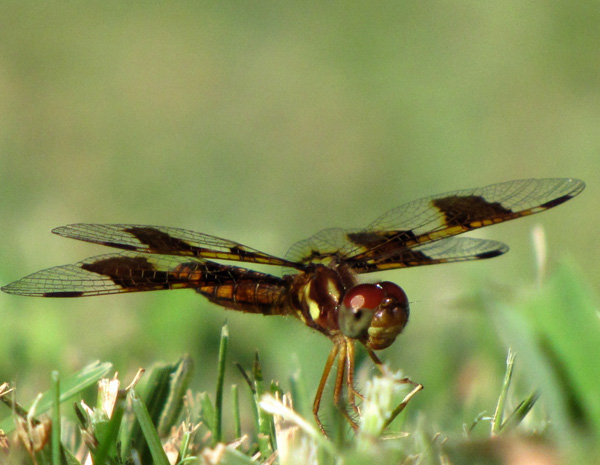
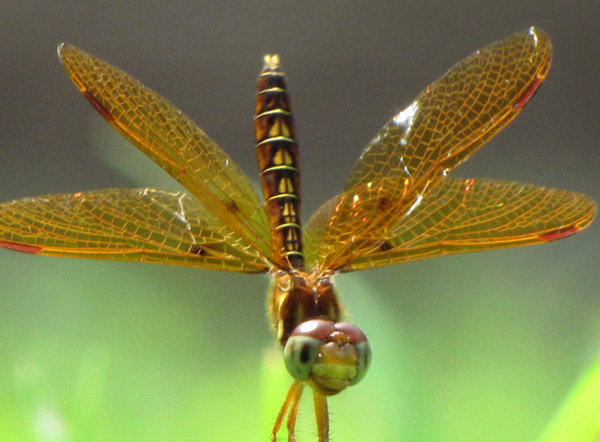
Eastern Amberwing Dragonflies

I want a dragonfly field guide, though I suspect many of my dragonfly photos would defy identification.

Dragonfly identification seems to depend, in large part, on minutiae. “Major” identifying characteristics include eye configuration and wing vein patterns, details that are hard to spot as a dragonfly zips past. Even when they perch, allowing close inspection of eyes and wings, they seldom give me enough time to catalogue the minor variations of thorax and abdomen that are key in separating related species. In some cases, identification is further complicated by differences between males and females.

The more I learn, the less I know. Now, every time I photograph a dragonfly, I want to say, “Pardon me, but could you turn to your left? Your right? Raise your wings a bit? Yes. Very good… Now, here’s a pen. Please write down your name.”

I don’t know why I haven’t given up. Even my successes feel incomplete. Every identification is tentative. I can never say, with complete confidence, “These are Eastern Amberwing dragonflies.” I’ll always need to add, “Please correct me, if I am wrong.”
Bees!

Bees everywhere. Sparring in the irises. Lurking on the back door handle (ouch!). Patrolling the newly cut grass. Mostly, however, they are in the pear tree.

There’s a varied crop of weeds, should the bees grow weary of pear nectar.

And, should my camera grow tired of bees, there are plenty of other visitors in the yard. I hope these two decide to stay. I would love a nest to watch!

Inspiration and Happy Accidents

This crocus is a bit late because it had to penetrate the husks of last year’s ginger lilies. Most of my poems happen like this, sprouting in the dark. Pale, nebulous tendrils of urgency. A few die in this phase, too weak to persevere. Others toughen in time, burrowing through sheaves of revision. They emerge with varying degrees of definition and emphasis. The best ones bloom.

One of my recent poems followed a much different course.

A few days ago, I watched part of a program about ancient gods. The segment dealt with Medusa. Later in the day, unable to get Medusa off my mind, I googled her. I chose the first link, which was Wikipedia. Then I clicked another link, and another, and another, straying through topics that eventually had nothing to do with Medusa. I tired of links before I tired of reading, and my mouse wandered into a cache of poetry bookmarks. I soon landed on the vox poetica prompts page.*

The current prompt reverberated for me. Until that moment, my rambling Medusa research had yielded only a vague field of oscillating ideas. The photo collapsed it into a poem particle, which coalesced, with very little input on my part, into “Ceto, in Decline, Calls Out to Medusa”. It’s the rarest type of poem, in my world. One that writes itself and requires only fidgety revisions to clarify meaning and capitalize on sound. (It will remain posted on the prompts page until the prompt changes.)

I’m always delighted by creations, like the Medusa poem, that occur as random accidents. Like this robin photo, which was a mistake, a miscalculation of light that produced an image I could never have planned. I’m happy to live in such a world, where serendipity matters.

* If you aren’t familiar with vox poetica, I recommend setting aside some time to explore. Publisher Annmarie Lockhart is a tireless advocate for poetry and poets. Her website is a treasure. There’s a new poem every day, an archived poemblog, links to her blog talk radio show, and a number of different ways to contribute. If you write poetry, why not submit something?

Gaia

Fiery breath roils through mantle bronchi
Flares forth from volcanic vents
Seamed between scales of shale

Into troposphere lungs, which are sky
Flora and fauna the intricate web
Of capillary

A delicate matrix, venule and arteriole
Mating to pass molecular necessities
From one organ to the next

From the dense liver that is land
The massive seven-lobed filter
Swollen with blood and bile

To the estuarine inlets of kidney
Loops of salt gradient and chemical pump
And pulsing tides, heartbeat wrung by the moon

To the alimentary marshes
Where everything rots and is passed
Down the vital chain, back into earth

Subducted deep underground
As one plate heaves its bulk atop another
In a colossal copulation that seeds nothing

But is felt by the unrenewable ones
The wingless ones who crave
Solace and brilliance and ecstasy

A brief moment in Gaia’s hungry mind
To glimpse her ancient memories
Before time passes down the vital chain

Limits

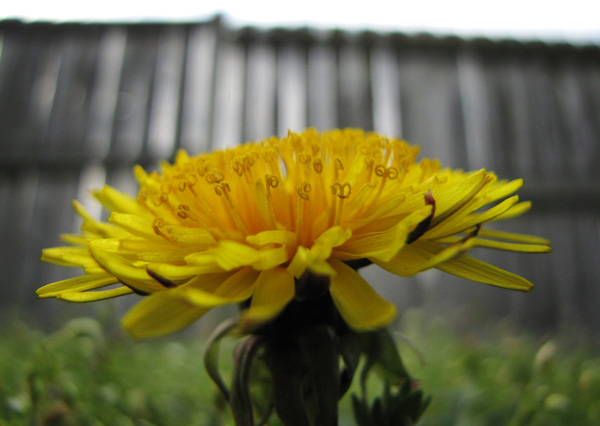
Dandelions? I’m eternally fascinated with them.

Purple Dead-nettle? I think it’s beautiful

However, even I have limits. Thistles are tough on my bare feet and the dog’s tender toes.

And ants? I don’t mind them in the yard, but they’re never content to stay in the yard. They always want to move into the garage, or the kitchen, or the mailbox…

But it’s good to have limits, isn’t it? Otherwise life would dissolve into a mad, messy carnival of happiness.

Hm.

On the other hand, thistles are quite pretty…