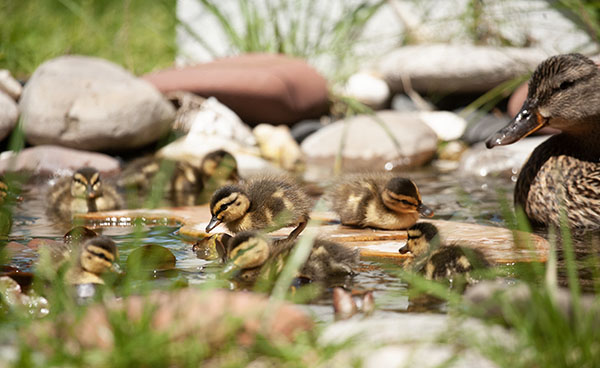
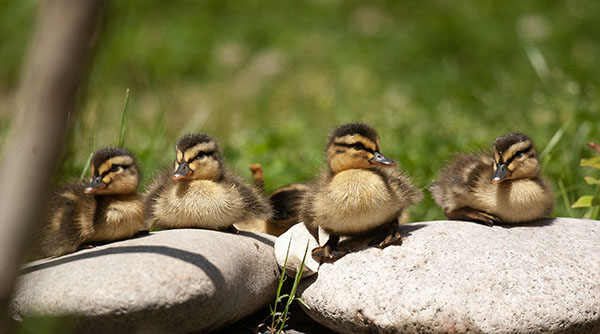
Focusing on Mallards Part V: Hunting by the Numbers

Content Warning: This multi-part blog post contains references to hunting, agriculture, and research practices of killing birds. This installment contains a photograph of a duck hunter with his kills—a pair of dead Mallards. If you choose not to read on, I respect and admire your choice.
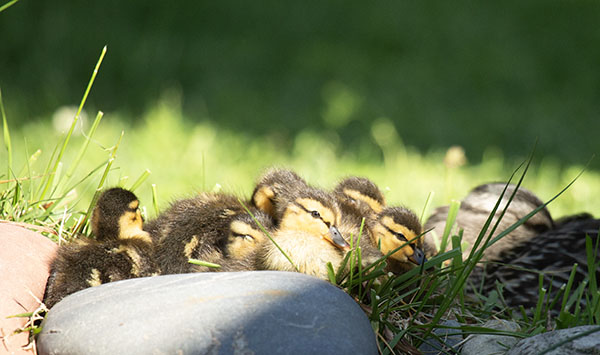
Photograph of a brood of Mallard ducklings huddled for a nap in the sunshine. The downy ducklings are yellow and brown with prominent eye stripes. Their mother is sleeping behind them, beak tucked under her wing feathers. Her feathers are shades of tan and gray, and she also has a prominent eye stripe. All are gathered on the stone border surrounding our dragonfly pond.
Photograph of a huddle of Mallard ducklings resting in the sunshine on the stone border of our dragonfly pond. Their mother is just behind them (right of frame).

Like most of my blog journeys, this long perseveration on Mallards started with questions about a visitor in the yard: What happens to a Mallard hen’s flight muscles while she is nesting? If she spends a flightless month on the nest, then two more flightless months escorting her flightless ducklings, how does she keep her muscles in flying condition?

A Mallard hen stretches her wings after a splashy bath in a small backyard dragonfly pond. She is standing tall in the water, facing the camera, wings extended behind her. Her feathers are mostly speckled and striped shades of brown with bright white coloration on the underside of her wing feathers. A round, floating solar-powered fountain is spending up a small spray of water (left). An array of water plants are growing in the pond, including water lilies. Tall irises and grasses grow around the pond's river-stone border, filling the background with greenery.
Photo of the Mallard hen who inspired this blog series. In this photo, she is standing tall in the dragonfly pond, facing the camera as she flaps vigorously after a splashy bath.

A prolonged literature search produced partial answers. And raised more questions.

In the end, a research paper out of North Dakota (Krapu, 1981) confirmed that wild Mallard hens lose significant body weight during nesting, including most of their fat reserves. But the researchers did not measure or comment on flight muscles.

Beyond that 1981 anchor point, my flight muscle question lies abandoned, waiting for another researcher or reader to pick it up. Until then, I’m content with Part III‘s conclusion: Only the Mallards know.

Photo of a Mallard hen standing in a shallow spot in the dragonfly pond. Her brood of ducklings are gathered beside her. The hen's feathers are shiny and sleek, speckled brown and tan. The ducklings are downy with brown and yellow markings. Both hen and ducklings have the prominent dark eye stripe common to Mallards. In the background, large smooth river stones are stacked loosely around the pond's border. A pair of conch shells are visible, incorporated into the border.
Photo of a different Mallard hen, one who visited in the spring of this year (2025), resting in the dragonfly pond with her ducklings. She was wary of me and my camera and taught her ducklings to be wary as well. This is how wild Mallard ducklings learn to be wild Mallards. Usually. Later in this series I will introduce some exceptions.

Caught in tangles of tangents

I can’t resist tangents. They are how my world expands. And how my mind works, OCD and all. So here I am, more than a year later, still exploring this labyrinthine idea web of Mallards and Mallard literature.

But this particular perseveration, my Mallard fixation, runs deeper than most of my blog ideas. In fact, it runs straight into a mire of social and psychological issues that I am poorly equipped to navigate. So here I remain. Grappling for words and wisdom in the Mallard archives. Because much of what motivates me to care about this world, much of what motivates me to read and write, is also in the Mallard archives.

Sharp black-and-white image scanned from a slide. The image dates to the 1970s, and shows me as a pre-adolescent. I am squatting behind a smallish round wire cage, which has a leather carrying strap. I am holding onto the wires of the cage and peering into the distance. My body language and facial expression suggest that I am misbehaving and trying not to get caught. Inside the cage, a speckled white and gray duck is panting or vocalizing, beak open. The duck is too large for the cramped cage.
Photograph of me in some awkward childhood era, caught coveting a duck at some fair or other event. I was attempting to stay small and inconspicuous behind the big fancy duck, so that Mother wouldn’t catch me coveting.

In all of the decades between the anxious moment captured, above, and my present seat at the blog table, I’ve lived in the tensions between mine and not-mine. Between the coop and the wetlands. Between the self-protective urge to stay small and inconspicuous and the inescapable longing for expansive connections.

I expect most readers live in the same tensions. It’s part of being human. It is, perhaps, part of being Mallard, as well.

Photo of five Mallard ducklings climbing onto the border of the dragonfly pond while their mother watches from the water. Four of the ducklings are immediately visible, center frame, but the fifth is partially hidden behind a clump of short grass. The ducklings are downy with yellow and brown markings. One has tiny water droplets clinging to its head and neck.
Photo of five ducklings climbing out of the dragonfly pond while their mother keeps watch from her position in the water. The fifth duckling is small and inconspicuous, hidden behind a tuft of grass on the right.

Out of my comfort zone

These Mallard posts have turned into foundation work for a policy argument.

(Spoiler alert: I am not crafting an argument against hunting.)

Policy arguments are not my norm and most definitely are not my creative strength. But I’m wading in.

I’m wading in without a map or floatation device, hoping for the kind of synergy that sometimes makes words more wise than their author. Hoping for fewer small and inconspicuous silences.

Photo of a Mallard duckling peering over the stone border of the dragonfly pond. This photo was taken at ground level, so the duckling's head is only partially visible over the stones, concentrating focus on the duckling's eye. A second duckling's rounded back, fluffy with down, appears to the far right of the frame.
Photo of a duckling peeking over the border of the dragonfly pond. The duckling has downy markings of yellow and brown and has the exaggerated forehead and eye proportions of infant cuteness.

I grew up around poultry, both wild and domestic. I also grew up around guns and hunting. Through all my many long years, I have accepted, unquestioning, most of the arguments in favor of hunting as both a sport and a science-backed approach to wildlife management and conservation.

I still accept some of these arguments. But I’m developing deep resistance to others. Resistance based on all of this reading about the history and practices of Mallard hunting and conservation.

(Let me repeat that spoiler: I am not crafting an argument against hunting.)
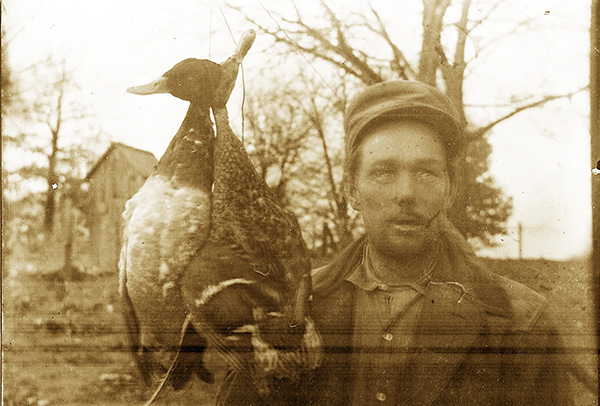
Blurry sepia-toned photo of a man standing beside two dead Mallards, which are hanging from a string or wire so that they are at head-height. The man is wearing a brimmed hat, a buttoned-up shirt with a rumpled collar, and a padded coat that appears to be made of canvas or similar material. The Mallards are male and female, judging by their plumage, and one of the female's wings hangs in way that suggests the wing was broken when she was shot. The outdoor scene shows trees that have lost their leaves for winter and a very small wooden outbuilding with a tin roof. The outbuilding looks to me like an outhouse or smoke shed.
Photo of an unknown man posing with two dead Mallards. One of the Mallards is in male plumage, the other in female plumage. I found this photo, which likely dates from the 1920s or 30s, in an album belonging to a great aunt. Based on labelling of a companion photo, the man’s name was Harry Kenyon. I don’t know how or why he ended up in Aunt Birdie’s album.

I’m not comfortable arguing policy, which means there will be throat clearing and wandering off-topic. I am, after all, a blogger. Not a lobbyist. A poet, not a lawmaker. I seldom demand rhetorical precision of myself, in my creative work. Which is part of why I enjoy blogging. Rhetorical precision is for the classroom and office, not the blog.

But there are upsides to making this argument in blog form. There’s freedom from structure and stricture. My hybrid interweaving of literature review and memoir is choice, not style guide. More importantly, there’s no peer review. I am my own editor and publisher, so I’m allowed to make overt appeals to emotion. Including photos and videos of ducklings.

These photo and videos are my unsubtle attempt to convince readers that ducks are stakeholders in policy discussions about waterfowl hunting.

Photo of a Mallard hen leading her ducklings out of the dragonfly pond. All are standing on a section of flagstone set level into the yard. In the background are a coiled green hose and an orange, plastic, five-gallon bucket stamped with white lettering reading "Let's do this" in all-caps. The Mallard hen is maybe a foot tall and has mostly brown feathers edged with tan, except for a patch of blue edged with black and white on her wing. The ducklings are maybe three or four inches tall and have downy feathers with yellow and brown markings. There are seven ducklings readily visible, though they are difficult to count due to how they are crowded together. (In all, this hen had eleven ducklings.)
Photo of a Mallard hen and her ducklings exiting the dragonfly pond in spring, 2025. In the background, a bright orange bucket is stamped with the big-box slogan “Let’s do this”.

Sport hunting is a profitable mine, and Mallards are a form of ore

Unlike many of my blog topics, Mallard hunting isn’t a rabbit hole. It’s a multi-level, vastly profitable mine regulated by international treaties and cooperative relationships between state and federal agencies.

Everything in the Mallard mine is complicated by tradition and money and land.

This isn’t about the flight muscles

I introduced a few ideas about the capitalism behind the science curtain in Part II. And where Mallards are concerned, science isn’t the only interested party. Mallard hunting (and farming) is not an independent storefront on the town square. This is big business and big money, so big policy questions come into play.

Who owns wildlife, on public and private lands? Who gets to decide how wildlife is exploited, on public and private lands? When is wildlife no longer wild? (Keep inserting “on public and private lands”, as the questions roll on…) What are the roles and aims of conservation work? Who gets to own and discharge firearms? Why and how are tradition and research guiding individual and community decision making, when it comes to hunting?

This isn’t about flight muscles.

Except, isn’t it?

Mallards are poultry. And once Mallards are defined as poultry, once flight muscles are defined as breast meat, Mallard hunting is only about the flight muscles. Wild Mallards are protein harvested by shotgun.

Photo of a Mallard hen grazing through a helping of wild bird seed that I scattered into the grass (and weeds) just beside the dragonfly pond. Her eleven ducklings are either watching her eat or beginning to wander back toward the pond. 
They sampled the seed but didn't eat much.
Photo of a Mallard hen eating bird seed. She is surrounded by her eleven ducklings. The ducklings sampled the seed but were unimpressed.

Just how big is this business?

A 2006 survey from the US Fish & Wildlife Service (USFWS) found that “…waterfowl hunters represented 10 percent of all hunters, 7 percent of all hunting-related expenditures, and 6 percent of all hunting equipment expenditures” (Carver, 2008, pg. 3).

Here’s the waterfowl hunting numbers for 2006 (derived from Carver, 2008, Table 1, p. 4):

Number of US hunters (ducks)1,147,000
Number of US hunters (geese)700,000
Number of US hunters (all waterfowl)1,306,000
Reported US trip expenditures (waterfowl)$493,987,000
Reported US equipment expenditures (waterfowl)$406,298,000
Total US spending (waterfowl)$900,285,000

Those zeros are not a typo. That’s over nine hundred million dollars spent, in 2006, on hunting ducks, geese, and other waterfowl. While more than half of those dollars went to the travel industry, some four hundred million dollars were non-travel purchases, including “rifles, shotguns, other firearms, ammunition, telescopic sights, decoys, hunting dogs and associated costs. Also included are auxiliary equipment such as camping equipments, binoculars, special hunting clothing, processing and taxidermy costs. Due to small sample sizes, special equipment purchases such as boats, campers, trucks, and cabins are excluded…” (Carver, 2008, Table 1, pg. 4).

The author of this report adjusted the economic impact of waterfowl hunting through input–output modeling, to estimate how this spending radiates through the economy: “The trip expenditures of $494 million by waterfowl hunters generated $1.2 billion in total output while equipment expenditures of $406 million generated $1.1 billion in total output in the United States” (Carver, 2008, pg. 10).

So it’s fair to say that waterfowl hunting is a multi-billion dollar industry, in the US. That’s multi-billion per year. And Mallard hunting is a massive chunk of that industry. “Hunter reports indicate that mallards made up about 43% (5.5 million annually) of the ducks taken before 1960, when mallard regulations were less restrictive; the Duck Wing Survey indicates that mallards have made up 33% of the harvest (3.6 million annually) since 1960″ (Martin & Carney, 1977, p. IX).
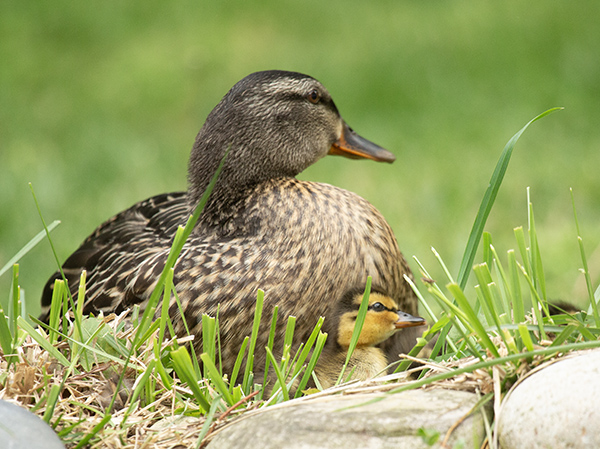
Photo of a Mallard hen settling for a rest beside the dragonfly pond. In this phot0, most of her ducklings were hidden beneath her, tucked into the feathers of her chest and abdomen. One duckling has not settled, yet, and is standing just under her neck, looking around. Another duckling is barely visible to the right of frame, mostly hidden by a tuft of short, cut grass.
Photo of a Mallard hen settling for a nap with her ducklings beside the dragonfly pond in spring, 2025. Tucked beneath her chest, one duckling has raised its head to look around.

Given the money spent on hunting ducks, geese, and other waterfowl, it’s not a surprise that “…waterfowl hunting is positively correlated with income. That is, as household income increases, the percentage of waterfowl hunters for each group also increases. Income is also positively correlated with the participation rate of all hunters. However, all hunters do not tend to be as affluent as waterfowl hunters” (Carver, 2008, pg. 6).

This is not subsistence hunting. For the majority of duck hunters in the US, suspension of duck season would not equate to food insecurity. Yes, many hunters eat the ducks they kill. But they would still be able to eat, even if they killed no ducks.

How many Mallards are there, anyway?

Efforts to count the continent’s ducks began as early as the 1940s, when researchers tramped out into the marshes for hand counts. Then pilots joined the work, providing population estimates (and species distributions) for flocks spotted during aerial flyovers. Hunter surveys, requesting that hunters report how many and what kinds of ducks have been killed in the season, add a final dimension of data. At the confluence of these ongoing data streams, USFWS calculates Mallard “abundance”, which isn’t exactly a population count but is close enough for my purposes.

As of 1974, “The estimated size of the continental mallard population in May has ranged from a high of 14.4 million in 1958 to a low of 7.1 million in 1965. Generally, the mallard population began to decline after the 1958 peak until 1962, and remained below 10 million birds until 1970. The decline and consequent low level of the mallard population between 1959 and 1969 generally coincides with a period of poor habitat conditions on the major breeding grounds” (Pospahala, Anderson, & Henney, p. 49).

Over more recent decades (from 1992–2024) the “mid-continent” stock of US Mallards has ranged between 6.2 million and 11.9 million (USFWS, 2024, p. 12). (There are management purposes at work, in this focus on “mid-continent” Mallards, which I will get to later.)

Photo of a Mallard hen standing in a shallow place in the dragonfly pond. Her ducklings are gathered in the water, beside her. Her head is tipped slightly to her left, right eye angled toward the sky in search of aerial predators. Anthropomorphized, her head angle and expression look questioning.
Photo of a Mallard hen and her ducklings in the dragonfly pond, taking a brief break from their wanderings in the spring of 2025.

In 2024, Mallard abundance in the US registered some 6.6 million. In 2023, about 6.1 million (USFWS, 2024, p. iii).

With recent numbers hovering near the low end of the 1992–2024 Mallard abundance range, and below the lowest 1960s numbers, it seems that the Mallard glass is currently half-empty. But if accounts from the late 1800s and early 1900s are accurate, the North American Mallard glass has been half-empty for over a century. (Drop a pin in this claim. There will be evidence later.)

Where do North American Mallards come from, and where do they go?

Continental Mallard production can vary wildly over a very short span of years. For example, 1957 produced a count of 22.1 million Mallard “young”, but 1961 saw only 5.9 million (Anderson, 1975, p. 33). Granted, it’s difficult to count Mallard young, but there was undoubtedly a major decline between 1957 and 1961.

By the 1970s, it was clear that Mallard production was related to the number of ponds in Mallards’ breeding grounds. (Here is where that focus on mid-continent Mallards starts to become important, as the largest and most productive breeding grounds are in the north and central portions of North America, in “prairie pothole” country.) And, prior to 1960, the number of ponds steadily declined everywhere. But habitat was never the only factor.

Nesting season and shooting season

The existence of a “long-term average” population number for Mallards, of around 7.9 million (USFWS, 2024, p. iii), flattens into stasis a seasonally dynamic population. Spring and summer are boom and winnow seasons. Some 75% of Mallard mortality occurs in first-year ducks, either in the nest or during the weeks immediately after hatching, before young birds learn to fly (Anderson, 1975, p. IX). Then fall and winter bring the hunter’s guns.

“…it may be predicted that about 60 out of every 100 mallards flying south along the Mississippi Flyway will be hit by shot” (Bellrose, 1953, p. 358-359).
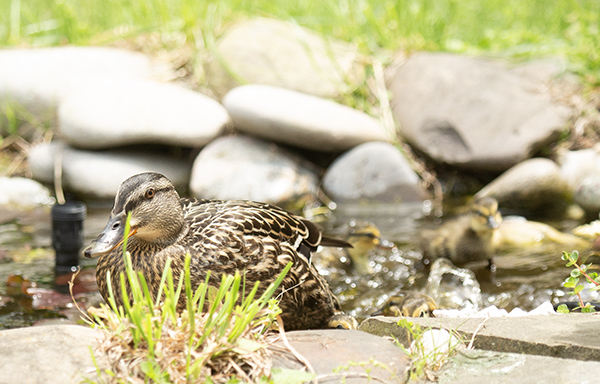
Photo of a Mallard hen just stepping up onto the stone border of the dragonfly pond. In the background, splashes and sprays of water fill the air, churned up by her recent splashy bath and the excited actions of her ducklings.
Photo of a Mallard hen getting ready to climb out of the dragonfly pond. Behind her, ducklings are splashing and playing in the water.

After Mallards survive their first summer, death by shotgun accounts for a significant percentage of overall Mallard mortality. Of the adult males that die each year, about 50% die by shotgun (Anderson, 1975, p. 24). The percentages are slightly lower for females (40%) and first-year Mallards (45%) (Anderson, 1975, p. 24).

Given all these shotguns, and all of the other Mallard hazards out there, the majority of Mallards that survive their first summer do not live more than two adult winters (Anderson, 1975, p. IX). That doesn’t mean that a three-year-old Mallard is an old Mallard, only that it is a lucky Mallard. Even luckier Mallards have lived as long as 13 years in the wild (a few female Mallards), and one particularly charmed male Mallard survived 18 years (Anderson, 1975, p. 26).

Harvest by shotgun

In the US, prior to 1960 hunters bagged some 5.5 million Mallards every year (Martin & Carney, 1977, p. IX). It’s worth repeating that number: 5.5 million Mallards. Every year.

After hunting regulations were tightened in 1960, the Mallard kill dropped to about 3.6 million per year (Martin & Carney, 1977, p. IX). Such numbers fluctuate, of course, and have dropped somewhat further since the 1970s. But hunting still claims millions of Mallards, each year. USFWS estimated a Mallard harvest of 2,042,668 birds, in 2022 (USFWS, 2023, Table 1E, p. 25).

Up through the 1970s, close to a quarter of the entire North American Mallard population was killed by hunters, every year (Anderson & Burnham, 1976, p. 40).

Based on the numbers previously cited for 2022 (2,042,668 Mallards killed by hunters) and 2023 (estimated population of 6.1 million), it seems that perhaps one-third of the US Mallard population continues to die by shotgun every year.

Overkill?

Only a few paragraphs ago, the USFWS estimated a 2024 Mallard population of 6.6 million. In 2024, a pre-1960 harvest (during years when harvests averaged 5.5 million ducks per year) would have obliterated the US population of Mallards.

In fact, the pre-1960s binges, on top of widespread habitat destruction, dealt multiple near-obliteration blows to North American Mallards. Starting early in the 1900s, hunters and researchers agreed that something needed to be done to save the Mallards. At least, they agreed that something needed to be done to save Mallard hunting.

The first (documented) North American Mallard bottleneck, circa 1920

Prior to the 1900s, hunters spoke of North America’s duck populations in awe-tinged phrases.

“It is about the finest country you could imagine in the wildest flights of fancy; Ducks getting up under your feet at every yard; Hawks, Goatsuckers, Prairie Chickens, and small birds in all directions… I shot a Teal and a splendid Shoveller drake for the pot. I can fancy I hear you exclaiming against the barbarism of eating such a bird; but I am getting daily accustomed to birds which are considered rare in England, and regard them now from a more utilitarian point of view” (Wood, 1885, p. 225).

“During this autumnal movement the number of ducks frequenting the lakes and ponds throughout Manitoba is prodigious. I shall not soon forget the hundreds I saw on the innumerable ponds between Rapid City and the Oak River, whilst on an excursion towards Fort Ellice, in the middle of October, 1883. Yet those I saw must have been as nothing compared with the abundance to be seen in some other places. A friend who had several days’ shooting at Totogon, near the south end of Lake Manitoba, about the end of September, describes the ducks as being so numerous that only the terms ‘acres’ and ‘millions’ could adequately express their abundance. The majority were Mallards, Anas boscas…” (Christy, 1885, p. 133).

By the 1920s, Mallards populations had declined to a notable low:

“The duck marshes on the Saginaw River no longer teem with water fowl. In early September and before the first frost the cackle of the Carolina rail is on every hand. These little birds—the Sora, seem as plentiful as ever, so I have not given up the marshes of the Saginaw entirely, but once or twice in the early part of September I get out the old canoe and with Alphonse to paddle or push, I take the trip through several miles of the Cheboyganning rice beds and usually get what the law allows of rail shooting, but in making all of this distance through acres and acres of rice, one or two ducks is all I see in place of the thousands of old” (Mershon, 1923, p. 73).

And this is where I leave the Mallards, for now. A poor remnant of a once thriving species, scarce and growing scarcer into the 1920s. In the next post, help arrives.
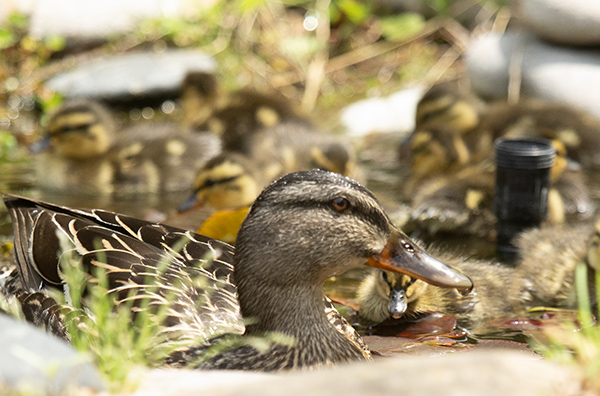
Photo of a Mallard hen and her ducklings in the dragonfly pond. Taken along ground level, the photo shows the hen's head and neck and back, with a blurred foreground of stone blocking the rest of her. Framed under the arch of her neck and chin, one of her ducklings is in sharp focus, facing the camera.
Photo of a Mallard hen and her ducklings exploring the dragonfly pond in spring, 2025. Here the hen is in the foreground and one of her ducklings is framed by her silhouette.

A housekeeping note (or, rather, a territory-keeping note)

Throughout this post, I’ve switched back and forth between talking about North American Mallards and US Mallards without much fanfare. Doesn’t it sound presumptuous? It’s almost as if I have forgotten that there are other countries on the continent. (Doesn’t it sound familiar?)

But from here on out, I’ll need to take more care. Because, starting in the early 1900s, lawmakers and researchers divvied up North America’s Mallards. There were, and still are, jurisdictions and flyways. More importantly, genetic work has identified two discreet and rarely-intermixing populations of Mallards, an eastern gene group and a western gene group (Lavretsky, Janzen, & McCracken, 2019). And my particular policy argument involves eastern Mallards, alone.

Preview of Part VI: The US judicial branch decides who owns the Mallards that visit US lands, and funding arrives for conservation

As long as there were plenty of Mallards, everywhere, distinctions between North American and US Mallards were moot. But as Mallard populations dwindled, hunters came into conflict over who got to shoot the Mallards that remained. And with increasing scarcity came increasing value, along with politicians to squabble over resource ownership.

The problem was (and still is, to a certain extent) that Mallards have always migrated according to their own maps, which existed long before humans decided that land could be owned. Given that the North American Mallard mine spans three (or more) countries, including most of the states in each country, and that Mallards are valuable ore, who owns the profit? Who gets to harvest this particular protein, and how should they be allowed to market it?

North American Mallards as a species have continued breeding and migrating, and US Mallards as a resource have continued falling into hunters’ bags, but the species and resource exist on two seemingly separate planes.

Oliver Wendell Holmes summed it up succinctly, in a landmark case that upheld the 1918 Migratory Bird Treaty: “The whole foundation of the State’s rights is the presence within their jurisdiction of birds that yesterday had not arrived, tomorrow may be in another State and in a week a thousand miles away” (Missouri v. Holland, 1920, para. 6).
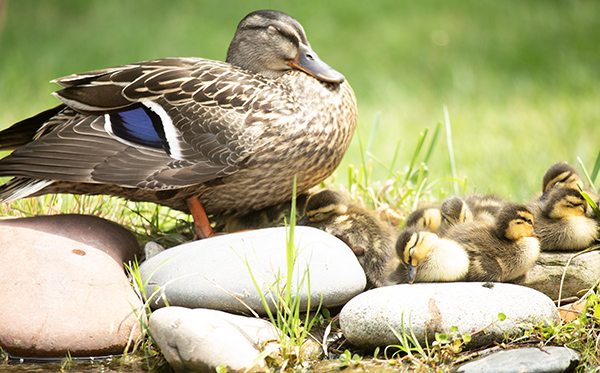
Photo of a Mallard hen drifting off to sleep while still standing. She is perched on the sunlit, stony border of our dragonfly pond. Her brood of ducklings are scattered under and in front of her, most in different sleep poses. One duckling is still awake, though visibly drowsy with half-closed eyes. Another duckling is barely balanced on the edge of a rounded, smooth stone, and appears on the verge of falling off backwards. Yet another duckling has nodded off with its neck bent and the tip of its beak just touching the sun-warmed rock.
Photo of a Mallard hen resting (asleep while standing up) on the stone border of the dragonfly pond in spring, 2025. Her ducklings are napping in a loose cuddle-heap, sprawled from just under her chest to almost a foot away. Some of the ducklings are slumped awkwardly in sleep, exhausted from their first hours off the nest, while others are fidgeting for a more comfortable position.

References

Anderson, D.R. (1975). Population ecology of the Mallard: V. Temporal and geographic estimates of survival, recovery, and harvest rates. Resource Publication 125. U.S. Department of the Interior, Fish and Wildlife Service. https://nwrc.contentdm.oclc.org/digital/collection/p16473coll29/id/4786

Anderson, D. R., & Burnham, K. P. (1976). Population ecology of the Mallard. VI: The effect of exploitation on survival. Resource Publication 128. U. S. Department of Interior, Fish and Wildlife Service. https://nwrc.contentdm.oclc.org/digital/collection/p16473coll29/id/4899

Bellrose, F. C. (1953). A preliminary evaluation of cripple losses in waterfowl. In James B. Trefethen (Ed.) Transactions of the Eighteenth North American Wildlife and Natural Resources Conference (pp. 337-360). The Wildlife Management Institute. https://wildlifemanagement.institute/conference/transactions/1953

Carver, E. (2008). Economic impact of waterfowl hunting in the United States: Addendum to the 2006 national survey of fishing, hunting, and wildlife-associated recreation. U. S. Fish and Wildlife Services. https://www.fws.gov/sites/default/files/documents/2024-04/1153.pdf

Christy, R. M. (1885). Notes on the birds of Manitoba. The Zoologist: A Monthly Journal of Natural History, 3rd Series, IX(100). https://ia801303.us.archive.org/27/items/zoologist85lond/zoologist85lond.pdf

Gillham, C. E. (1947). Wildfowling can be saved. In Ethel M. Quee (Ed.), Transactions of the Twelfth North American Wildlife and Natural Resources Conference (pp. 47-52). The Wildlife Management Institute. https://wildlifemanagement.institute/conference/transactions/1947

Krapu, G. L. (1981) The role of nutrient reserves in Mallard reproduction. The Auk 98, 29-38. doi: 10.1093/auk/98.1.29

Lavretsky, P., Janzen, T., & McCracken, K. G. (2019). Identifying hybrids and the genomics of hybridization: Mallards and American Black Ducks of Eastern North America. Ecology and Evolution (9), 3470–3490. DOI: 10.1002/ece3.4981 https://onlinelibrary.wiley.com/doi/full/10.1002/ece3.4981

Martin, E.M., & Carney, S.M. (1977). Population ecology of the Mallard: IV. A review of duck hunting regulations, activity, and success with special reference to the Mallard. Resource Publication 130. U.S. Fish and Wildlife Service. https://pubs.usgs.gov/unnumbered/5230112/report.pdf

Mershon, W. B. (1923). Recollections of My Fifty Years Hunting and Fishing. The Stratford Company. https://archive.org/details/recollectionsofm00mers_0

Missouri v. Holland, 252 U.S. 416. (1920). https://www.law.cornell.edu/supremecourt/text/252/416

Organ, J. F., Mahoney, S. P., & Geist, V. (2010). Born in the hands of hunters: The North American model of wildlife conservation. The Wildlife Professional 4(3), 22-27. https://www.researchgate.net/publication/267749137_Born_in_the_hands_of_hunters_the_North_American_Model_of_Wildlife_Conservation

Pospahala, R. S., Anderson, D. R., & Henney, C. J. (1974). Population ecology of the mallard. II: Breeding and habitat conditions, size of the breeding populations, and production indices. Resource Publication 115. U.S. Department of Interior, Fish and Wildlife Service, Bureau of Sport Fisheries and Wildlife. https://nwrc.contentdm.oclc.org/digital/collection/p16473coll29/id/10213/rec/1

USFWS (2023). Migratory Bird Hunting Activity and Harvest during the 2021–2022 and 2022–2023 Hunting Seasons. USFWS. https://www.fws.gov/sites/default/files/documents/migratory-bird-hunting-activity-and-harvest-report-2021-to-2022-and-2022-to-2023.pdf

USFWS (2024). Waterfowl Population Status, 2024. US Department of the Interior. https://www.fws.gov/sites/default/files/documents/2024-08/waterfowl-population-status-report-2024.pdf

Wood, T. B. (1885). Notes on the zoology of Manitoba. The Zoologist: A Monthly Journal of Natural History, 3rd Series, IX(100). https://ia801303.us.archive.org/27/items/zoologist85lond/zoologist85lond.pdf

The Unwild Mallards

Each spring, our semi-wild population of suburb mallards leave their lakes, ponds, and canals in search of private nesting habitats. This local migration often brings pairs of mallards to the yard, though none have stayed to nest. Until this year.

In this photo, taken April 29, five baby mallards huddle under their mother as she stands on a rock beside our pond. A sixth baby sits on the next rock over. These mallard ducklings were less than 18 hours out of the egg and are only half of the clutch. Six more babies were waiting in the nest behind their siblings.

Less than a week after I posted about the dragonfly pond, a pair of mallards arrived and began redecorating the pond. They shoved rocks from the border, collapsed minnow caves, uprooted plants, stirred sediment into columns of mud, and added enough nutrient (in the form of duck poop) to start a massive algae bloom.

In this photo, taken March 3, a pair of semi-wild mallards visit the pond. The male mallard floats near the center of the pond, preening his wings, while the female searches for underwater food. The water is still relatively clear and the pond‘s rocks and plants are still somewhat in place.
This photo, taken March 7, shows the view from our kitchen window as the mallards nap in the pond. Both ducks have their heads resting along their backs, beaks tucked into the feathers between their wings. The water is turbid and dark, with scattered remnants of uprooted plants. The rocks are still mostly in place, though that didn’t last.
Photo of the pond, taken March 14, showing filthy greenish-brown water. The pond heater is still deployed, though I removed it shortly after. A board shaped like a fish floats in the far end of the pond.1

The dragonfly pond soon looked and smelled like a cattle pond.

The ducks ate everything they could catch in the water. Minnows and dragonfly larvae, damselfly larvae and snails. Anything that swam or wriggled.2

We shooed and herded the pond-wrecking mallards, who returned day after day for further wreckage. I complained to family and friends about the mallards’ destructive invasion, but I also hoped for a nest. Truth be told, I always hope for nests. Plus, I have nostalgic affection for ducks.

This photo3 shows me at some early elementary school age, complete with crooked bangs, ill-fitting shorts and halter top, knobby knees, and a welter of mosquito bites. I’m holding our pet duck Fred, who was very spoiled.
This photo, dated 1975, shows a group of mature white ducks in our Tennessee back yard.
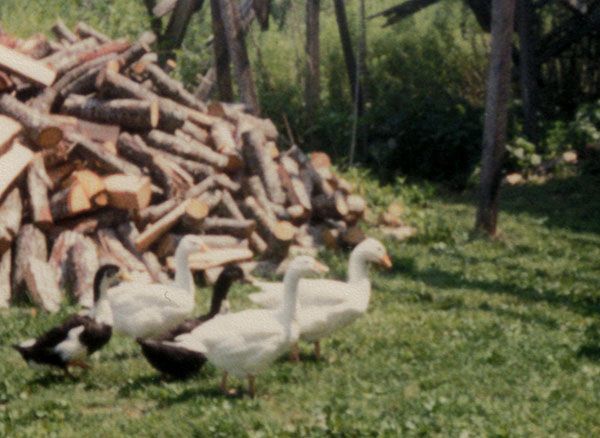
In this later photo, probably late 1980s, three white geese and two black-and-white ducks amble past a newly delivered cord of winter wood in our Tennessee yard.4
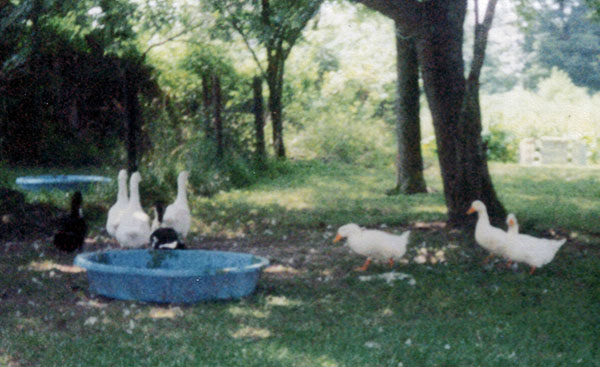
This photo, dating to the late 1980s or early 1990s, shows three white geese, two black-and-white ducks, and three white ducks visiting their blue plastic wading pool in our Tennessee back yard.5

Hoping to lure the mallards away from the pond for at least a few hours each day, I purchased a blue plastic wading pool (definitely a theme in my lifelong efforts to keep waterfowl happy) and an extra bag of wild bird feed. Pool and feed in hand, I set up a duck station near the fence in our Virginia back yard, including steps for easy entry into the pool. Then I herded the mallards out of the pond and toward the pool.

In this photo from March 12, a blue plastic wading pool is wedged into the back seat of my car. Many thanks to the very patient Target employee who brought the wading pool out for curbside pickup and helped load it while we both fought off fits of the giggles because who buys a wading pool in March? For ducks? While masking and social distancing because COVID is not over? (I’ll add that COVID is still not over. Especially for families, like mine, who have immunocompromised households.)

Not surprisingly, the mallards saw peril in the duck station and refused to try the wading pool. At that point, the pair were still semi-wild, after all. They retreated into the pollinator beds and rummaged through duff when I was in the yard, then circled back to the pond when I went inside.

And the pond grew more and more fetid. (I had almost forgotten the smell of our chicken house in Tennessee, and sometimes the yard when our flocks grew too populous, but now I’ve been reminded.)

In this photo from March 14, the male mallard watches warily from behind the irises that shore up one end of the pond. Neither of the mallards tried the wading pool until after I quit trying to convince them to try the wading pool.

When the female mallard built her nest in the irises and began laying, we stopped all efforts to shoo or herd or otherwise interfere. Almost immediately, the mallards took to the wading pool for luxurious sessions of bathing and splashing.

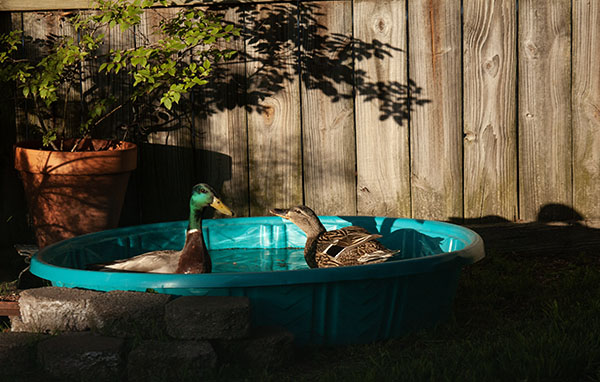
Photo from March 21, showing the female mallard bathing in the wading pool as the male mallard stands guard.
Photo, dated April 14, showing the female mallard bathing in the wading pool as the male mallard stands guard.
Photo, dated April 18, showing both mallards in the wading pool.

Resigned to a lengthy mallard residency, we invested in a pump and filter for the pond. For the next month, I cleaned the pond filter daily, dumped and refilled the wading pool every other day, put out feed each morning and evening, and lingered in the kitchen window for hours on end, watching. The mallards hunted in the pond (and further rearranged the rocks), bathed and basked in the wading pool, ate their feed and grazed through the yard, and generally unwilded until they were as comfortable in the yard as our domestic flocks had been in the yard of my childhood home.

And while the mallards unwilded, the nest grew.

Photo, dated March 20, of the nest with a single egg.
Photo, dated March 28, of the nest with five eggs.
Photo, dated April 1, of the nest with nine eggs.

On April 1, with nine eggs in the nest, the female mallard settled to incubating. Giving up all pretense of productivity, I sat in the kitchen window, day after day. While she sat on her nest. Day after day.

Photo, dated April 14, of the female mallard on her nest.
Photo, dated April 18, of the eggs nestled in layers of down.
Photo, dated April 18, of the female mallard on her nest.

And then, on April 28, the hatching commenced. All afternoon the mallard fidgeted and turned and tended, eating some of the discarded shells and membranes, tucking the rest under the nest’s foundation of dried grasses. By nightfall the nest was filled with ducklings instead of eggs.

In this photo, taken April 28, a freshly hatched mallard is nestled deep into the downy feathers lining the nest. The female mallard is half-standing in the nest, with two still-unhatched eggs visible beneath her.
Here a duckling, still damp from hatching, is just visible under the female mallard as she stands in her nest.
Here the ducklings are getting their first views of the world from inside their nest, still guarded by their mother.

I set my alarm for sunrise the next morning, certain that the female mallard would lead her brood away as soon as the hatchlings were mobile enough. I didn’t want to miss a moment of their brief stay in the yard.

April 29. The now-fluffy-and-dry baby mallards peer out from around their mother as the little family begins to stir in their nest.
The baby mallards follow their mother from the nest for their first outing. In this photo, two babies hover under their mother as she stands on the rocks just in front of the nest.
All twelve eggs hatched seemingly healthy babies. Their first clamber down the rocks was eager for some and timid for others. In this photo, one of the eager ducklings takes an awkwardly long step down from the first rock.
The eager duckling from the previous photo experiences a bit of a rough landing in the water. The impromptu dive didn’t phase the duckling, which swam busily away.
The more timid ducklings took more care climbing down from the nest. In this photo, a group of three ducklings linger on the first rock as one of their siblings stretches a careful foot down toward the next step.
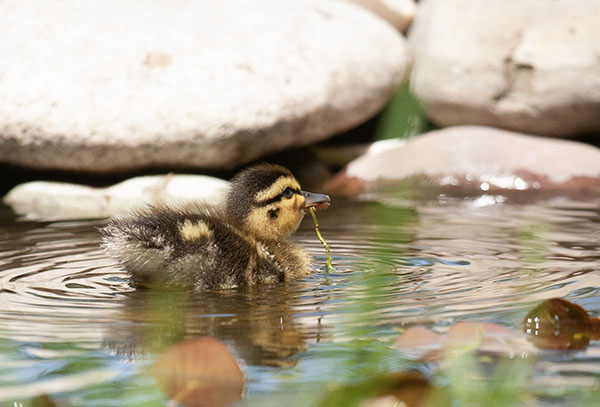
The ducklings tasted everything they found. Here, a baby mallard floats on the pond and nibbles at a long plant stem.
The fish-shaped board proved a popular resting spot for the ducklings as they practiced swimming and diving and eating. Here, two ducklings perch on the board while their siblings swim around them. The female mallard is just visible in frame, keeping an eye on her brood.
The ducklings also rested on the pond’s bordering rocks, which were warm from the sun. Here, four ducklings sit on the warm rocks.
A baby mallard, less than 24 hours out of the egg, perches on one of the warm rocks bordering our small dragonfly pond.
Exhausted after their first few swim lessons, the mallard family returned to their nest between adventures. Here, two of the babies have tipped over into awkward sleeping positions on the rocks while their siblings gather in the nest beneath the female mallard.

And, of course, they didn’t stay.

I followed the mallards as their mother led them out of the yard and down our street and through a playground and up the next street over to a house on a canal without a fenced back yard. The homeowner was working in his yard when our odd parade arrived, and he nodded and shrugged when I waved from the sidewalk across the street. He told me that mallard mothers lead their brood through his yard, the only unfenced yard along the canal, all spring long. They head for the canal despite its dangerous populations of snapping turtles, snakes, and bullfrogs large enough to eat a baby duck. We agreed that yards are safer but mallards need canals.

Then I trudged home alone, wishing for a world both more and less wild.

I was shocked when the mallard led her brood back, that evening. My husband saw them coming up the sidewalk and called for me. The female mallard had guided her dozen day-old ducklings out into the canal and back again, safe and tired. We opened the gate and welcomed them home, pond wreckage forever forgiven as the sleepy family spilled back into their nest.

The next morning they left for good, of course. The yard, for all of its unwild safety, is not meant for mallards. Nor are mallards meant for the yard.

They haven’t returned, and they won’t. At least, not as the same little family that left. But every mallard I see, for all my years to come, will be one of them.


The Unwild Mallards

The unwild mallards were stubborn and messy
Unwily in their need
And the pond was water enough for nesting

An unwild nest
In unwild irises

A quick meal and a bath
Then back to the nest

Days growing longer and hotter
In the unwild yard
With unwild waters

And then
The unwild dozen

That afternoon, they left
Then returned for one last night
Before they left for good

Heading toward the good wild waters
Where unwild mallards might learn
To be wild

Video comprised of still images and iPhone video clips of the mallards’ time in the yard. Text over the images repeats the poem printed above. The audio is a separate recording made in the yard as I edited this video. Traffic noise and wind dominate the audio, but crows and a blue jay make guest appearances.

Footnotes

1 We added the board after removing a commercial floating planter/island. We removed the island because it was ruined, then added the board because we felt sorry for the minnows that had enjoyed hanging out under the island. (Click here to go back.)

2 The ducks were not so efficient as to depopulate the minnows and invertebrates. I’m not certain how anything survived, between the feasting and the fouling, but some survived and carried on. Currently, the pond is teeming with baby minnows and every surface is clumped with snail eggs. (Click here to go back.)

3 This is another of my oldest sister’s “Rae with pets” series of photos, which span years and will likely continue to appear on this blog. In the background, two chickens and our shepherd make guest appearances. (Click here to go back.)

4 After our father left, the job of stacking wood fell to me. Mother purchased cut wood from a neighbor, who unloaded it in a heap. I would sort the wood by size and age, stacking it all in our pole shed. The freshest cuts went at the bottom of the pile (to age/cure) and the aged/cured wood at the top. The largest logs started at the left and the smallest kindling at the right. I even sorted the wood according to Mother’s lore: she believed that the hardest woods (usually hickory and oak) burned long and hot, the softer woods (often maple and hackberry, but sometimes others that I didn’t recognize) burned fast and cool, and the evergreens (pines and the occasional cedar) burned oily and deposited more creosote in the chimney. When bad weather was forecast, I brought days or weeks worth of wood to the porch, where it stayed drier than the shed. But Mother didn’t like keeping wood stacked on the porch because warm air escaping through the door woke the woodpile’s insects, who followed the warm air indoors. (I never had cause to doubt Mother’s wood fire lore and would likely stack wood by size and hardness, away from the porch, if we burned wood for heat today.) (Click here to go back.)

5 The wading pool was the closest thing they had to a pond. A second blue plastic wading pool, visible in the background, was in the dog pen and helped our dogs stay cool. The second pool also kept the dogs from digging under the fence because they wanted to play in water. (Click here to go back.)


I regret that I do not have a list of links, for this post, to articles and essays that are more important and more interesting than the small unfoldings in our small yard. I have been tired, of late, and taking a break from the larger world. I will resume reading and exploring and learning once I have regathered my energy, both emotional and physical. In the meantime, please post links of your own, to articles and essays that have helped you better understand the world. (Please also note that I screen comments.)