I never feed the rabbits on purpose. They are wild rabbits, not domestic.

It’s a weak argument, at best, because I often put out bird seed. Birds are wild, as are the squirrels who steal the bird seed. Why feed them, but avoid feeding rabbits? Also, as a reader noted in commenting on a previous post, rabbits sometimes graze on flowers. Recent developments have made me consider this fact in new light. How can I claim to “never feed the rabbits” if I am planting flowers the rabbits will eat?
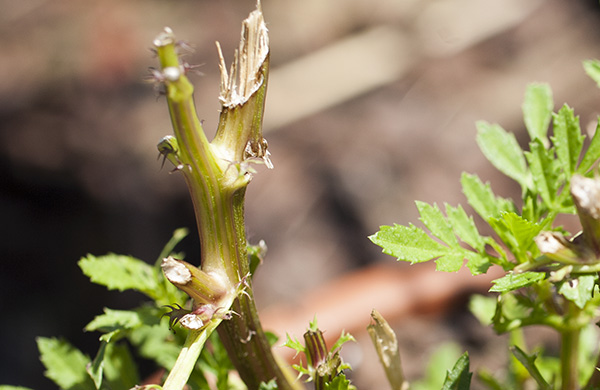
In past years the rabbits’ appetite for flowers has been low-impact, but this year’s toll is on the rise. By mid-July the victims included marigolds, rose of Sharon, succulents, a pair of ornamental sweet potato vines (which are in the process of recovering in a hanging basket), and coneflowers.


All of these losses were logged under “remember not to plant these again” and forgiven, until coneflowers entered the picture. Quite literally entered the picture, stoking my obsessive fascination with bees and bee photos.

I bought the summer’s first coneflower on a whim, trying to ignore foggy memories of a previous coneflower failure. For over a week I enjoyed an increasing spectacle of bee activity.

Then I woke one morning to a pitiful collection ruined coneflower parts. That afternoon, while a series of rabbits munched on the flower’s remains, I concocted a coneflowers-in-containers scheme. A short trip to the garden store later, I had a new bee-magnet planted out of the reach of rabbits. Or so I thought. Coneflowers, it seems, are irresistible rabbit treats. Containers that provided dependable rabbit-proofing in the past are no match for a motivated rabbit.
Deep in the grip of bee-mania, I returned to the garden store in search of a taller, better container. During that trip I bought two more coneflowers. I also bought tickseed and a hybrid black-eyed Susan, both labelled “deer resistant.”

As I’m sure any true gardener would already know, “deer resistant” is not the same as “rabbit resistant.”

As for my taller, better coneflower container…

The big rabbits conquered it almost immediately, and the smaller rabbits soon followed.
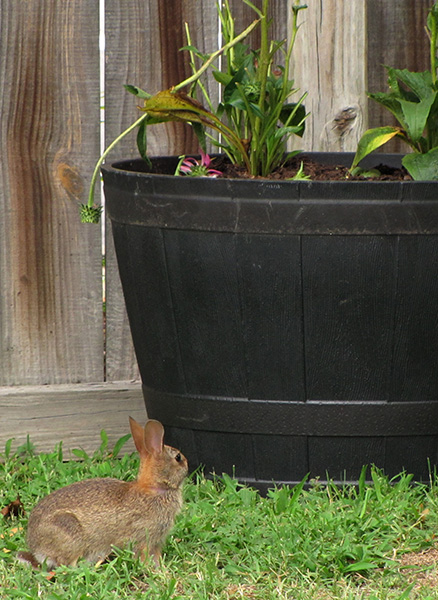
After eating its fill, this one spent some time mocking me…

I knew the rabbits could jump that high. I just didn’t think they would. Especially as there was very little cover available in or around the coneflower container, and hawks often hunt in our neighborhood. Under normal circumstances, the rabbits avoid being so exposed.

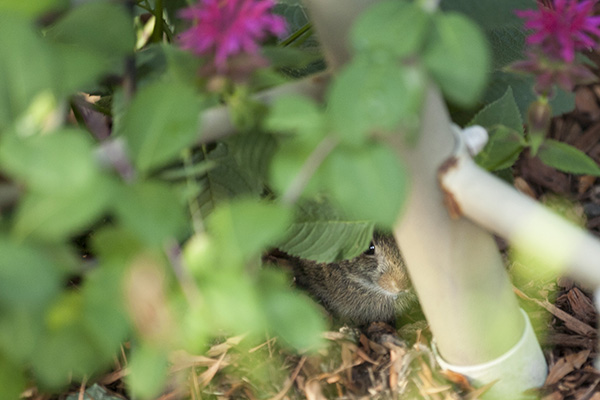
The following photo shows the same rabbit as earlier. I’m pretty sure it was still mocking me…
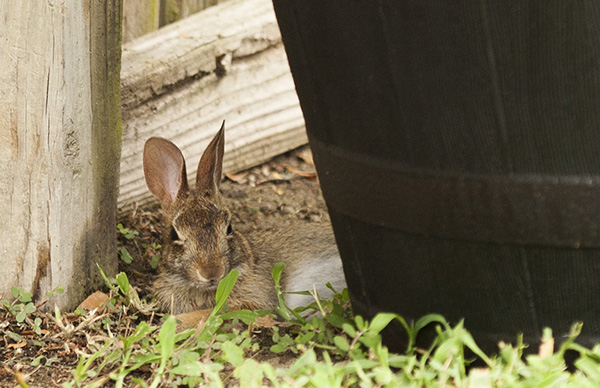
I should have given up after the second failure. More reasonably, after the first. Because, in the end, all of my efforts added up to an embarrassing series of rabbit feasts. And, as much as I enjoy watching and photographing the rabbits, I didn’t mean to feed them.
I didn’t mean to feed them because I enjoy watching and photographing them.


(The above photos were taken in late June. The babies are still growing, and a group of slightly older rabbits has joined them in the yard.)

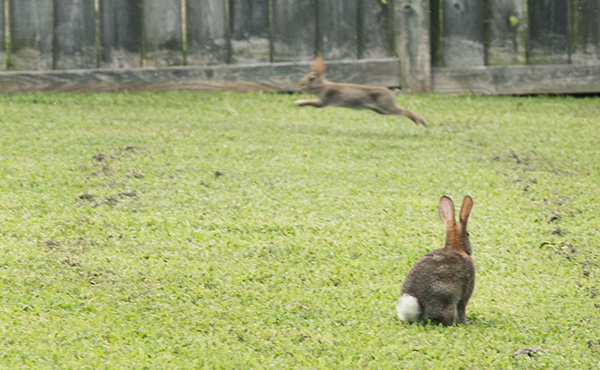
The yard has never supported more than one or two rabbits over subsequent seasons, and five (or more) seems an invitation for overpopulation troubles. Ticks and tick-borne diseases are an obvious concern, as ticks are visible in many of my photos.

Also, winter will certainly bring a shortage of food for the rabbits, along with other stressors. At this age, they should be learning how to find food. I fear that having it so easily delivered makes them less fit. It also encourages them to stay in a territory that cannot support such a dense population.
In trying to learn from my coneflower debacle, I’ve frozen my yard budget for the rest of the summer. No more new flowers. No more new containers. (I made one last purchase, before freezing the budget, which will appear in a future post.) The rabbits may take what they need from what the yard produces, and I will continue enjoying their antics, but they will remain wild. As wild as possible in their suburban habitat.







 Rae Spencer