While the yard didn’t have its very own Mallard nest, this year, we had regular visits from a hen who nested in the neighbor’s yard. Throughout April, the hen stopped in to graze and have a bath in the dragonfly pond. Then, on the morning of April 30, she brought along her brood of nine.
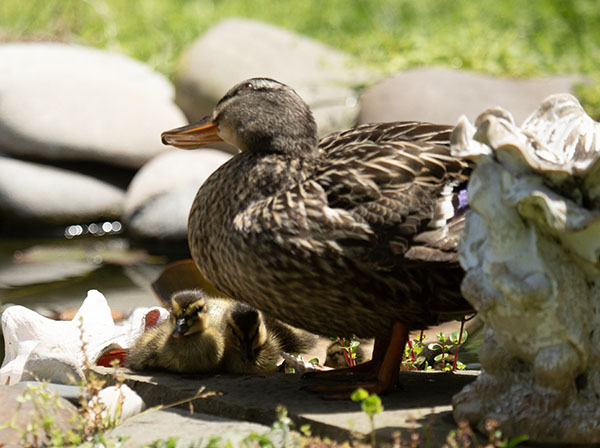
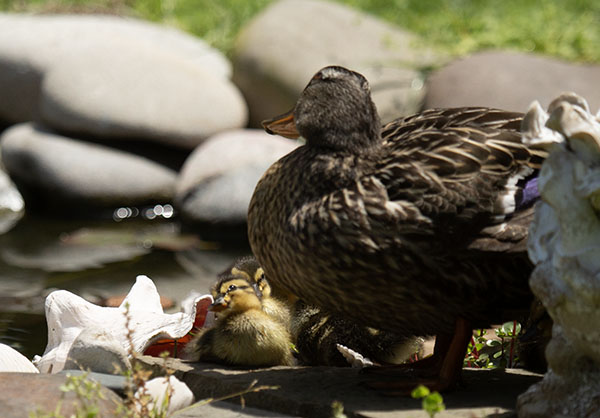
Photo of a Mallard hen standing beside our dragonfly pond. Almost hidden in her shadow are nine ducklings, huddled for a nap after a busy excursion in the pond.
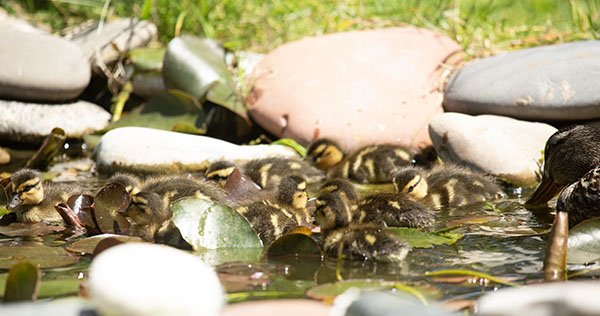
A Mallard hen (far right) swims with her nine ducklings in our dragonfly pond on April 30, 2024. The hen is mostly in shadow, her head in silhouette as she forages with her brood.
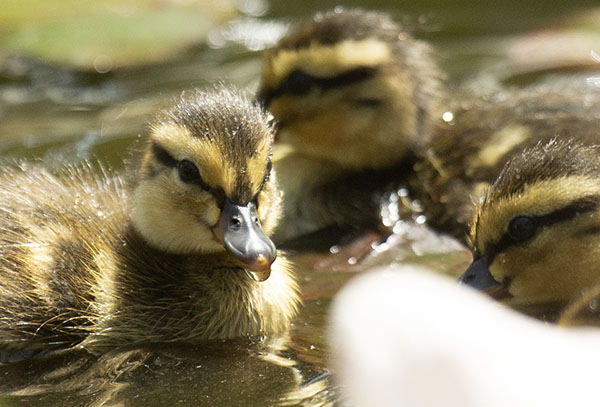
Photo of three downy, day-old Mallards swimming in our dragonfly pond. One duckling faces the camera lens, a drop of water hanging under its bill. The light pink remnant of its egg tooth is visible.
Watching the next-door hen sit her nest day after day, watching her amble into our yard to bathe and eat, I wondered about her flight muscles. All told, with about a month on the nest and maybe two months more until her ducklings can fly, she’s grounded for three months. That’s a quarter of her year. What happens to her vital flight muscles during that time? Are stretching and flap-bathing enough to keep a Mallard’s muscles in flight condition?
As I’ve noted before, I can’t resist a bit of research…
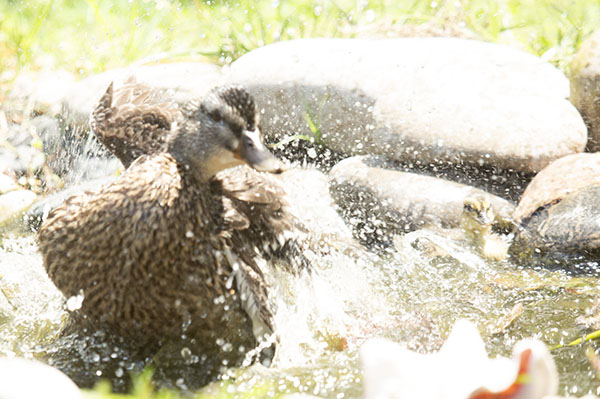
Photo of the Mallard hen enjoying a vigorous bath in our dragonfly pond on April 30, 2024. Here, her head, chest, and wings are lifted out of the water as she flaps furiously against the surface, churning the water into sprays. One of her ducklings (far right) is just visible through the splashes.
Photo of the Mallard hen, still indulging in her vigorous bath. She has moved to the other end of the small pond as she continues to splash with her wings. A duckling watches from the foreground (lower left), safely anchored on the surrounding rocks.
Another photo of the Mallard hen, still bathing. Here she is leaning into her bath, wings clapping against the water hard enough to throw spray under her feathers.
Yet another photo of the Mallard hen, here nearing the end of her bath. She is standing tall in the water facing the camera, wings extended behind her, showing the white feathers on the underside of her wings.
Photo of the Mallard hen stretching her wings after enjoying a splashy bath. She is standing tall in the water, facing away from the camera, both wings at full extension. The tops of her wings are visible, complete with patches of deep blue feathers on each wing.
I haven’t found any research into the changes (or lack of changes) in the flight muscles of nesting Mallard hens. That doesn’t mean this research isn’t out there. I simply haven’t found it. (I’m still searching.) But I did find a lot about flight muscles, and an article about flight muscle changes in molting, captive barnacle geese. (I’ll get to the geese in a later post.)
I’ll start with anatomy, because that always seems a reasonable place to start.
Unless you’re a duckling, then maybe start with the duck version of situational awareness. The world is a dangerous place for Mallards.
Photo of the Mallard hen teaching her ducklings to look overhead for danger. Whenever a crow or hawk flew over, she tilted one eye toward the sky (as seen in this photo) and gave a sharp quack. The ducklings froze in place, when they heard that quack, and they soon began to mimic her skywatching behavior.
Photo of the Mallard hen teaching her ducklings to look overhead for danger. Here, one of the babies is copying its mother’s tilt of head, one eye turned to the sky.
Photo taken the next day, May 1, 2024, after the Mallard hen and her brood returned from spending their first night on the big water. They basked and bathed in our little water for one last calm day, but were not completely free of danger. Here, the hen has flattened herself in the grass at the pond’s edge, her wide and wary eye skyward, while a Bald Eagle passed high overhead. This was her most extreme reaction, while I was watching, but it was the ducklings’ least attentive response. A few of them glanced upward, but they didn’t freeze in place. Instead they continued to fidget and stretch in preparation for a nap. I wondered if they couldn’t see the eagle, as it was too high for my camera to find with autofocus.
Flight muscles in birds
Bird flight is powered by chest muscles. Each wing needs one muscle to raise the wing and another muscle to lower the wing. Two wings, two muscles per wing, four muscles in total. All in the chest.
Pretend your arms are wings. Now try mimicking flight. Can you feel your chest and back muscles moving? Now imagine you are a bird. All that flying, with only chest muscles at work.
Huh?
Birds have one upstroke muscle per wing…
Photo of the Mallard hen stretching her wings. In this photo, both wings are raised, meaning the upstroke muscles are contracting (shortening) while the downstroke muscles are relaxing (lengthening).
…and one downstroke muscle per wing…
Photo of the Mallard hen, stretching her wings. Here she is shifting from a completed downstroke into an upstroke. The downstroke muscles are beginning to relax and lengthen, while the upstroke muscles are beginning to contract and shorten. Her wings and flight feathers are positioned to minimize air resistance on the upstroke.
…groups of smaller muscles coordinate fine movements of flight feathers and joint angles, but power for flight lies in the muscles of the chest. The downstroke and upstroke muscles stretch, one on top of the other, between the sternum (the breastbone) and the humerus (the first and largest wing bone). One downstroke muscle and one upstroke muscle on the left side of the chest, for the left wing. One downstroke muscle and one upstroke muscle on the right side of the chest, for the right wing. If you eat poultry, these muscles are the breast meat.
Photo of the Mallard hen watching over her brood as they settle for a nap after an excursion in our dragonfly pond. I’m not here to preach against meat-eating, or against hunting. Both are part of the world, and both have been part of my world. But baby duck cuteness is part of why I am happier, here in my middle years, as a herbivore.
Birds’ outermost chest muscles, the ones closest under the skin, are the downstroke muscles. They’re called the right and left pectoralis. They connect the sternum to the humerus on each side. When contracted, or shortened, these muscles pull the wings down. This anatomy is as straightforward as muscular anatomy gets. Sternum to humerus. When the muscles contract, they pull each humerus toward the sternum and the wings go down. A simple mechanism for a simple downstroke.
Flight anatomy gets its magic in the other flight muscles, the upstroke muscles. They’re called the right and left supracoracoideus. These muscles, nestled beneath the right and left pectoralis, also connect the sternum to humerus. But each upstroke muscle condenses into a tendon, as it nears its associated shoulder, and threads through a triosseal canal. A “three bone canal”. This canal lets each tendon emerge behind and over its associated shoulder, essentially passing from chest to back, before attaching to the top of the humerus.
This anatomical upstroke slight-of-hand, accomplished via the shoulder’s “three bone canal”, allows a pair of chest muscles to function like a pair of back muscles. When the upstroke muscles contract, or shorten, they pull the humerus away from the sternum so the wing goes up. An elegant mechanism for a simple upstroke.
Photo, from May 1, 2024, of the Mallard hen taking another vigorous bath in the dragonfly pond. Her ducklings (right foreground) bob on rough water and scatter to avoid being swamped as she churns up waves and spray with her strong wings. All of her wing power rests in her chest muscles.
If you think of a mechanical pulley system, the upstroke tendon would be the rope that runs over the wheel, while shoulder bones would be the wheel. Contracting, or shortening, the upstroke muscle is like pulling down on your end of the rope. The tendon slides over the bones, like the rope sliding over the wheel, and the wing (or the load you are lifting) rises up.
Presto.
The following video makes it much clearer (animation of the supracoracoideus and pectoralis starts at 3:59 and ends at 4:36).
Embedded YouTube video from medical illustrator Kelly Kage. A thesis video about the mechanics of bird flight, the video begins by describing skeletal anatomy, then moves into an animation of flight muscles at about three minutes and fifty seconds. Animation of the supracoracoideus and pectoralis begins at about 3:59 and ends about a minute later, at around 4:36. The entire video is nine-and-a-half minutes long. (I recommend the entire video, when you have time. The animations and narration are excellent.)
Bird flight isn’t exactly magic, but it’s mighty magical.
Why am I so fascinated?
An earlier version of myself, somewhere in my early twenties, taught a single semester of Introductory Zoology lab to undergraduates. (I was technically a graduate student at the time, but only because I needed two graduate courses to complete my prerequisites for veterinary school. I had no intention of finishing a Master’s degree.)
My most vivid memory, from my (thankfully) brief stint as a lab instructor, is the supracoracoideus exercise. I remember the uncanny slip of knowledge and knowing gliding across each other. The cognitive dissonance of trying to imagine a pair of flight muscles on my own chest.
Flex a chest muscle, and the wing goes down. Flex a different chest muscle, and the wing goes up.
Wing down. Wing up.
Chest. Chest.
Photo of a two-day old mallard duckling exercising its wing muscles. Here, with wings raised, the upstroke muscles in its chest are contracting while the downstroke muscles in its chest are relaxed. Photo taken May 1, 2024.
Photo of a two-day-old Mallard duckling exercising its wing muscles. In this frame, the wings are early in the downstroke phase, meaning the little bird’s downstroke muscles are beginning to contract while the upstroke muscles are beginning to relax.
[Full disclosure: I was a bad teacher. I was both stupid and ignorant. I feared my human empathy, so I had conditioned myself to ignore the body language, verbal cues, and emotions of people around me. And I never thought to apply imagination to the teaching guide. I never thought to have my students move their own arms and feel their own muscles, then try to imagine the upstroke as a chest muscle, instead of a back muscle. As a tension through the shoulder while a tendon slides. If this post ever reaches any of my unfortunate students, I want to thank them for their patience and attention. They showed up, week after week. They showed up and they tried to learn what they needed, despite being burdened with an incompetent lab instructor. I know an apology is not enough. Even so, I’m sorry.]
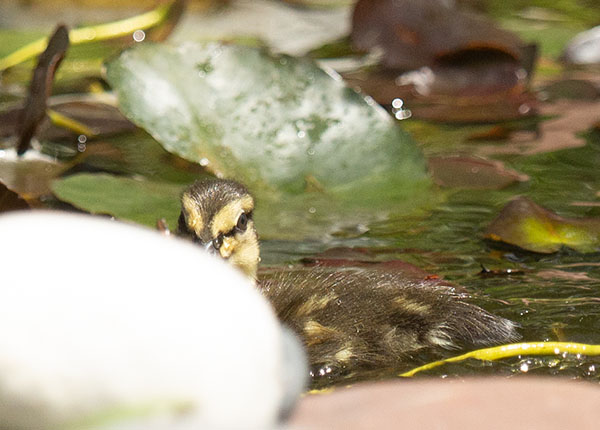
Photo of a two-day-old Mallard duckling swimming in our dragonfly pond. The duckling is gazing at the camera lens from behind a rock. The facial markings of a Mallard duckling, with dark eye stripes over yellow down, make the babies look grumpy from this angle. I imagine my students felt grumpy, and likely overwhelmed, after each of my class sessions. I would have felt angry and betrayed, had I been my own student.
The muscular choreography of bird flight is nothing like what I had imagined and mimicked, as a child. Not pushing my arms down with chest muscles and pulling them up with back muscles. Not a rowing cycle, over and over. Every time I pretended my arms were wings, my chest and back muscles cooperated. But for birds, it’s all chest. Chest muscles down and chest muscles up.
Photo of the Mallard hen with her brood scattered about her. In this photo, some of the ducklings are sleeping, some are fidgeting, and some are practicing preening. The hen is watching me and my camera with her head turned to one side, one eye focused directly on me. I can’t help but imagine an internal monologue for her. “What is wrong with this human? Why is she so nosy? Should I be afraid?”
Even today, despite my long familiarity with bird anatomy, I struggle to imagine how flight must feel. When I read about science fiction and fantasy creatures with wings, especially dragons, I usually forget to wonder about the musculature that powers fictional flight. But, in moments when I do pause to wonder, my imagination becomes richer.
A preview of Part II: More about Mallards and their flight muscles
So here is a duckling, with its clever wings and wing muscles, destined for flight. How it proceeds, how it uses those wings and wing muscles, determines how bulky the wing muscles must be. Or, do I have it backward? Do the wing muscles, with their relative bulks, determine how the duckling must use its wings? As with much, when it comes to physiology, the answer is a loop. The relative bulk of wing muscles influences how a duck might use its wings, and the ways a duck uses its wings influences the relative bulk of its muscles. Part II will have more about flight muscles, more about Mallards, and more photos of these ridiculously cute ducklings.
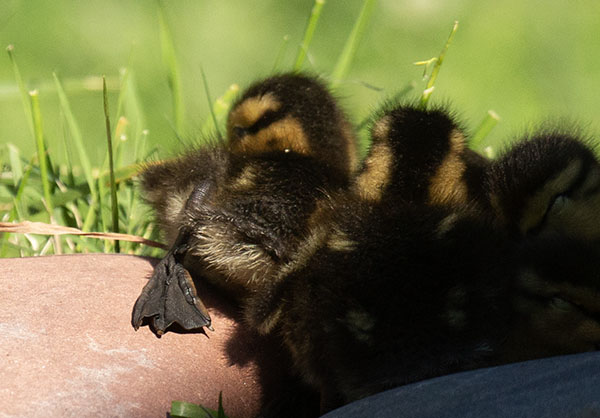
Photo of sleepy Mallard ducklings, one with a webbed foot stretched into the sunlight. If you are still reading, thank you.
The following links lead to articles and posts that are more important and more interesting that my Mallard musings:
A cold and drowsy snake visited in January. The yard had experienced floods, in days before, so I expect the snake fled some drenched winter hideaway. Moving slowly in the chill, our visitor spent a half-hour or more searching for dry accommodations in leaves that had settled against our house’s concrete foundation.
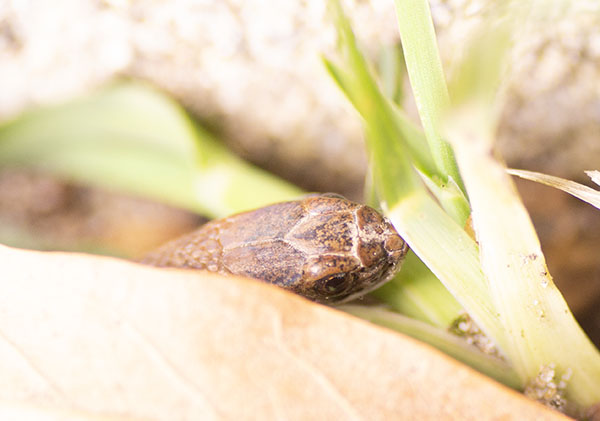
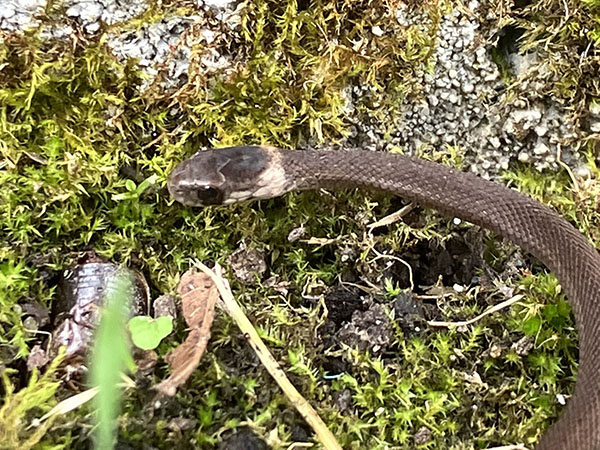
Photo of a Dekay’s Brownsnake peeking from under a dry brown leaf. The scales on top of the snake’s head are mottled brown with pale tan coloration between scales. Its large brown eye has a round pupil.
Over the past decades, I’ve caught rare glimpses of these snakes in the yard. Each time, I filed them in the generic “garter snake” folder of my internal memory bank. My flawed and over-capacity garter snake folder, in my flawed and over-capacity memory, holds all of the small, striped (or not), yard-sized snakes I’ve ever encountered. As long as the small, striped (or not), yard-sized snakes weren’t green, I called them garter snakes. (Green snakes are, obviously, “green snakes” in my flawed internal memory bank.)
Many of my “garter snakes” were, most likely, garter snakes.
Photo of a strongly marked snake with tan stripes and checkerboard patterns of dark brown and pale tan–an Eastern garter snake. This dapper little snake didn’t want to give up its sunny spot beside the paved walking trail and assumed the defensive posture shown in this photo–head raised, neck in an s-curve, body tense. Everything about this posture says “if you don’t leave me alone, I’ll bite you”. The snake attempted a strike shortly after this photo. I didn’t get bitten, because I was wary enough to stay out of strike’s reach, but I’m ashamed that I didn’t heed the snake’s clear request to be left in warm contentment. Instead, in my zeal for photos, I intruded so thoughtlessly that I made the little creature anxious enough to strike. I apologized, before leaving, but couldn’t restore the snake’s sun-soaked relaxation.
Many of my “garter snakes” were, most definitely, not garter snakes.
Garter snake. Not garter snake. Other snake. Each time I get a chance to patch my flawed and over-capacity internal memory bank, I’m relieved. Especially here, in my middle years.
As it’s been too cold for snakes to emerge, except in emergencies, I haven’t tested my brownsnake memory patch against snakes found in the wild. Or in the yard. So I’ve been testing it against my photo archive. At the moment, I’m still mid-correction, my internal dialogue still chirping “garter snake” when I come across photos of small, not-green, striped (or not striped), yard-sized snakes, still needing the gestalt-shift between first impression and new information. Still needing the pause and closer look. Not always garter snake. Sometimes, Dekay’s Brownsnake.
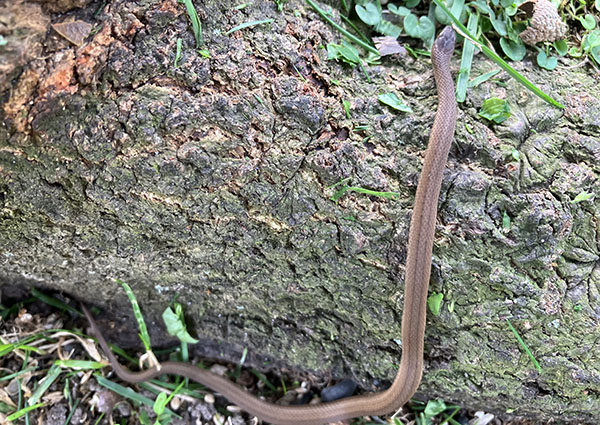
Photo of a Dekay’s Brownsnake, no more than 10 inches long, retreating over a tree root as I mowed the back yard. At the time, my internal dialogue tagged the photo “garter snake” and rambled off toward a more interesting (at the time) topic. Now, captivated by the newness of “Dekay’s Brownsnake” in my vocabulary, I clearly see the identifying keeled scales and parallel lines of dark spots down its back.
As for snakes in vases, or other yard art, maybe they are neither garter snake nor Dekay’s Brownsnake?
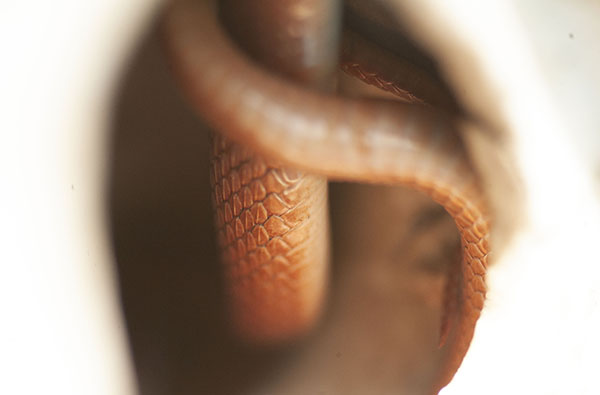
Photo of a snake’s tail dangling out of the bottom opening of a hollow piece of ceramic yard art. The tiny snake, smaller in diameter than a pencil, was reddish-brown with a pale belly. I labeled these photos “garter snake”, though I now wonder if they show a reddish variant of Dekay’s Brownsnake. Or maybe some other species, still unnamed in my vocabulary?
Another photo of the reddish snake that overwintered in a hollow piece of ceramic yard art. I tried following the identification key-map provided by the Virginia Herpetological Society, to no avail. Keels are readily visible on the snake’s side scales, but no dorsal scales are visible in the photos, which is where my attempts at identification break down. (Please comment if you can help with the ID!)
I’ve seldom had the luxury of hovering here, at the pivot point of internal correction. But my time, this winter, has slowed with the chill. Long nights and short days trigger depression and anxiety, steering me toward torpor. And this winter’s torpor has been more meditative than some years. I’ve lingered over these photos of our little reptile visitor. I want to call this moment learning, except that overused word feels both too small and too large. As do other words, like knowledge and discovery.
Photo of a very small Dekay’s Brownsnake emerging between dry brown leaves. In this side view, the snake’s overlarge eye and round pupil are fully visible, along with a row of dark spots along its upper lip. Its pale lower lip curves up in an anthropomorphic smile.
Such words, and the ideas they attempt to convey, have been claimed and reclaimed, used and abused, lauded and cursed for centuries. Well before I began grappling with my own understandings and misunderstandings, philosophers and critics set their pens to the task of recording, preserving, and passing on observations that make reality a little bit safer, a little bit more predictable, for future generations of humanity. So many men (yes, mostly men) writing letters to a future with so much more to observe.
Macro photograph of the face and eye of a Dekay’s Brownsnake. The small snake’s large eye shows a round pupil and an iris of iridescent brown and bronze. Its facial scales are mottled brown.
What goes into a name? Constructing (or deconstructing) Dekay’s Brownsnake
Dekay’s Brownsnake has the dubious honor of being named after two 19th century (male) naturalists. Its taxonomic genus-species name is Storeria dekayi. This caught me by surprise. An entire genus of snakes named for David Humphreys Storer (1804-1891), an American physician and naturalist.
I couldn’t resist a stroll through the search engine. I never can. Literature search is my favorite phase of projects, and archives are my happy place.
According to his obituary, David Humphreys Storer (1804-1891) was the dean of Obstetrics and Medical Jurisprudence for Harvard Medical School. He also had a great fondness for collecting. His collections encompassed everything from coins to birds eggs, and he cultivated connections with toll takers and sailors to bolster his coin, shell, and fish collections. His work with the Boston Society for Natural History led to a position with the Natural History Survey of the Commonwealth, where Storer managed the fishes and reptiles portion of the survey, resulting in the eventual publication of A History of the Fishes of Massachusetts.
Storer’s internet presence also includes an 1831 pamphlet, noted on page two to be the “Report of a Trial: Miles Farmer, versus Dr. David Humphreys Storer; commenced in the Court of Common Pleas, April Term, 1830, from which it was appealed to the Supreme Judicial Court, and by consent of parties, referred to Referees, relative to the transactions between Miss Eliza Dolph and George Washington Adams, Esq., son of the late President of the United States. It is impossible but that offences will come; but woe unto him through whom they come! It were better for him that a mill stone were hanged about his neck, and he cast into the sea. —Luke, xvii. 1, 2. Reported by the Plaintiff.” (!?)
I must admit that my interest in Storer dissipated before I read the entire pamphlet. Historical gossip aside (“…the transactions between Miss Eliza Dolph and George Washington Adams…”? Might this have been a scandal worthy of Lady Whistledown?), the pamphlet doesn’t contribute to my relationship with the little snakes in my yard.
Neither the obituary nor the pamphlet help me understand the man, David Humphreys Storer, who was so admired as to have a small genus of small snakes carrying his name to this day. And here lies part of the trouble with eponymous taxonomy. No matter how admired, in collecting circles, nor how despised, in other circles, Storer’s name cannot help me understand the habits and habitats of the little snakes I’m currently obsessed with.
James Ellsworth Dekays’ name doesn’t help, either. Another American physician and naturalist, Dekay (1792-1851) participated in a different state sponsored natural survey, for the state of New York. Dekay eventually published his findings in Zoology of New-York: Or the New-York Fauna: Comprising Detailed Descriptions of all the Animals Hitherto Observed within the State of New-York, with brief Notices of Those Occasionally Found Near Its Borders, and Accompanied by Appropriate Illustrations. In Part III (Reptiles and Amphibia), Dekay described a small brown snake collected by “…John Crumby, Esq., a zealous sportsman and acute observer, who captured [the snake] as it was swimming across a large bay on the northern coast of Long Island” (pp. 46-47).
Dekay’s three-paragraph note about the little brown snake is widely attributed as the first description. (A formality often conflated with discovery.) Dekay first used the genus name Tropidonotus but later corrected it to the genus name Coluber. Today the genus Storeria is classified within the family Colubridae.
A quick search engine query leads to a slightly more interesting article about Dekay–“Between the First Blind Cavefish and the Last of the Mohicans: The Scientific Romanticism of James E. Dekay” by Aldemaro Romero. But again, this article doesn’t help me understand or appreciate the yard’s snakes.
So my stroll through the binomial etymology of Storeria dekayi found my first example of an eponymous genus, two 19th century (male) physician-naturalists, a sex scandal with political connections, an article that tethers blind cavefish to James Fenimore Cooper, and one unfortunate little brown snake that fell prey to a sportsman while the snake was (likely) minding its own snake-business, swimming across a large bay on the coast of Long Island.
Reconstructing my memory, brown snakes included
But why do I crave a relationship, a learning or knowing, with the small, shy, nocturnal, snail-and-slug eating snakes in my yard?
Macro photo of a Dekay’s Brownsnake. The snake was approaching the lens, so its head and eye are in focus while the rest of its body is out of focus. Its facial scales are mottled brown, with darker spots under its eye. The scales of its lower lip are very pale tan.
Why, after so many years of being content to see these snakes as “garter snakes”, do I care so much now? I suppose part of my previous contentment is rooted in a youthful mis-hearing and mispronunciation. Garter snakes were garden snakes, most often encountered during gardening. Small, not-green, striped (or not), yard-sized snakes. As long as they weren’t venomous, they were simply garden snakes.
Venomous-or-not was my earliest snake knowledge, my first lessons in the garden. Some snakes were, and are, venomous. Avoid. Don’t get bitten. Be afraid, if you must. If that’s what keeps you safe, be afraid of snakes. (Of course, all of this gets mixed in with Genesis, with Adam and Eve and a serpent that spoke of temptation. The lesson, again, was fear.)
Our father was a snake killer. Every snake he saw, he slaughtered with whatever tool was closest at hand. His histrionics over snakes were the stuff of family lore, which added a dose of realism to the lesson. My older siblings, and sometimes our mother, ridiculed our father’s snake phobia. I absorbed an adjacent lesson, that the reflex killing of snakes was an action worthy of ridicule.
I developed a fascination with these animals that were so terrifying to our father. I wanted to be not-afraid of what our father feared. (And I wanted to avoid being another target of family ridicule.) Rat snakes, king snakes, corn snakes, green snakes, garden/garter snakes. All the hen-house thieves and barn guardians. All the camouflaged brush and grass dwellers. I watched for them with a cautious kind of hope, longing to catch a glimpse. To see them glide across a rafter or ripple into the next row of okra or bask, egg-sated, near the hen house.
And then, during my years in the boggy woods, the fear-laced lessons of my past peeled away like the hull of a seed.
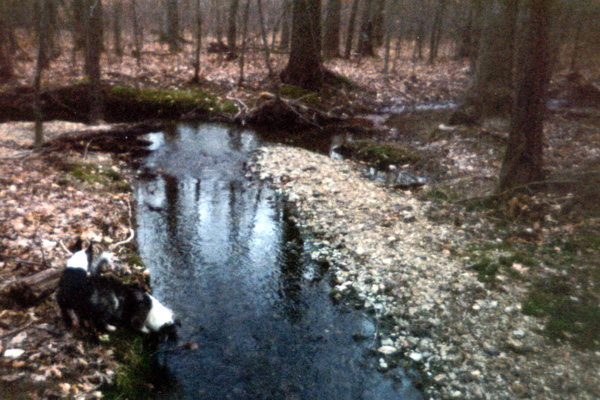
Photo taken in “the woods”, sometime during winter (bare trees, no underbrush, a thick blanket of fallen leaves) in the early 1990s. Shown here is a portion of the spring-fed creek that was the center of all activity in the woods. It was a shallow creek with shallow banks, flat gravel in places and woody in places, the wooded banks supported by exposed tree roots and moss. I visited the creek and woods as often as, and for as long as, time would allow. I was always escorted by a pack of dogs (and sometimes a cat or two, if the cats chose to follow). In this photo are my Boston Terrier (Simon) and Mother’s corgi mix (Bonnie). This photo smells like petrichor, sounds like water and wind and dry leaves and excited dogs, and looks like nostalgia. It feels like silence and loss, and it tastes like I’ve swallowed a memory because I was hungry for time.
In my boggy woods, hidden from the lessons of my parents and their religion, I sprouted. I developed an observational habit of naming and knowing the cottonmouths and the water snakes around the creek, the copperheads and the corn snakes near the edges, the rattlesnakes and the rat snakes under and in the trees. I knew where the gravid females basked and where the hungry youngsters hunted. I knew the woods and the creek because they were my favorite place to be myself. Should a snake have spoken to me, there, I would have eaten without hesitation whatever it offered.
Photo of a non-venomous water snake. The photo is cropped to concentrate on the snake’s face, showing the round pupil and lack of a heat sensing pit between eye and nostril. The snake is banded in various shades of brown with vertical stripes on both upper and lower lip.
Photo of a cottonmouth (or water moccasin), zoomed in to show the snake’s face and head. The cat-eye shaped, vertical pupil is clearly visible, as is the opening of its heat-sensing pit between eye and nostril. These two traits are common to the venomous pit viper family of snakes.
But the garden snakes, as long as they weren’t venomous, were simply garden snakes. The garden wasn’t my habitat, so I didn’t need to know its snakes. I tended the garden, and ate its tame offerings, with impatient distraction, always longing for the woods.
Here in my middle years, the garden and yard have become my habitat. I no longer visit the woods, except as a tourist. Now I need to name and know the garden snakes.
Other than the practicality and predictability of recognizing our Dekay’s Brownsnake as not-venomous, I can’t put my finger on the reason for my need. It’s not learning, knowledge, or discovery. It’s simply there. As are the garter snakes. The not garter snakes. The Dekay’s Brownsnakes, who, I’m happy to note, are drawn to the yard and garden because they like to eat slugs and snails. Perhaps this is reason enough to name them and to know them?
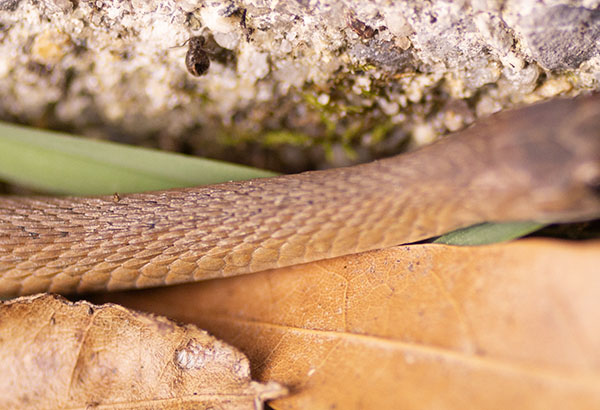
Photo of the Dekay’s Brownsnake, focused on the snake’s body scales. Each reddish-brown scale has a raised central keel, like a line drawn the length of the scale. These body scales overlap more tightly than the facial scales. A row of pinpoint black dots is just visible along the snake’s back.
Perhaps it’s all simply my personal gestalt-shift. The vase is Tennessee and the silhouettes are Virginia. The vase is the woods, the silhouettes our yard. The vase is youth, the silhouettes are now. The vase is water snakes, the silhouettes are garden/garter snakes.
Photo of a juvenile snake exploring a mossy corner of the yard. The snake is gray-brown with a pale ring around its neck. Its overlarge eye has a round pupil. I initially leapt to the conclusion that this might be a ring-necked snake, but now suspect it’s a young Dekay’s Brownsnake.
Here are links to three reviews of my poetry collection, Watershed:
“The collection focuses on the natural world and the human relationship with nature. …” by Crafty Green Poet (read the full review here)
“The poems have both a logical and mystical aura that keep the reader in place while the poems flow forward. …” by Lynette G. Esposito at North of Oxford (read the full review here)
“Watershed from Kelsay Books is an antidote to compulsion, to insistence, to the headlong rush into the next thing and the next. …” by GriffinPoetry at Verse Image (read the full review here)
I’m grateful for the time that readers, editors, and reviewers have spent with my writing, and with my book. I’ve loved every minute of my writing journey.
Here are a few articles and essays that are more interesting, and more important, than my musings:
Ecological countermeasures to prevent pathogen spillover and subsequent pandemics by Raina K. Plowright, Aliyu N. Ahmed, Tim Coulson, Thomas W. Crowther, Imran Ejotre, Christina L. Faust, Winifred F. Frick, Peter J. Hudson, Tigga Kingston, P. O. Nameer, M. Teague O’Mara, Alison J. Peel, Hugh Possingham, Orly Razgour, DeeAnn M. Reeder, Manuel Ruiz-Aravena, Nancy B. Simmons, Prashanth N. Srinivas, Gary M. Tabor, Iroro Tanshi, Ian G. Thompson, Abi T. Vanak, Neil M. Vora, Charley E. Willison, & Annika T. H. Keeley at Nature Communications
Biology Is Not Binary by Kate Clancy, Agustin Fuentes, Caroline M Vansickle, & Catherine Clune-Taylor at American Scientist (another hat tip to Science for Everyone)
I don’t mark the anniversary of Mother’s car accident every year. In years where the date (today) passes without my noticing how it is today, I congratulate myself. This is not one of those years. This year I’ve noticed. All week.
I’ve noticed, but I can’t say that I’ve wallowed. This feels like an improvement over the wallowing years, though perhaps a step back from the not-noticing years. Maybe each of these years are actually equal, on my journey. Wallowing, noticing, not-noticing, maybe these things say more about growth and time than I’m capable of understanding.
And perhaps these noticings and not-noticings say something about how my mind works, about how it was working (or not working) in those individual years. Perhaps it’s not a complete non sequitur to point out that bee’s toes are much more exciting and interesting than bee’s knees, though the knees tend to get all the memes.
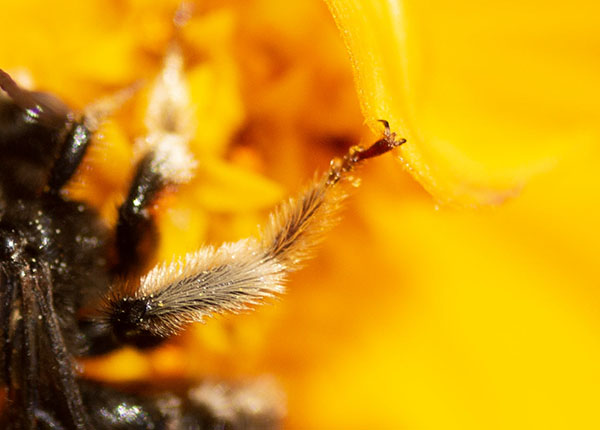
Macro photograph of a bee’s furry leg as it grasps a bright yellow cosmos petal while it is perched to sip nectar. The bee’s foot seems to be made up of three delicate hooked toes, each curled around the edge of the petal, while the bee’s knees appear to be simple hinge joints.
All of these wonderings and maunderings feel somewhat unproductive, but they are sometimes where poems start. So I’m letting myself wonder and maunder.
Macro photograph of a bee collecting pollen and nectar from the tiny yellow flowers of fennel. The black-and-yellow bee has yellow pollen dusting the hairs on its legs, head, and thorax. There’s even a scatter of pollen across the front edge of its wings. Its eyes are large and vaguely reflect the sky and sun, its antennae are long and segmented, and its delicate hooked toes are visible. Its knees are, relatively speaking, unremarkable.
While I’m waiting to see if a poem arrives, it seemed reasonable to update an old entry from April 2012, Finding What I Wasn’t Looking For. (In the post, I talked about Mother’s affinity for four-leafed clovers.) Except somehow, in updating the post (to add photo captions, mostly), I managed to change the post’s date to today. Now I can’t change it back.
Perhaps this, too, says something about how my mind works.
Macro photograph of a small plant with pointed leaves and three light-purple flowers. Each flower has four petals and four prominent stamens.
In trying to capture this weed (which I believe might be field madder), I’ve committed every possible photography blunder. Over the past few weeks, I’ve discarded images that were blurry, poorly lit, overwhelmed by background clutter, too distant, too close, blocked by a sleeve or the camera strap… the list goes on. I almost gave up.
Since today began as a failure day, marred by oversleep, bookkeeping errors, and lost office supplies, I decided to try again. What harm could come from adding one more frustration?
Instead of frustration, I found a moment of complete peace. This four-leaf clover, growing beside a patch of madder, felt like a visit from my mother.
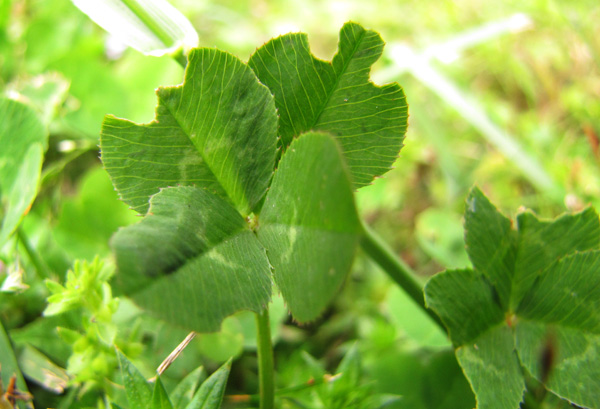
Macro photograph of a four-leafed clover surrounded by blades of grass and other indistinct greenery.
One of Mother’s many talents was an affinity for four-leaf clovers. From her chair on the porch, glass of iced tea in hand, she’d point to a spot across the driveway. My siblings and I would follow her directions and retrieve the prize. Walking into the pediatrician’s office, she’d pause near the sidewalk, then laugh as we groaned over her obsession. Getting out of her car at school, she’d drop a book, reach to pick it up, and find a four-leaf clover growing through a crack in the pavement
I did not inherit this particular skill. Four-leaf clovers are vanishingly rare for me, so today’s find felt as if Mother must have been looking over my shoulder. The sensation doubled when I found a second one.
Macro photograph of a second four-leafed clover surrounded by blades of grass and other indistinct greenery.
In August of last year, Mother was involved in a serious car accident. She died in October. As we emptied her house, day after day of sorting memories and treasures and curious little mysteries, we found four-leaf clovers everywhere. Saved in envelopes, filed with old bills, stuffed in drawers and cabinets, sprinkled across shelves. Even pressed in the pages of her Bible.
Photograph of a dried four-leaf clover, pressed between the pages of one of Mother’s Bibles.
The house cried four-leaf clovers, orphaned keepsakes sifting from every crevice. A lifetime’s worth and more. So many that I felt no urge to pick today’s pair, though I was very grateful to have found them. I hovered a while, happy as I’ve been in months. Then I took my pictures, said another goodbye, and left Mother’s four-leaf clovers in the yard.
I’m delighted to announce that my first poetry collection, Watershed (Kelsay Books), has been released in paperback and Kindle ebook formats. The paperback ($20/US) is available through the Kelsay Books website (here) or through Amazon (here), while the Kindle ebook ($9.99/US) is available through Amazon (here). (For more details, I’ve created a permanent page for Watershedhere.)
Watershed front cover: a pale sunset image of clouds and sky over a pool of water, which reflects the clouds and sky, surrounded by seagrasses and shrubs. Text on the cover reads: Watershed, poems, Rae Spencer.
The poems in Watershed are mostly autobiography, written within my nostalgia for the landscapes of Tennessee, my journey into Virginia’s coastal landscapes, and my tenuous understandings of how “growing up” changes my gaze.
Photograph of a chickadee fledgling perched on our deteriorating fence. The young chickadee is shedding downy nestling feathers, while the fence’s aged wood is cracked and weathered.
As I pondered this post, how to introduce my debut collection, I finally grasped the word connection between debut and debutante. How ridiculous to contrast myself–middle-age, married, and profoundly awkward–against the idealized debutantes of historical romances.
Photograph of my reflection in a window. My face is hidden by the camera I used to capture the image. My graying hair is shoulder-length in tangled layers. I’m wearing a sleeveless shirt, so the tattoos on my hands and arms are visible–an ink collection of flora and fauna.
And yet, here I am, a debut author sending my first poetry collection into the world. I’ve loved every minute of the process, from the writing to the planning to the organizing to the submission to the rounds of editing after acceptance, all the way through this final phase of setting up author pages and posting announcements. I suppose all of this means that I’m finding my way.
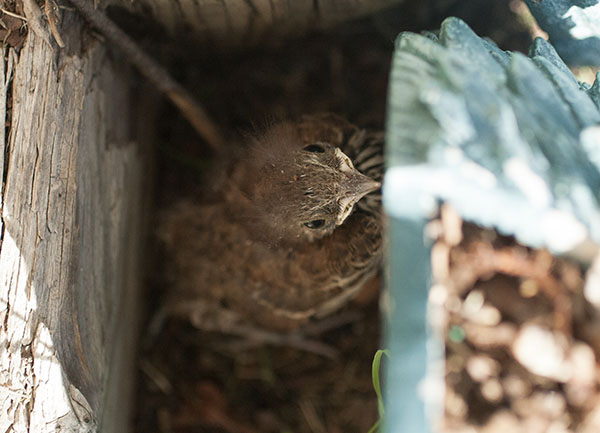
Photograph of a brown thrasher fledgling hiding in a nook between a planter and our fence. The little fledgling is brown-and-tan-striped with the exaggerated beak, forehead, and eyes that render baby birds endearingly cute.
Finding my way to where?
To here, for now. To exactly where I am.
Photograph of an osprey passing overhead with a large fish grasped in its talons. The osprey’s muscular wings are fully extended, long tan-striped primary feathers spread at the tips, and its sharp beak and eyes are turned toward some unseen destination.
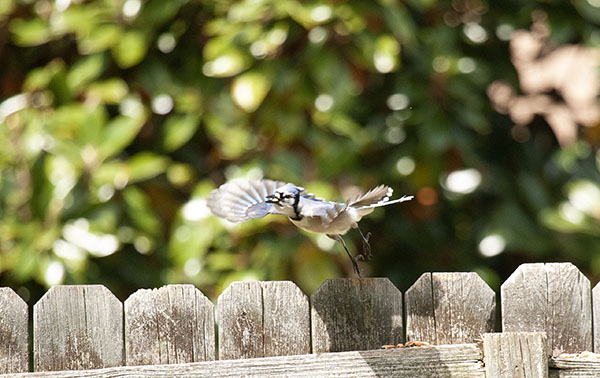
Photograph of a blue jay in the process of taking flight from the top of our wooden fence. The blue jay’s wings are extended, tiny black feet stretched into its launch. The bird is carrying in its beak a peanut, selected from a small pile of peanuts we left on the fence.
To a small yard in a sprawling suburb, somewhere in the middle of life’s extremes, poised between the lush luxuries of nostalgia and hope. There’s always something precarious on the horizon, but, for today, I’m here.
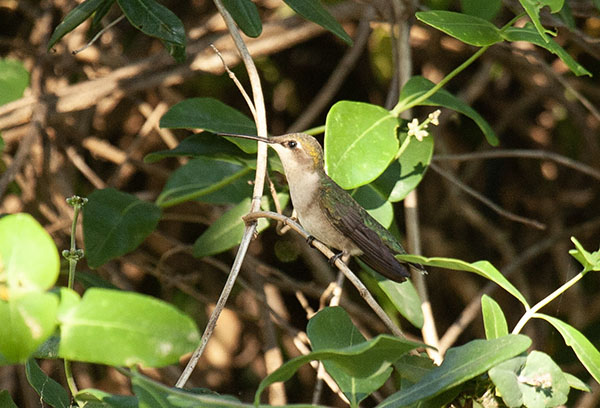
Photograph of a hummingbird perched on a woody vine of honeysuckle. There are no honeysuckle blooms in frame, so everything is green and brown, including the hummingbird’s feathers.
The following links lead to articles, essays, and posts that are more important and more interesting than my debut poetry collection:




















 Rae Spencer