Focusing on Mallards, Part II

Content warning: This blog post contains references to the hunting, agriculture, and research practices of killing birds. If you choose not to read on, I respect and admire your choice.

Part of my purpose in writing this Mallard series is to highlight the price that has been paid (and continues to be paid) for the knowledge we have about Mallards and other birds. I might have constructed these posts, as a younger writer, without acknowledging the deaths behind the data. But as I’ve aged, I’ve grown more aware of the cost of knowledge.

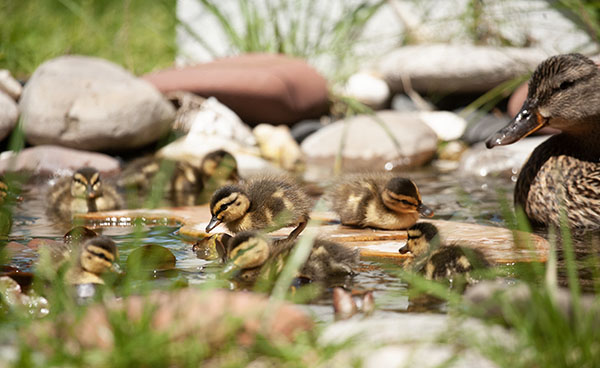
In this photo, the Mallard hen who inspired this series of blog posts swims with her brood of day-old ducklings in our dragonfly pond.
In this photo, the Mallard hen who inspired this series of blog posts swims with her brood of day-old ducklings in our dragonfly pond. The ducklings are gathered around a grassy seed head that the hen tugged down to within their reach. The hen nested in our neighbor’s yard, during spring 2024, and brought her brood to the dragonfly pond the morning after they hatched and again the next day. I wondered, during and after her long inactivity on the nest, if she experienced the kind of changes in muscle mass that I might experience if I spent most of a month in bed. I didn’t find a good answer for that question, but I found adjacent answers to adjacent questions. Enough adjacent questions and answers for this multi-part blog post.

What I mean by “knowledge”

It’s one thing, for me, to observe our yard and its visitors. To slip away from human concerns and simply watch. To sate myself with wonder. These hours shift my perspective. They build new connections between old memories. I sometimes emerge with splintered metaphors to sand and patch and paint. Sometimes with fine-grained phrases that liven up a drab idea. On the rarest and best days, I emerge with blueprints for new knowledge.

Observation and wonder are one thing. But knowledge is an entirely different state.

Separate and distinct from the metaphysical implications of knowing, my definition of knowledge is an inventory of education and experience. The nouns of my past and the context in which I encountered them, indexed by subject and era. A cross-referenced heap of biology, shuffled around the edges with chemistry. A shelf of style guides and writing advice. A few notebooks of math, physics, and cosmology. A faded box of recipes, crochet patterns, and needlework hints. Stacks of genre reading. Great aisles of emptiness where business, economics, and law failed to catch my interest.

I was recently asked to list my areas of expertise. I wanted to respond that I have none. I am a worksite traced with utility locator flags, not a finished library. I might claim my main parlor, biology, but even there the framework is incomplete. And, to align the metaphor with my theme, construction materials are expensive.

For many long decades I failed to appreciate the cost of knowledge, with its scaffolds of data. In this post, I’ve chosen to pull back the curtain I so blithely ignored as a young science student. Much of what I find behind that curtain forces me to stock those great empty aisles of business, economics, and law. Because the dimly-lit ledger of science history, written mostly by rich old white men, seldom accounts for cost. But every so often, jotted in the margins or tucked between the pages, the writers left remnants of their invoices.
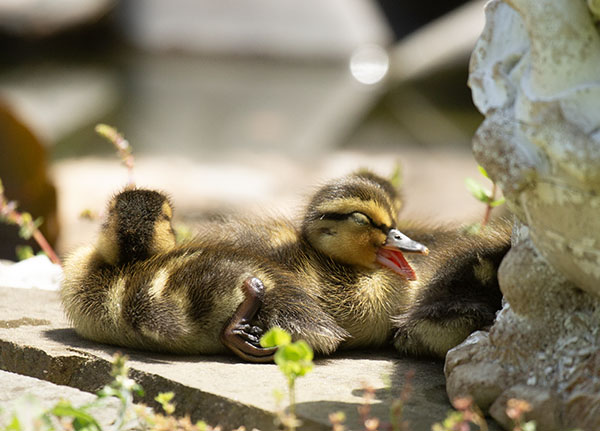
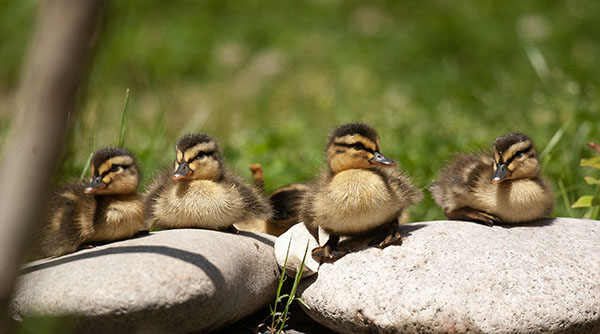
In this photo, sleepy Mallard ducklings bask on a sun-warmed rock beside our dragonfly pond. One of the ducklings is yawning. From many perspectives, these ducklings are resources to be managed and controlled. For me, here in my middle years, these ducklings are downy singularities of wonder and charm far more valuable than mere resources.

The capitalism behind the curtain

During my brief foray in the humanities silo, I chafed over intense criticisms of science and science writing. But I couldn’t deny the foundational weakness. Science motored along for centuries, impervious to criticism, fueled by colonialism and capitalism. For the most part, it still does.

What would it look like, if science and science writing discarded the curtain and directly acknowledged the capitalism? The colonialism? Not just here and there, but in every published report? If the ledger was complete and brightly lit?

I don’t expect a humanities-approved (and strengthened) science literature would look like anything I can imagine. I am neither scientist nor science writer. What’s more, my little graduate certificate in professional writing is not a stamp of humanities approval. So I can’t answer the questions that followed me home from the humanities silo.

But I am an avid science consumer. As such, the word cost is not chosen lightly. Whenever I look behind the curtain of knowledge, no matter the era or discipline, I find the busy (and visible) hands of capitalism.

As ubiquitous as hunger, questions are free for anyone who has the energy and time to ask them. But answers? Answers are capital. They are expensive. And, weighed in the hands of capitalism, answers are expected to reap a profit.

What happens when answers are not synonymous with capital gain? When hunger lingers or multiplies because the investment outweighs the return? In very short order, the hands of capitalism divert resources and time toward less costly questions and more profitable answers. Or, at least, toward questions perceived to be less costly and answers anticipated to be more profitable. The question I should have been asking for years, the question I am asking now, is this: Whose perceptions and anticipations control the resources?

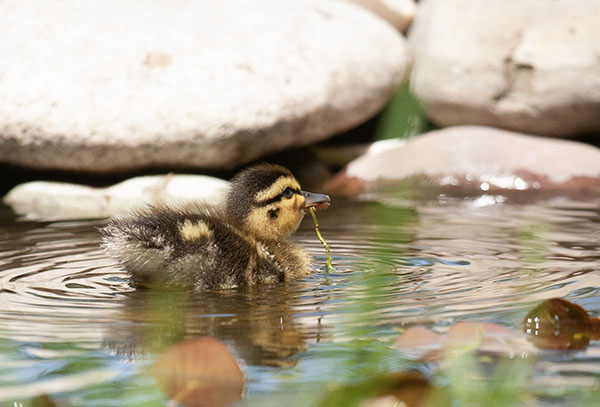
In this photo, a day-old duckling stretches upward to sample a mostly bald dandelion head. During their brief time in the yard, the ducklings stripped all the seeds from all the dandelions within several feet of the pond. I don't know if they ate the seeds or merely pulled them off as part of their exploration process
In this photo, a day-old duckling stretches upward to sample a mostly bald dandelion head. During their brief time in the yard, the ducklings stripped all the seeds from all the dandelions within several feet of the pond. I don’t know if they ate the seeds or merely pulled them off as part of their exploration process.

Some practicalities about Mallards and other waterfowl

Historically, Mallards had value (and have value, still) because they were and are hunted and farmed. When it comes to funding research, and to collecting data for research, hunted and farmed species are valuable, easy resources. “Valuable” in the capitalist sense of being actual capital, but also in the academic sense of data. “Easy” because these species live and die in larger, more accessible numbers than similar species that are neither hunted nor farmed.

Hunted waterfowl (and other game birds) live and die in their large numbers within easy reach of researchers. I can’t write a path around the pragmatism of this system, but I am increasingly uncomfortable with such pragmatism.

As capital, a Mallard’s value is tethered to its food and sport potential. Driven by this food and sport value, research funding adds further value to a Mallard. Each bird is data. Whether hunted, farmed, or recorded into a set of measurements, a Mallard’s value peaks with its death. (Perhaps this is true of every individual, of every species, but I’ll leave that notion for a later post.)

What of this spring’s next-yard hen, with her downy brood? When I perceive them as more than units of capital, when I anticipate their ongoing existence as more than a value that peaks when they die, my ability (and desire) to control them as resources wanes. For me, this feels like a good and useful adjustment of my perceived and anticipated place in the world.

The older I get, the less comfortable I am with capitalism and its pragmatisms. Far from being an agriculture, research, or policy pragmatist, I want the next-door hen and her offspring to have an embodied value separate from their muscle mass and plumage. I want empathy to count. My still and quiet moments in the yard. The silly antics of ducklings in a dragonfly pond. The charm of infant proportions and curious hungers. I want to measure value as a sense of shared life, a shared world, and shared safety or peril.
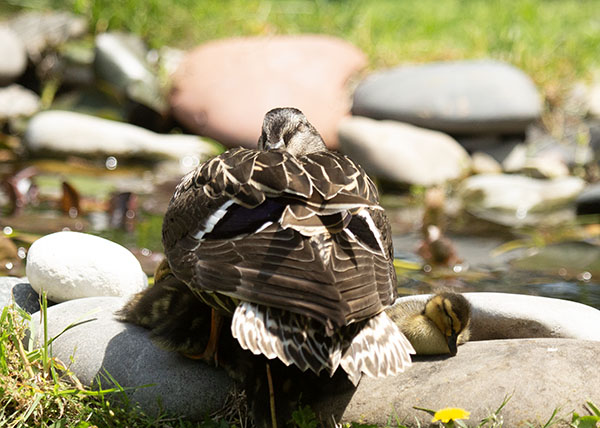
Photo of the next-yard Mallard hen sleeping at the edge of the dragonfly pond. She is asleep standing up, the equivalent of a duck cat-nap, beak tucked under the feathers of her wing. Her babies are nestled in her shadow, all except one duckling that has edged out onto the warm rocks in the warm sunlight.

Aside: the literature’s euphemisms for “kill”

According to Google’s default dictionary, the word euphemism is derived from the Greek roots eu-, meaning “well”, and -phēmē, meaning “speaking”. I was taught, somewhere in my education, to translate euphemism as good word. But in my more recent years I have come to view euphemisms as veiled words. Intentional deflections. Syntactical high ground for writers (and researchers?) who wish to describe expanses of quicksand without getting mired. I sympathize with the impulse to build polite nomenclatures. To write around shock words and trauma words. But we’re all in the quicksand, no matter what we write.

(Remember the opening content warning? I do understand the need, the profound and pressing need, to protect victims of shock and trauma from experiencing further shock and trauma. This is why I embrace the practice of content warnings. The remainder of this blog post contains frequent references to the research, agriculture, and hunting practices of killing birds. If you choose not to read on, I respect and admire your choice.)

Policy, agriculture, and hunting literatures shy from the words kill and slaughter. “Kill” is rather imprecise, I suppose, for research literature. And “slaughter” is a bloody word, even with its Merriam-Webster finesse—“the butchering of livestock for meat”. In that sense, I acknowledge that “slaughter” is imprecise, as well. The birds (including Mallards) that populate policy, agriculture, and hunting literatures are resources. They are capital and data, not meat. Does it matter how we describe their deaths? (Yes! Of course it does.)

In the literatures, birds (including Mallards) are hunted, shot, collected, harvested, culled, sacrificed, and euthanized. Dead birds are examined, necropsied, and sampled. Wings are placed in the mail.

For this post and its subsequent parts (I’m not certain how many parts there will be), I’m choosing the word slaughter. Because I added up the numbers behind the data. The research numbers in the tiny subset of articles referenced here run into the thousands. The hunting numbers, hundreds of thousands per year. I feel the word slaughter fits.

The rest of my multi-part Mallard post draws heavily from work done by and for the research, agriculture, and hunting industries. Birds died for these questions and answers. For better or for worse, this is the world we have shaped for Mallards and their avian kin.

In this photo, a day-old Mallard duckling sleeps in a patch of clover and grass at the foot of one of the stones lining our dragonfly pond. The duckling is slumped forward, having nodded off after slipping down from the stone where most of its siblings were sleeping. Other siblings have slipped off of the stone, too, and are nodding off in a stair-step heap behind the sleeping duckling.

The research numbers

The following section, which deals with variations in the relative sizes of flight muscles, leans heavily on an article by D. C. Deeming, PhD.: “Allometry of the pectoral flight muscles in birds: Flight style is related to variability in the mass of the supracoracoideus muscle.” Deeming’s article pulled data from three primary sources: two tracts (1961 and 1962) from the Smithsonian Miscellaneous Collections and a 2016 survey out of Romania.

  1. Greenewalt, C. H. (1962). Dimensional relationships for flying animals. Smithsonian Miscellaneous Collections 144(2).
    • Greenewalt collated pectoral muscle weights from a 1922 French publication: Magnan, A. (1922). Les caractéristiques des oiseaux suivant le mode de vol. Annales des sciences naturelles, Series 10, Volume 5, 125-334. (Yes, that is the same Antoine Magnan responsible for the urban legend that bees should be mathematically incapable of flight.) Magnan’s work used captive birds and, as Greenewalt cited, “…those which appear to be in bad health were discarded” (Greenewalt, 40). Some 228 birds, representing about 223 species, were slaughtered for this data. (I’m hedging my numbers because counting=math=possibility of error.)
  2. Hartman, Frank A. (1961). Locomotor mechanisms of birds. Smithsonian Miscellaneous Collections 143(1).
    • Hartman’s tract drew from more ambitious work that took place in Florida, Maine, Ohio, and Panama. Birds were “collected” (or, even more euphemistically, “obtained”) from January to March, mostly before 11 AM (p. 3). The method of collection isn’t specified, nor the method of slaughter, though the authors specify that birds and their dissected muscles were weighed in “fresh condition” (p. 2). The pages and pages of data (pp. 38-91) represent more than 360 species. Individual numbers range from 1 (i.e., a solitary Bicolored Hawk of unknown sex and a single male Ruddy-capped Nightingale Thrush) to 50 or more (i.e., 55 House Sparrows, 51 White-breasted Nuthatches, 52 Rufous-tailed Hummingbirds, 50 Smooth-billed Anis, and 103 Brown Pelicans). In total, more than 6000 birds. (Again, hedging because math.)
  3. Vágási, C. I., Pap, P. L., Vincze, O., Osváth, G., Erritzøe, J., & Møller, A. P. (2016). Morphological adaptations to migration in birds. Evolutionary Biology 43, 48-59.
    • Vágási et al. captured and banded live birds in Romania, but also “[c]arcasses from natural deaths (e.g. road kill, building collision, electrocution, starvation) were collected in Romania and Denmark for taxidermy” (p. 50). The authors clarify, “Numerous bird specimens were brought frozen to JE, more than 95% of them being found dead and the remaining were shot by hunters” (p. 51). The dataset, here, includes some 115 species. Sample sizes ranged from single individuals (i.e., one Grey Wagtail , one Peregrine Falcon, and one Whinchat) to more than 100 (i.e., 824 House Sparrows, 228 Eurasian Blackbirds, and 193 Eurasian Sparrowhawks). In total, more than 3800 birds. (This article models a practical and effective approach to science without fresh slaughter, primarily sourcing data from carcasses submitted for the study. Granted, “natural deaths” from road kill, building collision, and electrocution are hardly “natural”, but I appreciate the distinction between carcass repurposing and the slaughter of otherwise healthy birds for research purposes.)

So Deeming gleaned data from more than 10,000 birds, without listing a single slaughter in the Materials and Methods section. This is both efficient science and inefficient communication. The actual numbers were curtained off, in at least one case, two sources deep and a century back. I applaud the reuse of data, but I resent the legwork required to find the birds within the data.

I expect that most of The Journal of Zoology‘s readers feel no need to find the birds. After all, the article’s intended audiences hold greater and deeper knowledge of birds, wings, and flight than I bring to the moment. The author and intended audiences would likely characterize my stroll down the numbers rabbit-hole as a tangent prompted by unrealistic purposes and fueled by OCD. But, was it?

What is the capital, here? Or rather, which capital is more valuable? The answers and knowledge, so satisfactory to my passing curiosity? The data and findings, so neatly packaged for future reference? Or the birds themselves, so fleetingly alive?

Ask a different me, in a different era, and my response to these questions would change. But, for now, my heart yearns toward the birds so fitted for flight as to seem almost magical, winging through yards and migrating over landscapes and dabbling with their downy chicks in dragonfly ponds.
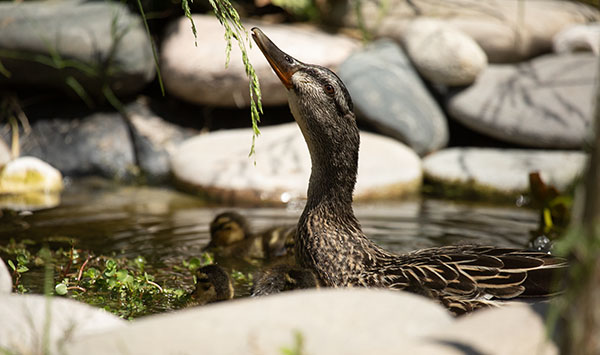
In this photo, the Mallard hen reaches up to strip seeds from an overhanging, overgrown, and unknown species of grass that was growing around the foot of the dragonfly pond. The hen is floating in the pond surrounded by her day-old brood.
Here, the Mallard hen has pulled the overhanging grass down toward her day-old ducklings. One of the ducklings is looking up from its place floating in front of her in the dragonfly pond, waiting for her to pull the grass low enough for the ducklings to sample the seeds.

Variation in the relative masses/sizes of flight muscles

(For specifics of flight muscle anatomy, see Part I of this post. In short, two muscles power bird flight: the large pectoralis muscle, which powers a wing’s downstroke, and the smaller supracoracoideus muscle, which powers a wing’s upstroke. Both muscles stretch across birds’ chests, from wing to sternum. If you eat poultry, these flight muscles are the breast meat.)

An average bird with average flying habits pushes down against air with its downstroke muscle, wing extended and feathers angled to maximize (or to finesse) the lift. How much force is needed depends on the birds’ weight and acceleration. Is it a heavy-bodied duck or a sleek-framed crow? At a minimum, the downstroke muscle is massive enough to lift the bird’s weight against gravity and accelerate according to the bird’s habits. Imagine the initial heaves of a Mallard taking flight. The lazy hop-launch of a crow. Which bird has bulkier downstroke muscles?

Back to the average bird with average flying habits, downstroke accomplished. Now it tucks and rotates its wings, to minimize air resistance for the upstroke.

Push (PUSH) down. Tuck. Pull (pull) up. Flap. Flap.

Large downstroke muscle, for the heavy work of lifting body weight against gravity. Much smaller upstroke muscle, lifting only the weight and feather-drag of tucked and rotated wings against air. Whether Mallard or crow, the upstroke muscle does less work. (Read on for exceptions, because there are always exceptions.)

In average birds with average wings, downstroke muscles are between 8 and 13 times larger than upstroke muscles (Deeming, “Discussion”, para. 1). So much pushing, so little pulling.

But what about not-average birds? What about birds with exceptional flight habits? What about flightless birds?

Some birds need to pull (PULL) as they raise their wings. They need a mightier upstroke muscle. Penguins, auks, and many other diving birds use their wings under water. No matter how much they tuck and rotate, water isn’t air. There’s more drag. These birds’ upstroke muscles are large, both in proportion to their downstroke muscles and in proportion to their body sizes. Their downstroke muscles are still the largest flight muscle, but only about 1 to 3 times larger than the upsized upstroke muscle. No more of those 8 and 13 numbers (Deeming, “Discussion”, para. 2).

Hummingbirds, which actually rotate and invert their wings during the upstroke, generate lift in both phases of the flap: push (PUSH) and pull (PULL). Surprisingly, to me, pigeons also generate lift in the upstroke, via a trick of the wing tip to change their wing shape. Both hummingbirds and pigeons measure in the same range as diving birds that swim with their wings; their downstroke muscles are only 1 to 3 times larger than their upstroke muscles (Deeming, “Discussion”, para. 2 & para. 5).

More special conditions occur for flightless birds, such as Rheas, and for owls and hawks. More special distributions of muscle. The Deeming article is packed with details.

I didn’t mean to write this much. But I’m fascinated. And I have OCD. It’s a dangerous combination, where tangents are concerned. But in the next part of this post, I’ll move on to flight muscle changes during a bird’s life cycle, as there is plenty of evidence regarding changes in flight muscle mass during molt.
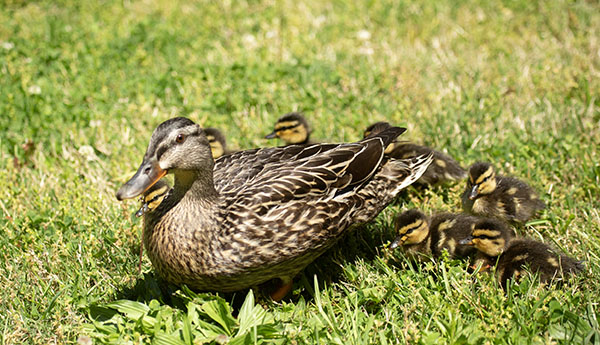
Photo of a Mallard hen walking through the mown grass and weeds that make up our back yard. She is followed by her day-old brood of nine. Here, they were beginning their first stroll away from our tame-ish yard, toward the big waters running through our Tidewater area.
Photo of the Mallard hen walking through the mown grass and weeds that make up our back yard. She is followed by her day-old brood of nine. Here, they were beginning their first stroll away from our tame-ish yard, toward the big waters running through our Tidewater area.

Publication Announcement!

If you’re still here, I very much appreciate your time and attention. And, while I do feel a pang of irony as I promote my own writing while complaining about capitalism, my second poetry collection is now available!

Alchemy (Kelsay Books, 2024)

Photo of the front cover of Alchemy, which features trinkets and jewelry (many passed down from my mother) arranged on a cloth background. Each broach, bracelet, pendant, earring, and trinket illustrates a theme or topic from the poetry. Featured in the center, a Noah's ark pin and a globe-and-animals pin are connected by an antique miniature watch on a chain. Other items show mammals, birds, insects, fish, reptiles, amphibians, plants, and a fossilized seashell. Text on the cover reads "Alchemy, poems, Rae Spencer".
Photo of the front cover of Alchemy, which features trinkets and jewelry (many passed down from my mother) arranged on a cloth background. Each broach, bracelet, pendant, earring, and trinket illustrates a theme or topic from the poetry. Featured in the center, a Noah’s ark pin and a globe-and-animals pin are connected by an antique miniature watch on a chain. Other items show mammals, birds, insects, fish, reptiles, amphibians, plants, and a fossilized seashell. Text on the cover reads “Alchemy, poems, Rae Spencer”.

Alchemy is a different kind of collection than my previous Watershed. The poems in Alchemy are arranged in five sections after the style of academic articles: Introduction, Methodologies, Results, Discussion, and Conclusion. The poems celebrate my fascination with science and the history of science, but also express my yearning for the kind of metaphysical knowing I referenced earlier in this post. I hope readers feel their own celebrations and yearnings, as they read. Alchemy is available in paperback ($20) from Kelsay Books and in paperback ($20) or Kindle ebook ($9.99) from Amazon.


References

Deeming, D. C. (2023). Allometry of the pectoral flight muscles in birds: Flight style is related to variability in the mass of the supracoracoideus muscle. Journal of Zoology 319(4), 264-273. https://doi.org/10.1111/jzo.13043

Greenewalt, C. H. (1962). Dimensional relationships for flying animals. Smithsonian Miscellaneous Collections Vol 144(2).

Hartman, F. A. (1961). Locomotor mechanisms of birds. Smithsonian Miscellaneous Collections Vol 143(1).

Vágási, C. I., Pap, P. L., Vincze, O., Osváth, G., Erritzøe, J., & Møller, A. P. (2016). Morphological adaptations to migration in birds. Evolutionary Biology 43, 48-59. https://doi.1007/s11692-015-9349-0
Dekay’s Brownsnake (ophidiophobia alert!)

A snake by any other name

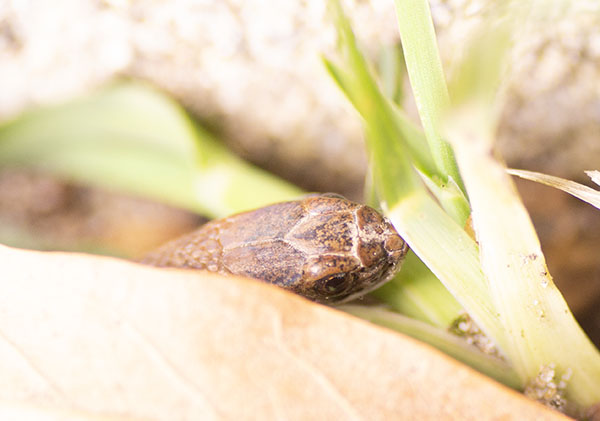
A cold and drowsy snake visited in January. The yard had experienced floods, in days before, so I expect the snake fled some drenched winter hideaway. Moving slowly in the chill, our visitor spent a half-hour or more searching for dry accommodations in leaves that had settled against our house’s concrete foundation.

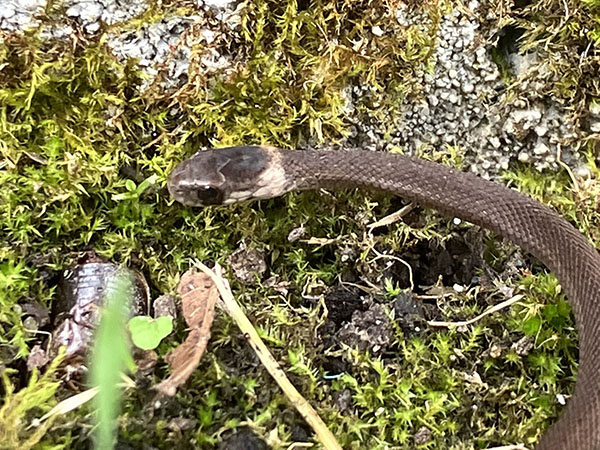
Photo of a Dekay's Brownsnake peeking from under a dry brown leaf. The scales on top of the snake's head are mottled brown with pale tan coloration between scales. Its large brown eye has a round pupil.
Photo of a Dekay’s Brownsnake peeking from under a dry brown leaf. The scales on top of the snake’s head are mottled brown with pale tan coloration between scales. Its large brown eye has a round pupil.

Over the past decades, I’ve caught rare glimpses of these snakes in the yard. Each time, I filed them in the generic “garter snake” folder of my internal memory bank. My flawed and over-capacity garter snake folder, in my flawed and over-capacity memory, holds all of the small, striped (or not), yard-sized snakes I’ve ever encountered. As long as the small, striped (or not), yard-sized snakes weren’t green, I called them garter snakes. (Green snakes are, obviously, “green snakes” in my flawed internal memory bank.)

Many of my “garter snakes” were, most likely, garter snakes.

Photo of a strongly marked snake with tan stripes and checkerboard patterns of dark brown and pale tan. I believe this is, indeed, an Eastern garter snake. The dapper little snake didn't want to cede its sunny spot beside the paved walking trail and assumed the defensive posture shown in this photo--head raised, neck in an s-curve, body slightly flattened and puffed. Everything about this posture says "if you don't leave me alone I'll bite you". (The snake attempted a strike shortly after this photo. I didn't get bitten, because I was wary enough to stay out of strike's reach, but I'm ashamed that I didn't heed the snake's clear request to be left in warm contentment. Instead, in my zeal for photos, I intruded so thoughtlessly that I made the little creature anxious enough to strike. I apologized, before leaving, but couldn't restore the snake's sun-soaked relaxation.)
Photo of a strongly marked snake with tan stripes and checkerboard patterns of dark brown and pale tan–an Eastern garter snake. This dapper little snake didn’t want to give up its sunny spot beside the paved walking trail and assumed the defensive posture shown in this photo–head raised, neck in an s-curve, body tense. Everything about this posture says “if you don’t leave me alone, I’ll bite you”. The snake attempted a strike shortly after this photo. I didn’t get bitten, because I was wary enough to stay out of strike’s reach, but I’m ashamed that I didn’t heed the snake’s clear request to be left in warm contentment. Instead, in my zeal for photos, I intruded so thoughtlessly that I made the little creature anxious enough to strike. I apologized, before leaving, but couldn’t restore the snake’s sun-soaked relaxation.

Many of my “garter snakes” were, most definitely, not garter snakes.

Garter snake. Not garter snake. Other snake. Each time I get a chance to patch my flawed and over-capacity internal memory bank, I’m relieved. Especially here, in my middle years.

As it’s been too cold for snakes to emerge, except in emergencies, I haven’t tested my brownsnake memory patch against snakes found in the wild. Or in the yard. So I’ve been testing it against my photo archive. At the moment, I’m still mid-correction, my internal dialogue still chirping “garter snake” when I come across photos of small, not-green, striped (or not striped), yard-sized snakes, still needing the gestalt-shift between first impression and new information. Still needing the pause and closer look. Not always garter snake. Sometimes, Dekay’s Brownsnake.

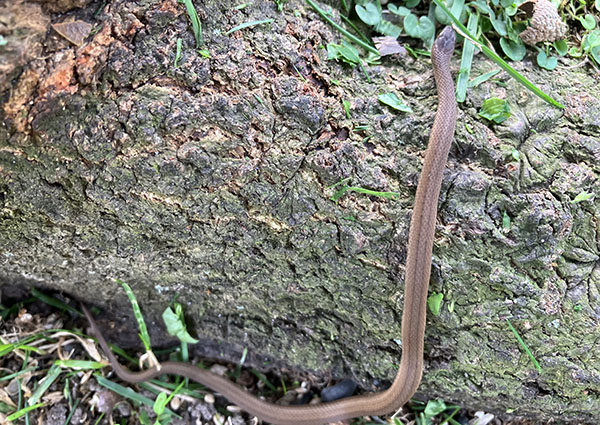
This little Dekay's Brownsnake, no more than 10 inches long, retreated over a tree root as I mowed the back yard. At the time, my internal dialogue tagged the photo "garter snake" and rambled off toward a more interesting (at the time) topic. Now, captivated by the newness of "Dekay's Brownsnake" in my internal dialogue, I clearly see the identifying keeled scales and parallel lines of dark spots down its back.
Photo of a Dekay’s Brownsnake, no more than 10 inches long, retreating over a tree root as I mowed the back yard. At the time, my internal dialogue tagged the photo “garter snake” and rambled off toward a more interesting (at the time) topic. Now, captivated by the newness of “Dekay’s Brownsnake” in my vocabulary, I clearly see the identifying keeled scales and parallel lines of dark spots down its back.

Is the image a vase or a pair of silhouettes? Is the snake a generic “garter snake” or a Dekay’s Brownsnake? The gestalt-shift between recognitions feels like wonder to me.

As for snakes in vases, or other yard art, maybe they are neither garter snake nor Dekay’s Brownsnake?

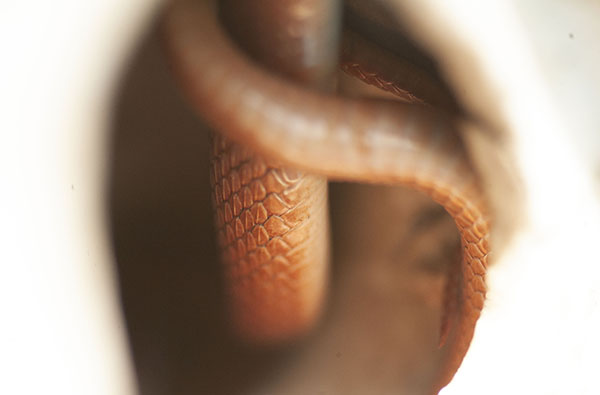
Photo of a snake's tail dangling out of the bottom opening of a hollow piece of ceramic yard art. The tiny snake, smaller in diameter than a pencil, was reddish-brown with a pale belly. I labeled these photos "garter snake", though I now wonder if they show a reddish variant of Dekay's Brownsnake. Or maybe some other species, still unnamed in my memory?
Photo of a snake’s tail dangling out of the bottom opening of a hollow piece of ceramic yard art. The tiny snake, smaller in diameter than a pencil, was reddish-brown with a pale belly. I labeled these photos “garter snake”, though I now wonder if they show a reddish variant of Dekay’s Brownsnake. Or maybe some other species, still unnamed in my vocabulary?
Another photo of the reddish snake that overwintered in a hollow piece of ceramic yard art. In this photo, keeled scales are clearly visible along the snake's sides, but I can't see enough of the snake's back to know if there are keels on its dorsal scales, as well. I tried following the identification key-map provided by the Virginia Herpetological Society, to no avail. (Please comment if you can help with the ID!)
Another photo of the reddish snake that overwintered in a hollow piece of ceramic yard art. I tried following the identification key-map provided by the Virginia Herpetological Society, to no avail. Keels are readily visible on the snake’s side scales, but no dorsal scales are visible in the photos, which is where my attempts at identification break down. (Please comment if you can help with the ID!)

I’ve seldom had the luxury of hovering here, at the pivot point of internal correction. But my time, this winter, has slowed with the chill. Long nights and short days trigger depression and anxiety, steering me toward torpor. And this winter’s torpor has been more meditative than some years. I’ve lingered over these photos of our little reptile visitor. I want to call this moment learning, except that overused word feels both too small and too large. As do other words, like knowledge and discovery.

Photo of a very small Dekay's Brownsnake emerging between dry brown leaves. In this side view, the snake's overlarge eye and round pupil are fully visible, along with a row of dark spots along its upper lip. Its pale lower lip curves up in an anthropomorphic smile.
Photo of a very small Dekay’s Brownsnake emerging between dry brown leaves. In this side view, the snake’s overlarge eye and round pupil are fully visible, along with a row of dark spots along its upper lip. Its pale lower lip curves up in an anthropomorphic smile.

Such words, and the ideas they attempt to convey, have been claimed and reclaimed, used and abused, lauded and cursed for centuries. Well before I began grappling with my own understandings and misunderstandings, philosophers and critics set their pens to the task of recording, preserving, and passing on observations that make reality a little bit safer, a little bit more predictable, for future generations of humanity. So many men (yes, mostly men) writing letters to a future with so much more to observe.

Macro photograph of the face and eye of a Dekay's Brownsnake, taken in January of 2024. The small snake's large eye shows a round pupil and an iris of iridescent brown and bronze. Its facial scales are mottled brown.
Macro photograph of the face and eye of a Dekay’s Brownsnake. The small snake’s large eye shows a round pupil and an iris of iridescent brown and bronze. Its facial scales are mottled brown.

What goes into a name? Constructing (or deconstructing) Dekay’s Brownsnake

Dekay’s Brownsnake has the dubious honor of being named after two 19th century (male) naturalists. Its taxonomic genus-species name is Storeria dekayi. This caught me by surprise. An entire genus of snakes named for David Humphreys Storer (1804-1891), an American physician and naturalist.

Species names have long been used to preserve and honor the names of explorers, scientists, and/or celebrities (a dusty old practice, also evident in common names such as Dekay’s Brownsnake, that is under discussion and overdue for a change) but genus names tend to be more functional. Genus names often highlight one of the traits (or missing traits) that identify the included species as similar enough to be grouped together while simultaneously dissimilar from other groups. Granted, the genus Storeria remains a small genus (only four species, according to the University of Michigan’s Museum of Zoology/Animal Diversity Web), but still….

I couldn’t resist a stroll through the search engine. I never can. Literature search is my favorite phase of projects, and archives are my happy place.

According to his obituary, David Humphreys Storer (1804-1891) was the dean of Obstetrics and Medical Jurisprudence for Harvard Medical School. He also had a great fondness for collecting. His collections encompassed everything from coins to birds eggs, and he cultivated connections with toll takers and sailors to bolster his coin, shell, and fish collections. His work with the Boston Society for Natural History led to a position with the Natural History Survey of the Commonwealth, where Storer managed the fishes and reptiles portion of the survey, resulting in the eventual publication of A History of the Fishes of Massachusetts.

Storer’s internet presence also includes an 1831 pamphlet, noted on page two to be the “Report of a Trial: Miles Farmer, versus Dr. David Humphreys Storer; commenced in the Court of Common Pleas, April Term, 1830, from which it was appealed to the Supreme Judicial Court, and by consent of parties, referred to Referees, relative to the transactions between Miss Eliza Dolph and George Washington Adams, Esq., son of the late President of the United States. It is impossible but that offences will come; but woe unto him through whom they come! It were better for him that a mill stone were hanged about his neck, and he cast into the sea. —Luke, xvii. 1, 2. Reported by the Plaintiff.” (!?)

I must admit that my interest in Storer dissipated before I read the entire pamphlet. Historical gossip aside (“…the transactions between Miss Eliza Dolph and George Washington Adams…”? Might this have been a scandal worthy of Lady Whistledown?), the pamphlet doesn’t contribute to my relationship with the little snakes in my yard.

Neither the obituary nor the pamphlet help me understand the man, David Humphreys Storer, who was so admired as to have a small genus of small snakes carrying his name to this day. And here lies part of the trouble with eponymous taxonomy. No matter how admired, in collecting circles, nor how despised, in other circles, Storer’s name cannot help me understand the habits and habitats of the little snakes I’m currently obsessed with.

James Ellsworth Dekays’ name doesn’t help, either. Another American physician and naturalist, Dekay (1792-1851) participated in a different state sponsored natural survey, for the state of New York. Dekay eventually published his findings in Zoology of New-York: Or the New-York Fauna: Comprising Detailed Descriptions of all the Animals Hitherto Observed within the State of New-York, with brief Notices of Those Occasionally Found Near Its Borders, and Accompanied by Appropriate Illustrations. In Part III (Reptiles and Amphibia), Dekay described a small brown snake collected by “…John Crumby, Esq., a zealous sportsman and acute observer, who captured [the snake] as it was swimming across a large bay on the northern coast of Long Island” (pp. 46-47).

Dekay’s three-paragraph note about the little brown snake is widely attributed as the first description. (A formality often conflated with discovery.) Dekay first used the genus name Tropidonotus but later corrected it to the genus name Coluber. Today the genus Storeria is classified within the family Colubridae.

A quick search engine query leads to a slightly more interesting article about Dekay–“Between the First Blind Cavefish and the Last of the Mohicans: The Scientific Romanticism of James E. Dekay” by Aldemaro Romero. But again, this article doesn’t help me understand or appreciate the yard’s snakes.

So my stroll through the binomial etymology of Storeria dekayi found my first example of an eponymous genus, two 19th century (male) physician-naturalists, a sex scandal with political connections, an article that tethers blind cavefish to James Fenimore Cooper, and one unfortunate little brown snake that fell prey to a sportsman while the snake was (likely) minding its own snake-business, swimming across a large bay on the coast of Long Island.

Reconstructing my memory, brown snakes included

But why do I crave a relationship, a learning or knowing, with the small, shy, nocturnal, snail-and-slug eating snakes in my yard?

Macro photo of a Dekay's Brownsnake. The snake was approaching the lens, so its head and eye are in focus while the rest of its body is out of focus. Its facial scales are mottled brown, with darker spots under its eye. The scales of its lower lip are very pale tan.
Macro photo of a Dekay’s Brownsnake. The snake was approaching the lens, so its head and eye are in focus while the rest of its body is out of focus. Its facial scales are mottled brown, with darker spots under its eye. The scales of its lower lip are very pale tan.

Why, after so many years of being content to see these snakes as “garter snakes”, do I care so much now? I suppose part of my previous contentment is rooted in a youthful mis-hearing and mispronunciation. Garter snakes were garden snakes, most often encountered during gardening. Small, not-green, striped (or not), yard-sized snakes. As long as they weren’t venomous, they were simply garden snakes.

Venomous-or-not was my earliest snake knowledge, my first lessons in the garden. Some snakes were, and are, venomous. Avoid. Don’t get bitten. Be afraid, if you must. If that’s what keeps you safe, be afraid of snakes. (Of course, all of this gets mixed in with Genesis, with Adam and Eve and a serpent that spoke of temptation. The lesson, again, was fear.)

Our father was a snake killer. Every snake he saw, he slaughtered with whatever tool was closest at hand. His histrionics over snakes were the stuff of family lore, which added a dose of realism to the lesson. My older siblings, and sometimes our mother, ridiculed our father’s snake phobia. I absorbed an adjacent lesson, that the reflex killing of snakes was an action worthy of ridicule.

I developed a fascination with these animals that were so terrifying to our father. I wanted to be not-afraid of what our father feared. (And I wanted to avoid being another target of family ridicule.) Rat snakes, king snakes, corn snakes, green snakes, garden/garter snakes. All the hen-house thieves and barn guardians. All the camouflaged brush and grass dwellers. I watched for them with a cautious kind of hope, longing to catch a glimpse. To see them glide across a rafter or ripple into the next row of okra or bask, egg-sated, near the hen house.

And then, during my years in the boggy woods, the fear-laced lessons of my past peeled away like the hull of a seed.

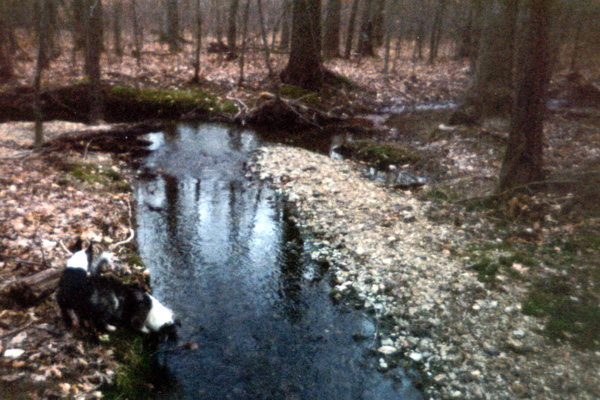
Photo taken in “the woods”, sometime during winter (bare trees, no underbrush, a thick blanket of fallen leaves) in the early 1990s. Shown here is a portion of the spring-fed creek that was the center of all activity in the woods. It was a shallow creek with shallow banks, flat gravel in places and woody in places, the wooded banks supported by exposed tree roots and moss. I visited the creek and woods as often as, and for as long as, time would allow. I was always escorted by a pack of dogs (and sometimes a cat or two, if the cats chose to follow). In this photo are my Boston Terrier (Simon) and Mother’s corgi mix (Bonnie). This photo smells like petrichor, sounds like water and wind and dry leaves and excited dogs, and looks like nostalgia. It feels like silence and loss, and it tastes like I’ve swallowed a memory because I was hungry for time.

In my boggy woods, hidden from the lessons of my parents and their religion, I sprouted. I developed an observational habit of naming and knowing the cottonmouths and the water snakes around the creek, the copperheads and the corn snakes near the edges, the rattlesnakes and the rat snakes under and in the trees. I knew where the gravid females basked and where the hungry youngsters hunted. I knew the woods and the creek because they were my favorite place to be myself. Should a snake have spoken to me, there, I would have eaten without hesitation whatever it offered.

Photo of a non-venomous water snake. The photo is cropped to concentrate on the snake's face, showing the round pupil and lack of a heat sensing pit between eye and nostril. The snake is striped in various shades of brown with vertical stripes on both upper and lower lip.
Photo of a non-venomous water snake. The photo is cropped to concentrate on the snake’s face, showing the round pupil and lack of a heat sensing pit between eye and nostril. The snake is banded in various shades of brown with vertical stripes on both upper and lower lip.
Photo of a cottonmouth (or water moccasin), zoomed in to show the snake's face and head. The cats-eye shaped, vertical pupil is clearly visible, as is the opening of its heat-sensing pit between eye and nostril. These two traits are common to the venomous pit viper family of snakes.
Photo of a cottonmouth (or water moccasin), zoomed in to show the snake’s face and head. The cat-eye shaped, vertical pupil is clearly visible, as is the opening of its heat-sensing pit between eye and nostril. These two traits are common to the venomous pit viper family of snakes.

But the garden snakes, as long as they weren’t venomous, were simply garden snakes. The garden wasn’t my habitat, so I didn’t need to know its snakes. I tended the garden, and ate its tame offerings, with impatient distraction, always longing for the woods.

Here in my middle years, the garden and yard have become my habitat. I no longer visit the woods, except as a tourist. Now I need to name and know the garden snakes.

Other than the practicality and predictability of recognizing our Dekay’s Brownsnake as not-venomous, I can’t put my finger on the reason for my need. It’s not learning, knowledge, or discovery. It’s simply there. As are the garter snakes. The not garter snakes. The Dekay’s Brownsnakes, who, I’m happy to note, are drawn to the yard and garden because they like to eat slugs and snails. Perhaps this is reason enough to name them and to know them?

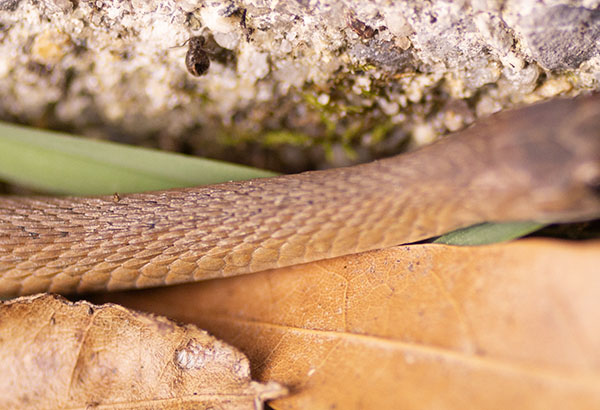
Photo of the Dekay's Brownsnake, focused on the snake's body scales. Each reddish-brown scale has a raised central keel, like a line drawn the length of the scale. These body scales overlap more tightly than the facial scales. A row of pinpoint black dots is just visible along the snake's back.
Photo of the Dekay’s Brownsnake, focused on the snake’s body scales. Each reddish-brown scale has a raised central keel, like a line drawn the length of the scale. These body scales overlap more tightly than the facial scales. A row of pinpoint black dots is just visible along the snake’s back.

Perhaps it’s all simply my personal gestalt-shift. The vase is Tennessee and the silhouettes are Virginia. The vase is the woods, the silhouettes our yard. The vase is youth, the silhouettes are now. The vase is water snakes, the silhouettes are garden/garter snakes.

Gestalt-shift. (Dare I say paradigm shift? I dare, but shouldn’t. It’s a rabbit hole.) At any rate, it’s another moment of wonder.

Photo of a juvenile snake exploring a mossy corner of the yard. The snake is gray-brown with a pale ring around its neck. Its overlarge eye has a round pupil. I initially leapt to the conclusion that this might be a ring-necked snake, but now suspect it's a young Dekay's Brownsnake.
Photo of a juvenile snake exploring a mossy corner of the yard. The snake is gray-brown with a pale ring around its neck. Its overlarge eye has a round pupil. I initially leapt to the conclusion that this might be a ring-necked snake, but now suspect it’s a young Dekay’s Brownsnake.

Here are links to three reviews of my poetry collection, Watershed:

“The collection focuses on the natural world and the human relationship with nature. …” by Crafty Green Poet (read the full review here)

“The poems have both a logical and mystical aura that keep the reader in place while the poems flow forward. …” by Lynette G. Esposito at North of Oxford (read the full review here)

“Watershed from Kelsay Books is an antidote to compulsion, to insistence, to the headlong rush into the next thing and the next. …” by GriffinPoetry at Verse Image (read the full review here)

I’m grateful for the time that readers, editors, and reviewers have spent with my writing, and with my book. I’ve loved every minute of my writing journey.


Here are a few articles and essays that are more interesting, and more important, than my musings:

Discovered in Collections, Many New Species are Already Gone by Katarina Zimmer at Undark

When Scientists “Discover” What Indigenous People Have Known for Centuries by George Nicholas at Smithsonian Magazine

The history of natural history and race: Decolonizing human dimensions of ecology by Maria N. Miriti, Ariel J. Rawson, and Becky Mansfield at esa journals (Ecological Society of America)

Feds announce plans to begin rescuing sick sawfish amid mysterious die-off by Jenny Staletovich at WLRN 91.3FM

People more often are origin of infectious diseases in animals than vice versa, data suggest by Mary Van Beusekom, MS, at CIDRAP

Ecological countermeasures to prevent pathogen spillover and subsequent pandemics by Raina K. Plowright, Aliyu N. Ahmed, Tim Coulson, Thomas W. Crowther, Imran Ejotre, Christina L. Faust, Winifred F. Frick, Peter J. Hudson, Tigga Kingston, P. O. Nameer, M. Teague O’Mara, Alison J. Peel, Hugh Possingham, Orly Razgour, DeeAnn M. Reeder, Manuel Ruiz-Aravena, Nancy B. Simmons, Prashanth N. Srinivas, Gary M. Tabor, Iroro Tanshi, Ian G. Thompson, Abi T. Vanak, Neil M. Vora, Charley E. Willison, & Annika T. H. Keeley at Nature Communications

living shadows: aesthetics of moral worldbuilding by Brandon at sweater weather (hat tip to Science for Everyone)

Fear and Loathing in Tennessee: Librarians Face Anxiety, Burnout, Job Threats, and Hate Speech Due to Book Challenges and Legislation by Alex Sharp, Jessica McClure, and Cassandra Taylor at Tennessee Library Association

Why flying insects gather at artifical light by Samuel T. Fabian, Yash Sondhi, Pablo E. Allen, Jamie C. Theobald, & Huai-Ti Lin at Nature Communications

Biology Is Not Binary by Kate Clancy, Agustin Fuentes, Caroline M Vansickle, & Catherine Clune-Taylor at American Scientist (another hat tip to Science for Everyone)

‘Brain fog’ is one of Covid-19’s most daunting symptoms. A new study measures its impact by Elizabeth Cooney at STAT

When Horror Is the Truth-teller: It is hard, in the era of the AR-15, to fear a vampire. by Alexander Chee at Guernica

Twelve Years (and, of course, counting…)

I don’t mark the anniversary of Mother’s car accident every year. In years where the date (today) passes without my noticing how it is today, I congratulate myself. This is not one of those years. This year I’ve noticed. All week.

I’ve noticed, but I can’t say that I’ve wallowed. This feels like an improvement over the wallowing years, though perhaps a step back from the not-noticing years. Maybe each of these years are actually equal, on my journey. Wallowing, noticing, not-noticing, maybe these things say more about growth and time than I’m capable of understanding.

And perhaps these noticings and not-noticings say something about how my mind works, about how it was working (or not working) in those individual years. Perhaps it’s not a complete non sequitur to point out that bee’s toes are much more exciting and interesting than bee’s knees, though the knees tend to get all the memes.

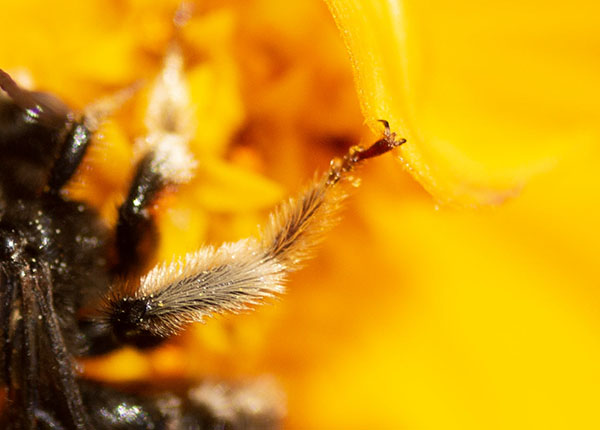
Macro photograph of a bee’s furry leg as it grasps a bright yellow cosmos petal while it is perched to sip nectar. The bee’s foot seems to be made up of three delicate hooked toes, each curled around the edge of the petal, while the bee’s knees appear to be simple hinge joints.

All of these wonderings and maunderings feel somewhat unproductive, but they are sometimes where poems start. So I’m letting myself wonder and maunder.

Macro photograph of a bee collecting pollen and nectar from the tiny yellow flowers of fennel. The black-and-yellow bee has yellow pollen dusting the hairs on its legs, head, and thorax. There’s even a scatter of pollen across the front edge of its wings. Its eyes are large and vaguely reflect the sky and sun, its antennae are long and segmented, and its delicate hooked toes are visible. Its knees are, relatively speaking, unremarkable.

While I’m waiting to see if a poem arrives, it seemed reasonable to update an old entry from April 2012, Finding What I Wasn’t Looking For. (In the post, I talked about Mother’s affinity for four-leafed clovers.) Except somehow, in updating the post (to add photo captions, mostly), I managed to change the post’s date to today. Now I can’t change it back.

Perhaps this, too, says something about how my mind works.

Debut Poetry Collection: Watershed

I’m delighted to announce that my first poetry collection, Watershed (Kelsay Books), has been released in paperback and Kindle ebook formats. The paperback ($20/US) is available through the Kelsay Books website (here) or through Amazon (here), while the Kindle ebook ($9.99/US) is available through Amazon (here). (For more details, I’ve created a permanent page for Watershed here.)

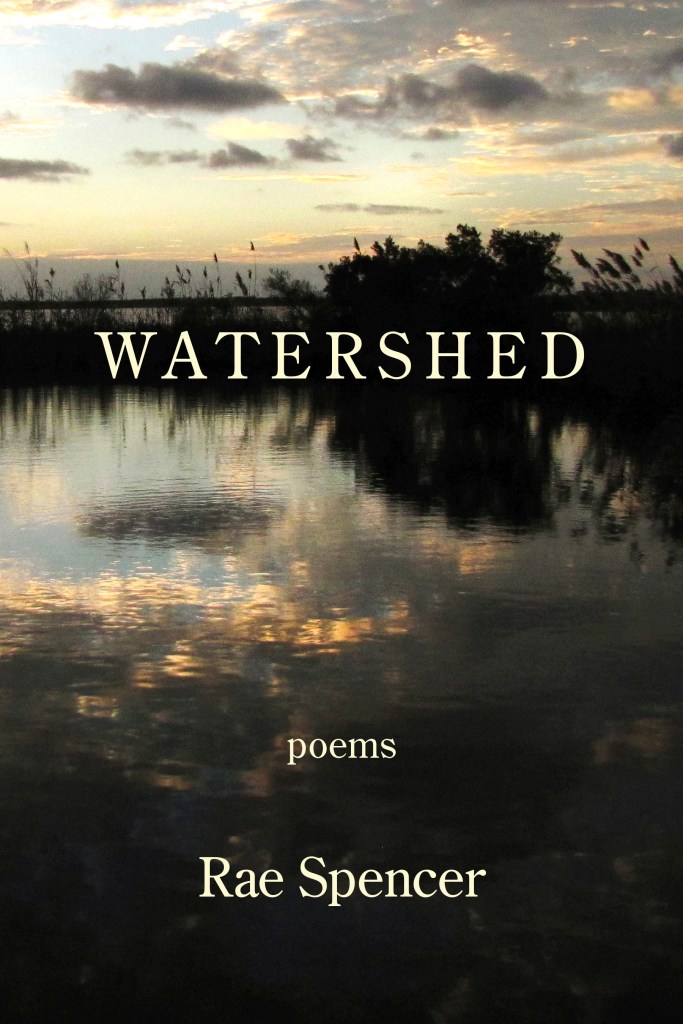
Watershed front cover: a pale sunset image of clouds and sky over a pool of water, which reflects the clouds and sky, surrounded by seagrasses and shrubs. Text on the cover reads: Watershed, poems, Rae Spencer.

The poems in Watershed are mostly autobiography, written within my nostalgia for the landscapes of Tennessee, my journey into Virginia’s coastal landscapes, and my tenuous understandings of how “growing up” changes my gaze.

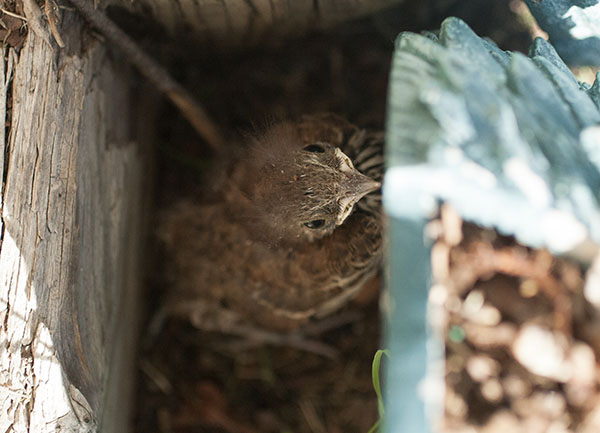
Photograph of a chickadee fledgling perched on our deteriorating fence. The young chickadee is shedding downy nestling feathers, while the fence’s aged wood is cracked and weathered.

As I pondered this post, how to introduce my debut collection, I finally grasped the word connection between debut and debutante. How ridiculous to contrast myself–middle-age, married, and profoundly awkward–against the idealized debutantes of historical romances.

Photograph of my reflection in a window. My face is hidden by the camera I used to capture the image. My graying hair is shoulder-length in tangled layers. I’m wearing a sleeveless shirt, so the tattoos on my hands and arms are visible–an ink collection of flora and fauna.

And yet, here I am, a debut author sending my first poetry collection into the world. I’ve loved every minute of the process, from the writing to the planning to the organizing to the submission to the rounds of editing after acceptance, all the way through this final phase of setting up author pages and posting announcements. I suppose all of this means that I’m finding my way.

Photograph of a brown thrasher fledgling hiding in a nook between a planter and our fence. The little fledgling is brown-and-tan-striped with the exaggerated beak, forehead, and eyes that render baby birds endearingly cute.

Finding my way to where?

To here, for now. To exactly where I am.

Photograph of an osprey passing overhead with a large fish grasped in its talons. The osprey’s muscular wings are fully extended, long tan-striped primary feathers spread at the tips, and its sharp beak and eyes are turned toward some unseen destination.
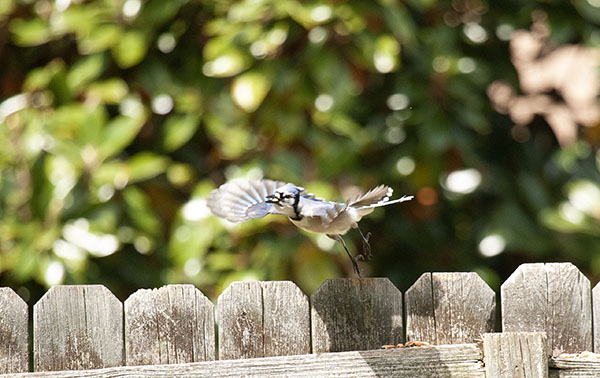
Photograph of a blue jay in the process of taking flight from the top of our wooden fence. The blue jay’s wings are extended, tiny black feet stretched into its launch. The bird is carrying in its beak a peanut, selected from a small pile of peanuts we left on the fence.

To a small yard in a sprawling suburb, somewhere in the middle of life’s extremes, poised between the lush luxuries of nostalgia and hope. There’s always something precarious on the horizon, but, for today, I’m here.

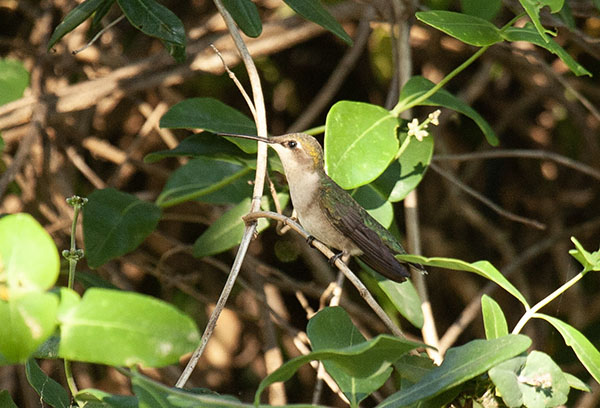
Photograph of a hummingbird perched on a woody vine of honeysuckle. There are no honeysuckle blooms in frame, so everything is green and brown, including the hummingbird’s feathers.

The following links lead to articles, essays, and posts that are more important and more interesting than my debut poetry collection:

The Unwild Mallards

Each spring, our semi-wild population of suburb mallards leave their lakes, ponds, and canals in search of private nesting habitats. This local migration often brings pairs of mallards to the yard, though none have stayed to nest. Until this year.

In this photo, taken April 29, five baby mallards huddle under their mother as she stands on a rock beside our pond. A sixth baby sits on the next rock over. These mallard ducklings were less than 18 hours out of the egg and are only half of the clutch. Six more babies were waiting in the nest behind their siblings.

Less than a week after I posted about the dragonfly pond, a pair of mallards arrived and began redecorating the pond. They shoved rocks from the border, collapsed minnow caves, uprooted plants, stirred sediment into columns of mud, and added enough nutrient (in the form of duck poop) to start a massive algae bloom.

In this photo, taken March 3, a pair of semi-wild mallards visit the pond. The male mallard floats near the center of the pond, preening his wings, while the female searches for underwater food. The water is still relatively clear and the pond‘s rocks and plants are still somewhat in place.
This photo, taken March 7, shows the view from our kitchen window as the mallards nap in the pond. Both ducks have their heads resting along their backs, beaks tucked into the feathers between their wings. The water is turbid and dark, with scattered remnants of uprooted plants. The rocks are still mostly in place, though that didn’t last.
Photo of the pond, taken March 14, showing filthy greenish-brown water. The pond heater is still deployed, though I removed it shortly after. A board shaped like a fish floats in the far end of the pond.1

The dragonfly pond soon looked and smelled like a cattle pond.

The ducks ate everything they could catch in the water. Minnows and dragonfly larvae, damselfly larvae and snails. Anything that swam or wriggled.2

We shooed and herded the pond-wrecking mallards, who returned day after day for further wreckage. I complained to family and friends about the mallards’ destructive invasion, but I also hoped for a nest. Truth be told, I always hope for nests. Plus, I have nostalgic affection for ducks.

This photo3 shows me at some early elementary school age, complete with crooked bangs, ill-fitting shorts and halter top, knobby knees, and a welter of mosquito bites. I’m holding our pet duck Fred, who was very spoiled.
This photo, dated 1975, shows a group of mature white ducks in our Tennessee back yard.
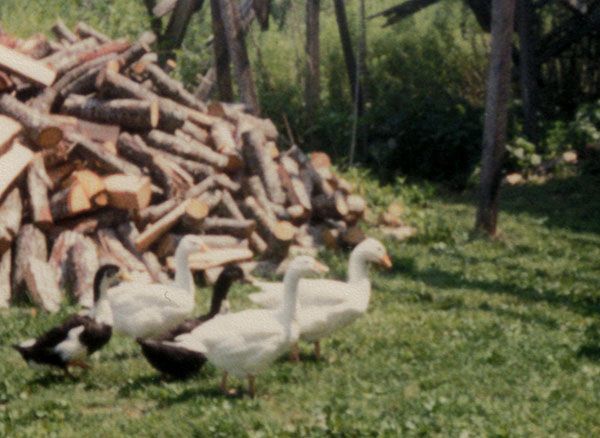
In this later photo, probably late 1980s, three white geese and two black-and-white ducks amble past a newly delivered cord of winter wood in our Tennessee yard.4
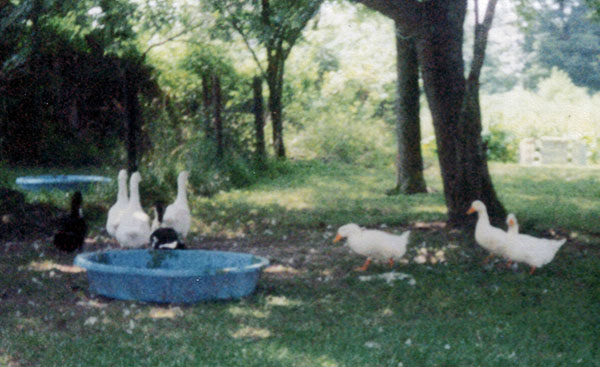
This photo, dating to the late 1980s or early 1990s, shows three white geese, two black-and-white ducks, and three white ducks visiting their blue plastic wading pool in our Tennessee back yard.5

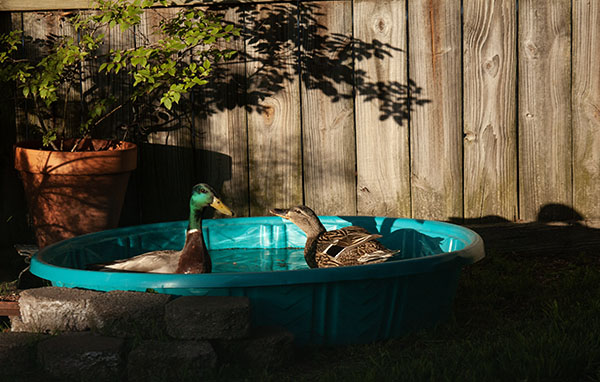
Hoping to lure the mallards away from the pond for at least a few hours each day, I purchased a blue plastic wading pool (definitely a theme in my lifelong efforts to keep waterfowl happy) and an extra bag of wild bird feed. Pool and feed in hand, I set up a duck station near the fence in our Virginia back yard, including steps for easy entry into the pool. Then I herded the mallards out of the pond and toward the pool.

In this photo from March 12, a blue plastic wading pool is wedged into the back seat of my car. Many thanks to the very patient Target employee who brought the wading pool out for curbside pickup and helped load it while we both fought off fits of the giggles because who buys a wading pool in March? For ducks? While masking and social distancing because COVID is not over? (I’ll add that COVID is still not over. Especially for families, like mine, who have immunocompromised households.)

Not surprisingly, the mallards saw peril in the duck station and refused to try the wading pool. At that point, the pair were still semi-wild, after all. They retreated into the pollinator beds and rummaged through duff when I was in the yard, then circled back to the pond when I went inside.

And the pond grew more and more fetid. (I had almost forgotten the smell of our chicken house in Tennessee, and sometimes the yard when our flocks grew too populous, but now I’ve been reminded.)

In this photo from March 14, the male mallard watches warily from behind the irises that shore up one end of the pond. Neither of the mallards tried the wading pool until after I quit trying to convince them to try the wading pool.

When the female mallard built her nest in the irises and began laying, we stopped all efforts to shoo or herd or otherwise interfere. Almost immediately, the mallards took to the wading pool for luxurious sessions of bathing and splashing.

Photo from March 21, showing the female mallard bathing in the wading pool as the male mallard stands guard.
Photo, dated April 14, showing the female mallard bathing in the wading pool as the male mallard stands guard.
Photo, dated April 18, showing both mallards in the wading pool.

Resigned to a lengthy mallard residency, we invested in a pump and filter for the pond. For the next month, I cleaned the pond filter daily, dumped and refilled the wading pool every other day, put out feed each morning and evening, and lingered in the kitchen window for hours on end, watching. The mallards hunted in the pond (and further rearranged the rocks), bathed and basked in the wading pool, ate their feed and grazed through the yard, and generally unwilded until they were as comfortable in the yard as our domestic flocks had been in the yard of my childhood home.

And while the mallards unwilded, the nest grew.

Photo, dated March 20, of the nest with a single egg.
Photo, dated March 28, of the nest with five eggs.
Photo, dated April 1, of the nest with nine eggs.

On April 1, with nine eggs in the nest, the female mallard settled to incubating. Giving up all pretense of productivity, I sat in the kitchen window, day after day. While she sat on her nest. Day after day.

Photo, dated April 14, of the female mallard on her nest.
Photo, dated April 18, of the eggs nestled in layers of down.
Photo, dated April 18, of the female mallard on her nest.

And then, on April 28, the hatching commenced. All afternoon the mallard fidgeted and turned and tended, eating some of the discarded shells and membranes, tucking the rest under the nest’s foundation of dried grasses. By nightfall the nest was filled with ducklings instead of eggs.

In this photo, taken April 28, a freshly hatched mallard is nestled deep into the downy feathers lining the nest. The female mallard is half-standing in the nest, with two still-unhatched eggs visible beneath her.
Here a duckling, still damp from hatching, is just visible under the female mallard as she stands in her nest.
Here the ducklings are getting their first views of the world from inside their nest, still guarded by their mother.

I set my alarm for sunrise the next morning, certain that the female mallard would lead her brood away as soon as the hatchlings were mobile enough. I didn’t want to miss a moment of their brief stay in the yard.

April 29. The now-fluffy-and-dry baby mallards peer out from around their mother as the little family begins to stir in their nest.
The baby mallards follow their mother from the nest for their first outing. In this photo, two babies hover under their mother as she stands on the rocks just in front of the nest.
All twelve eggs hatched seemingly healthy babies. Their first clamber down the rocks was eager for some and timid for others. In this photo, one of the eager ducklings takes an awkwardly long step down from the first rock.
The eager duckling from the previous photo experiences a bit of a rough landing in the water. The impromptu dive didn’t phase the duckling, which swam busily away.
The more timid ducklings took more care climbing down from the nest. In this photo, a group of three ducklings linger on the first rock as one of their siblings stretches a careful foot down toward the next step.
The ducklings tasted everything they found. Here, a baby mallard floats on the pond and nibbles at a long plant stem.
The fish-shaped board proved a popular resting spot for the ducklings as they practiced swimming and diving and eating. Here, two ducklings perch on the board while their siblings swim around them. The female mallard is just visible in frame, keeping an eye on her brood.
The ducklings also rested on the pond’s bordering rocks, which were warm from the sun. Here, four ducklings sit on the warm rocks.
A baby mallard, less than 24 hours out of the egg, perches on one of the warm rocks bordering our small dragonfly pond.
Exhausted after their first few swim lessons, the mallard family returned to their nest between adventures. Here, two of the babies have tipped over into awkward sleeping positions on the rocks while their siblings gather in the nest beneath the female mallard.

And, of course, they didn’t stay.

I followed the mallards as their mother led them out of the yard and down our street and through a playground and up the next street over to a house on a canal without a fenced back yard. The homeowner was working in his yard when our odd parade arrived, and he nodded and shrugged when I waved from the sidewalk across the street. He told me that mallard mothers lead their brood through his yard, the only unfenced yard along the canal, all spring long. They head for the canal despite its dangerous populations of snapping turtles, snakes, and bullfrogs large enough to eat a baby duck. We agreed that yards are safer but mallards need canals.

Then I trudged home alone, wishing for a world both more and less wild.

I was shocked when the mallard led her brood back, that evening. My husband saw them coming up the sidewalk and called for me. The female mallard had guided her dozen day-old ducklings out into the canal and back again, safe and tired. We opened the gate and welcomed them home, pond wreckage forever forgiven as the sleepy family spilled back into their nest.

The next morning they left for good, of course. The yard, for all of its unwild safety, is not meant for mallards. Nor are mallards meant for the yard.

They haven’t returned, and they won’t. At least, not as the same little family that left. But every mallard I see, for all my years to come, will be one of them.


The Unwild Mallards

The unwild mallards were stubborn and messy
Unwily in their need
And the pond was water enough for nesting

An unwild nest
In unwild irises

A quick meal and a bath
Then back to the nest

Days growing longer and hotter
In the unwild yard
With unwild waters

And then
The unwild dozen

That afternoon, they left
Then returned for one last night
Before they left for good

Heading toward the good wild waters
Where unwild mallards might learn
To be wild

Video comprised of still images and iPhone video clips of the mallards’ time in the yard. Text over the images repeats the poem printed above. The audio is a separate recording made in the yard as I edited this video. Traffic noise and wind dominate the audio, but crows and a blue jay make guest appearances.

Footnotes

1 We added the board after removing a commercial floating planter/island. We removed the island because it was ruined, then added the board because we felt sorry for the minnows that had enjoyed hanging out under the island. (Click here to go back.)

2 The ducks were not so efficient as to depopulate the minnows and invertebrates. I’m not certain how anything survived, between the feasting and the fouling, but some survived and carried on. Currently, the pond is teeming with baby minnows and every surface is clumped with snail eggs. (Click here to go back.)

3 This is another of my oldest sister’s “Rae with pets” series of photos, which span years and will likely continue to appear on this blog. In the background, two chickens and our shepherd make guest appearances. (Click here to go back.)

4 After our father left, the job of stacking wood fell to me. Mother purchased cut wood from a neighbor, who unloaded it in a heap. I would sort the wood by size and age, stacking it all in our pole shed. The freshest cuts went at the bottom of the pile (to age/cure) and the aged/cured wood at the top. The largest logs started at the left and the smallest kindling at the right. I even sorted the wood according to Mother’s lore: she believed that the hardest woods (usually hickory and oak) burned long and hot, the softer woods (often maple and hackberry, but sometimes others that I didn’t recognize) burned fast and cool, and the evergreens (pines and the occasional cedar) burned oily and deposited more creosote in the chimney. When bad weather was forecast, I brought days or weeks worth of wood to the porch, where it stayed drier than the shed. But Mother didn’t like keeping wood stacked on the porch because warm air escaping through the door woke the woodpile’s insects, who followed the warm air indoors. (I never had cause to doubt Mother’s wood fire lore and would likely stack wood by size and hardness, away from the porch, if we burned wood for heat today.) (Click here to go back.)

5 The wading pool was the closest thing they had to a pond. A second blue plastic wading pool, visible in the background, was in the dog pen and helped our dogs stay cool. The second pool also kept the dogs from digging under the fence because they wanted to play in water. (Click here to go back.)


I regret that I do not have a list of links, for this post, to articles and essays that are more important and more interesting than the small unfoldings in our small yard. I have been tired, of late, and taking a break from the larger world. I will resume reading and exploring and learning once I have regathered my energy, both emotional and physical. In the meantime, please post links of your own, to articles and essays that have helped you better understand the world. (Please also note that I screen comments.)