Review: My Beloved Brontosaurus

My Beloved Brontosaurus: On the Road with Old Bones, New Science, and Our Favorite Dinosaurs by Brian Switek (Scientific American / Farrar, Straus and Giroux, 2013)

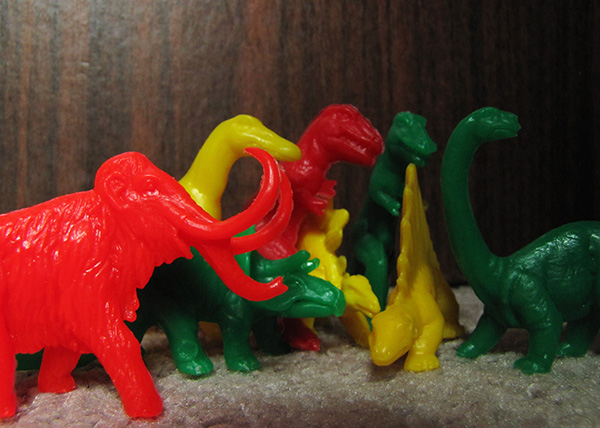
First, I have to confess that this is not really a review. It’s mostly a chance for me to visit one of my favorite topics. I have been fascinated by dinosaurs for a very, very long time. As I read My Beloved Brontosaurus, my fingers began to itch for the feel of my old plastic toys, the ones that roared through my childhood and paced across my shelves. They are (and were at the time) scientifically inaccurate. However, they were (and still are) great fun.

Dinosaurs April 4

Unlike my battered collection of mismatched toys, My Beloved Brontosaurus is equal parts good science and good fun. Much of it is a journey through paleontology’s growing pains, exploring name changes, skeletal puzzles, and feather mysteries. Chapter by chapter, the book details how Brontosaurus became Apatosaurus, how the upright posture that once defined a dinosaur was discovered in non-dinosaurs from the same time period, and how evidence hints that many dinosaurs had feathers or protofeathers (sometimes referred to as dinofuzz.)

My Beloved Brontosaurus is the most fun I’ve had with dinosaurs in years. Not only is the science interesting, the book strikes resonant chords in each chapter with elements of memoir, personal essay, and travel writing. As I turned the last page, I was filled with a deep yearning to pack a bag and head off on a multi-state museum tour. A few minutes later, coming to my senses and realizing that travel is not my favorite way to spend time, I headed off to the attic in search of a dusty box full of memories.

Dinosaurs April 4

(I don’t know how the woolly mammoth [definitely not a dinosaur] made it into this batch of plastic dinosaurs. Nor the sail-backed Dimetrodon. Perhaps it’s no coincidence that I found a blog post, yesterday, explaining how Dimetrodon is #notadinosaur”.)

Dinosaurs April 4

Since I started this post with a confession, it seems appropriate to end with one. I don’t remember some of these dinosaurs. They mysteriously appeared in my collection when Mother mailed off several boxes of old toys as she attempted to de-clutter her house. I can’t say with certainty which of the dinosaurs were mine and which ones became mine as Mother packed the boxes, but I’m happy to claim them all now.

Dinosaurs April 4

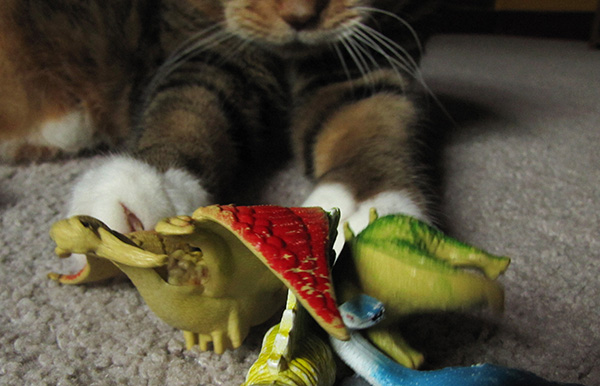
(As an aside, it’s somehow logical to me that cats might have had something to do with most of history’s extinction crises.)

Dinosaurs April 4

Poetic Prose: Music

I don’t have a concise definition for music in writing, but I tend to think of it as a pleasing combination of syllable sounds and meaning. It’s heavily dependent on word choice and word order, and the richest music is enhanced by metaphor and imagery. Music is what makes poetry poetic, but there’s no rule that says prose can’t be poetic, too.

Researchers at the University of Exeter recently published a study in which they compared the brain’s response to prose and poetry. The following is from the university’s website:

In a specific comparison between poetry and prose, the team found evidence that poetry activates brain areas, such as the posterior cingulate cortex and medial temporal lobes, which have been linked to introspection. (1)

(I highly recommend reading the brief University of Exeter article in its entirety, because it contains details of how the study was conducted, along with a caution that “This was a preliminary study.”)

A post at Your Universe Online says:

The team also found that emotionally charged writing activated areas of the brain which are known to respond to music. Predominantly on the right side, these regions had previously been shown to give rise to the “shivers down the spine” feeling caused by an emotional response to music. (2)

Perhaps musical writing is music, as far as the brain is concerned. At a minimum, musical writing engages readers’ minds in a more complex fashion than non-musical writing. Does this explain, in part, my emotional connection to books like The Book ThiefThe Story of Edgar Sawtelle, and Shine Shine Shine? And how, as a writer, do I add music to my fiction?

Here’s the first sentence of The White Deer by James Thurber:

If you should walk and wind and wander far enough on one of those afternoons in April when smoke goes down instead of up, and nearby things sound far away and far things near, you are more than likely to come at last to the enchanted forest that lies between the Moonstone Mines and Centaurs Mountain. (3)

The opening lilts through a series of syllables that start with soft sounds and end sharply: “… walk and wind and wander far enough … .” Alliteration is part of the magic, but there’s more than alliteration at work here. It can’t be read aloud without falling into rhythm.

The rhythm changes with “in April,” becoming staccato: “… smoke goes down instead of up … .” Now syllables begin sharply as well. And the words sound like what they mean: “goes down” has a sinking inflection and “up” make the voice rise. The same is true of “nearby things sound far away,” where the words trail off with a train of fading syllables then recover with the crisper syllables of “far things near.”

The images are surreal, setting the scene for the sentence’s eventual arrival in an enchanted forest. Each image is more strange and whimsical than the last, until:

There’s even a tale, first told by minstrels in the medieval time, that rabbits here can tip their heads as men now tip their hats, removing them with their paws and putting them back again. (4)

Intense rhythmic elements continue throughout the book, complete with a few tongue-twisting sections:

“My father and my brothers and I pursued a deer,” said Clode, “which against the wall of Centaurs Mountain underwent a marvelous and mortifying metamorphosis. I am a little touchy on the topic, too, so do not turn your tongue to taunts.”

“He does not turn his tongue,” said Jorn. “He twists your own, to ‘m’s’ and ‘t’s.’ ”

“And ‘w’s,’ ” said the wizard, “as you shall see.”

“Try twice that trick on Tlode,” said the King, with great dignity, “my mousey man of magic, and we will wid these wids of woozards.” King Clode made a royal gesture of arrogance, authority, and austerity, while his sons stared at him in astonishment. (5)

The temptation to read aloud is overwhelming, and the audiobook for The White Deer is the most exquisite recording in my collection.

The White Deer is a masterful example of how word choice and order create music, but the book’s music is not wholly dependent on sound. The imagery is bright and inventive, and the metaphors are layered and slippery. No detail is overlooked. No matter how many times I read The White Deer (or listen to it) I always find something new to love in its pages.

Whenever I get frustrated with my fiction, convinced that too much poetry has crept in, I return to The White Deer. After reading it, I realize how leaden my pages are, how barren of music. My feeble phrases gasp and wheeze. Should I accidentally write a musical paragraph, it looks out of place. I make the mistake of seeing it as “too much.” And, while some stories and genres require more subtle music than others, the problem is never too much poetry in my prose. It is always too little.

References

1. “Poetry is like music to the mind, scientists prove.” Medical School, News. University of Exeter. 9 October 2013. Web. 29 October 2013.

2. Flowers, April. “This Is Your Brain. This Is Your Brain On Poetry.” Your Universe Online, redOrbit.com. 10 October 2013. Web. 30 October 2013.

3. Thurber, James. The White Deer. New York: Harcourt, Brace and World, Inc., 1945. Print. 3.

4. Thurber, James. The White Deer. New York: Harcourt, Brace and World, Inc., 1945. Print. 4.

5. Thurber, James. The White Deer. New York: Harcourt, Brace and World, Inc., 1945. Print. 16.


Mushroom Aug 21

If you pluck one of the ten thousand toadstools that grow in the emerald grass at the edge of the wonderful woods, it will feel as heavy as a hammer in your hand, but if you let it go it will sail away over the trees like a tiny parachute, trailing black and purple stars. (pg 1-2)

Mushroom Aug 21


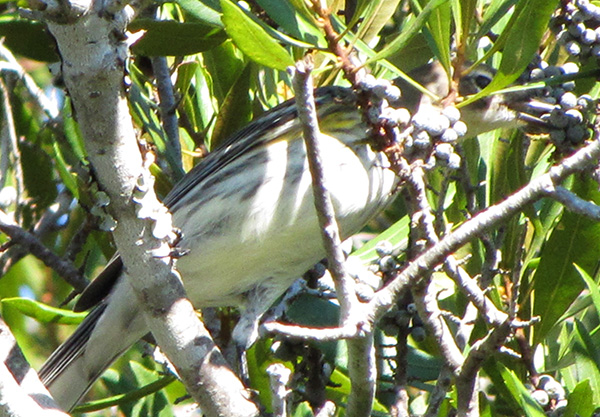
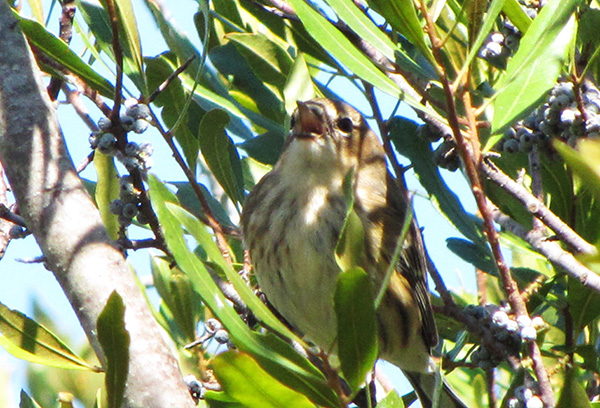
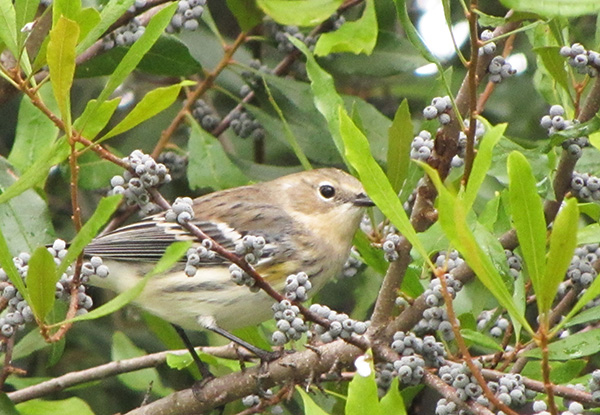
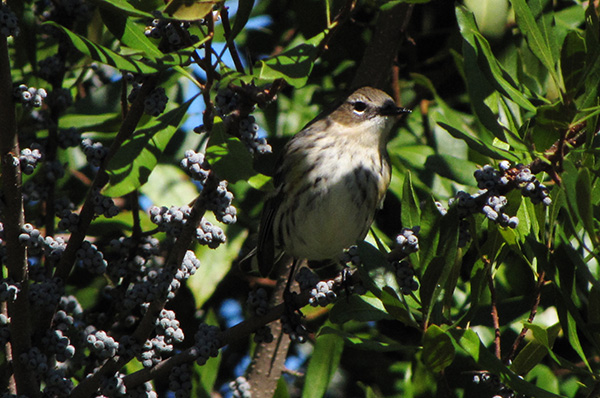
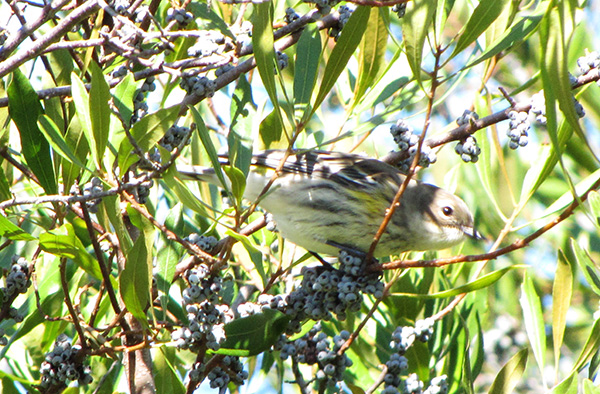
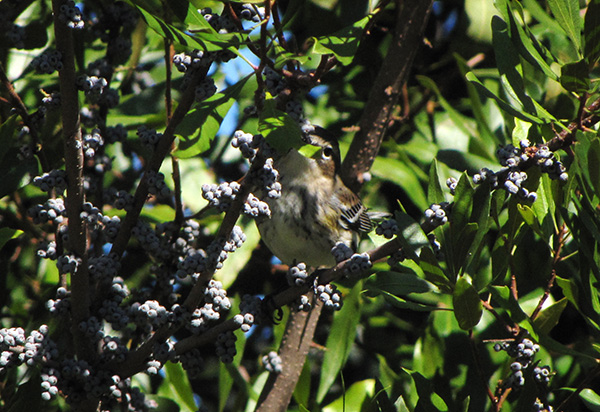
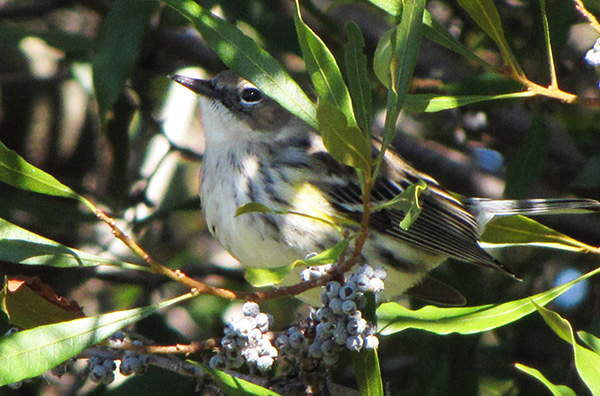
Hungry Warblers

Warbler October 24

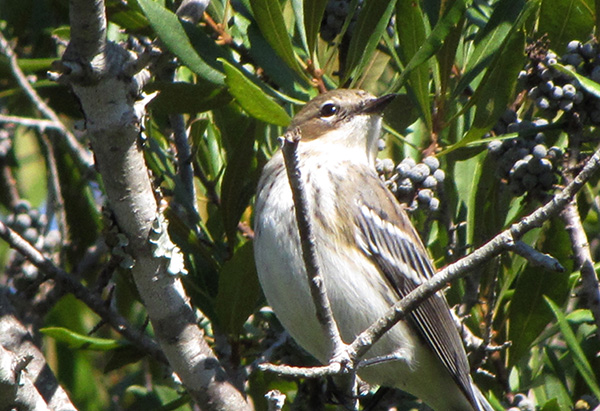
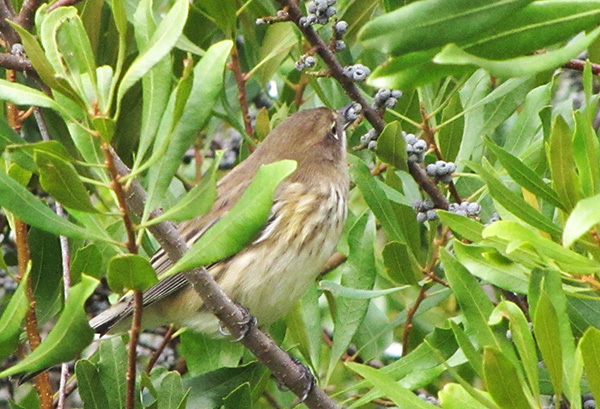
Yellow-rumped Warblers began arriving a few weeks ago. Now they are a constant presence in the wax myrtle as they gorge on the small, unappealing berries that other warblers cannot digest.

Warbler October 23

Warbler October 24

Every year I fall in love with the warblers, all over again, and spend hours trying to photograph them.

Warbler October 24

Cloudy days test my patience with low light and grainy images.

Warbler October 23

Sunny days emphasize the warblers’ camouflage, turning photos into abstract riddles of highlight and shadow.

Warbler October 24

Exposures set for the interior of the wax myrtle flare distractingly bright whenever a bird strays into a patch of sunlight.

Warbler October 26

Exposures set for sunlight fail when a bird retreats into shadow.

Warbler October 24

Every so often, sunlight, shadow, and bird merge into a split-second of breathtaking beauty. At those moments I freeze, too captivated to remember my camera. Then the moment passes, and I’m left snapping a photo of perfection’s echo.

Warbler October 24

These photos are the most frustrating of all, teasing reminders of what might have been. They are also my favorites. They are cause and effect. A reason to keep taking photos. Photos worth keeping.

Warbler October 26

I’m finding that photography, like poetry, is a hunger that returns season after season.

Review: At Age Twenty

At Age Twenty by Maxwell Baumbach
(unbound CONTENT, 2012)

Maxwell Baumbach’s poems are perceptive, ambitious, and unapologetic. They are also wryly aware that age seldom listens to youth with the kind of respect these poems yearn for.

the god is………..you
this is your….reality
your………….world (“Kaleidoscopes (an experimental sestina)” pg 20)

but the world does not cease
leaving its oversized handprints on my back
shoving me
onward (“My Fifth Birthday” pg 64)

While I usually prefer more complexity of sound, there’s plenty of music here. It’s a raw music of line breaks and candor: “I am your / zip lock lover” (“Zip Lock Lover” pg 25), “your eyes are gods / they make me believe that I am / capable…” (“the gods in your eyes” pg 28), and “no one kills themselves / on their own” (“Lemmings” pg 69).

There’s chaos and gratitude. Despair, sarcasm, and humor. The world is vulnerable and absurd. Brakes fail, Harry Caray sings through a seventh-inning stretch, and pro wrestlers soar and fall. Orion has a belt but no pants.

Some of these poems are terse fragments of dialogue, others are expansive recollections. They drop F-bombs, have a few drinks, and fall in love. Bruises and broken hearts are part of the journey, as are breathtaking insights.

I couldn’t help seeing the future in this book, nestled inside one of my favorite poems from the collection:

Sphere Within a Sphere

I saw a sculpture
in Ireland
of the new world
emerging from the old one

it is not the
now rusting gold
or the curvature
of the spheres
that made it so wondrous

but rather
that this sculpture
will be perpetually relevant

(reprinted with the author’s permission)

The new world is, indeed, emerging from the old.

Poetic Prose: Metaphor’s Impact on Pace

In 2012, brain studies made headlines with evidence that metaphors activate sensory regions of the brain. The implications for fiction writers are readily obvious. If you want your readers to see, hear, smell, and feel your world, you can help them along by using descriptive metaphors. Articles like “The Neuroscience of Your Brain on Fiction” from the New York Times cover the topic in eloquent detail:

The brain, it seems, does not make much of a distinction between reading about an experience and encountering it in real life; in each case, the same neurological regions are stimulated. Keith Oatley, an emeritus professor of cognitive psychology at the University of Toronto (and a published novelist), has proposed that reading produces a vivid simulation of reality, one that “runs on minds of readers just as computer simulations run on computers.” Fiction — with its redolent details, imaginative metaphors and attentive descriptions of people and their actions — offers an especially rich replica. Indeed, in one respect novels go beyond simulating reality to give readers an experience unavailable off the page: the opportunity to enter fully into other people’s thoughts and feelings. (1)

The New York Times article references, in part, research done at Emory University in Georgia. The university’s website describes the methods employed in one of the more prominently discussed studies:

Seven college students who volunteered for the study were asked to listen to sentences containing textural metaphors as well as sentences that were matched for meaning and structure, and to press a button as soon as they understood each sentence. Blood flow in their brains was monitored by functional magnetic resonance imaging. On average, response to a sentence containing a metaphor took slightly longer (0.84 vs 0.63 seconds). (2)

For me, that last detail adds a new dimension to the discussion about metaphor in writing. Metaphors take longer to process. And, while the time lag may not seem significant when applied to single sentences, it adds up over the course of a book. Even over the course of a paragraph.

Here’s the first paragraph of The Last Unicorn:

The unicorn lived in a lilac wood, and she lived all alone. She was very old, though she did not know it, and she was no longer the careless color of sea foam, but rather the color of snow falling on a moonlit night. But her eyes were still clear and unwearied, and she still moved like a shadow on the sea. (3)

A lilac wood? Is the wood made entirely of lilacs? Is it purple? Maybe it smells like lilacs? Perhaps the intent goes deeper than description. Lilacs appear in mythology, flower lore, and in a well-known poem by Walt Whitman. Since there is no rule limiting each word in a text to a single meaning, lilac may mean all of these things. And, no matter which meanings I choose, I am alert for the next metaphors — a series of sea and water images used to describe the unicorn. These make me thirsty for more.

By the time I finish this first paragraph, the book’s opening pace is established. It flows from page to page in unhurried leisure, giving me plenty of time to explore and enjoy the scenery. At the bottom of the first page I’m told, “Unicorns are immortal.” And I understand. They have no need to hurry.

But things change for the unicorn, and for me, on page six.

From that first moment of doubt, there was no peace for her; from the time she first imagined leaving her forest, she could not stand in one place without wanting to be somewhere else. She trotted up and down beside her pool, restless and unhappy. Unicorns are not meant to make choices. She said no, and yes, and no again, day and night, and for the first time she began to feel the minutes crawling over her like worms. (4)

As the unicorn frets, so does the text. The first part hurries along, a straightforward description of restless indecision. Then time slows uncomfortably with “… minutes crawling over her like worms.” Further down the page, I find this paragraph:

Under the moon, the road that ran from the edge of her forest gleamed like water, but when she stepped out onto it, away from the trees, she felt how hard it was, and how long. She almost turned back then; but instead she took a deep breath of the woods air that still drifted to her, and held it in her mouth like a flower, as long as she could. (5)

The road “gleamed like water.” It’s an arresting image, recalling the first paragraph’s water imagery. I expect the road to ripple when the unicorn steps on it, and I share her surprise at finding it solid. I’m ready for her deep breath, because I need one too, but then I am caught by the uniqueness of “…and held it in her mouth like a flower.” Like a lilac? It’s so captivating that I, too, pause as long as I can.

Comparing the two scenes from page six, the second is shorter than the first, and yet it holds more intricacy. I linger, savoring the shorter passage. The first scene is useful and informative. The second is a critical turn in the plot, and its metaphors force me to pay attention as I read.

I could go on and on, quoting page after page of equally wonderful metaphors in The Last Unicorn. They make the beautiful parts more beautiful, the suspenseful parts more suspenseful, and the emotional parts more emotional. They keep me engaged, and they transform a lovely story about a unicorn into a classic.

But how do I apply lessons learned in The Last Unicorn to my own writing? I begin by planning my metaphors better, capitalizing on their ability to engage a reader’s senses, as well as their pace. Too little metaphor renders stories thin and featureless. Too much slows them to tedium. Where will metaphors enhance my stories, and where will they get in the way?

References

1. Paul, Annie Murphy. “Your Brain on Fiction.” The New York Times. 17 March 2012. The New York Times Sunday Review/The Opinion Pages. Web. 9 September 2013.

2. Woodruff Health Sciences Center. “Hearing metaphors activates sensory brain regions.” Emory News Center. Emory University. 7 February 2012. Web. 9 September 2013.

3. Beagle, Peter S. The Last Unicorn. Fourth Printing. New York: Ballantine Books. 1972. Print. 1.

4. Beagle, Peter S. The Last Unicorn. Fourth Printing. New York: Ballantine Books. 1972. Print. 6.

5. Beagle, Peter S. The Last Unicorn. Fourth Printing. New York: Ballantine Books. 1972. Print. 6.

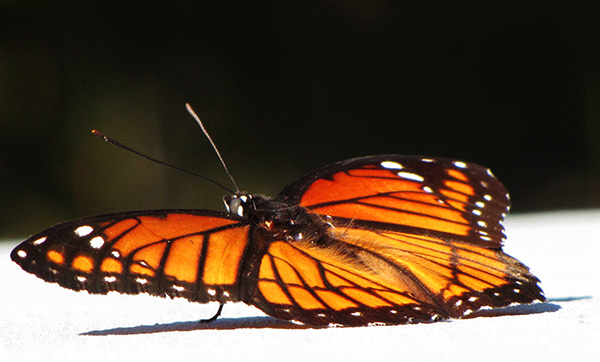
Butterfly Sept 13

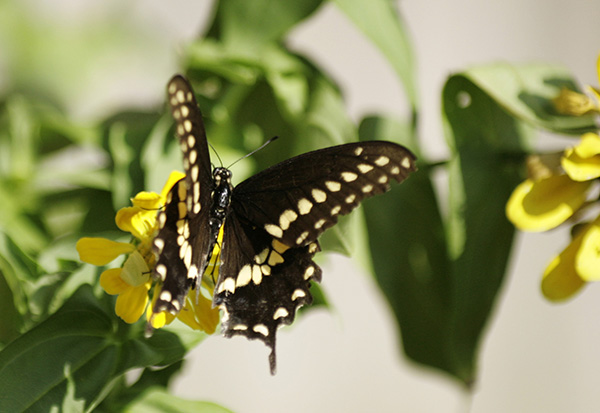
“Say my name, then,” the unicorn begged him. “If you know my name, tell it to me.”
“Rumpelstiltskin,” the butterfly answered happily. (pg 10)

Butterfly Sept 30

You know better than to expect a butterfly to know your name. All they know are songs and poetry, and anything else they hear. They mean well, but they can’t keep things straight. And why should they? They die so soon. (pg 11)