Introducing a Live Oak (Treebeard)

Live Oak Oct 12

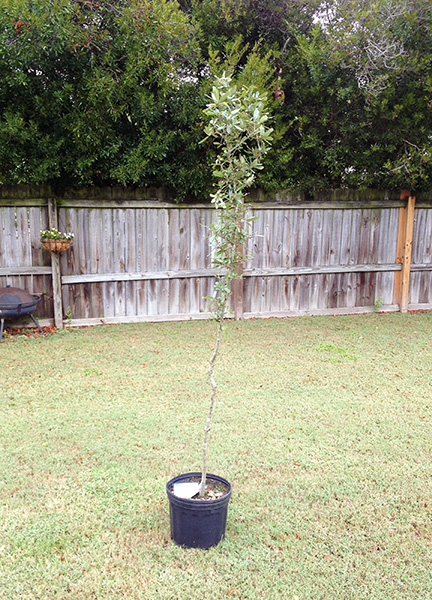
We planted a tree yesterday — a live oak from Friends of Live Oaks in Virginia Beach. From the time we left to pick up our tree until the time we stood back and admired our work, the entire process took less than three hours.

Live Oak Oct 12

The result of our three hour investment will (hopefully) outlive us. It’s a profoundly satisfying concept, that something so simple can be so permanent.

Live Oak Oct 12

The website says these trees may live 1,400 years, a span impossible to feel. I’ve lived forty-four years. My father lived fifty-two years. My mother, seventy-six. My grandmother, one hundred years.

Beyond one hundred years, I’m grasping mist. A few family photos from the late 1800s. A Civil War diary. A name that may or may not be an ancestor. Rumors and speculation.
Live Oak Oct 12

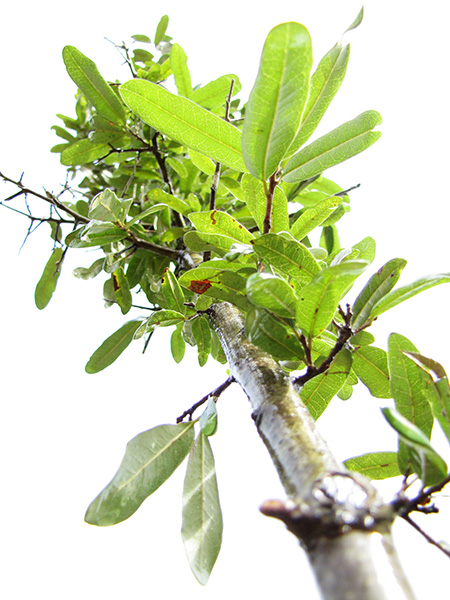
It makes me wish paper could be shaved, sheet by sheet, from a tree’s cross-section. Pages would preserve rings far more interesting than the words I write. Seasons of flood and drought, ages of ice, flashes of fire.

Today our little live oak has two rings, three at most. Each says nursery in healthy excess. Next year a smaller ring will say transplanted. After that? Mist again…
Live Oak Oct 12

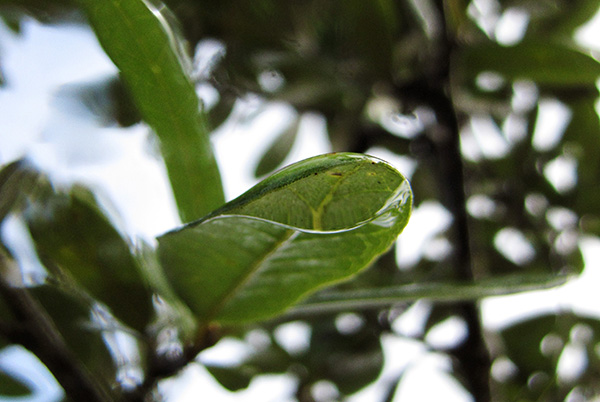
I haven’t named any of the yard’s trees, until now. A few days ago I started calling the live oak Treebeard, and the name stuck.
Kleptoparasites

Wasp Sept 7

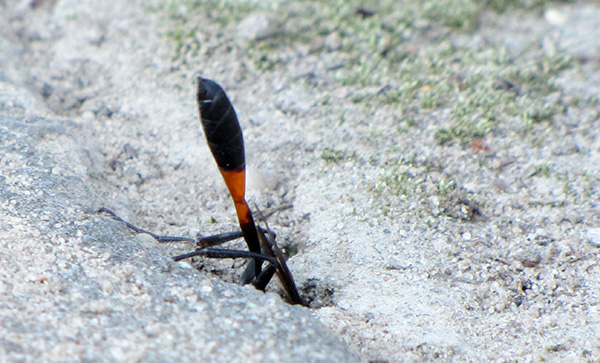
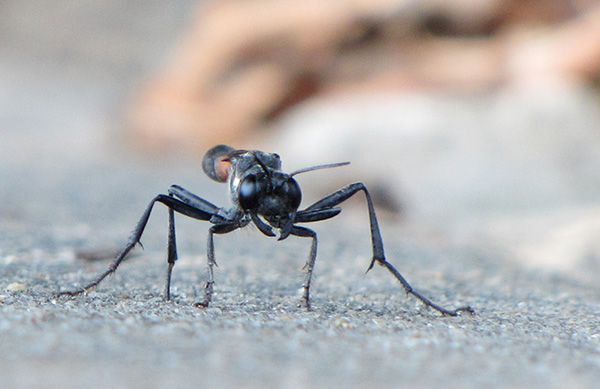
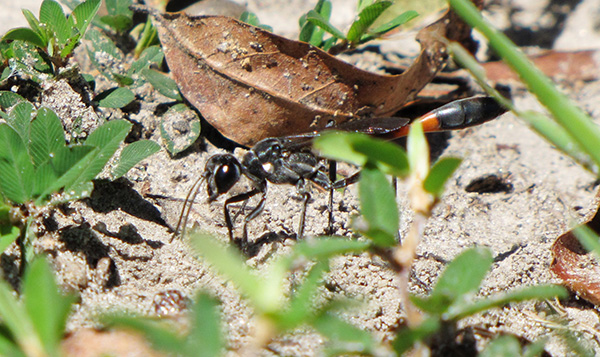
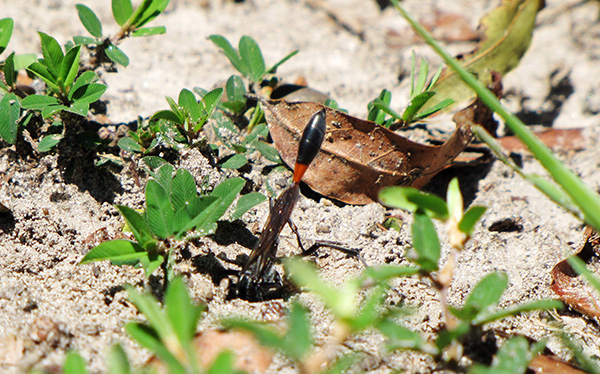
The tree in our front yard had fewer caterpillars this summer, so the yard had fewer thread-waisted wasps. Instead of a daily swarm of wasps under our tree, I saw one or two a week.

Wasp Sept 7

The wasps dug burrows as usual, but I didn’t see any of them return to their burrows with prey.

Wasp Sept 11

Twice I waited over an hour as wasps searched through leaf litter on the ground and branches overhead. Both times the wasps were still hunting when appointments called me away.

Wasp Sept 11

My wasp failures were disappointing, but it’s always worthwhile to spend a few hours sitting quietly in the yard. Last year as I waited on the wasps, I found a wolf spider carrying her army of spiderlings. This year I found flies.

Fly Sept 11

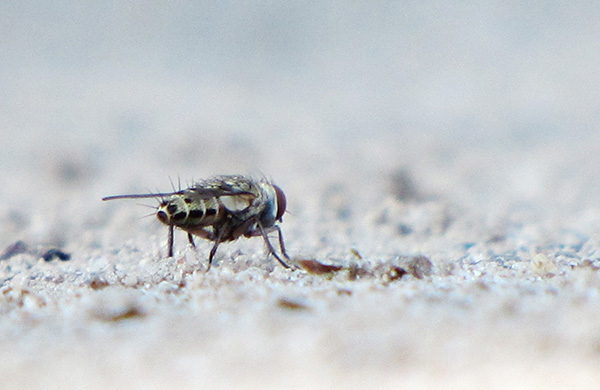
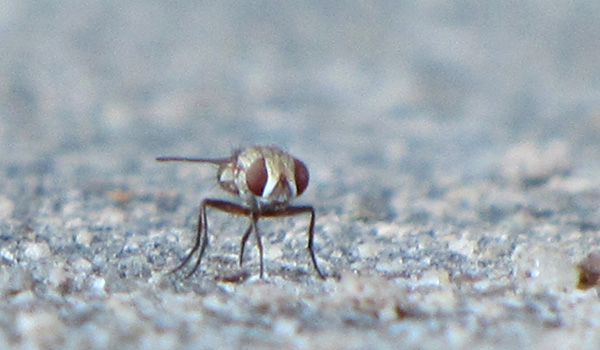
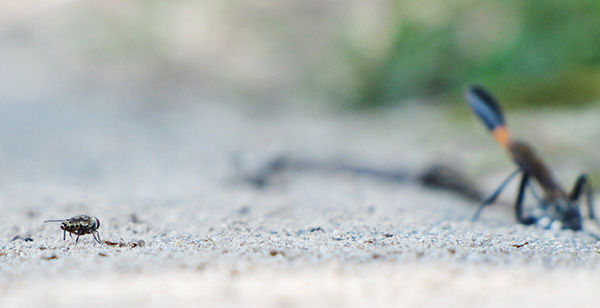
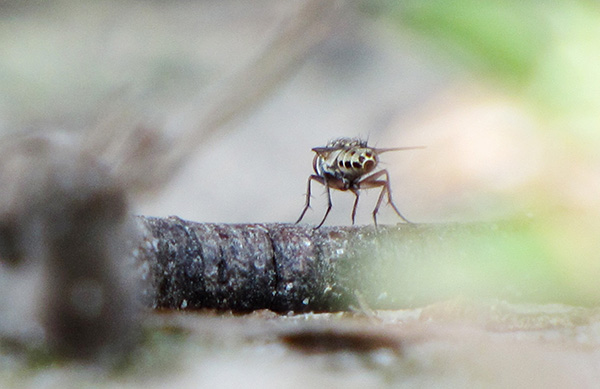
The flies caught my attention because they seemed as interested in the wasps’ activity as I was. They watched as intently as I did.

Fly Sept 11

As the wasps dug, three or four flies positioned themselves within a few inches of the developing burrows. Each time a wasp carried a pinch of excavated dirt away, the flies zoomed in and flew quick figure-eight patterns over the burrow. When the wasps returned and resumed digging, the flies lit nearby and watched until the wasps left again.

Fly Sept 11

The longer I watched, the more convinced I became that the flies were kleptoparasites. They were waiting to deposit their larvae in the wasps’ larder, alongside the wasps’ hungry larvae.

Fly Sept 11

The behavior is well-documented. It’s one of those complicated, clever twists of nature that fills me with questions. How do the flies learn to follow the wasps? Generation after generation, flies see a thread-waisted wasp and something whispers deep within their experience. Follow it. And they obey. Why?

Praying Mantis, September 2013

Last night I found a praying mantis on the kitchen window. As I watched it groom its antennae and feet, I imagined it was using the window as a mirror.

Mantis Sept 26

I have no doubt that clean antennae and feet matter on a functional level, but does some portion of a praying mantis’s experience reflect a sentiment I would call vanity?

Mantis Sept 26

I thought about the mantis off and on all night. Does fall make it anxious? Are these last few weeks of summer, its last few weeks of life, more urgent than all of its previous weeks?

I decided to look for the mantis again today, starting with the flower beds closest to the kitchen window. When I found it (or a similarly sized mantis) the situation was decidedly urgent.

Mantis Sept 27

At first I thought a mantis had caught one of the yard’s few remaining dragonflies. Then I realized it had caught another praying mantis. Or rather, the two insects had caught each other.

When I approached with my camera, they retreated to the underside of the ginger lily’s leaf.

Mantis Sept 27

The battle took place in slow motion, a strained embrace of stamina, strength, and will. Both sustained significant injuries:  the larger mantis mauled its opponent’s bent and broken wing, while the smaller mantis locked one barbed foreleg over a vulnerable eye.

Mantis Sept 27

Gradually, the smaller mantis extracted its damaged wing, and it seemed on the verge of gaining an advantage.

Mantis Sept 27

But the larger mantis broke its opponent’s grip and disabled the smaller mantis by biting through the major joints of both forelegs.

Mantis Sept 27

It was a brutal way to end the battle, precursor to an even more brutal death for the defeated. I didn’t stay to watch the victor dine, but when I returned a half-hour later, little remained of the smaller mantis.

Mantis Sept 27

I’m fond of praying mantises. They are among my favorite subjects to photograph. But this encounter? This is not why I love praying mantises, and I didn’t enjoy taking these photos. I don’t know why I watched so long.

In particular, I regret that my presence changed the course of their struggle. Except, it’s possible my presence in the yard changes the course of every struggle. Perhaps my camera affects everything I photograph, and my eyes affect everything I see.

Mantis Sept 27

Spider Wasp (Arachnophobia Alert!)

I was talking on the phone yesterday afternoon, laughing (and cringing) about how awful it feels to walk through a spider web, when I noticed something moving along the fence. It looked like a leaf, caught (of course) in one of the yard’s many spider webs, being blown about by the wind. But it moved too far along the fence to be anything anchored in a web, and it moved far too purposefully.

Wasp and Spider Sept 12

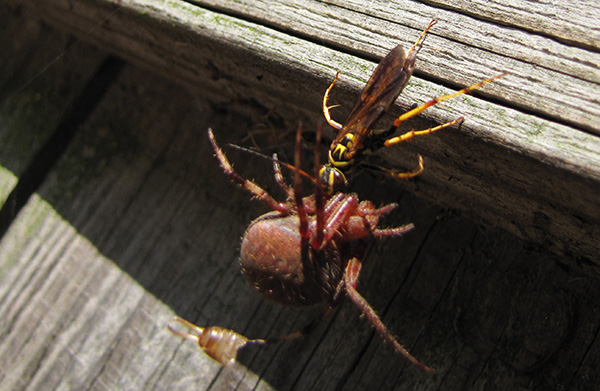
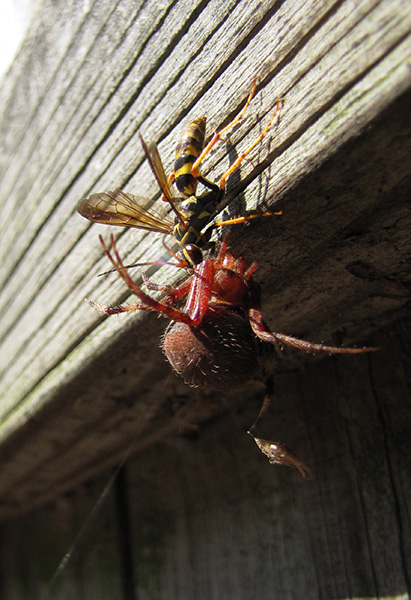
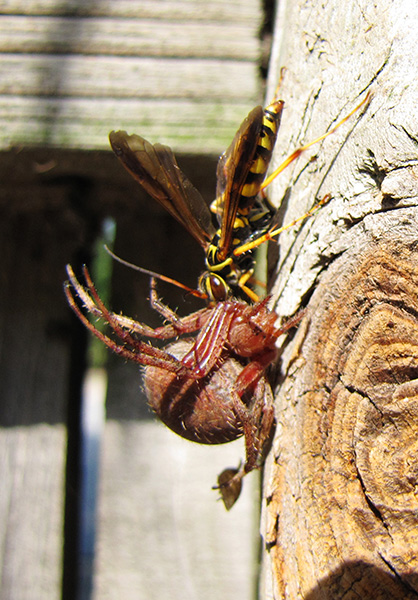
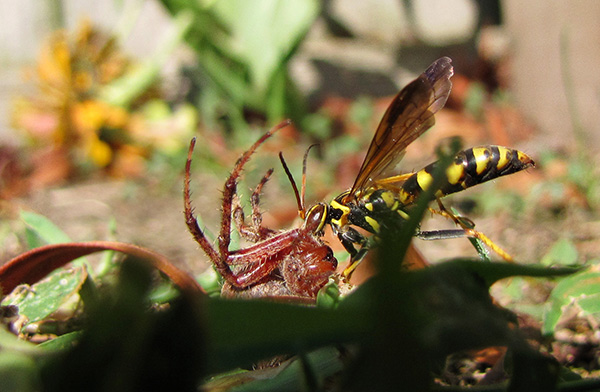
After I hung up the phone and raced to find my camera, I spent nearly an hour watching this little wasp. First she hauled her prey along the middle rail of the fence …

Wasp and Spider Sept 12

… lowered it down one of the posts …

Wasp and Spider Sept 12

… and tugged it over the ground until she found a clump of grass big enough to hide it.

Wasp and Spider Sept 12

Wasp and Spider Sept 12

Wasp and Spider Sept 12

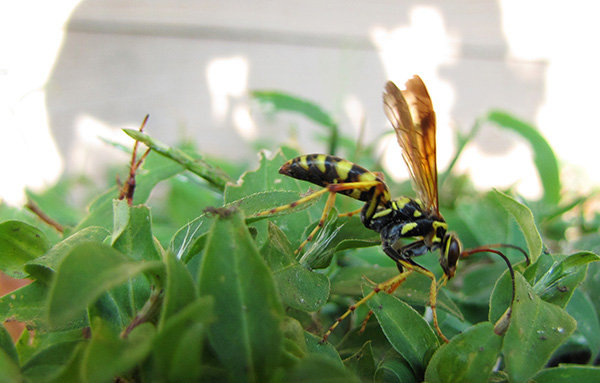
Then she crawled under an adjoining clump of grass and started digging, emerging every so often to check her catch. She seemed to be measuring, trying to see if her burrow was big enough yet.

Wasp and Spider Sept 12

Wasp and Spider Sept 12

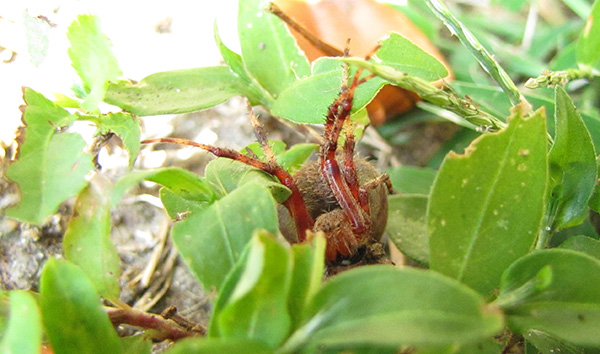
Once the burrow was finished, she turned the spider around a few times, wrestled it down through the clump of grass, and presumably buried it in her burrow with one (or more?) of her eggs.

Wasp and Spider Sept 12

The dynamic between these two predators, between the web spinner and its stinging foe, seems particularly cruel to me. Chances are the spider wasn’t dead when the wasp buried it with her egg. Merely paralyzed by her sting.

It’s a story that belongs in a horror movie or a nightmare, not in the yard. Except, it does belong in the yard. It belongs anywhere there are spiders and spider wasps. Perhaps what doesn’t belong are my words. Perhaps there is no place in the yard, at least in the lives of spiders and spider wasps, for words like “cruel” and “nightmare.” But where is the line? Where on the spectrum of consciousness do words begin? More importantly, where does empathy begin?

Cicadas, Cicada Killers, and Freshly Pressed Gratitude

Cicada Sept 2

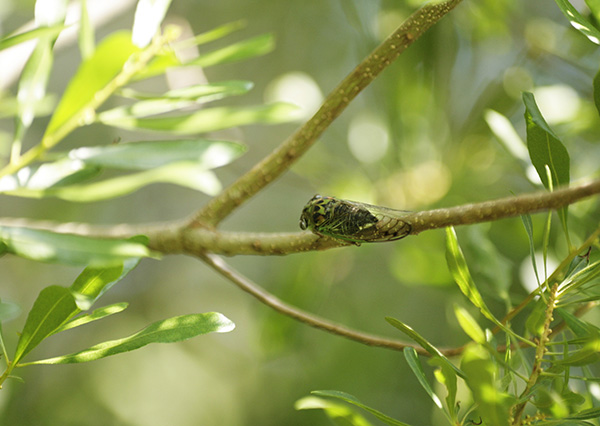
It’s cicada season in the yard. Each night a handful of them emerge from the ground and undergo their final molt.

Cicada August 21

They climb until some secret signal tells them they have climbed high enough, then they wait.

Cicada August 21

The wait must be uncomfortable–squeezed tight in hardening skin, wings constricted, an itchy seam along each tense back. Do they already understand flight? Do they regret leaving the safety of their root-laced tunnels?

Cicada August 21

Or do they simply stretch their new bodies until their old existence ruptures, until their wings straighten and strengthen, until they fling themselves into the dark abyss of the humid night sky.

Cicada August 21

Compared to last year’s numbers, the yard’s cicada population is small this year. Their molts are not accumulating in heaps at the base of the fence or over the roots of our trees. There’s no steady drone of cicada song, only occasional bursts from the wax myrtle.

Cicada Sept 2

Cicada Sept 2

Despite the relatively low number of cicadas, the yard has an unusually high concentration of cicada killer wasps.

Cicada Killer August 15

Here’s a post about these wasps from the Scientific American Blog Network:  A Feast of Cicadas. Our yard doesn’t have as many wasps as are described in the linked post, but I’ve seen more this year than ever before.

Cicada Killer August 15

But, are there actually more wasps than before? Or do I simply notice them more?

Cicada Killer August 15

Moving away from unanswerable questions, here’s a video from last summer:

In a final note, I want to thank the WordPress editors who Freshly Pressed my last post. Also, I want to thank the readers who visited the post, especially those who clicked the “like” button and commented. Each notification e-mail included links to your blogs, and I followed as many as time allowed. I found stories and poems full of laughter, tears, inspiration, and wisdom. I saw marvelous photographs, bookmarked tempting recipes, and added a dozen books to my wish list. It’s been a wonderful experience. Thank you!