Hellbender Salamanders

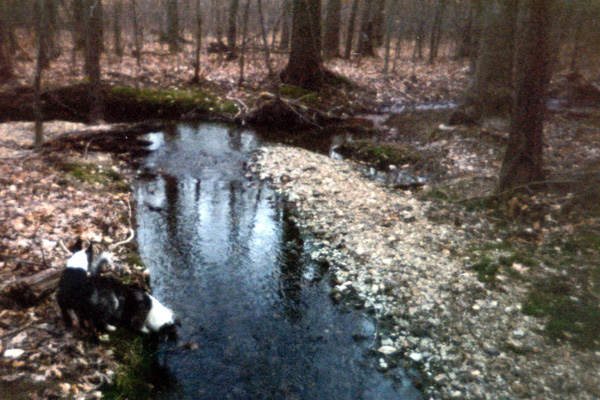
I spent countless hours, when I was young, exploring the creek that ran through our woods. I found crawdads and snails, snakes and minnows, darters and stream lamprey. I also found an amazing variety of small, slippery salamanders, the kind that lived in every creek in the county. But I never found a hellbender.
Woods

I didn’t know hellbenders existed until one of my classmates brought one to school. I was fascinated, but I was also jealous. So jealous that I didn’t want to look too closely at the giant salamander, which I remember as a vague, slimy shadow, curled up and completely covering the bottom of a five-gallon bucket. Instead of participating in the general excitement over the hellbender, I hung near the back of the crowd, wishing the bell would ring so that I could go home and catch one of my own.

(As with all of my memories, it’s possible this story isn’t true. The past is treacherously malleable, changing as I change, fading as I age. It’s possible that I stared at the hellbender for hours. I might have reached in and touched it. There might have been some other creature in the bucket, or there might not have been a bucket at all.)

I never did find a hellbender of my own. Not in my creek (I realized later it had always been too small and shallow for hellbenders) and not in any of the other creeks I visited. But I never quit looking.
Abrams Falls

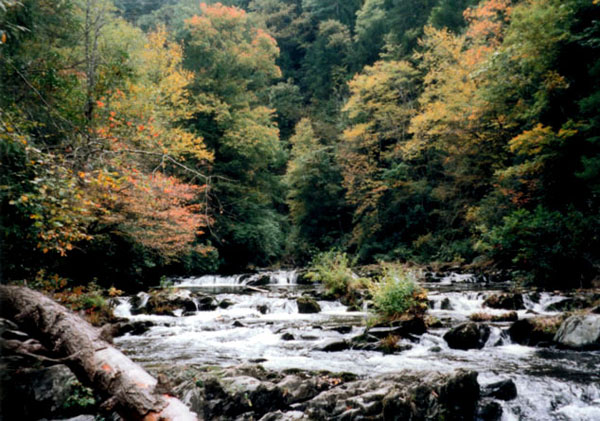
I now live in eastern Virginia, where there are no hellbenders. My childhood creek belongs to someone else, and hellbenders are increasingly rare, even in suitable creeks. At this point, my chances of finding a hellbender are roughly equal to my chances of finding a dragon. But the story isn’t over. There is hope for the future, for hellbenders and for me. Conservation efforts are making progress, so perhaps hellbenders won’t disappear altogether. And the next time someone shows up with a bucket full of wonder, I won’t be too jealous to look.
Anaxyrus (formerly Bufo)*

Toad May 2

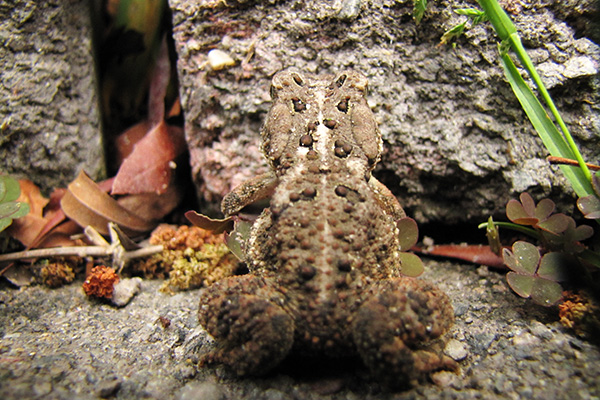
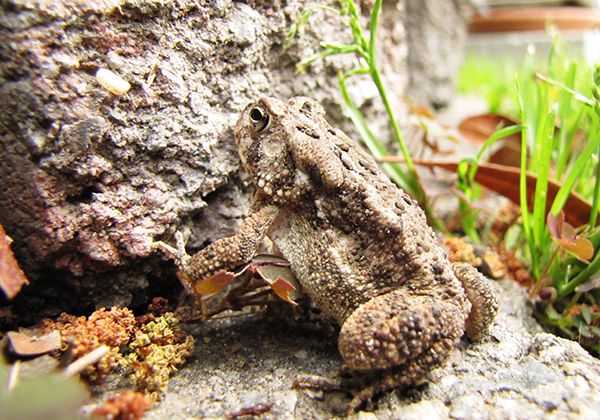
Early in May I found this little toad while I was mowing. After taking a few photos, I helped it into a flower bed and continued mowing, planning out a blog post as I made circuit after circuit around the yard.

I thought it would be a fun exercise to identify my toad. In the past, I’ve had good luck identifying reptiles and amphibians using the information provided on the Virginia Herpetological Society’s website, so I started there.

Have a look at this page from the website, which outlines the anatomy of a toad’s head, particularly the cranial crests, postorbital ridges, and parotid glands. The next page illustrates how these structures help identify three of the six species of toads found in Virginia.

Based on a visible (but not prominent) cranial crest, I narrowed the list of possibilities to either an Eastern American Toad or a Fowler’s Toad. But the pertinent detail for separating these two species, whether or not the postorbital ridge contacts the parotid gland, was not discernible. Falling back on secondary characteristics, I spent some time counting the number of warts in each of the toad’s spots. One or two warts per spot indicates an Eastern American Toad, while Fowler’s Toads have three or more. My toad had one or two in most of its spots, but three in a few. Since the two species are known to hybridize, was this inconsistency enough to identify my toad as a hybrid?

Two of the other listed characteristics aren’t visible in my photos. I can’t say whether my toad had spots on its chest and abdomen, nor if it had any enlarged warts on its tibia. (No enlarged warts are visible in my photos, but the photos do not show the full length of both tibias.)

Having exhausted my vague knowledge of toad anatomy, but still without a definite identification, I was curious as to whether an expert might have better luck. I sent my photos to the Virginia Herpetological Society’s e-mail identification resource, and their prompt response said my toad was likely a Fowler’s Toad. But they added a note: “Toad ID can be a bit tricky…”

Toad May 2

* In the last decade, genetic findings have shaken up the world of toad nomenclature. One of the changes removed some North American toads from the genus Bufo and shifted them into a new group with an old name, Anaxyrus. This article provides a good overview. So, for most of my Virginia toads, Bufo has been reduced to a parenthetical:  Anaxyrus (formerly Bufo). I feel a bit bereft, as Bufo was one of the few genus names I had bothered to memorize, but I suppose Anaxyrus is easy enough to remember. Except, I’m not quite certain why I would ever need to remember the genus names of North American toads…

Review: My Beloved Brontosaurus

My Beloved Brontosaurus: On the Road with Old Bones, New Science, and Our Favorite Dinosaurs by Brian Switek (Scientific American / Farrar, Straus and Giroux, 2013)

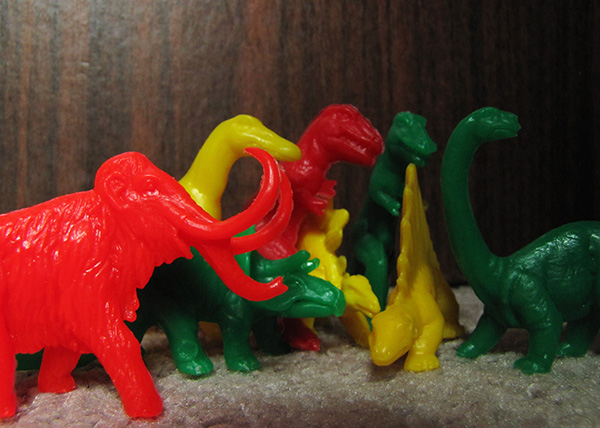
First, I have to confess that this is not really a review. It’s mostly a chance for me to visit one of my favorite topics. I have been fascinated by dinosaurs for a very, very long time. As I read My Beloved Brontosaurus, my fingers began to itch for the feel of my old plastic toys, the ones that roared through my childhood and paced across my shelves. They are (and were at the time) scientifically inaccurate. However, they were (and still are) great fun.

Dinosaurs April 4

Unlike my battered collection of mismatched toys, My Beloved Brontosaurus is equal parts good science and good fun. Much of it is a journey through paleontology’s growing pains, exploring name changes, skeletal puzzles, and feather mysteries. Chapter by chapter, the book details how Brontosaurus became Apatosaurus, how the upright posture that once defined a dinosaur was discovered in non-dinosaurs from the same time period, and how evidence hints that many dinosaurs had feathers or protofeathers (sometimes referred to as dinofuzz.)

My Beloved Brontosaurus is the most fun I’ve had with dinosaurs in years. Not only is the science interesting, the book strikes resonant chords in each chapter with elements of memoir, personal essay, and travel writing. As I turned the last page, I was filled with a deep yearning to pack a bag and head off on a multi-state museum tour. A few minutes later, coming to my senses and realizing that travel is not my favorite way to spend time, I headed off to the attic in search of a dusty box full of memories.

Dinosaurs April 4

(I don’t know how the woolly mammoth [definitely not a dinosaur] made it into this batch of plastic dinosaurs. Nor the sail-backed Dimetrodon. Perhaps it’s no coincidence that I found a blog post, yesterday, explaining how Dimetrodon is #notadinosaur”.)

Dinosaurs April 4

Since I started this post with a confession, it seems appropriate to end with one. I don’t remember some of these dinosaurs. They mysteriously appeared in my collection when Mother mailed off several boxes of old toys as she attempted to de-clutter her house. I can’t say with certainty which of the dinosaurs were mine and which ones became mine as Mother packed the boxes, but I’m happy to claim them all now.

Dinosaurs April 4

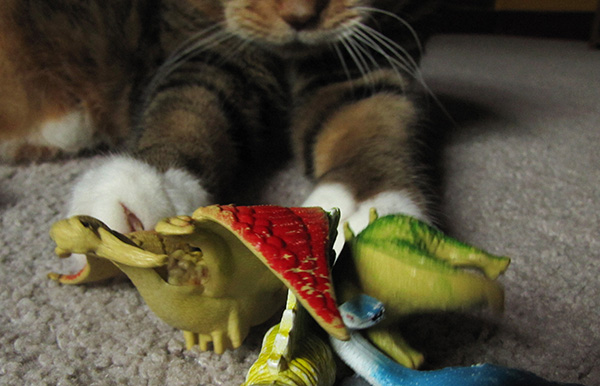
(As an aside, it’s somehow logical to me that cats might have had something to do with most of history’s extinction crises.)

Dinosaurs April 4

Indigo, 1999-2014

Indigo Feb 22


This is the last photo I took of Indigo, who died earlier this month. I can’t claim that she was ever a well-behaved dog, but she was always a well-loved dog, and the house feels strange without her.


(The slideshow photos were taken by my husband.)

This slideshow requires JavaScript.


Treasures from Home, Part Two (The Red Chairs)

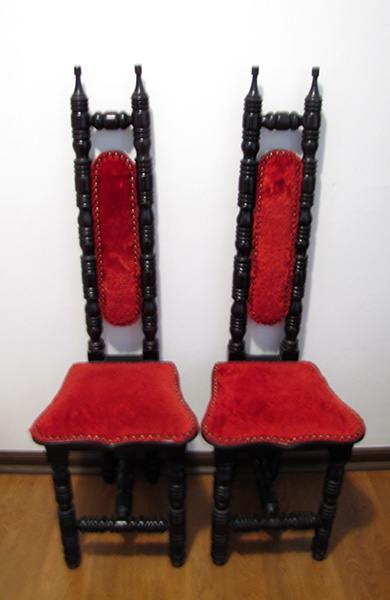
Chairs

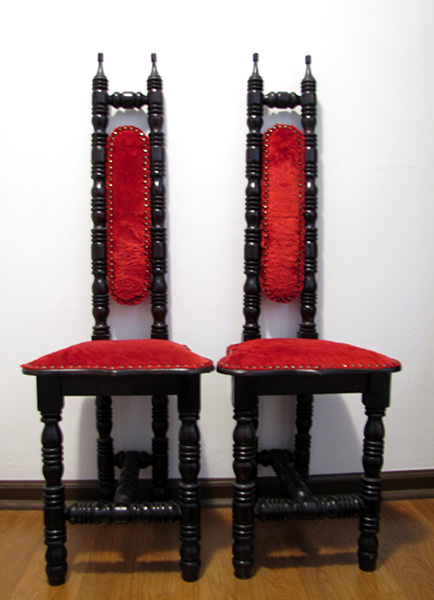
These chairs belonged to my grandmother, and they dominate my memories of visiting her house. The red chairs seemed stern, like Grandmother (we weren’t allowed to call her anything less formal than “Grandmother”). Sitting on them reminded me that I was expected to be still and quiet during our visits.

Despite the chairs’ lack of comfort, I admired them. They were, for me, irresistibly exotic. Ornate to the point of absurdity, designed for beauty instead of utility. Only now, when it’s too late for curiosity, does it occur to me that the chairs were different from the rest of Grandmother’s furniture, which was all very sturdy and practical. So why did she keep them? What did she see, when she looked at the chairs?

I never asked Grandmother about the chairs, just as I never asked about the years she spent as a single working mother. I never asked how she managed to raise a daughter, alone, during World War II and the decade that followed. How she managed to raise a daughter, alone, while working full-time.

Time hasn’t softened the chairs, which are so uncomfortable that even the cats refuse to sit on them, but it has softened my memories of Grandmother. She wasn’t a kind, cozy grandmother, but neither was she as stiff and disapproving as I imagined. Her truth, like the chairs’ truth, is an unsolvable mystery.

But now the chairs have come to me and I have the opportunity to create a new truth for them. I keep them in our living room, one on each side of the room. As I sit between them, they remind me to be still and quiet, to listen more carefully, and to understand that some stories are told in silences, rather than words.

Chairs