Review: Elegy

Elegy: Poems by Raphaela Willington
(unbound CONTENT, 2012)

In the foreword to Elegy, John Briggs begins by saying, “Raphaela Willington died on January 6, 2004, of ovarian cancer. Death became her muse in her last years.” He goes on to describe a woman of admirable strength and a poet of considerable talent.

The first poem begins: “Sometimes you wake / into silence” (“Sometimes You Wake”, pg 20). From there the book proceeds to muffle death’s dirge with birdsong and rustling leaves. The poems’ gardens are vividly alive. Zucchini and paperwhites thrive there, tomatoes and zinnias. Deer, squirrels, and groundhogs roam the pages, and “The sun is today a citadel / falling falling / yet standing” (“This Day”, pg 28).

In Elegy, death isn’t a morbid centerpiece, nor is it draped in mourning. Instead, it is herded into place as simply another visitor in the gardens. When the author finds the skull of a buck, antlers still attached, she says:

“One ear remains intact, as if listening, I imagine,
for the sound of the voice of my father calling us,
     mother and me,
in from the dusk of the garden
     at the end of a long day.” (“Endgame”, pg 45)

Later, she hears her name in winter’s approach:

“deer feasting on our hearts,
tomatoes crystallized into summer’s rubies
set in circlets of dying vines” (“Growing Seasons”, pg 76)

The foreword says, “A culture plumped with its belief in self-importance and fixated on amassing accomplishment might judge that Raphaela didn’t ‘do’ much with her life.” (pg 12) I say she did much that was remarkable, and I’m particularly grateful to her for writing Elegy. It seems to me as if she peered through the veil that separates life from death and fearlessly recorded what she saw. Then she wrote her observations into beautifully lyrical, meticulously revised poetry.

  • Find out more about the book here.
  • Six poems from Elegy were the inspiration for a song cycle that recently premiered at Western Connecticut State University. Read about “Wrensong” here.
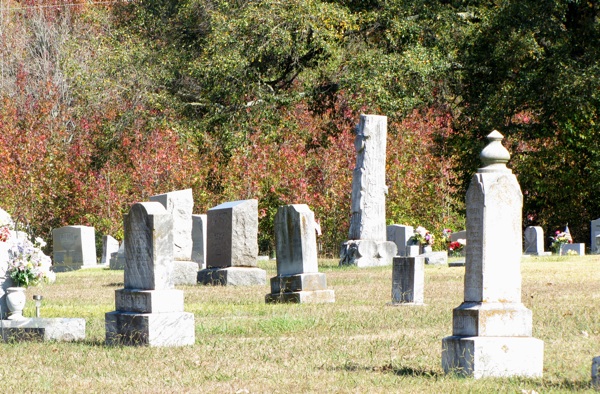
Last week, my trip included a morning in Elora, Tennessee, where my mother’s father is buried alongside his parents and a handful of other relatives. I never met my maternal grandfather, who died before I was born, and I have few memories of his parents.

My visit was intended to honor Mother’s memory, more than theirs, so I was surprised by how their headstones affected me. I became intensely curious, wandering past name after name. Who were these people? How much of them lives on, in me? My connection to these graves was strengthened by my recent experience reading Elegy, which I had finished the day before our drive to Elora.
Katydids

Growing up, katydids were my summer lullaby. On hot, still nights, I would move my pillow to the foot of the bed and sleep with my face inches from the open window. I remember the night air’s damp smell and the moonlit silhouette of silver maples. I remember the hollow calls of barred owls in the swamp across the road. And I remember the rhythmic, echoing chorus of katydids. Mother told us they were saying katydid katydid katydid… katydidn’t… katydid katydid…

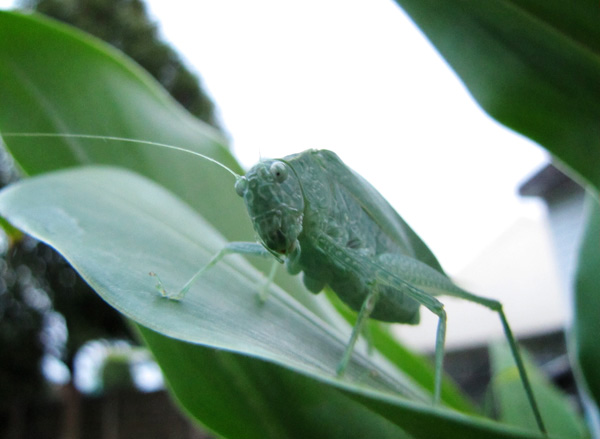
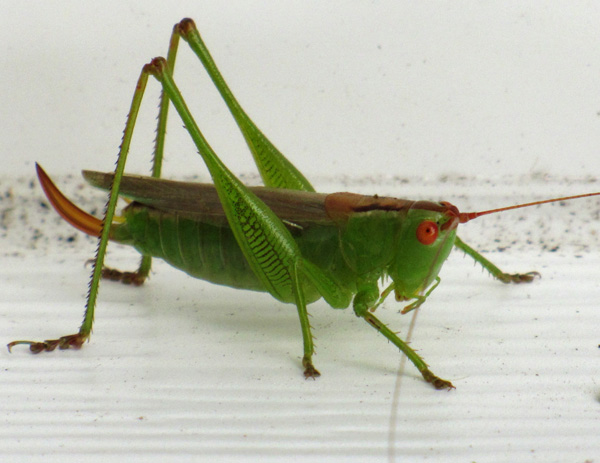
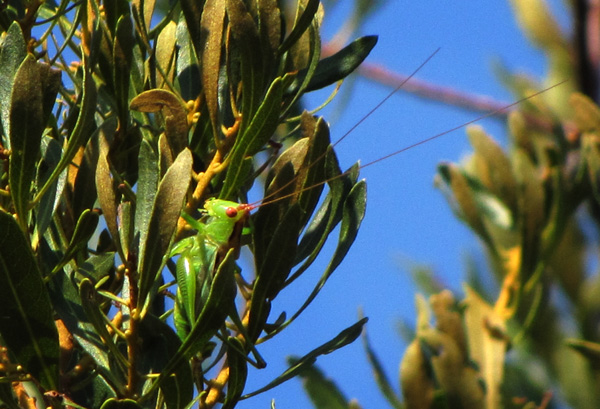
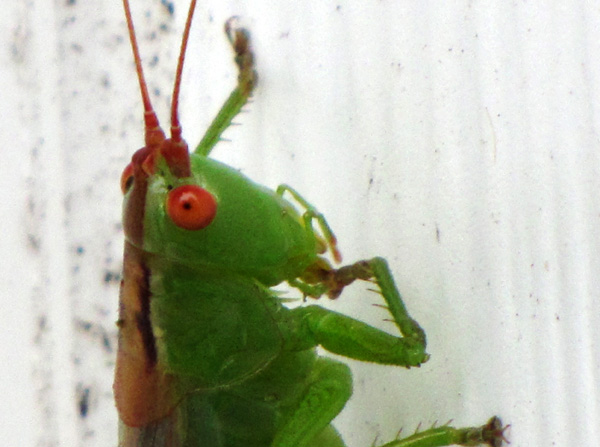
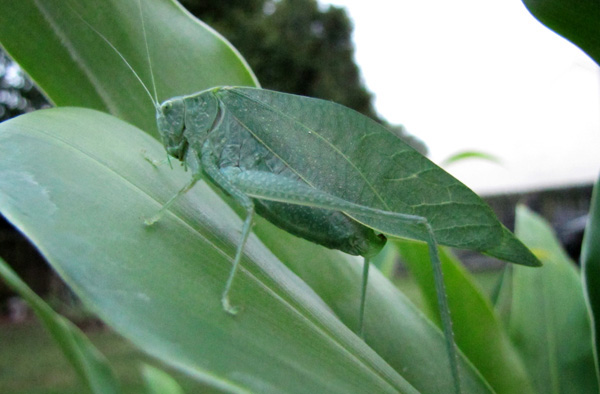
I never imagined that I was leaving katydids behind, when I moved to Virginia. The closest thing I’ve seen, since moving, is the greater angle-wing pictured above. (Photos taken in 2011).

The yard does have a thriving population of small katydid cousins, meadow katydids, but they sound nothing at all like my childhood.

Check out this web page for recordings. Click on the common true katydid, to hear the call I grew up with, then compare it to the common meadow katydid. You might also listen to the greater angle-wing, which solves one of my ongoing yard mysteries. I’ve spent many a night creeping around the yard with a flashlight, trying to figure out who makes that repetitive click…

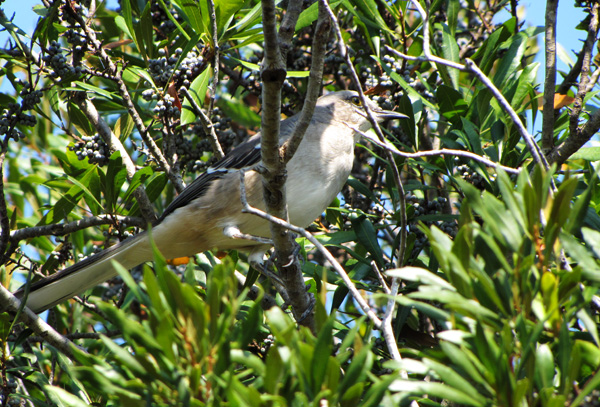
While I was hunting katydids today, trying unsuccessfully for a video clip, I kept hearing what sounded like a sneeze. A tiny, high-pitched bird sneeze. This mockingbird seemed embarrassed, when I traced the sound to it. I wonder if birds suffer from allergies, too?

Gesundheit!

What the Spiders Eat (Arachnophobia Alert!)

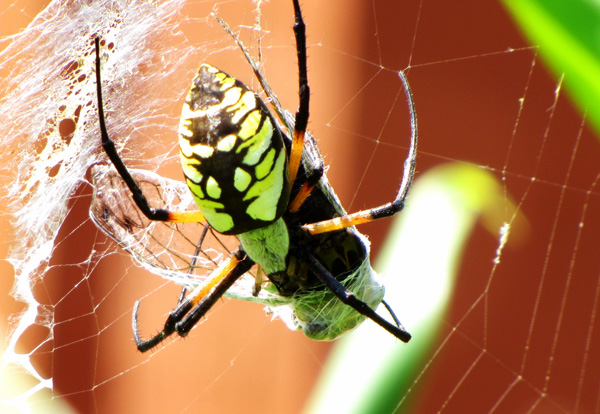
This year the ginger lilies have sheltered and fed four enormous garden spiders. Mid-summer, this impressive quartet graduated from eating flies and began to catch moths and beetles. One of them even tried for a June bug. The June bug escaped, but the spider was in no danger of starvation.

Thanks to our mild winter and productive summer, the spiders’ webs are never empty. They eat and grow, eat and grow, molting over and over again as the summer wears on. Now they are giants, far larger than any of the yard’s June bugs.

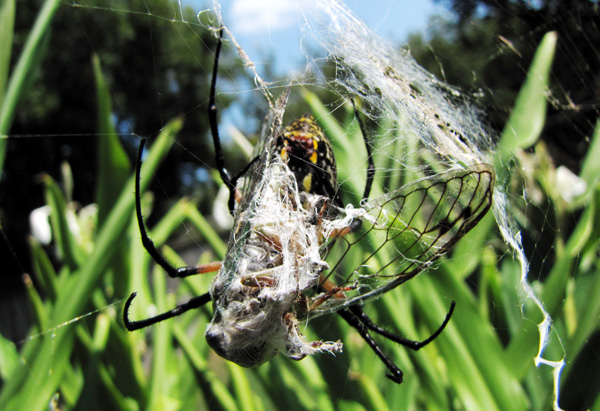
Over the past few weeks, I’ve been fascinated by the variety of prey these spiders have snared. A Cloudless Sulfur butterfly, last week. A sphinx moth and a dragonfly. Yesterday, one of the spiders managed to catch and consume a cicada.

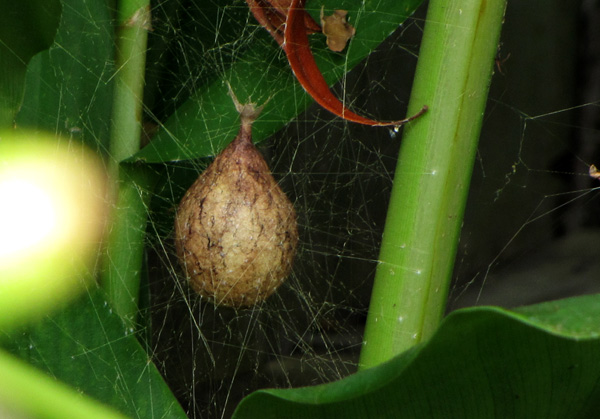
Despite my affection for cicadas, I had to admire the spider’s audacity. And, despite my wretched arachnophobia, I softened into nostalgia over a large egg sac. (The egg sac belongs to a different spider, one of equal size and appetite.)

I remember a dark living room with an old television, where a little girl sat curled in a chair with a cat on her lap and a dog at her feet, watching a favorite movie. The movie featured a pig named Wilbur and a spider named Charlotte. I remember my tears, when Charlotte died, and my delight when her daughters emerged from their silken nursery.

So this year, late in November, I’ll cut back the ginger lilies and weave their stalks into a frost-protective blanket over the bulbs. In the process, I’ll tuck this egg sac into a safe corner of the flower bed, cringing a little as I imagine the multitudes within. Then, thanks to a lovely book and heartwarming movie, I’ll remember that these spiders aren’t quite horrible. In fact, they are almost charming. Especially when they say “Salutations!”

June Bugs

For me, “June bug” is synonymous with “summer”. I have vivid memories of a yard teeming with these large beetles, loud with the drone of their wings. There was a trick to catching them, a certain turn in their flight that signaled they were landing. Watch, watch, watch, then race across the yard to the spot where one had just disappeared into the grass. I remember the pinch and scratch of their legs and the sharp odor they left on my hands.

Here in Virginia, summer after summer has passed with no June bugs. Since leaving Tennessee, I’ve only seen one or two. Until this week. Seemingly out of nowhere, dozens of them have buzzed into the yard. It’s been a blissful dose of nostalgia, watching them come and go, listening to their heavy flight. I’m no longer interested in catching them, except with my camera, but I smell them on my skin again. Their unexpected arrival is a breezy memory that makes me yearn for another sprint through the sunlit yard of my youth.

It never occurred to me, before beginning this post, that what I know as a June bug might not be the same insect that everyone knows as a June bug. For clarification, when I say “June bug”, I actually mean green June beetle.

To further complicate matters, I photographed the next beetle on the same day, thinking it was simply a small individual of the same species. Turns out, this is probably an entirely different species, an Emerald Euphoria beetle.

A few years ago, Mother called me after hearing a song on the radio called “Junebug Waltz”. She loved the song so much that she searched out the CD, It Don’t Mean I Don’t Love You by Hurray for the Riff Raff. I’m grateful to her for introducing me to the song, and the group.

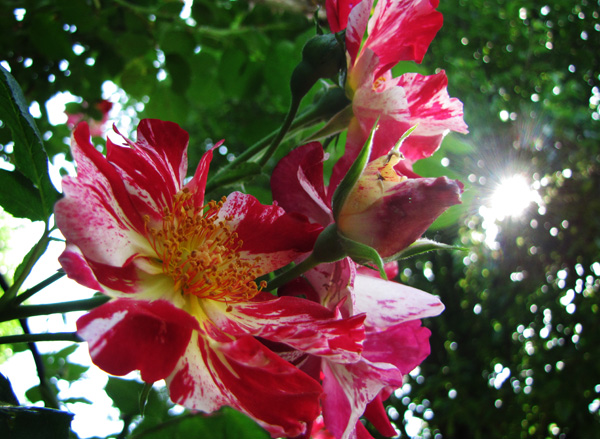
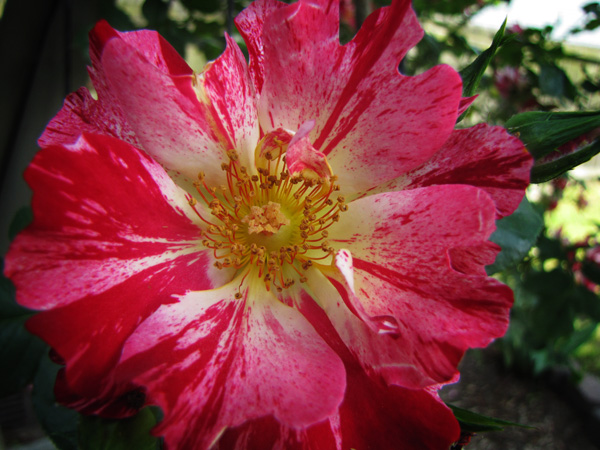
Fourth of July Rose

We purchased this rose almost a decade ago. In my memory of that day, the rose’s label reads “Fireworks”.

Last year, during an early attempt at blogging, I tried to find an online reference for fireworks roses. None existed. Turns out, our fireworks rose is a climbing Fourth of July rose.

What trick of memory switched the labels in my mind? And what of all my other memories? Are they equally flawed?