Focusing on Mallards Part IV: Positioning My Perspective(s)

Content warning

This multi-part blog post contains references to the hunting, agriculture, and research practices of killing birds. This particular installment contains references to hunting other prey and killing chickens from a backyard flock. If you decide not to read on, I respect and admire your choice.

Photograph of five Mallard ducklings resting on the stone border of our dragonfly pond after a tiring swim. Four of the ducklings are settled in and nodding off, while the fifth is still standing and fidgeting. The ducklings are fluffy with down (immature feathers), have yellow and brown markings, and each still has a visible remnant of egg tooth at the beak tip. They were less than 24 hours old when this photo was taken.
Photograph of five Mallard ducklings resting on the stone border of our dragonfly pond. Four of the ducklings are settled in and nodding off, while the fifth is still standing and fidgeting.

Livestock are living stock. And sometimes pets.

Until they are not.

Growing up in rural Tennessee, I had daily exposure to food chain realities. Our freezers (we had two) were stocked with meat from assorted livestock we raised. Livestock we loved. Chickens and cows, during my memory years, with vague early memories of pigs.

A 1970s-era photo, scanned from our family archive, of four fancy chickens roaming free in our yard. Two of the chickens have dark feathers with reddish highlights, one with additional iridescent green highlights on its wing feathers. A third chicken has almost all light reddish-brown feathers. The fourth's feathers are black over its head and neck, reddish tan across its chest, and gray over its wings, back, abdomen, and tail. The gray feathers on its back and abdomen are fluffier and downier than regular feathers. All four chickens have topknots of varying fluffiness and fanciness. All four are notably dainty.
A 1970s-era photo of four “banties” (bantams), dainty chickens with variously fancy topknots, roaming free in our yard.
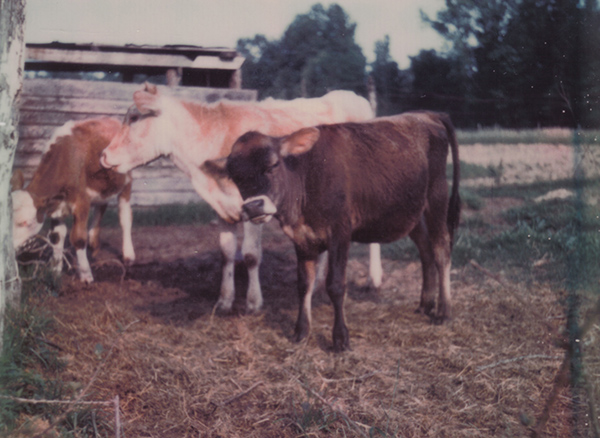
A 1970s-era photograph scanned from our family archive. Three young cows are standing near a fence line, pasture and woods in most of the background, with one wall of a weathered wooden shed visible. The cows are browsing through a scatter of trampled hay. The cows' coat colors indicate their mixed heritage. The cow closest to the camera strongly favors a Brown Swiss milk cow: its body is mostly dark brown with lighter shading on its legs and ears and a very pale muzzle with a dark nose. The middle cow likely has some Charolais beef breeding: its coloration is a patchy mix of pale tans and white. The cow furthest from the lens has markings typical of Hereford beef cattle: primarily reddish coloration with white legs, a white stripe down its back, and a white face.
A 1970s-era photograph of three young cows standing near a fence line with pasture and woods in the background.
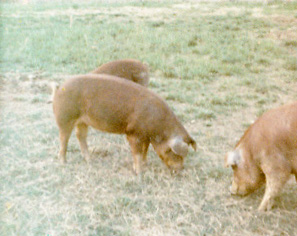
Another 1970s-era photo, scanned from the family archive. In this photo, three red pigs are grazing in a dry, clean patch of short pasture grass. The pigs are likely of Duroc descent, given their red coloration and the widespread popularity of the Duroc breed.
A 1970s-era photo of three red pigs grazing a patch of short pasture grass.

Our chickens and cows and pigs had individual names and individual personalities. We raised them and cared for them and loved them. But food chain reality means that livestock exists to be eaten. No matter how cherished. No matter how tame.

In this 1970s-era photograph, a red-and-white Hereford cow stands over her very young and very sleepy calf. The calf is red and white, like its mother, and its coat is thick and curly and damp in places. Just behind this cow and calf, a small cluster of black cows have gathered. These background cows would be of Angus breeding. All of the cows are standing in a patch of scattered straw and hay. The ground under the straw and hay would probably have been a trampled mire of mud. The bare-limbs tree line, just visible, indicates a winter setting.
Yet another 1970s-era photograph from the family archive. Here, a red-and-white Hereford cow stands over her very young calf. The calf is curled up on the ground, sleepy eyes and ears drooping.

Off to slaughter

Our cows and pigs were slaughtered and processed by local-ish butchers, but Mother slaughtered our chickens with a hatchet. Then she cleaned and portioned their carcasses while I collected and bagged bloody feathers.
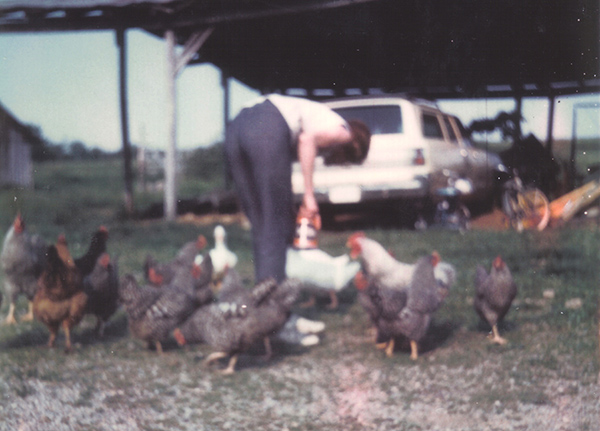
In this 1970s-era photograph, Mother is feeding a flock of some 15 chickens, along with 3 white ducks, from a repurposed coffee can filled with whatever mix of feed and corn was on the day's menu. The chickens are mostly gray-and-white speckled Dominiques (we called them "domineckers"), with a single white leghorn rooster and a few Rhode Island red hens. In the background, our white station wagon is parked under a pole shed, along with several bicycles. The photo is poorly focused with faded colors.
In this 1970s-era photograph, Mother is feeding our small flock of chickens and ducks. At the moment this photo was snapped, Mother was bent over, using her free hand to enforce order. If photos came with sound, you would hear her scolding the greedy birds and coaxing the shy ones.1

In reviewing family archives for this post, I was struck by how similar the above scene is to a photo from the early 1900s, found in our maternal grandmother’s album. There was clearly something generational going on at our table.
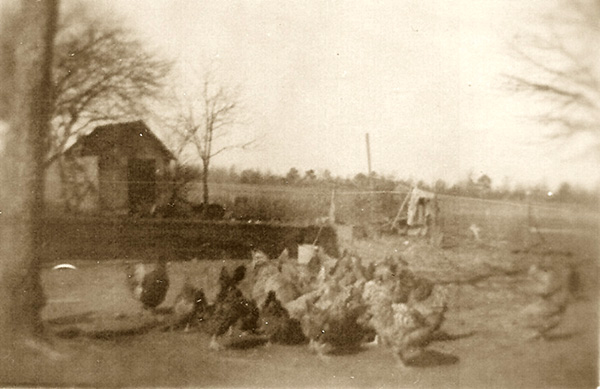
Scanned image of an early 1900s photograph from my grandmother's photo album. The sepia-toned black-and-white image shows a flock of large chickens foraging in a tight bunch, probably having just been given feed. Some of the chickens have dark feathers and some have light feathers. The background is bare-limbed trees (winter), a large flat field, a post-and-wire fence with a closer fence having its lower section blocked off by tin. There is also a small outbuilding with an open door, with what appears to be a tractor parked in front.
Early 1900s-era photograph of some twenty chickens foraging in a bare yard with farm equipment, fences, and an outbuilding in the background.

Wildlife can also be living stock, to a hunter

Small and sundry prey

In addition to eating chicken, beef, and pork raised on our property, we sometimes ate squirrels and rabbits shot by my father and brothers. It’s possible that our beagles sometimes helped on these hunts. (It’s more likely that our beagles hindered these hunts.)
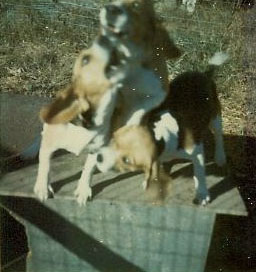
A small square photograph of three beagles, motion-blurred, play-fighting on top of a wooden doghouse. Shadows of fencing are visible on the doghouse. I believe these three beagles are Daisy, Fella, and Little Bit, though we also had a fourth beagle named Dan.
A 1970s-era photo of three naughty beagles play-fighting on top of a doghouse.

I helped skin and clean the squirrels and rabbits, and I remember being fascinated by their soft fur. I also remember Mother muttering and tsking while she cooked squirrel and rabbit meals. She breaded and fried the meat, and served barely edible, extremely tough portions with open disdain.

I developed a lasting case of meat snobbery, rooted in Mother’s disdain. Squirrels and rabbits were in the lowest edibility tier. Nothing lower was served. No frog legs. No snake, turtle, or alligator meat. No opossums.

Something generational was going on at our table there, too, but in the opposite sense of backyard flocks. Mother preserved her family’s tradition of raising chickens for slaughter, but put a permanent end to the family tradition of opossum hunting. (Scroll quickly if you don’t care to see a sepia-toned group of early 1900s ancestors showing off a bunch of dead, dying, or faking-death opossums, along with the dogs that facilitated the hunt.)

Scanned image of a photograph from my grandmother's photo album. In the album, the hand-printed caption read "The morning after our great Opposum hunt. 'We won't forget.'" This deep-sepia-toned black-and-white photo, circa early 1900s, shows five people standing in a row with a fourth person kneeling in front. Posing outdoors in a yard, the people are holding at least three opossums. The opossums are either dead, dying, or faking death. The woman to the far left is holding a smallish black-and-white dog, while the man kneeling in front is restraining two hounds. Probable (possible?) identifications include standing L to R: Sarah Harrison, Georgia Linton, Charlie Linton, Bill Linton, and an unknown girl; kneeling in front: Buck Linton.
In my grandmother’s album, this photo is labelled “The morning after our great Opposum hunt. ‘We won’t forget’.”

That’s my grandmother, second from the left, one hand behind her back and the other hand dangling an opossum for the camera. This particular hunt (it wasn’t the only time the family hunted and ate opossums) was special because one of the cousins (Sarah Harrison, standing on the far left) had come to visit.

Scanned image of a sepia-toned black-and-white photograph in my great aunt's photo album. In the album, the hand-printed caption reads "Sarah Harrison / Popman's cousin / 'the Possum hunt'". The outdoor photo shows a woman wearing a plaid dress with intricately pieced trim and pockets, white stockings, and white shoes. The woman is holding two dead, dying, or faking-death opossums, one opossum in each hand. The woman's dark hair is pinned up, and she is looking at the camera but not smiling. Beside her is a smallish black-and-white dog with a bobbed tail and half-pricked ears. The dog is looking up, attention fixed on the woman and opossums.
This photo was in a great aunt’s album. The photo is labelled: “Sarah Harrison / Popman’s cousin / ‘the Possum hunt’ “2

I should add that Mother’s disdain was not coherently taxonomic. Reptiles, amphibians, and insects were off the menu, but so were ducks, geese, and goats. Which meant some of our livestock were exempt from slaughter. What’s more, “dairy” came from cows and cows exclusively. There’s no logic here, only family and cultural tradition.

Cue any stand-up comic mocking a southern drawl. For that matter, cue any bully standing in their own tradition, mocking other traditions.

Photograph from 2021 of a white-tailed deer trotting beside a paved path at Back Bay Wildlife Refuge in Virginia Beach, VA. The background and foreground are winter-toned in oranges and browns of dormant shrubs and grasses, with occasional greens of live oaks and wax myrtles typical of coastal Virginia. The deer's head and tail are up, ears angled to listen behind her, in a body language that suggests alertness verging on alarm but not panic. Moments after I snapped this photo, the deer vanished into the tall seagrass.
Photograph of a white-tailed deer trotting beside a paved path at Back Bay National Wildlife Refuge. In my southern-Tennessee lexicon, “venison” very specifically refers to deer meat. I only learned in my middle-age that the word “venison” has different and wider definitions in different cultures.

In my late teen and early adult years, my oldest sister’s boyfriend often gifted us venison. I was particularly fond of what I called “Bambi roast” and “Bambi spaghetti”. Bambi, it seems, ranked high in my edible-mammal hierarchy. A bit below pet chickens and cows, but certainly above squirrels and rabbits. Which were at least on the list. Unlike opossums.

Here in my middle years, my childhood memories of skinning squirrels and rabbits seem dreamlike. As if those skinny arms and small hands weren’t my own. After all, any brief stroll through my blog history will find some tender post about squirrel and rabbit nests. I cringe, extra, thinking about any of the yard’s visitors heading into a hunter’s sights, then into a frying pan or stew pot.

Photograph from the spring of 2024. Five Mallard ducklings, less than two days old, are floating in a cluster in our dragonfly pond. Two of the ducklings have their heads cocked, one eye looking skyward. They are responding to an alarm call from their mother, who had spotted a hawk wheeling overhead.
Yes, Mallard babies. I’m talking about you. I’m aching to protect you.

But I didn’t always equate animals, my own pets and livestock in particular, with the meat on my table.

Further aside… so many eggs

Gathering the eggs

On mornings when my oldest sister was too tired or busy or sick to tend the chickens, I was roused and sent in her place. I remember egg gathering as sleepy, smelly, spidery work. Early morning work. (I’ve never been an early morning kind of girl.)

Egg gathering meant wrestling the chicken pen latch, which grew tighter each year as the posts and gate warped. Then I had to put down my bucket—to unclip the rusty chicken house latch and heave the rickety door over hills of weeds, dirt, and dung—and usually had two or three hens perched in my hair and on my shoulders by the time I bent to retrieve the bucket. Finally, I would stumble over the plank sill into the warm, dimly lit interior.

(Yes, I always stumbled. My severe astigmatism couldn’t navigate the sudden change from light to dark, and the hens dashed in and out through the door in frenzied delight.)

Our chicken house was closer in size to a closet than a house. I don’t have any chicken pen/chicken house photos to share, but almost any wire pen around almost any vine-covered tin-roof-and-plank outbuilding would be an accurate visual.

Veils of cobweb hung from the low rafters. Snakes, flies, wasps, spiders, and light entered and exited through gaps in the walls and roof. A short row of nest boxes lined one wall. The floor was dirt, feathers, dung, and broken shells. The chicken house smelled strongly of chickens and dust, but also of cat urine (from our army of yard cats) and dog feces (from the adjoining dog pen) and, every so often, of predators.3

Shooing hens from their nests, or reaching beneath those who refused to be shooed, I gathered eggs by touch more than sight. (It’s not as easy as it sounds. Our hens didn’t give up their eggs willingly, especially to the tentative little sister of their usual egg-gatherer. Wing slaps left bruises, and claws and beaks drew blood.)

The warm, sticky, tough-shelled eggs that I gathered didn’t feel like they held nascent chicks and ducklings. 

A 1980s-era photograph of a red hen and her brood of variously yellow, tan, or striped chicks, all safely enclosed in one of our wood-and-chicken-wire coops. The stocky hen shows strong Rhode Island Red characteristics, but the chicks' mixed genetics were more typical of our flock.
A 1980s-era photograph of a red hen and her brood of eleven(ish) striped chicks, all safely enclosed in one of our wood-and-chicken-wire coops.

Breaking the eggs

Our father began leaving during my pre-teen years. He sold the cows, let the fences lay where they fell, and stopped shoring up the barn and sheds. After he finished leaving, neglect cascaded into decay. Vines pulled down the chicken house and the gate fell off the pen.

Both pre- and post-chicken house era, egg gathering mistakes were inevitable. In the chaos of the crowded, rickety henhouse, broody laying hens stole eggs from the adjacent nests of setting hens. Predators and predator alarms rolled and bounced eggs between nest boxes. An egg laid by a setter a week or more ago, carefully incubated since, might end up alone in a layer’s nest. An egg laid by a layer last night might end up in a two-weeks-along setter’s nest.

After our flocks were entirely free-roaming, they hid their nests so well that eggs were often days old before being found. Eventually, increasing incidences of “bad eggs”, coupled with decreasing egg demand as siblings moved out, halted all egg collecting.
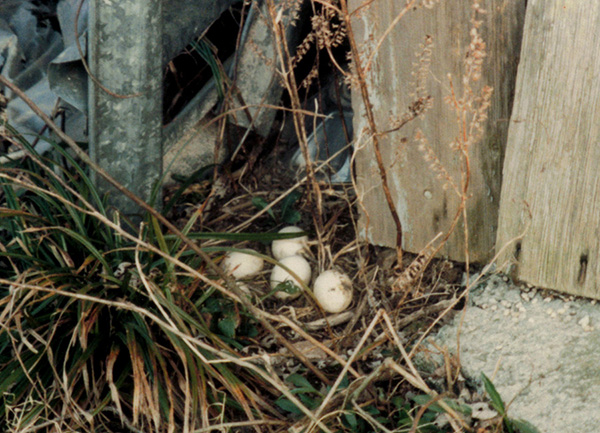
Late 1980s-era photograph of five large white eggs in a rough nest on the ground. The flat nest is made only of trampled grass and dry, dead weeds. The nest is positioned beneath an unused steel livestock gate that is leaning against the wall of a post-and-panel shed.
Photograph of five eggs, probably duck eggs, in a nest on the ground. This nest was tucked between an unused livestock gate and the outer corner of a shed.

The term “bad eggs” most obviously referred to rotting or rotten eggs. The kind that burst on their own or floated in water. But “bad eggs” also encompassed fertilized eggs that were mistakenly collected mid-incubation.

When an incomplete carcass, some mid-development stage of a chick or duckling, spilled from an egg I had cracked, I writhed with regret. It happened often enough, in my early years, that I still crack eggs into a separate bowl when cooking.

After our egg-collecting years ended, our increasingly feral flock was left to hatch and raise what young they could in whatever nests they chose.
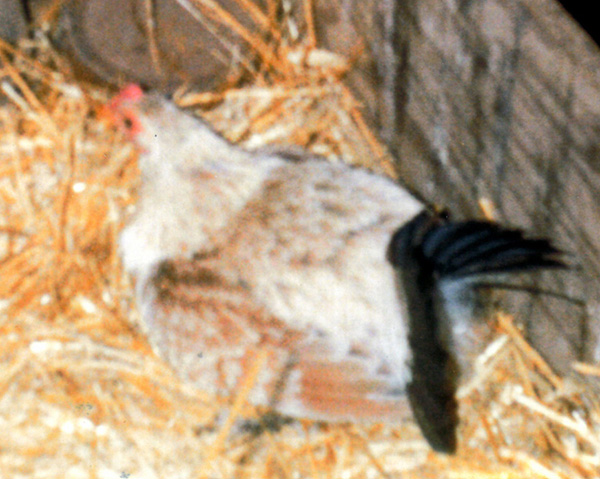
Late 1980s-era photograph of a gray-and-tan feathered game hen with black tail feathers. The hen is setting on a nest that she made in a deep pile of straw left in the bottom of a large wooden box that once held bales of straw. The colors in this photograph are over-bright due to using a flashbulb on the camera, and the image is somewhat blurry.
A late 1980s photo of a game hen (conveniently named “Game Hen”) sitting a nest of eggs in a straw-lined box.
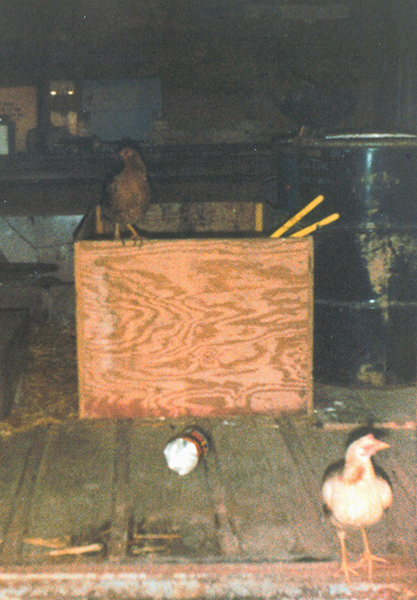
Late 1980s-era photograph of the inside of an ancient out-of-service livestock trailer that served as a shed for storing straw, hay, and feed. The trailer's flooring is wooden planks laid between steel bars. A massive, open-topped wooden crate/box is positioned in the middle of the trailer, an overturned tin can is on the floor in front of the box, and a large weathered 50-gallon oil drum is to the right. Game Hen is perched at the entryway, looking out. A reddish hen is perched on the edge of the large box, and another hen (mostly in shadow) is perched on the oil drum's closed lid. In the far background, shadows and reflections show equipment, bottles, and boxes stored (and long forgotten) on a shelf. The massive box once held bales of straw, but by this time held only a deep bed of leftover straw which was used by the cats and chickens for warm bedding. The oil drum held bags of feed. We kept the trailer doors closed, most of the time, but there were plenty of holes through the sides and bottom that the chickens, cats, rats, and opossums used for entry- and exit-ways.
A late 1980s view inside the “trailer” (a dilapidated, out-of-service livestock trailer that we treated as a bonus shed for feed storage). The massive wooden open-topped box/crate (center frame) once held bales of straw, so it was lined with broken bales. Inside this box, in the right back corner, was Game Hen’s nest.
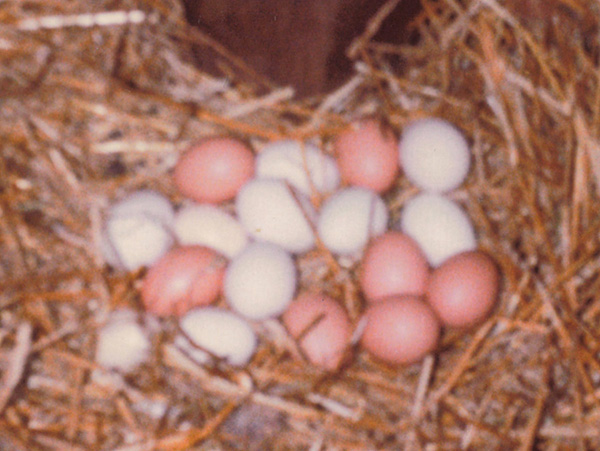
Late 1980s-era photograph of 11 white eggs and 7 brown eggs in a nest made of straw. This was Game Hen's nest to sit, though the eggs were likely provided by multiple hens. The nest was in the far back-right corner of a massive open-topped wooden crate/box the sat in the middle of the ancient out-of-service livestock trailer we used for straw, hay, and feed storage.
The same late 1980s nest, photographed after bribing Game Hen with feed. Heaped in the nest are 11 white eggs and 7 brown eggs. The hens literally shared prime nesting spots.
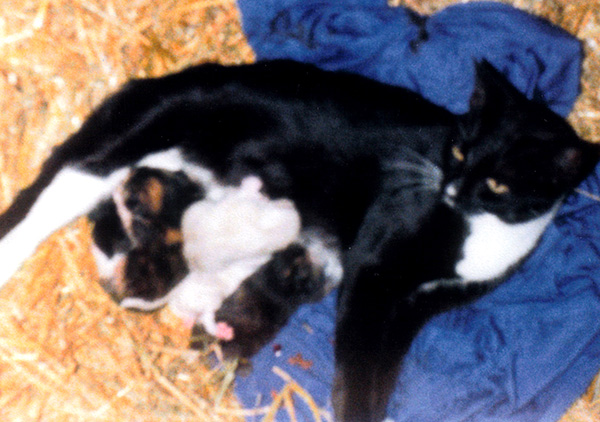
Late 1980s-era photograph of a golden-eyed black-and-white cat (Mischief) nursing a newborn litter of kittens. All are settled in a deep, warm nest of straw, loosely lined with an old blue shirt. There are five kittens, three tortoiseshell and two solid white (destined to develop silver-and-gray "points" typical of siamese, but with the much longer hair typical of ragdoll cats). This litter of kittens was delivered and nursed in the massive wooden open-topped crate/box that we used to store straw in the ancient out-of-service livestock trailer that served as our feed shed.
Another late 1980s-era photograph, taken in the exact same spot in the trailer’s box of straw as the above nest photos. This is my cat Mischief nursing a newborn litter of five beautiful kittens. Two of these kittens will reappear later in this post, in a photo taken after they were grown.

Growing up in rural Tennessee, eating the animals and dissociating

While my egg-mistake memories are mostly visual, wetly curled bodies in a puddle of albumin, my memories of chicken, squirrel, and rabbit carcasses are sticky with remorse and smell like blood, grease, and guilt left out in the sun.

But expressing regret, remorse, or guilt at the table was forbidden. So was refusing to eat what was served. I don’t remember being told these rules, nor do I remember hearing these rules explained to my siblings. For that matter, I don’t remember learning these rules.

It is this lack of learning, this full memory cache with no record of creation, that warrants using the word “dissociated”. As a girl growing up in rural Tennessee, I dissociated from the eggs and meat on our table.

I coped with my forbidden regret, remorse, and guilt by inventing a private delusion, by defining eggs and meat as a different form of matter than living animals.
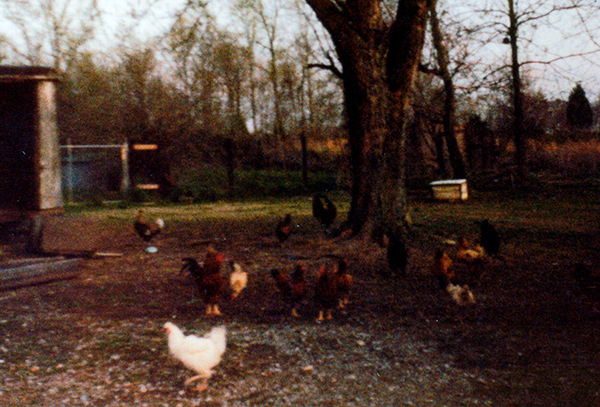
Mid-to-late-1980s-era photograph of our back yard, taken in late winter/early spring (indicated by the budding saplings in the background). Our small mixed flock of chickens, ranging in color from red-and-black to solid white, are resting, foraging, and roaming around the trunks and roots of a massive maple tree. An ancient out-of-service aluminum-sided livestock trailer is parked to the left, our wire-and-chain-link dog pen is in the left background, and a weathered old doghouse is in the middle background (used by cats, chickens, and yard dogs for warmth).
Mid-1980s photograph of our mostly free-roaming flock. We wouldn’t have eaten many of their eggs, in their later years, and their tough old carcasses would have been among the last added to the freezer. The trailer is visible to the left, with the dog pen behind it. The derelict chicken pen is hidden in the far center background, behind the row of saplings and shrub-like weeds.

Depression on top of dissociation

The photo immediately below is more metaphor than image. The worn paint and sagging shingles on our house and concrete-block wellhouse, the decaying barn-remnants to the far right, the unkempt pasture and yard, and the overgrowth marking downed fences. All of these illustrate the state of our dysfunctional household during my teen and young adult years.

A late-1980s or early-1990s-era photograph of our back yard. The edge of the house is just in view to the left, with worn paint on the wooden siding and facia boards. The concrete-block wellhouse, with its wide concrete stoop, sits just behind the house. Here, the wellhouse's roof is in bad disrepair, sagging with rot. Two cats and a hen are perched on the wellhouse, waiting to be fed. The yard is patchy, with some areas of dead grass and some areas of overgrown grass. The crumbled and rotting remains of a sloped loading chute and our barn are visible to the far right, and a heap of discarded debris (the remains of a fallen pole shed roof, the old pig pen fence, the old pig shed, and one wall of the barn) is thinly hidden behind a tall (>6 foot) curtain of dead brush. The woods in the far background are winter-bare.
A late 1980s- or early 1990s-era photo taken in the back yard. Perched atop our concrete block wellhouse, two cats and a red hen are waiting to be fed. The cats, Annie (right, tortoiseshell colored) and Gizmo (left, ragdoll marked) grew up out of the exact trailer-straw litter pictured above. The hen, whose name I’ve lost to time, was one of Game Hen’s daughters.

The hungry cats and hen on the wellhouse roof, waiting for a meal of table scraps and cheap kibble, are confusion, sorrow, and loneliness. This was the era of boyfriend venison and day-old bread. Of freezers stocked from clearance ads. Of oldest sister tending the garden in the dark of too-early mornings and too-late evenings because she was working three jobs while going to college.

We no longer ate the livestock we raised and loved, but clearance-case chicken and ground beef added a new facet to my dissociation. Grocery eggs and meat were always cold and bloodless, had never been embodied in the yard. And I had learned what it meant to be hungry.

Re-associating, for health reasons

Or, “Thanks for the genes, Dad”

My father died of heart disease at the age of 52. I was mid-teens, and he seemed so old. But he wasn’t old. I am, currently, older than 52.

I don’t feel so old.

I like being me, and I would like to continue being me for some good long number of years past 52.

Perseverating on 52

One of the ways I’ve packaged and carried grief is a fixation on 52nd birthdays. As each of my four older siblings passed 52, I breathed a bit easier. Long before I reached 52, I began researching and planning. Partly because of the grief fixation, but also because my cholesterol levels have been alarming physicians since I was a teen.

Note to father: Next time, maybe try leaving us money, instead.

Statins and exercise are no match for my father’s genes. My last resort for living past 52 was a complete overhaul of my diet. (I should have started there, but I’m a silly human with silly human habits.)

Call it plant based. Call it vegetarian. Call it desperation.

An unexpected side-effect of my diet overhaul has been re-associating with animal protein. My health ambitions were easier to realize when I reminded myself that pork is slaughtered pigs. That beef is slaughtered cows. That chicken is slaughtered chickens. That grocery eggs come from hens housed in industry conditions, not back yards.

Without my dad’s cholesterol, I would probably still perceive meat and living stock as unrelated forms of matter.

Enter the Mallards

Timing is everything, and my various perspectives and journeys are not random. If you are still reading, you might be starting to see a signal. Or not.

What looks like signal to me likely looks like noise to others.

Perhaps in a later post I’ll explain how a literature search through the history of prion testing catalyzed an ongoing reaction between a brood of suburban ducklings, a fetish-level case of nostalgia, a dysfunctional family history, and a stubborn set of lipid genes, resulting in this multi-part Mallard post.
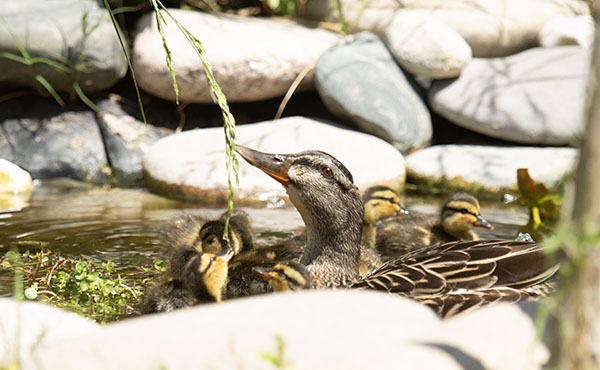
Photo from the spring of 2024, of a Mallard hen and her brood of ducklings swimming in the dragonfly pond. Here the hen is reaching up, tugging seeds from a long grass seedhead that had sagged over the pond's edge. One of her ducklings is reaching up, sampling the grassy seeds, while the others are milling around, watching.
In this photo from the spring of 2024, a female Mallard duck shows her brood how to eat grass seeds from a seedhead dangling over the dragonfly pond.

For the present, I’m a recovering carnivore lured to herbivory by a longing to live past 52. I grew up in a rural environment where the animal protein on our table came from our own yard, pasture, and woods. And I’ve known what it is to be hungry.

These perspectives matter, though it’s not entirely up to me to decide how they matter.

In the next episode…

Mallard hunting is big business.

Image scanned from my great aunt's photo album. This black-and-white photo, vaguely sepia-toned, shows a man in thick winter garb—newsboy(?) hat, hunting jacket (lots of pockets), bulky pants, and worn boots—holding a long gun and two dead Mallard ducks. In the album, a hand-printed caption on an adjoining photo identified this man as Harry Kenyon.
Early 1900s photograph of a duck hunter holding a gun and two dead Mallards. This photograph was scanned from a great aunt’s photo album. The hunter’s name was Harry Kenyon. I do not know who he was or how his image landed in my great aunt’s photo album.

2. While I’m perfectly awful at recognizing genetic and cultural heritages based on peoples’ features and clothes, I recognize that this distant cousin doesn’t look or dress like my grandmother’s family. I would love to know more about her. (Click here to return to your regularly scheduled photo caption.)

3. My parents believed weasels were the chickens’ craftiest predators, blaming almost all egg, chick, and hen losses on an invisible and trackless family of mustelid carnivores, traceable only by scent. Years later, I realized that the scent I was taught to identify as “weasel” covered everything from the musk of a water snake to fox scat to mouse urine. (Click here to return to your regularly scheduled paragraph.)

Productive Creativity and Creative Productivity

It’s been two years since my last post. Two entire years of an ongoing search for balance. Any and all versions of balance.

In this search, as with everything else, I fail more often than succeed. But failure is, of itself, productive.

Except, the word “productive” is problematic, isn’t it? What, exactly, constitutes productivity? If the results of my labors are largely invisible, even intangible, have I truly been productive?

“What Heisenberg discovered was that the limit to our ability to observe the universe determines the boundaries of reality. Physical reality and observability are tied together. If you and I cannot observe it, it does not exist… or is it perhaps, if it exists, it is because you and I observe it?” Evan Harris Walker in The Physics of Consciousness: The Quantum Mind and the Meaning of Life (1)

Maybe some adage applies, based on the laws of thermodynamics. Maybe I create and destroy in equal measures, so the sum of my productivity is zero. A cancellation of balances. Any and all versions of balance.

Or maybe words matter less than I imagine, and imagination matters more, when shaped into words.

“…nature is a chaos of forms and colors and shapes and forces, and the various ways in which that chaos has been untangled and made legible should never be taken as nature’s truth but rather as nature’s possibility within a human imaginary.” Rachel Poliquin in The Breathless Zoo: Taxidermy and the Cultures of Longing (2)

Independent of my blog activity, independent of words and definitions, the yard’s wheel bugs flourish and die and flourish and die with seasonal regularity.

(Catalogued in the family of assassin bugs, wheel bugs are considered beneficial predators. They possess a long “beak” for stabbing their prey, as seen in some of these photos. The same beak can be used defensively, and people who have been stabbed by wheel bugs report the bite to be “immediately and intensely painful”.)

The first generation I followed, in the summer of 2017, never knew life without my looming camera-presence. I found their egg clusters in the winter of 2016 and photographed them through their own egg-laying.

But I largely abandoned my camera the next year, so the next generation escaped my looming camera-presence. Can I prove that they flourished, without photos? That they were overtly and conspicuously productive? Populating the live oak and pear tree, the wax myrtles and pollinator beds. Always hunting and molting, destroying and creating.

Always, in my imagination, a chitin metaphor to be used in a future poem or blog post.

When I began planning this post, my long-awaited wheel bug post, I discovered what I should have expected all along. The yard’s current wheel bugs, unaccustomed to a looming camera-presence, are difficult to photograph.

These last photos, all taken yesterday, are the result of two weeks’ searching and stalking and standing quietly under the live oak. Two weeks for a set of blog photos.

Two weeks of productive creativity. Because I did other things, during those two weeks, but I approached each task with a bit more creativity than usual.

And now, a blog post! At last!

A brief moment of imperfect balance, two years in the making. Word-shaped and shared.


Quotation sources:

(1) Walker, Evan Harris. The Physics of Consciousness: The Quantum Mind and the Meaning of Life. Basic Books. 2000. p 54.

(2) Poliquin, Rachel. The Breathless Zoo: Taxidermy and the Cultures of Longing. Pennsylvania University Press. 2012. p 9.


Recommended reading:


Here are three of my favorite recently-read books. Have you read them? What did you think?

Poetry: Painting Czeslawa Kwoka, Honoring Children of the Holocaust by Theresa Senato Edwards and Lori Schreiner

Fiction: This Is How It Always Is by Laurie Frankel

Non-fiction: Stein on Writing by Sol Stein

Hampton Roads Writers, 5th Annual Writers’ Conference

Dragonfly July 7

I have not been writing.

I think about writing all the time. I plan outlines and schedules, every week, then discard them in favor of errands and yard work. I compose poem fragments in my head as I fold laundry, then move on to my next task without pausing to write them down.

For most of the last two years, I have been a writer who does not write.

Dragonfly July 7

I can’t claim writer’s block, because the words are there. In fact, I’m somewhat surprised by the words’ persistence. I’ve been ignoring them for a very, very long time, and they continue to clamor for attention. It’s like being under siege.

Dragonfly July 7

Over this past month, the words began to win. I looked at the HRW conference website two or three times. I read through the schedule. I printed the registration form.

I decided to submit a short story and poem to the free contests and spent a few days revising my entries. Then I decided to submit the first ten pages of my stalled work-in-progress for the optional critique and spent a few more days revising. Before I knew it, I had fallen into a routine. I was writing again. Every day.

Dragonfly July 7

My registration packet is in the mail, and I’m still writing. Every day. I don’t know if my renewed focus will last, because I went through a similar surge last year after returning home from the conference. But, for now, the words have won. I am a writer who writes.

Dragonfly July 8

Treasures from Home, Part Two (The Red Chairs)

Chairs

These chairs belonged to my grandmother, and they dominate my memories of visiting her house. The red chairs seemed stern, like Grandmother (we weren’t allowed to call her anything less formal than “Grandmother”). Sitting on them reminded me that I was expected to be still and quiet during our visits.

Despite the chairs’ lack of comfort, I admired them. They were, for me, irresistibly exotic. Ornate to the point of absurdity, designed for beauty instead of utility. Only now, when it’s too late for curiosity, does it occur to me that the chairs were different from the rest of Grandmother’s furniture, which was all very sturdy and practical. So why did she keep them? What did she see, when she looked at the chairs?

I never asked Grandmother about the chairs, just as I never asked about the years she spent as a single working mother. I never asked how she managed to raise a daughter, alone, during World War II and the decade that followed. How she managed to raise a daughter, alone, while working full-time.

Time hasn’t softened the chairs, which are so uncomfortable that even the cats refuse to sit on them, but it has softened my memories of Grandmother. She wasn’t a kind, cozy grandmother, but neither was she as stiff and disapproving as I imagined. Her truth, like the chairs’ truth, is an unsolvable mystery.

But now the chairs have come to me and I have the opportunity to create a new truth for them. I keep them in our living room, one on each side of the room. As I sit between them, they remind me to be still and quiet, to listen more carefully, and to understand that some stories are told in silences, rather than words.

Chairs

Dragons

Like most of my enduring interests, this one started with a book.

The Dragon's Handbook

I don’t remember exactly when The Dragon’s Handbook came to me, though I have vague memories of tugging on Mother’s purse in a used book store, begging for “this one.” Because of its odd shape, the book never fit comfortably on a shelf with my other books. So I propped it against my mirror and treated it more like a piece of art than a book, making it an integral part of my room’s decor.

While The Dragon’s Handbook held some of my favorite illustrations, my favorite stories featured horses and dogs. The Black Stallion series, 101 Dalmations, and Lad: a Dog. King of the Wind, Lassie Come Home, and Where the Red Fern Grows.

Then I found The White Dragon on a library shelf. Its cover featured a much fiercer dragon than Barbara Rinkoff’s Culhane, and I was suddenly ready for fiercer stories. I read Anne McCaffrey’s entire Pern series, and, from then on, I devoured any book with a dragon in its pages.

Books 1

The horses crowded closer together and shared their shelves with dragons. Today, dragons lurk in every corner of my office.

Dragon 3

Dragon 2

Dragon 1

I suppose this might explain why my favorite flowers are snapdragons.

Snapdragon April 1

Snapdragon April 1

And why I take so many pictures of dragonflies.

New Dragonfly 4s

Halloween Pennant

It certainly explains why my first complete manuscript is a literary fantasy. There’s a dragon, of course, but there are also hounds and horses. Because I couldn’t resist combining my two loves: my younger preference for stories about animals (especially stories that made me cry) and my teenage quest for adventure and magic and peril…

Dragon Oct 24

Botanical Garden Oct 24