It’s Definitely Not a Bee

I took a walk in Red Wing Park today, looking for butterflies. I found butterflies (there will be photos later), but I also found something I had never seen before. I believe these are Snowberry Clearwing Moths. (Which might be the same as a Bumblebee Moth?)

I was so excited, when I first noticed them, that I forgot my camera. And I’m pretty certain I was talking to myself. All alone, in the middle of a dappled path, mumbling things like “ooh how pretty” and “what odd bees” and, at last, “it’s definitely not a bee.”

Once I remembered my camera, it didn’t take long to realize that the moths moved too fast for me. They hovered to drink, never perching. A quick sip of nectar, then on to the next bloom. Most of my images could be labelled “a moth was here when I pressed the button, but flew away before the shutter clicked.”

I starting having success when I learned to focus on a clump of flowers and wait for a moth to zip into frame. This technique was a stretch for me, because I’m terrible at waiting. Perhaps, after today, I’ll be a tiny bit more patient with my life.

I’m tempted to wish for better photos, but the truth is that I’m lucky to have gotten any useful images at all. Most of my efforts look something like this:

Pondhawk Invasion

Eastern Pondhawks have taken over the yard. Every available perch is occupied, every patch of grass claimed. Active and aggressive, they patrol one area for five or ten minutes, then attempt to move on. It’s hard to say who wins the resulting bouts of mid-air combat, because I have trouble distinguishing individuals. But it seems to me as if territories steadily shift, so that one dragonfly might begin her morning in the southwest corner, move by noon into the northeast corner, then rotate back to her southwest starting position by evening. As she moves, others crowd in behind her, so that the entire yard is continuously occupied.

Fortunately for all the other dragonflies, the Eastern Pondhawks appear to prefer ground-level hunting and rarely move into the trees.

Blue Dragonfly Notes

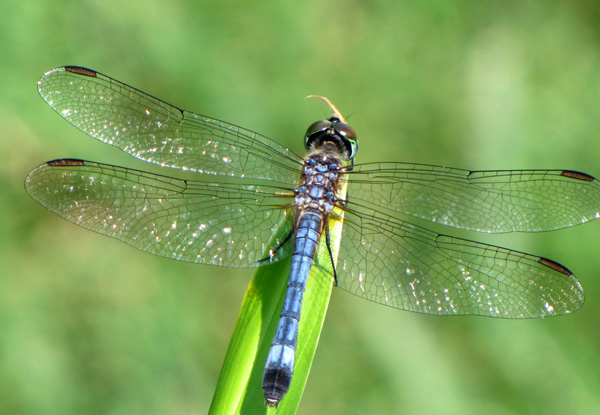
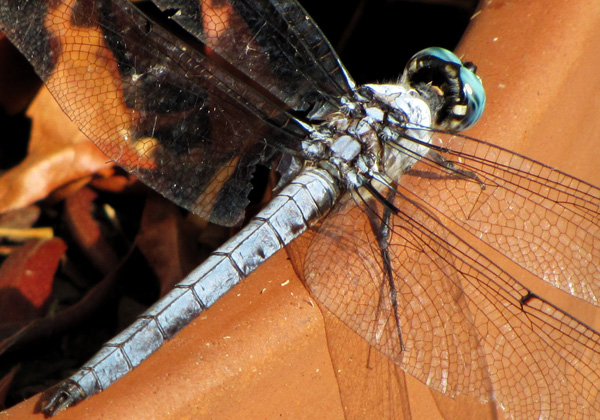
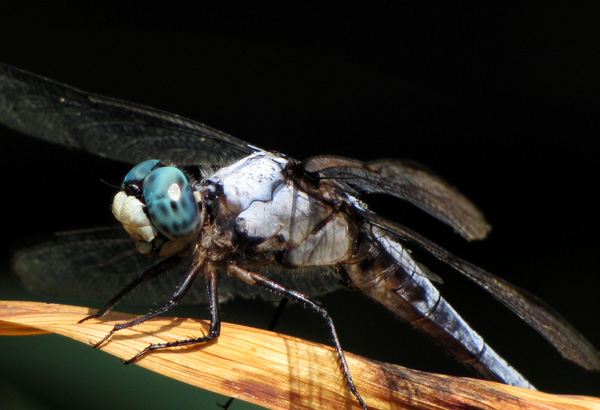
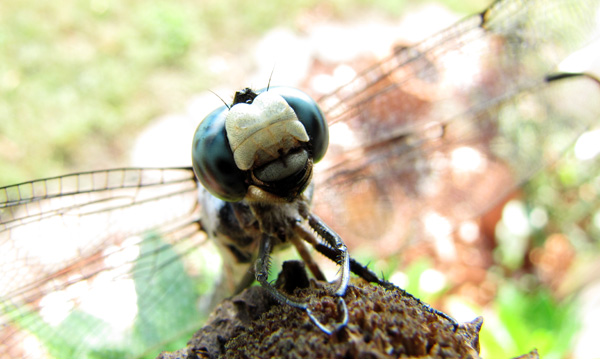
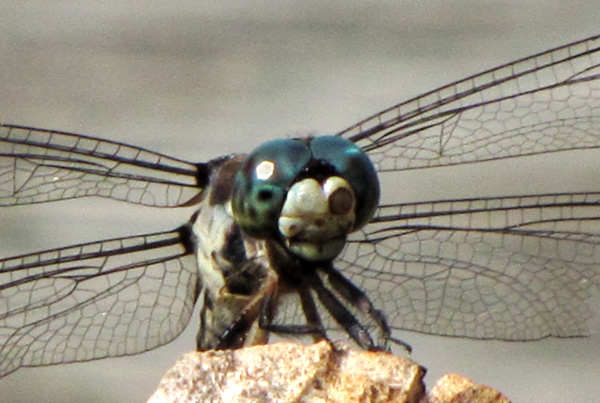
The blue on these mature dragonflies (I believe the top image is a Blue Dasher and the next is a Great Blue Skimmer) is called “pruinescence”. Often described as a powdery accumulation of pigment, the phenomenon of pruinescence is not confined to dragonflies. (I couldn’t find a definitive resource for a link, but this Wikipedia article contains some interesting observations.)

I tend to gravitate toward pruinose dragonflies, when I’m out with my camera. I like how the pale coloration exposes seams and joints, highlighting the intricate anatomy of these amazing insects.

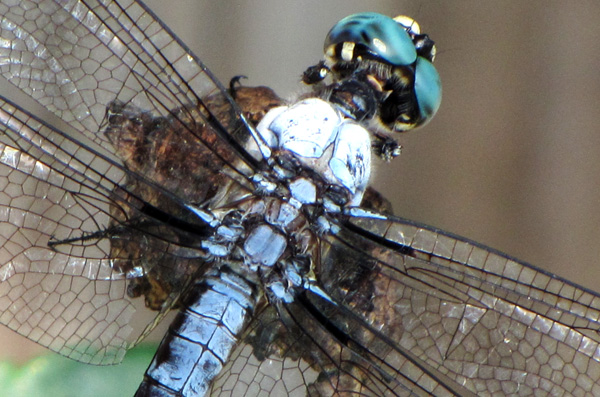
(This male Great Blue Skimmer was a very patient subject. Most of my dragonfly photos are taken using the zoom feature, but he let me experiment with the macro setting, which produced the next image.)

While coloration and wing patterns catch my attention first, wounds hold my attention. This female Great Blue Skimmer has a rather typical set of wing tears, but the wounds on her face are unusual. I wondered if the loss of symmetry made her less attractive, in dragonfly terms.

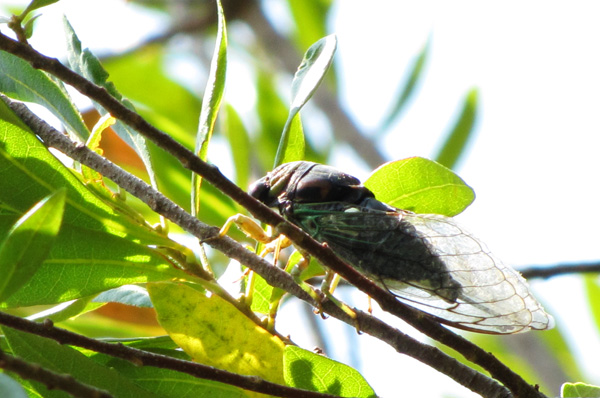
One final note (completely off-topic):  I’m happy to report that the summer’s first cicadas arrived this week.

New Rabbit Nest

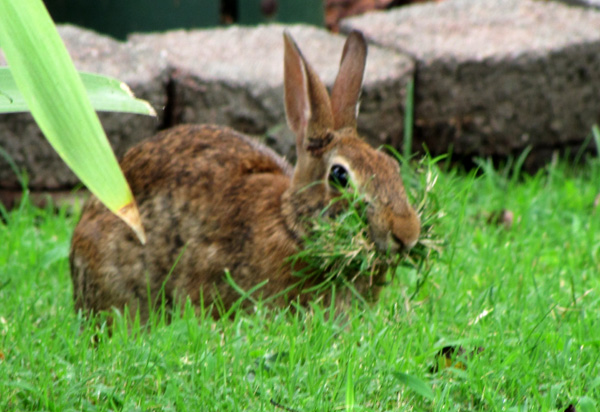
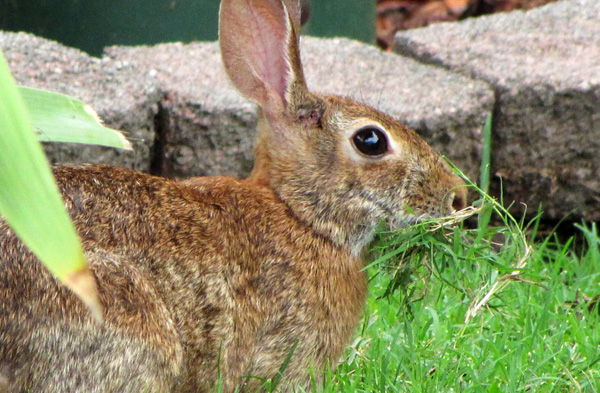
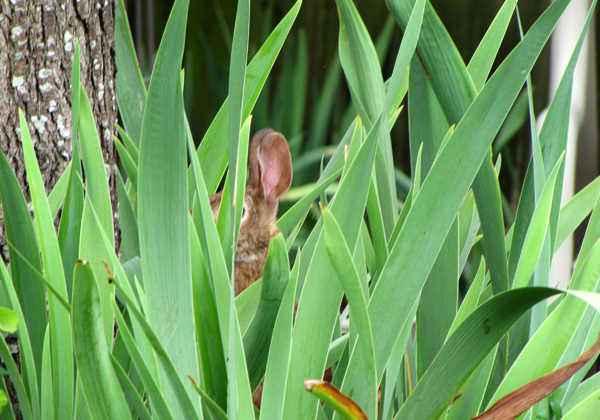
This morning, one of the rabbits built a new nest in the irises. It looked like a lot of work. She pulled grass in huge mouthfuls, carried it into the iris bed, arranged it carefully, then returned for more grass. She also spent a great deal of time digging, uprooting several irises in the process. (The irises will survive. They always do.)

I can hardly contain my curiosity, though I know better than to disturb the nest today. Maybe sometime mid-week, I’ll take a closer look.

I’m looking forward to a new litter of bunnies, and I’ll be very disappointed if the nest fails. Or if the hawk returns…

June Bugs, Escaping a Spider (Arachnophobia Alert!), and a Publication Note

The June bug invasion continues.

This morning, one of the June bugs had a narrow escape after flying into an orb weaver web. (Look away!!) It was a failure of either bite or venom for the spider, a triumph of size and strength for the June bug.

Publication Note:  My poem “Means of Dispersal” appears in the July/August 2012 issue of Eclectica. Many thanks to poetry editor Jennifer Finstrom!