Katydids

Growing up, katydids were my summer lullaby. On hot, still nights, I would move my pillow to the foot of the bed and sleep with my face inches from the open window. I remember the night air’s damp smell and the moonlit silhouette of silver maples. I remember the hollow calls of barred owls in the swamp across the road. And I remember the rhythmic, echoing chorus of katydids. Mother told us they were saying katydid katydid katydid… katydidn’t… katydid katydid…

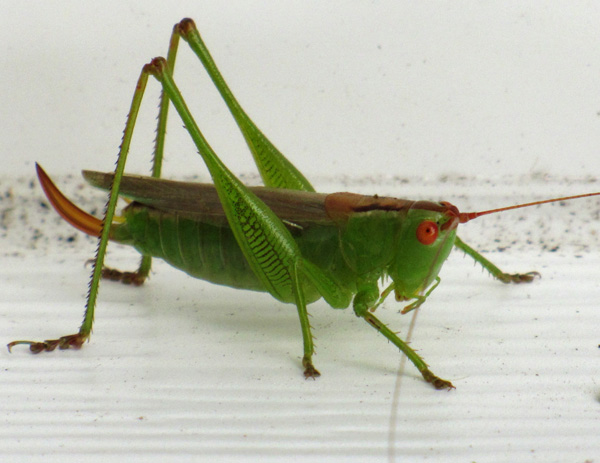
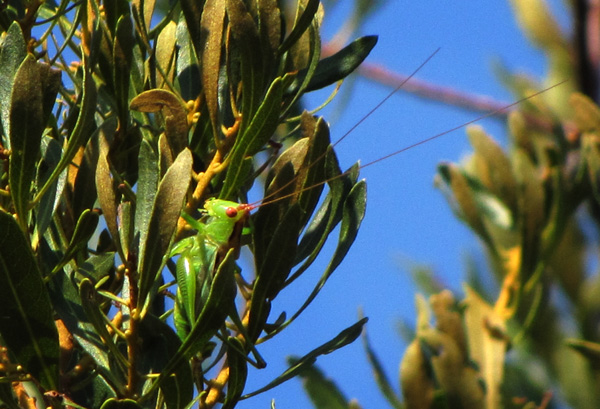
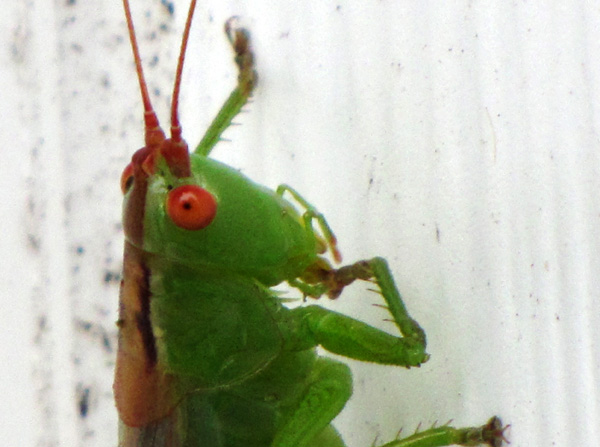
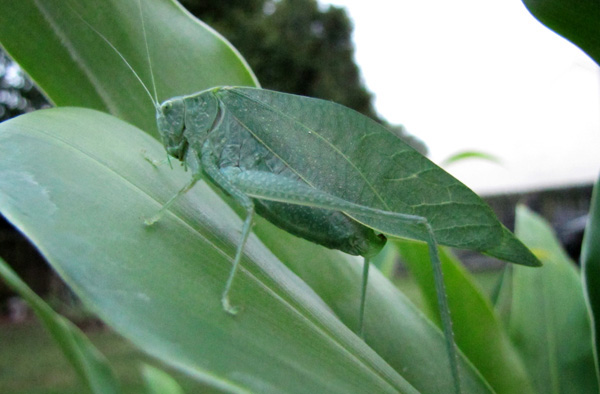
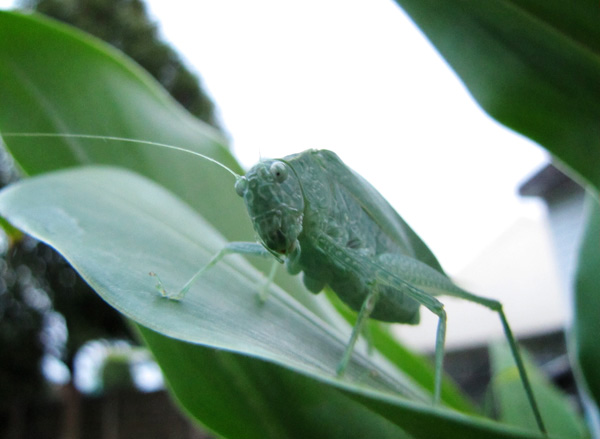
I never imagined that I was leaving katydids behind, when I moved to Virginia. The closest thing I’ve seen, since moving, is the greater angle-wing pictured above. (Photos taken in 2011).

The yard does have a thriving population of small katydid cousins, meadow katydids, but they sound nothing at all like my childhood.

Check out this web page for recordings. Click on the common true katydid, to hear the call I grew up with, then compare it to the common meadow katydid. You might also listen to the greater angle-wing, which solves one of my ongoing yard mysteries. I’ve spent many a night creeping around the yard with a flashlight, trying to figure out who makes that repetitive click…

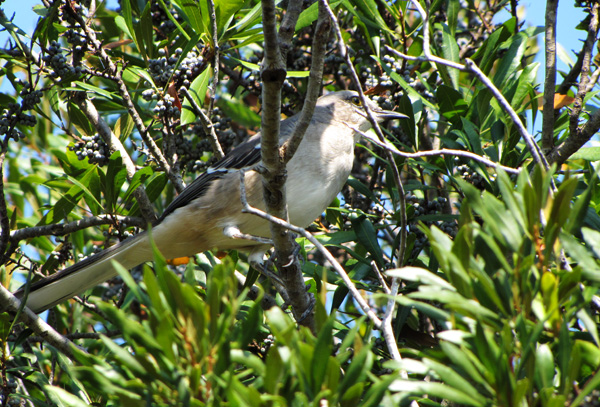
While I was hunting katydids today, trying unsuccessfully for a video clip, I kept hearing what sounded like a sneeze. A tiny, high-pitched bird sneeze. This mockingbird seemed embarrassed, when I traced the sound to it. I wonder if birds suffer from allergies, too?

Gesundheit!

Cicadas

Cicadas

Youth taps through a labyrinth
Of root, exploring in blind stages
Each nymph counts, each instar
Molts toward the relentless percussion
Of age, where the last skin hardens
And splits at the nape, final
Form shrugging free to unfurl song
In heat, muscles tuned to the sun’s declining
Tenor, late summer’s desperate chorus
Clings to tired limbs that droop
With the weight of leaves past saving
A monotonous harvest of lust
Set to succumb after securing the eggs
Muffling them in summer’s golden pith

2012 Hampton Roads Writers Conference, Part Two

One of the last things I did, before leaving for the conference, was bring in the mail. The top envelope in the box was one of my submission SASEs, which could only be a rejection. Since better than seventy percent of my submissions result in rejection, it was a safe assumption. The envelope contained my very first photography rejection.

As I drove to the conference, I mulled my usual regrets. Did I miss something in the submission guidelines? Did I choose wrong, as I selected what to send? (The photos in this post are some of the ones I considered, but decided against.) And, the biggest question of all, what was I thinking? Why did I ever imagine that my work was good enough for publication?

I’ve been submitting poetry since 2003. Nine years in, I’ve accumulated a drawer full of rejections and a folder’s worth of acceptances. My rejection-regret processing time is down to a little over an hour, so I reached the “it’s okay and I’ll try again” stage before check-in time at the conference. Even so, it wasn’t the best way to start my weekend.

The first night offered a choice between three sessions. I opted for “Mastering the ten-minute agent pitch” by Molly Jaffa of Folio Literary Management. Anyone who has ever considered submitting their work to an agent should hear this talk. Before, I had vague ideas of how I wanted to present my book. After, I had a firm outline and growing confidence that I was on the right track.

Friday and Saturday’s schedules included talks about poetry, fiction, and non-fiction. My favorite sessions focused on marketing and editing:

  • “A Day in the Life of a Literary Agent” by Molly Jaffa
  • “Getting Published … and Maybe Even Paid (for your poetry)” by editor and publisher Annmarie Lockhart
  • “Buffing and Polishing” by author John DeDakis

I learned from every speaker, but the daily first-ten-lines critique sessions were the most interesting part of the conference. The critique panel consisted of agents Molly Jaffa, Rachael Dugas, and Brooks Sherman, along with authors Rick Mofina and Patricia Hermes. Earlier in the summer, conference registrants had been invited to submit the first ten lines of their works-in-progress. These submissions were projected in the auditorium (with the authors’ information removed), read aloud, and discussed by the panel. Points of interest included formatting, character development, point of view, word choice, and placing your work within the proper genre. In each submission I recognized problems from my own work, and I left each session with new ideas about how to strengthen my writing.

By Saturday evening, my mind was full to overflowing. I was happy to come home and eager to start applying all that I had learned. Which brings me back to “what was I thinking?” I was thinking this: I prefer a drawer full of rejections to a computer hard drive packed with poems and stories and photos that I never bothered to edit and submit.

Now, it’s time to get back to work.
A note from the yard and part one of my report from the 2012 Hampton Roads Writers Conference

My first day back from the writing conference is sunny and cool, a perfect day to spend in the yard. I had planned to run straight to my office this morning, but the day is too beautiful to ignore.

Each bed of ginger lilies began the summer with several small praying mantises. Now each harbors a single large praying mantis. I don’t know if the survivors killed their competitors or forced them out. Perhaps they shift territories from day to day and I never find the same individual more than once. But it seems logical, to me, that the one above (photographed on September 7th) lives full-time in the small ginger lily bed, while the one below (photographed today) conquered the larger, corner bed.

However it works, I’m hoping there will be praying mantis egg cases by winter.

Report from the 2012 Hampton Roads Writers Conference, Part One

In the past three years, many of my fellow poets and writers have attended the Hampton Roads Writers conference. I decided to see it for myself this year.

The conference opened Thursday evening and ran through Saturday. Presenters included literary agents, journalists, professors, editors, publishers, and a wide range of authors. All three agents held ten-minute pitch sessions and participated in panel discussions during which they critiqued a series of first-ten-line submissions. The conference also offered three free writing contests (fiction, non-fiction, and poetry) with mid-summer deadlines.

My poem “On Fossil Links That Cannot Speak” placed second in The Barbara Dunn Hartin Memorial Poetry Prize. Barbara Dunn Hartin was a longtime member of the Albright Poets and a dear friend. When her son called my name yesterday, I floated to the front of the room through a fog of tears, speechless and overwhelmed. The certificate shook in my hands as I heard her laughter in the room’s echoes and saw her sparkling eyes in every face. It was a magical conclusion for the conference.

(Except it wasn’t quite the end. After my award, two other Albright Poets won prizes for their creative non-fiction!)

Home from the Writing Conference

The 2012 Hampton Roads Writers Conference ended this afternoon. I drove home tired and happy and wonderfully inspired. I plan to post more details over the next few days, but first I need to catch up on cat time.