Dekay’s Brownsnake (ophidiophobia alert!)

A snake by any other name

A cold and drowsy snake visited in January. The yard had experienced floods, in days before, so I expect the snake fled some drenched winter hideaway. Moving slowly in the chill, our visitor spent a half-hour or more searching for dry accommodations in leaves that had settled against our house’s concrete foundation.
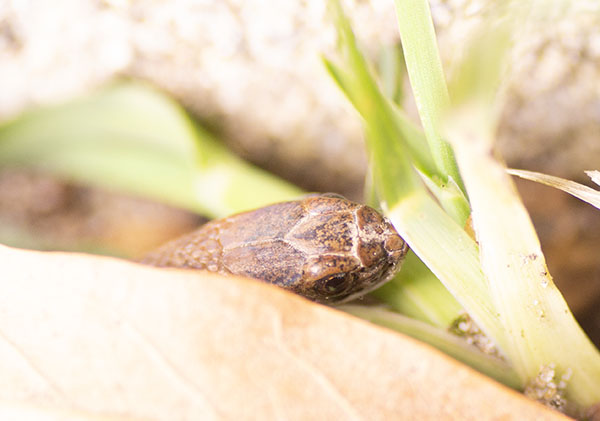
Photo of a Dekay's Brownsnake peeking from under a dry brown leaf. The scales on top of the snake's head are mottled brown with pale tan coloration between scales. Its large brown eye has a round pupil.
Photo of a Dekay’s Brownsnake peeking from under a dry brown leaf. The scales on top of the snake’s head are mottled brown with pale tan coloration between scales. Its large brown eye has a round pupil.

Over the past decades, I’ve caught rare glimpses of these snakes in the yard. Each time, I filed them in the generic “garter snake” folder of my internal memory bank. My flawed and over-capacity garter snake folder, in my flawed and over-capacity memory, holds all of the small, striped (or not), yard-sized snakes I’ve ever encountered. As long as the small, striped (or not), yard-sized snakes weren’t green, I called them garter snakes. (Green snakes are, obviously, “green snakes” in my flawed internal memory bank.)

Many of my “garter snakes” were, most likely, garter snakes.

Photo of a strongly marked snake with tan stripes and checkerboard patterns of dark brown and pale tan. I believe this is, indeed, an Eastern garter snake. The dapper little snake didn't want to cede its sunny spot beside the paved walking trail and assumed the defensive posture shown in this photo--head raised, neck in an s-curve, body slightly flattened and puffed. Everything about this posture says "if you don't leave me alone I'll bite you". (The snake attempted a strike shortly after this photo. I didn't get bitten, because I was wary enough to stay out of strike's reach, but I'm ashamed that I didn't heed the snake's clear request to be left in warm contentment. Instead, in my zeal for photos, I intruded so thoughtlessly that I made the little creature anxious enough to strike. I apologized, before leaving, but couldn't restore the snake's sun-soaked relaxation.)
Photo of a strongly marked snake with tan stripes and checkerboard patterns of dark brown and pale tan–an Eastern garter snake. This dapper little snake didn’t want to give up its sunny spot beside the paved walking trail and assumed the defensive posture shown in this photo–head raised, neck in an s-curve, body tense. Everything about this posture says “if you don’t leave me alone, I’ll bite you”. The snake attempted a strike shortly after this photo. I didn’t get bitten, because I was wary enough to stay out of strike’s reach, but I’m ashamed that I didn’t heed the snake’s clear request to be left in warm contentment. Instead, in my zeal for photos, I intruded so thoughtlessly that I made the little creature anxious enough to strike. I apologized, before leaving, but couldn’t restore the snake’s sun-soaked relaxation.

Many of my “garter snakes” were, most definitely, not garter snakes.

Garter snake. Not garter snake. Other snake. Each time I get a chance to patch my flawed and over-capacity internal memory bank, I’m relieved. Especially here, in my middle years.

As it’s been too cold for snakes to emerge, except in emergencies, I haven’t tested my brownsnake memory patch against snakes found in the wild. Or in the yard. So I’ve been testing it against my photo archive. At the moment, I’m still mid-correction, my internal dialogue still chirping “garter snake” when I come across photos of small, not-green, striped (or not striped), yard-sized snakes, still needing the gestalt-shift between first impression and new information. Still needing the pause and closer look. Not always garter snake. Sometimes, Dekay’s Brownsnake.
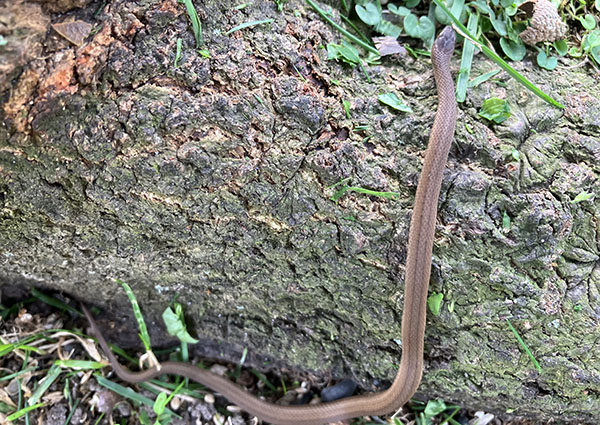
This little Dekay's Brownsnake, no more than 10 inches long, retreated over a tree root as I mowed the back yard. At the time, my internal dialogue tagged the photo "garter snake" and rambled off toward a more interesting (at the time) topic. Now, captivated by the newness of "Dekay's Brownsnake" in my internal dialogue, I clearly see the identifying keeled scales and parallel lines of dark spots down its back.
Photo of a Dekay’s Brownsnake, no more than 10 inches long, retreating over a tree root as I mowed the back yard. At the time, my internal dialogue tagged the photo “garter snake” and rambled off toward a more interesting (at the time) topic. Now, captivated by the newness of “Dekay’s Brownsnake” in my vocabulary, I clearly see the identifying keeled scales and parallel lines of dark spots down its back.

Is the image a vase or a pair of silhouettes? Is the snake a generic “garter snake” or a Dekay’s Brownsnake? The gestalt-shift between recognitions feels like wonder to me.

As for snakes in vases, or other yard art, maybe they are neither garter snake nor Dekay’s Brownsnake?

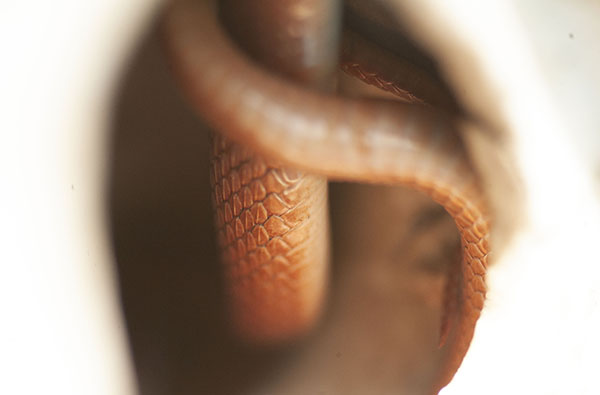
Photo of a snake's tail dangling out of the bottom opening of a hollow piece of ceramic yard art. The tiny snake, smaller in diameter than a pencil, was reddish-brown with a pale belly. I labeled these photos "garter snake", though I now wonder if they show a reddish variant of Dekay's Brownsnake. Or maybe some other species, still unnamed in my memory?
Photo of a snake’s tail dangling out of the bottom opening of a hollow piece of ceramic yard art. The tiny snake, smaller in diameter than a pencil, was reddish-brown with a pale belly. I labeled these photos “garter snake”, though I now wonder if they show a reddish variant of Dekay’s Brownsnake. Or maybe some other species, still unnamed in my vocabulary?
Another photo of the reddish snake that overwintered in a hollow piece of ceramic yard art. In this photo, keeled scales are clearly visible along the snake's sides, but I can't see enough of the snake's back to know if there are keels on its dorsal scales, as well. I tried following the identification key-map provided by the Virginia Herpetological Society, to no avail. (Please comment if you can help with the ID!)
Another photo of the reddish snake that overwintered in a hollow piece of ceramic yard art. I tried following the identification key-map provided by the Virginia Herpetological Society, to no avail. Keels are readily visible on the snake’s side scales, but no dorsal scales are visible in the photos, which is where my attempts at identification break down. (Please comment if you can help with the ID!)

I’ve seldom had the luxury of hovering here, at the pivot point of internal correction. But my time, this winter, has slowed with the chill. Long nights and short days trigger depression and anxiety, steering me toward torpor. And this winter’s torpor has been more meditative than some years. I’ve lingered over these photos of our little reptile visitor. I want to call this moment learning, except that overused word feels both too small and too large. As do other words, like knowledge and discovery.

Photo of a very small Dekay's Brownsnake emerging between dry brown leaves. In this side view, the snake's overlarge eye and round pupil are fully visible, along with a row of dark spots along its upper lip. Its pale lower lip curves up in an anthropomorphic smile.
Photo of a very small Dekay’s Brownsnake emerging between dry brown leaves. In this side view, the snake’s overlarge eye and round pupil are fully visible, along with a row of dark spots along its upper lip. Its pale lower lip curves up in an anthropomorphic smile.

Such words, and the ideas they attempt to convey, have been claimed and reclaimed, used and abused, lauded and cursed for centuries. Well before I began grappling with my own understandings and misunderstandings, philosophers and critics set their pens to the task of recording, preserving, and passing on observations that make reality a little bit safer, a little bit more predictable, for future generations of humanity. So many men (yes, mostly men) writing letters to a future with so much more to observe.

Macro photograph of the face and eye of a Dekay's Brownsnake, taken in January of 2024. The small snake's large eye shows a round pupil and an iris of iridescent brown and bronze. Its facial scales are mottled brown.
Macro photograph of the face and eye of a Dekay’s Brownsnake. The small snake’s large eye shows a round pupil and an iris of iridescent brown and bronze. Its facial scales are mottled brown.

What goes into a name? Constructing (or deconstructing) Dekay’s Brownsnake

Dekay’s Brownsnake has the dubious honor of being named after two 19th century (male) naturalists. Its taxonomic genus-species name is Storeria dekayi. This caught me by surprise. An entire genus of snakes named for David Humphreys Storer (1804-1891), an American physician and naturalist.

Species names have long been used to preserve and honor the names of explorers, scientists, and/or celebrities (a dusty old practice, also evident in common names such as Dekay’s Brownsnake, that is under discussion and overdue for a change) but genus names tend to be more functional. Genus names often highlight one of the traits (or missing traits) that identify the included species as similar enough to be grouped together while simultaneously dissimilar from other groups. Granted, the genus Storeria remains a small genus (only four species, according to the University of Michigan’s Museum of Zoology/Animal Diversity Web), but still….

I couldn’t resist a stroll through the search engine. I never can. Literature search is my favorite phase of projects, and archives are my happy place.

According to his obituary, David Humphreys Storer (1804-1891) was the dean of Obstetrics and Medical Jurisprudence for Harvard Medical School. He also had a great fondness for collecting. His collections encompassed everything from coins to birds eggs, and he cultivated connections with toll takers and sailors to bolster his coin, shell, and fish collections. His work with the Boston Society for Natural History led to a position with the Natural History Survey of the Commonwealth, where Storer managed the fishes and reptiles portion of the survey, resulting in the eventual publication of A History of the Fishes of Massachusetts.

Storer’s internet presence also includes an 1831 pamphlet, noted on page two to be the “Report of a Trial: Miles Farmer, versus Dr. David Humphreys Storer; commenced in the Court of Common Pleas, April Term, 1830, from which it was appealed to the Supreme Judicial Court, and by consent of parties, referred to Referees, relative to the transactions between Miss Eliza Dolph and George Washington Adams, Esq., son of the late President of the United States. It is impossible but that offences will come; but woe unto him through whom they come! It were better for him that a mill stone were hanged about his neck, and he cast into the sea. —Luke, xvii. 1, 2. Reported by the Plaintiff.” (!?)

I must admit that my interest in Storer dissipated before I read the entire pamphlet. Historical gossip aside (“…the transactions between Miss Eliza Dolph and George Washington Adams…”? Might this have been a scandal worthy of Lady Whistledown?), the pamphlet doesn’t contribute to my relationship with the little snakes in my yard.

Neither the obituary nor the pamphlet help me understand the man, David Humphreys Storer, who was so admired as to have a small genus of small snakes carrying his name to this day. And here lies part of the trouble with eponymous taxonomy. No matter how admired, in collecting circles, nor how despised, in other circles, Storer’s name cannot help me understand the habits and habitats of the little snakes I’m currently obsessed with.

James Ellsworth Dekays’ name doesn’t help, either. Another American physician and naturalist, Dekay (1792-1851) participated in a different state sponsored natural survey, for the state of New York. Dekay eventually published his findings in Zoology of New-York: Or the New-York Fauna: Comprising Detailed Descriptions of all the Animals Hitherto Observed within the State of New-York, with brief Notices of Those Occasionally Found Near Its Borders, and Accompanied by Appropriate Illustrations. In Part III (Reptiles and Amphibia), Dekay described a small brown snake collected by “…John Crumby, Esq., a zealous sportsman and acute observer, who captured [the snake] as it was swimming across a large bay on the northern coast of Long Island” (pp. 46-47).

Dekay’s three-paragraph note about the little brown snake is widely attributed as the first description. (A formality often conflated with discovery.) Dekay first used the genus name Tropidonotus but later corrected it to the genus name Coluber. Today the genus Storeria is classified within the family Colubridae.

A quick search engine query leads to a slightly more interesting article about Dekay–“Between the First Blind Cavefish and the Last of the Mohicans: The Scientific Romanticism of James E. Dekay” by Aldemaro Romero. But again, this article doesn’t help me understand or appreciate the yard’s snakes.

So my stroll through the binomial etymology of Storeria dekayi found my first example of an eponymous genus, two 19th century (male) physician-naturalists, a sex scandal with political connections, an article that tethers blind cavefish to James Fenimore Cooper, and one unfortunate little brown snake that fell prey to a sportsman while the snake was (likely) minding its own snake-business, swimming across a large bay on the coast of Long Island.

Reconstructing my memory, brown snakes included

But why do I crave a relationship, a learning or knowing, with the small, shy, nocturnal, snail-and-slug eating snakes in my yard?

Macro photo of a Dekay's Brownsnake. The snake was approaching the lens, so its head and eye are in focus while the rest of its body is out of focus. Its facial scales are mottled brown, with darker spots under its eye. The scales of its lower lip are very pale tan.
Macro photo of a Dekay’s Brownsnake. The snake was approaching the lens, so its head and eye are in focus while the rest of its body is out of focus. Its facial scales are mottled brown, with darker spots under its eye. The scales of its lower lip are very pale tan.

Why, after so many years of being content to see these snakes as “garter snakes”, do I care so much now? I suppose part of my previous contentment is rooted in a youthful mis-hearing and mispronunciation. Garter snakes were garden snakes, most often encountered during gardening. Small, not-green, striped (or not), yard-sized snakes. As long as they weren’t venomous, they were simply garden snakes.

Venomous-or-not was my earliest snake knowledge, my first lessons in the garden. Some snakes were, and are, venomous. Avoid. Don’t get bitten. Be afraid, if you must. If that’s what keeps you safe, be afraid of snakes. (Of course, all of this gets mixed in with Genesis, with Adam and Eve and a serpent that spoke of temptation. The lesson, again, was fear.)

Our father was a snake killer. Every snake he saw, he slaughtered with whatever tool was closest at hand. His histrionics over snakes were the stuff of family lore, which added a dose of realism to the lesson. My older siblings, and sometimes our mother, ridiculed our father’s snake phobia. I absorbed an adjacent lesson, that the reflex killing of snakes was an action worthy of ridicule.

I developed a fascination with these animals that were so terrifying to our father. I wanted to be not-afraid of what our father feared. (And I wanted to avoid being another target of family ridicule.) Rat snakes, king snakes, corn snakes, green snakes, garden/garter snakes. All the hen-house thieves and barn guardians. All the camouflaged brush and grass dwellers. I watched for them with a cautious kind of hope, longing to catch a glimpse. To see them glide across a rafter or ripple into the next row of okra or bask, egg-sated, near the hen house.

And then, during my years in the boggy woods, the fear-laced lessons of my past peeled away like the hull of a seed.
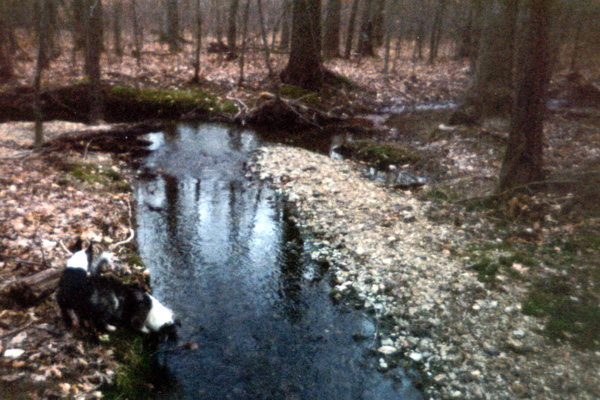
Photo taken in “the woods”, sometime during winter (bare trees, no underbrush, a thick blanket of fallen leaves) in the early 1990s. Shown here is a portion of the spring-fed creek that was the center of all activity in the woods. It was a shallow creek with shallow banks, flat gravel in places and woody in places, the wooded banks supported by exposed tree roots and moss. I visited the creek and woods as often as, and for as long as, time would allow. I was always escorted by a pack of dogs (and sometimes a cat or two, if the cats chose to follow). In this photo are my Boston Terrier (Simon) and Mother’s corgi mix (Bonnie). This photo smells like petrichor, sounds like water and wind and dry leaves and excited dogs, and looks like nostalgia. It feels like silence and loss, and it tastes like I’ve swallowed a memory because I was hungry for time.

In my boggy woods, hidden from the lessons of my parents and their religion, I sprouted. I developed an observational habit of naming and knowing the cottonmouths and the water snakes around the creek, the copperheads and the corn snakes near the edges, the rattlesnakes and the rat snakes under and in the trees. I knew where the gravid females basked and where the hungry youngsters hunted. I knew the woods and the creek because they were my favorite place to be myself. Should a snake have spoken to me, there, I would have eaten without hesitation whatever it offered.

Photo of a non-venomous water snake. The photo is cropped to concentrate on the snake's face, showing the round pupil and lack of a heat sensing pit between eye and nostril. The snake is striped in various shades of brown with vertical stripes on both upper and lower lip.
Photo of a non-venomous water snake. The photo is cropped to concentrate on the snake’s face, showing the round pupil and lack of a heat sensing pit between eye and nostril. The snake is banded in various shades of brown with vertical stripes on both upper and lower lip.
Photo of a cottonmouth (or water moccasin), zoomed in to show the snake's face and head. The cats-eye shaped, vertical pupil is clearly visible, as is the opening of its heat-sensing pit between eye and nostril. These two traits are common to the venomous pit viper family of snakes.
Photo of a cottonmouth (or water moccasin), zoomed in to show the snake’s face and head. The cat-eye shaped, vertical pupil is clearly visible, as is the opening of its heat-sensing pit between eye and nostril. These two traits are common to the venomous pit viper family of snakes.

But the garden snakes, as long as they weren’t venomous, were simply garden snakes. The garden wasn’t my habitat, so I didn’t need to know its snakes. I tended the garden, and ate its tame offerings, with impatient distraction, always longing for the woods.

Here in my middle years, the garden and yard have become my habitat. I no longer visit the woods, except as a tourist. Now I need to name and know the garden snakes.

Other than the practicality and predictability of recognizing our Dekay’s Brownsnake as not-venomous, I can’t put my finger on the reason for my need. It’s not learning, knowledge, or discovery. It’s simply there. As are the garter snakes. The not garter snakes. The Dekay’s Brownsnakes, who, I’m happy to note, are drawn to the yard and garden because they like to eat slugs and snails. Perhaps this is reason enough to name them and to know them?
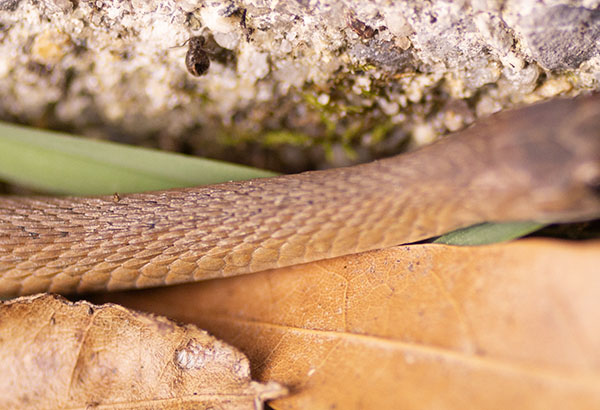
Photo of the Dekay's Brownsnake, focused on the snake's body scales. Each reddish-brown scale has a raised central keel, like a line drawn the length of the scale. These body scales overlap more tightly than the facial scales. A row of pinpoint black dots is just visible along the snake's back.
Photo of the Dekay’s Brownsnake, focused on the snake’s body scales. Each reddish-brown scale has a raised central keel, like a line drawn the length of the scale. These body scales overlap more tightly than the facial scales. A row of pinpoint black dots is just visible along the snake’s back.

Perhaps it’s all simply my personal gestalt-shift. The vase is Tennessee and the silhouettes are Virginia. The vase is the woods, the silhouettes our yard. The vase is youth, the silhouettes are now. The vase is water snakes, the silhouettes are garden/garter snakes.

Gestalt-shift. (Dare I say paradigm shift? I dare, but shouldn’t. It’s a rabbit hole.) At any rate, it’s another moment of wonder.
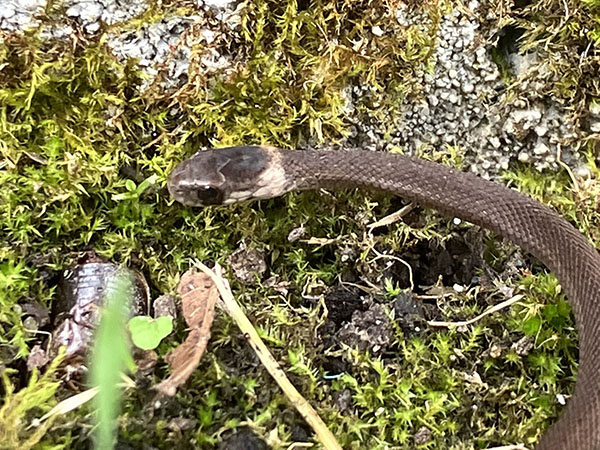
Photo of a juvenile snake exploring a mossy corner of the yard. The snake is gray-brown with a pale ring around its neck. Its overlarge eye has a round pupil. I initially leapt to the conclusion that this might be a ring-necked snake, but now suspect it's a young Dekay's Brownsnake.
Photo of a juvenile snake exploring a mossy corner of the yard. The snake is gray-brown with a pale ring around its neck. Its overlarge eye has a round pupil. I initially leapt to the conclusion that this might be a ring-necked snake, but now suspect it’s a young Dekay’s Brownsnake.

Here are links to three reviews of my poetry collection, Watershed:

“The collection focuses on the natural world and the human relationship with nature. …” by Crafty Green Poet (read the full review here)

“The poems have both a logical and mystical aura that keep the reader in place while the poems flow forward. …” by Lynette G. Esposito at North of Oxford (read the full review here)

“Watershed from Kelsay Books is an antidote to compulsion, to insistence, to the headlong rush into the next thing and the next. …” by GriffinPoetry at Verse Image (read the full review here)

I’m grateful for the time that readers, editors, and reviewers have spent with my writing, and with my book. I’ve loved every minute of my writing journey.


Here are a few articles and essays that are more interesting, and more important, than my musings:

Discovered in Collections, Many New Species are Already Gone by Katarina Zimmer at Undark

When Scientists “Discover” What Indigenous People Have Known for Centuries by George Nicholas at Smithsonian Magazine

The history of natural history and race: Decolonizing human dimensions of ecology by Maria N. Miriti, Ariel J. Rawson, and Becky Mansfield at esa journals (Ecological Society of America)

Feds announce plans to begin rescuing sick sawfish amid mysterious die-off by Jenny Staletovich at WLRN 91.3FM

People more often are origin of infectious diseases in animals than vice versa, data suggest by Mary Van Beusekom, MS, at CIDRAP

Ecological countermeasures to prevent pathogen spillover and subsequent pandemics by Raina K. Plowright, Aliyu N. Ahmed, Tim Coulson, Thomas W. Crowther, Imran Ejotre, Christina L. Faust, Winifred F. Frick, Peter J. Hudson, Tigga Kingston, P. O. Nameer, M. Teague O’Mara, Alison J. Peel, Hugh Possingham, Orly Razgour, DeeAnn M. Reeder, Manuel Ruiz-Aravena, Nancy B. Simmons, Prashanth N. Srinivas, Gary M. Tabor, Iroro Tanshi, Ian G. Thompson, Abi T. Vanak, Neil M. Vora, Charley E. Willison, & Annika T. H. Keeley at Nature Communications

living shadows: aesthetics of moral worldbuilding by Brandon at sweater weather (hat tip to Science for Everyone)

Fear and Loathing in Tennessee: Librarians Face Anxiety, Burnout, Job Threats, and Hate Speech Due to Book Challenges and Legislation by Alex Sharp, Jessica McClure, and Cassandra Taylor at Tennessee Library Association

Why flying insects gather at artifical light by Samuel T. Fabian, Yash Sondhi, Pablo E. Allen, Jamie C. Theobald, & Huai-Ti Lin at Nature Communications

Biology Is Not Binary by Kate Clancy, Agustin Fuentes, Caroline M Vansickle, & Catherine Clune-Taylor at American Scientist (another hat tip to Science for Everyone)

‘Brain fog’ is one of Covid-19’s most daunting symptoms. A new study measures its impact by Elizabeth Cooney at STAT

When Horror Is the Truth-teller: It is hard, in the era of the AR-15, to fear a vampire. by Alexander Chee at Guernica

A Post about Coronaviruses

Something has been bothering me for a while, which means this post has been brewing for a while. (It’s also been edited a few times, since posting. Mostly in this introductory section, where I’ve cut and rearranged because the first version had too many words and asides.)

I’m going to talk about coronaviruses.

Marie and Duchess sitting on a carpeted floor, looking up at the camera. Marie is a pale gray watermarked tabby cat. Duchess is a pale gray and orange tortoiseshell cat with a clipped left ear.

This post is a departure for me. In talking/writing about coronaviruses on this blog, I’m breaching the barrier between my two worlds. Between my relaxing world of creativity, where I indulge myself with poetry and photos and blog posts, and my anxious world of responsibilities, where I worry about knowledge and knowledge gaps and the idea that facts about the natural world exist but are seldom fully grasped.

In my anxious world of responsibilities, I’ve been talking about coronaviruses for much of the past year. But only with friends and family. And cats. Marie and Dutch are attentive listeners.

Sometimes.

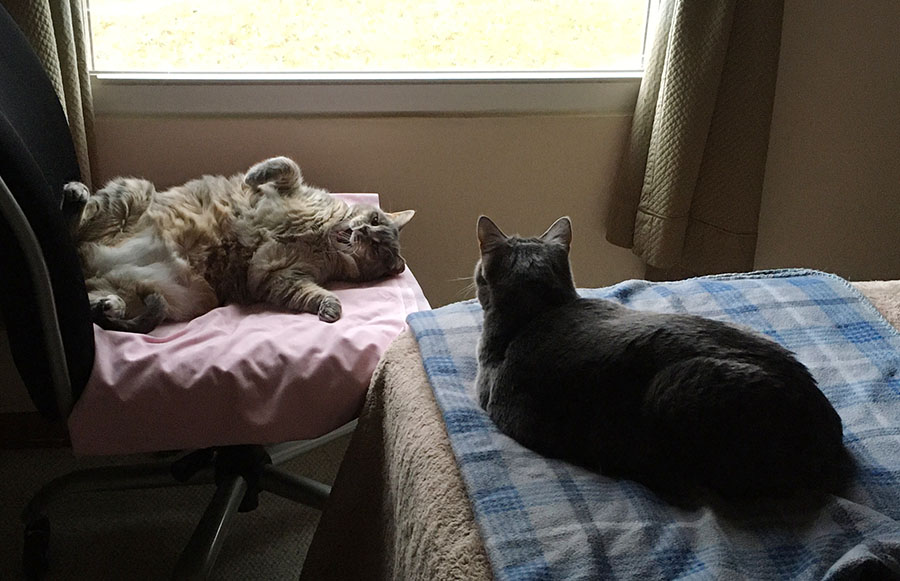
Marie, a pale gray watermarked tabby cat, is looking out of the window from her perch on a flannel blanket at the foot of a bed. Duchess, a pale gray and orange tortoiseshell cat, is sprawled in her back, yawning, in a chair in front of the window.

Actually, they’re not very good listeners at all.

Two cats, Marie and Duchess, are sitting on a carpeted floor, looking into their wire and canvas expandable play tunnels. One tunnel is green, the other is blue. Their heads and shoulders are fully inside the tunnels, so only their backs and tails are visible.

Moving on…

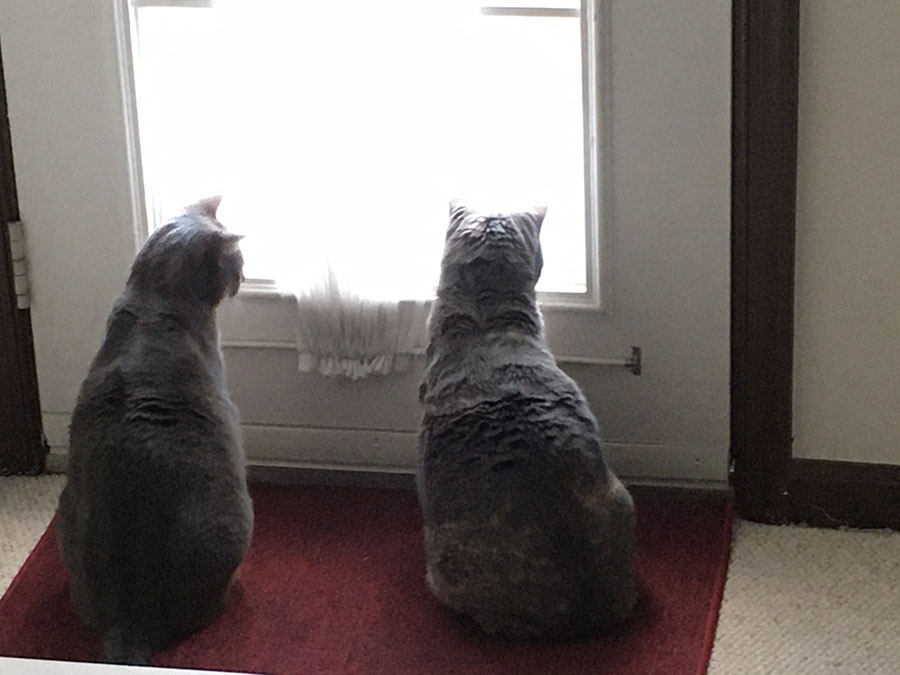
Two cats, Marie and Duchess, are sitting on a red mat, backs to the camera, looking out of a door that has windowpanes extending almost to the floor.

In this post, I’m going to explain some of what I know about feline coronavirus. Then I’m going to explain why I’ve been talking to my friends and family and cats about feline coronavirus during the COVID-19 pandemic.

Part I

The coronavirus family tree

To be clear, feline coronavirus is a distinctly different virus from COVID-19.

Taxonomically, both feline coronavirus and COVID-19 belong to the subfamily orthocoronavirinae (previously called coronavirinae), but they are in different genera. COVID-19 is in the genus betacoronavirus, while feline coronavirus is in the genus alphacoronavirus.

But what do these classifications mean? Obviously, they mean that feline coronavirus and COVID-19 are somewhat related, but does “somewhat related” mean anything useful for bloggers and readers and cats?

Two cats, Marie and Duchess, are looking at the camera while sitting on a gray desk chair that is in front of a white desk. The desk is stacked with papers and a spiral notebook. Marie is a pale gray watermarked tabby cat. Duchess is a pale gray and orange tortoiseshell cat with a clipped left ear.

A linguist might say It depends on what you mean by ‘useful.’ An editor might say The question needs editing before it can be answerable. And a taxonomist would likely say Please stop before you even start, because viral taxonomy follows its own rules and should not be compared to cats.

Two cats, Marie and Duchess, are sitting on a gray blanket with their backs to the camera, looking out of a window. Both have their front feet on the window sill. The tension in their bodies indicates that they are very interested in whatever is off-camera, outside the window.

The history of the taxonomy, classification, and nomenclature of viruses is an interesting study of its own. Efforts to classify viruses began in the 1960s and continue today, with a major expansion of the classification system having been proposed as recently as 2017. Currently, the family tree of coronaviruses looks something like this (Decaro & Lorusso 2020; Kipar & Meli, 2014):

  • Order – Nidovirales
    • Family – coronaviridae
      • Subfamily – coronavirinae (as of 2014) or orthocoronavirinae (as of 2020)
        • Genus – alphacoronavirus, betacoronavirus, deltacoronavirus, and gammacoronavirus

Beyond the genus level of classification, the coronavirus family tree branches into subgenera, species, and subspecies, with some 39 species of coronaviruses distributed across 27 subgenera (Coronaviridae Study Group of the International Committee on Taxonomy of Viruses, 2020).

But again, what do these classifications mean?

In a desperate and thoroughly unscientific attempt to answer this question, I’m borrowing an example from mammalian taxonomy. (Remember the taxonomist’s warning, that viral taxonomy should not be compared to cats? Like I said, the following comparison is thoroughly unscientific. I’ll understand if the taxonomist, or any other reader, snorts in contempt and walks away.)

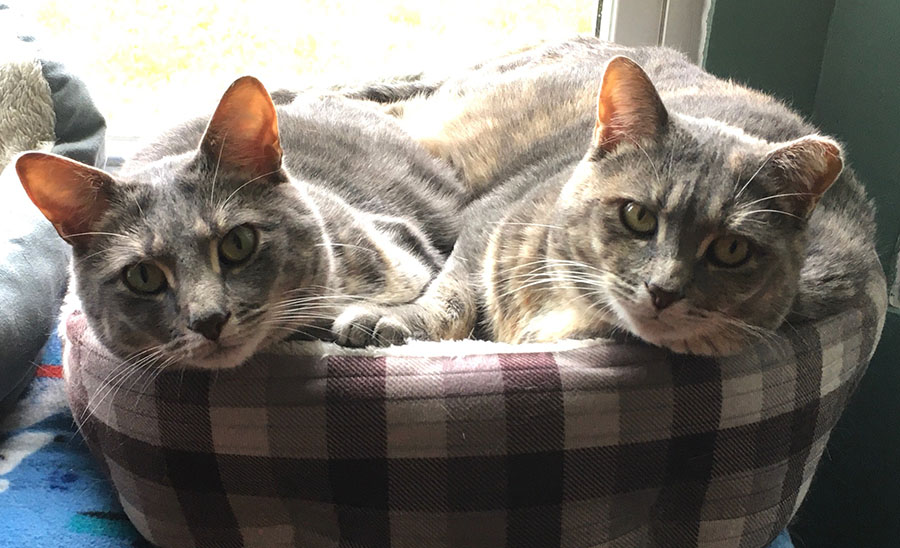
Two cats, Marie and Duchess, are sleeping together in a cat bed in front of a window. The cat bed is slightly too small for both of them to fit comfortably, so they look slightly uncomfortable. Beside them, there is a second cat bed, which is empty.

In viral taxonomy, feline coronavirus and COVID-19 are in the same subfamily, but in different genera.

In mammalian taxonomy, domestic cats and bobcats are in the same subfamily, but in different genera.

The feline family tree

Dutch and Marie are domestic cats. Spoiled, pampered, much loved house cats.

Two cats, Marie and Duchess, are curled up together on a brightly colored blanket on the floor in front of a glass door. Their backs are to the camera, and they are looking outside.

Taxonomically speaking, Dutch and Marie belong in subfamily Felinae, the genus Felis, and the species catus. Put in the more familiar binomial phrasing of genus-species, Dutch and Marie are Felis catus. By comparison, bobcats also belong to the subfamily Felinae, but are classified in the genus Lynx and species rufus. So, binomially, bobcats are Lynx rufus.

To add a third, and somewhat more complicated, data point (because everything is complicated in taxonomy), Pallas’s cats are also classified in the subfamily Felinae. But some sources place Pallas’s cats in the genus Felis and other sources separate them into the genus Otocolobus. All seem to agree on a species name for Pallas’s cats–manul. So Pallas’s cats are variously listed as Felis manulOtocolobus manul, or Felis (Otocolobus) manul.

Marie and Dutch, being pair-bonded rescue Felis catus, are clearly related to each other. Littermates, maybe. But they are only distantly related to bobcats and Pallas’s cats. Some taxonomists, those who classify Pallas’s cats in the genus Felis, might consider Marie and Dutch more closely related to Pallas’s cats than they are to bobcats. Other taxonomists, those who classify Pallas’s cats in the genus Otocolobus, might consider Marie and Dutch no more closely related to Pallas’s cats than they are to bobcats. For my purposes, it is enough to note that domestic cats, bobcats, and Pallas’s cats are all cats, but they are all distinctly different cats.

A gray cat, Duchess, is mostly hidden in a brown polka-dot cat bed with tall sides. All that can be seen over the sides of the bed are her ears and one hind foot extended over the bed's side, toward the camera. The pads of her foot are visible.

Feline coronavirus and COVID-19 are both coronaviruses, but they are distinctly different coronaviruses.

(Back to the taxonomist’s concerns: Viral taxonomy and mammalian taxonomy are, indeed, different systems. The above comparison is flagrantly unscientific. I offer it as a metaphorical demonstration of the messiness inherent in trying to describe, measure, or quantify relatedness among viruses and/or cats.)

A gray cat, Marie, is mostly hidden under a black sheet and white blanket. All that can be seen is her nose and part of one eye, along with a few toes of one front foot. Her position and tension indicate that she is stalking something from her hiding place under the sheet and blanket.

Part II

As recently as the early 1990s, when I first entered veterinary school, there were many knowledge gaps in the story of feline coronavirus. Now research has illuminated how the virus moves within cat populations and has unraveled some of the complex mechanisms that mediate how the virus affects individual cats.

From here, for the sake of brevity and clarity, I’m going to shorten “feline coronavirus” to FCoV. For one thing, I won’t have to keep typing the whole name. For another, I want to be as clear as possible that coronaviruses are a large and varied group of viruses, while FCoV is a very specific coronavirus that infects cats. Probably even Marie and Dutch, at some point in their lives.

Two cats, Marie and Duchess, are looking at the camera from their positions curled up together in a gray checked cat bed. They were asleep together and just woke up. Their expressions indicate they are interested in the camera.

Yes, even you, my dears. But it’s okay, because the overwhelming majority of cats that become infected with FCoV will have few or no symptoms. Perhaps some diarrhea or other gastrointestinal signs, perhaps some upper respiratory congestion.

(There’s more to the FCoV story, which I’ll come to later. For now, I’ll simply say that I’m grateful Marie and Dutch are among the overwhelming majority of cats who have avoided the “more” part of the FCoV story.)

Two pale gray cats, Marie and Duchess, are sleeping facing each other. Duchess has one front foot wrapped over Marie's neck, and Marie has both front feet propped on Duchess's chest. They are in front of a window, and grass is visible in the background.

Marie and Dutch have likely been infected with FCoV, perhaps on multiple occasions. Because FCoV is “worldwide and ubiquitous among virtually all cat populations”, found in more than 60% of pet cats in multi-cat households and in as many as 90% of kittens in shelters (Pedersen, 2009, p. 227).

FCoV is a single-stranded RNA virus

The particular feature of FCoV that is important to this post, and that has been important in my year-long discussions with friends and family, relates to the way coronaviruses carry their genetic information. Unlike humans and cats (and most other organisms), who carry their genetic information as double strands of DNA, coronaviruses carry their genetic information as single strands of RNA. So FCoV, like all other coronaviruses, employs single-stranded RNA as the primary molecule for carrying genetic information.

Dutch and Marie always go to sleep at this point. It’s okay if you do, too. I’ve fallen asleep several times, myself. But there is a point to this post. I’m getting close to it, and my next tangent about the differences between double-stranded DNA and single-stranded RNA will get even closer.

Two gray cats, Marie and Duchess, are sleeping nose-to-nose curled up together on blanket. The camera is very close to their heads, so their ears are prominently visible.

The double helix packaging of DNA provides a relatively stable structure for passing along genetic information. Each strand of DNA serves as a sort of back-up copy for its partner strand, and the process of DNA copying actually uses this back-up feature to proofread and correct mistakes. Should a strand of DNA break, or should mistakes occur in copying a strand, the back-up copy allows enzymes to repair the breaks and remedy the mistakes. This prevents mutations. Obviously, some mutations slip through, but at a far lower rate than would otherwise occur.

Single strands of RNA are less stable genetic carriers than double-stranded DNA. RNA is a more fragile molecule than DNA, and single-stranded RNA, lacking partner strands, has no back-up copies for enzymatic proofreading. Coronaviruses do have a unique mechanism for proofreading, a complex of enzymes and proteins that proofread key genes (Robson et al., 2020), and this unique mechanism provides some stability. But rapid and frequent mutations still occur.

As a single-stranded RNA virus, FCoV does a poor job of creating exact copies of itself. Every time FCoV copies itself, errors occur. Every time (Kipar & Meli, 2014, p. 507). For that matter, FCoV mutates so often that researchers characterize the array of viruses produced in the course of a single infection as a quasispecies–a group of “related genotypes” (Kipar & Meli, 2014, p. 507). Other researchers use the term “pseudo-strain” (Emmler et al., 2020, p. 792).

In short, within any FCoV infected cat, there are many mutated versions of the FCoV they originally contracted.

Two gray cats are snuggled together in front of a window. The camera is very close. Marie is sleeping with her forehead pressed against Duchess's back. Marie's nose and whiskers are visible. Duchess has her back to the camera and has fallen asleep while looking out of the window.

FCoV and feline infectious peritonitis

The overwhelming majority of cats that become infected with FCoV will have few or no symptoms. Perhaps some diarrhea or other gastrointestinal signs, perhaps some upper respiratory congestion. But there’s more to the story.

For somewhere between about 1% (Pedersen et al., 2012, p. 20) and 12% (Addie et al., 2009, p. 594) of infected cats, their particular FCoV quasispecies mutates into one of a number of forms that are able to cause a devastating and often fatal disease: feline infectious peritonitis (FIP).

I say “able to cause” because the FIP-able quasispecies do not always cause FIP. Some cats can resist FIP, even when their FCoV infection mutates into a form capable of causing FIP. Some cats are resistant at one point in their lives and later become susceptible, others perhaps follow an opposite path. In essence, FIP occurs at intersections between rapidly mutating FCoV quasispecies and the genetics and immune systems of individual cats. When an FCoV quasispecies gains the ability to cause FIP, in a cat that never had or has lost the ability to resist FIP, a deadly cascade of disease may begin.

What I’ve just described is the internal mutation theory of FIP. Put bluntly, this theory says that every case (or cluster of cases) of FIP represents a newly mutated variant of FCoV that is newly capable of causing FIP.

And now, all tangents complete, I come to the point of this post.

Two gray cats, Marie and Duchess, are stretched out together on a blue tie-dyed blanket in front of a window. Marie is asleep with her front feet extended, and Duchess is almost asleep, holding her head up, still, but her eyes are closed.

FIP is not rare.

  • As of 2008, FIP was “one of the leading infectious causes of death among young cats from shelters and catteries” (Pedersen, 2009, p. 225).
  • “In one study, FIP was the most common single cause of disease in cats younger than 2 years of age…. An average of 1-5% of young cattery or shelter cats in the US will die from FIP, with losses in catteries higher than from shelters” (Pedersen, 2009, p. 227).
  • “Up to 12% of FCoV-infected cats may succumb to FIP, with stress predisposing to the development of disease” (Addie et al., 2009, p. 594).

This is the source of my bother. (Remember the bother, all those paragraphs ago, that started this post?)

What does it all mean?

I haven’t found much information about the mutation rates of COVID-19. I feel like the data exists, at least in some rough estimate, but I’ve not found it in a reliable and readily accessible format. And, without ready access to the mutation rates of COVID-19, my frame of reference reverts to my existing knowledge about FCoV.

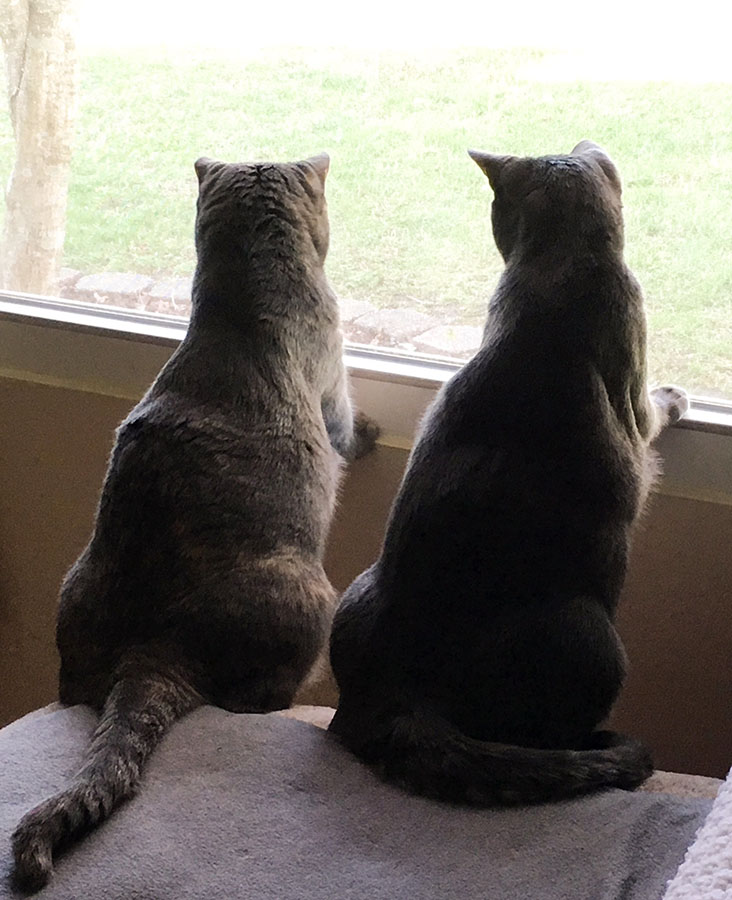
Two cats are silhouetted in front of a screened window. Both cats have their backs to the camera and are looking with interest at something outside the window. Grass is visible outside.

FCoV and COVID-19 are only distantly related, but all coronaviruses share the genetic instability that comes from having a single-stranded RNA genome. Yes, coronaviruses have a unique mechanism for some stability, but this mechanism can’t completely compensate for the instability that leads to mutations.

A vague measure of the instability of FCoV can be seen in the incidence of FIP in cats around the world. Because each case (or cluster of cases) of FIP represents an FCoV quasispecies that has newly acquired one or more of the mutations that enable FIP.

Remember those word problems in math class?

  1. Think about how many kittens and young cats there are in the world. (While no one counts the number of kittens born each year, the ASPCA estimates that 3.2 million cats enter US animal shelters each year…)
  2. Narrow the number down to all the kittens and young cats in shelters and multi-cat environments, each year. (Hint: That’s still so very many cats.)
  3. Between 60% and 90% of the cats in shelters or in multi-cat environments will, at some point, become infected with FCoV.
  4. Calculate a number that would be between 1% and 12% of FCoV-infected kittens and young cats.

That’s how many cats will develop FIP each year.

According to the internal mutation theory, that’s how many times FCoV mutates, each year, into a form capable of causing FIP in a cat that is incapable of resisting FIP. (To determine the exact number of times FCoV mutates into a form capable of causing FIP, add the times such mutations occur in a resistant cat.)

As a word problem, the math itself is not too complicated. The scope of the problem is obvious, even without exact numbers.

Limiting the emergence of variants is the point

The incidence of FIP represents a direct measure of how often one specific group of FCoV variants emerge in cats. Each case (or cluster of cases) of FIP represents a newly mutated variant of FCoV that is newly capable of causing FIP. And FIP is not rare.

I’ve spent the last year lecturing my family and friends and cats about the mutation rate of FCoV, pleading for everyone to do as much as possible to limit COVID-19’s infection cycles.

Yes, it’s true that FCoV and COVID-19 are only distantly related. (Metaphorically, about as distantly related as domestic cats are to bobcats.) But if the mutation rate of COVID-19 is even a fraction of what is seen with FCoV, the risk of new variants surges with each surge of infections.

While it is scientifically inaccurate and somewhat irresponsible to claim that more dangerous COVID-19 variants are inevitable if infections continue, it is equally inaccurate and irresponsible to claim that more dangerous variants are impossible. This, also, is the point.

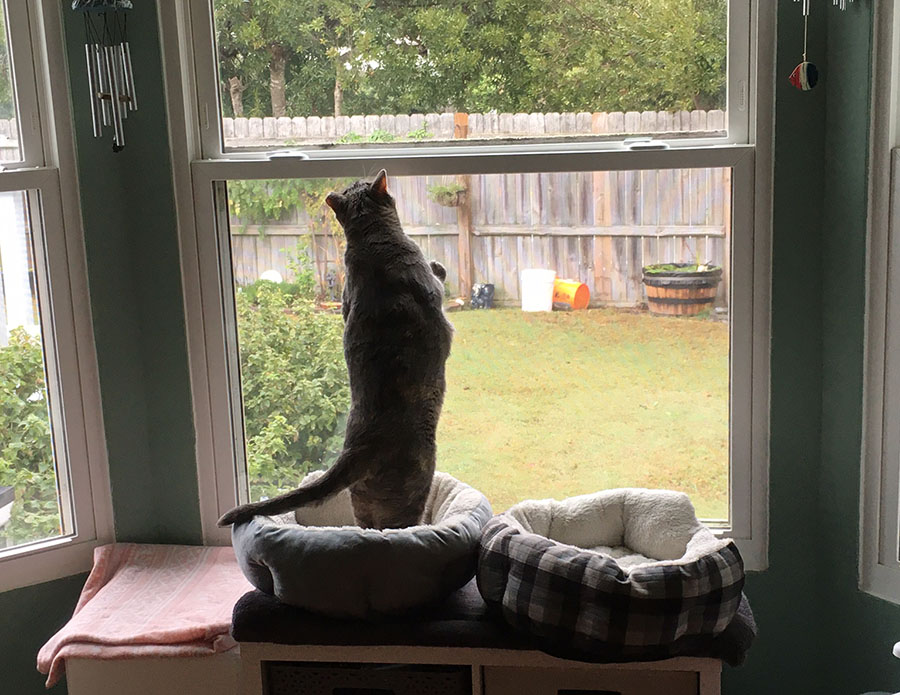
A slightly overweight cat (sorry, Duchess, but it's true) is standing on her hind legs with her front feet braced against a closed window. She is silhouetted, and grass, shrubbery, and a wooden fence are visible outside.

P.S. Marie and Duchess (Dutch) would like me to add that they are very good listeners, all the time. It’s just that they prefer listening to things other than my voice.


References:

Addie, D., Belák, S., Boucraut-Baralon, C. Egberink, H., Frymus, T., Gruffydd-Jones, T., Hartmann, K., Hosie, M. J., Lloret, A., Lutz, H., Marsilio, F., Pennisi, M. G., Radford, A. D., Thiry, E., Truyen, U., & Horzinek, M. C. (2009). Feline infectious peritonitis: ABCD guidelines on prevention and management. Journal of Feline Medicine and Surgery 11, 594-604. doi: 10.1016/j.jfms.2009.05.08

Coronaviridae Study Group of the International Committee on Taxonomy of Viruses (2020). The species Severe acute respiratory syndrome-related coronavirus: classifying 2019-nCoV and naming it SARS-CoV-2. Nature Microbiology 5, 536-544. https://doi.org/10.1038/s41564-020-0695-z

Decaro, N. & Lorusso, A. (2020). Novel human coronaviruses (SARS-CoV-2): A lesson from animal coronaviruses. Veterinary Microbiology 244(2020). 1-18. doi: 10.1016/j.vetmic.2020.108693

Emmler, L., Felten, S., Matiasek, K., Balzer, H.-J., Pantchev, N., Leutenegger, C., & Hartmann, K. (2020) Feline coronavirus with and without spike gene mutations detected by real-time RT-PCRs in cats with feline infectious peritonitis. Journal of Feline Medicine and Surgery 22(8). 791-799. doi: 10.1177/1098612X19886671

Kipar, A. & Meli, M. L. (2014). Feline infectious peritonitis: Still an enigma? Veterinary Pathology 51(2). 505-526. doi: 10.1177/0300985814522077

Pedersen, N. C. (2009). A review of feline infectious peritonitis virus infection: 1963-2008. Journal of Feline Medicine and Surgery 11. 225-258. doi: 10.1016/j.jfms.2008.09.008.

Pedersen, N. C., Liu, H., Scarlett, J., Leutenegger, C. M., Golovko, L., Kennedy, H., & Kamal, F. M. (2012). Feline infectious peritonitis: Role of the feline coronavirus 3c gene in intestinal tropism and pathogenicity based upon isolates from resident and adopted shelter cats. Virus Research 165, 17-28. doi: 10.1016/j.virusres.2011.12.020

Robson, F., Khan, K. S., Le, T. K., Paris, C., Demirbag, S., Barfuss, P., Rocchi, P., & Ng, W.-L. (2020). Coronavirus RNA proofreading: Molecular basis and therapeutic targeting. Molecular Cell 79, 710-727. https://doi.org/10.1016/j.molcel.2020.07.027

Anaxyrus (formerly Bufo)*

Toad May 2

Early in May I found this little toad while I was mowing. After taking a few photos, I helped it into a flower bed and continued mowing, planning out a blog post as I made circuit after circuit around the yard.

I thought it would be a fun exercise to identify my toad. In the past, I’ve had good luck identifying reptiles and amphibians using the information provided on the Virginia Herpetological Society’s website, so I started there.

Have a look at this page from the website, which outlines the anatomy of a toad’s head, particularly the cranial crests, postorbital ridges, and parotid glands. The next page illustrates how these structures help identify three of the six species of toads found in Virginia.

Based on a visible (but not prominent) cranial crest, I narrowed the list of possibilities to either an Eastern American Toad or a Fowler’s Toad. But the pertinent detail for separating these two species, whether or not the postorbital ridge contacts the parotid gland, was not discernible. Falling back on secondary characteristics, I spent some time counting the number of warts in each of the toad’s spots. One or two warts per spot indicates an Eastern American Toad, while Fowler’s Toads have three or more. My toad had one or two in most of its spots, but three in a few. Since the two species are known to hybridize, was this inconsistency enough to identify my toad as a hybrid?

Two of the other listed characteristics aren’t visible in my photos. I can’t say whether my toad had spots on its chest and abdomen, nor if it had any enlarged warts on its tibia. (No enlarged warts are visible in my photos, but the photos do not show the full length of both tibias.)

Having exhausted my vague knowledge of toad anatomy, but still without a definite identification, I was curious as to whether an expert might have better luck. I sent my photos to the Virginia Herpetological Society’s e-mail identification resource, and their prompt response said my toad was likely a Fowler’s Toad. But they added a note: “Toad ID can be a bit tricky…”

Toad May 2

* In the last decade, genetic findings have shaken up the world of toad nomenclature. One of the changes removed some North American toads from the genus Bufo and shifted them into a new group with an old name, Anaxyrus. This article provides a good overview. So, for most of my Virginia toads, Bufo has been reduced to a parenthetical:  Anaxyrus (formerly Bufo). I feel a bit bereft, as Bufo was one of the few genus names I had bothered to memorize, but I suppose Anaxyrus is easy enough to remember. Except, I’m not quite certain why I would ever need to remember the genus names of North American toads…