This multi-part blog post contains references to the hunting, agriculture, and research practices of killing birds. This particular installment contains references to hunting other prey and killing chickens from a backyard flock. If you decide not to read on, I respect and admire your choice.
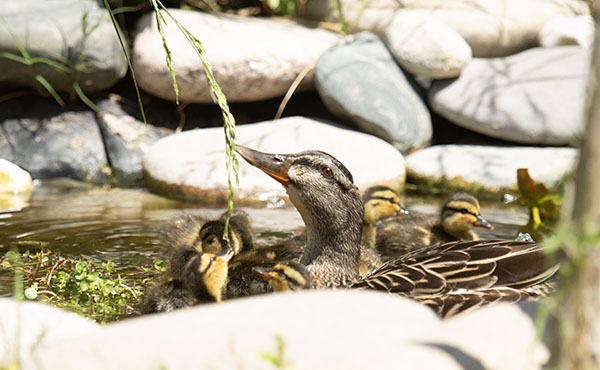
Photograph of five Mallard ducklings resting on the stone border of our dragonfly pond. Four of the ducklings are settled in and nodding off, while the fifth is still standing and fidgeting.
Livestock are living stock. And sometimes pets.
Until they are not.
Growing up in rural Tennessee, I had daily exposure to food chain realities. Our freezers (we had two) were stocked with meat from assorted livestock we raised. Livestock we loved. Chickens and cows, during my memory years, with vague early memories of pigs.
A 1970s-era photo of four “banties” (bantams), dainty chickens with variously fancy topknots, roaming free in our yard.
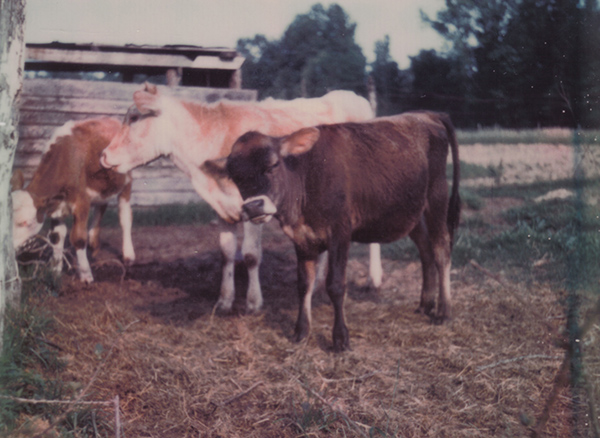
A 1970s-era photograph of three young cows standing near a fence line with pasture and woods in the background.
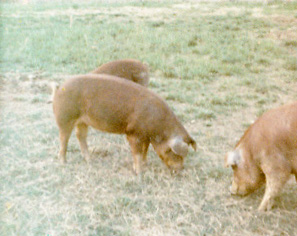
A 1970s-era photo of three red pigs grazing a patch of short pasture grass.
Our chickens and cows and pigs had individual names and individual personalities. We raised them and cared for them and loved them. But food chain reality means that livestock exists to be eaten. No matter how cherished. No matter how tame.
Yet another 1970s-era photograph from the family archive. Here, a red-and-white Hereford cow stands over her very young calf. The calf is curled up on the ground, sleepy eyes and ears drooping.
Off to slaughter
Our cows and pigs were slaughtered and processed by local-ish butchers, but Mother slaughtered our chickens with a hatchet. Then she cleaned and portioned their carcasses while I collected and bagged bloody feathers.
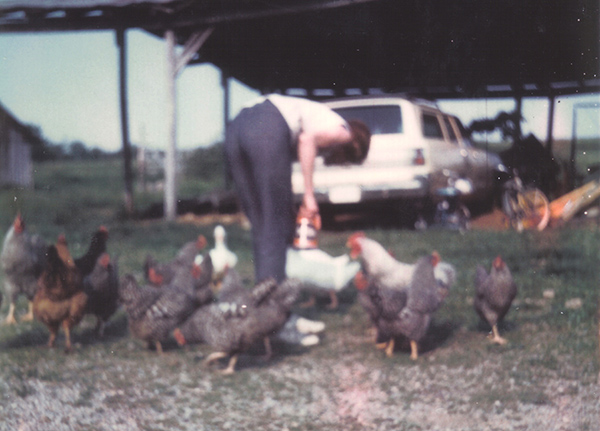
In this 1970s-era photograph, Mother is feeding our small flock of chickens and ducks. At the moment this photo was snapped, Mother was bent over, using her free hand to enforce order. If photos came with sound, you would hear her scolding the greedy birds and coaxing the shy ones.1
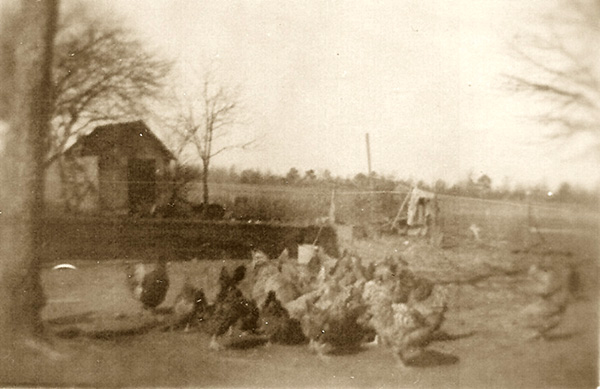
In reviewing family archives for this post, I was struck by how similar the above scene is to a photo from the early 1900s, found in our maternal grandmother’s album. There was clearly something generational going on at our table.
Early 1900s-era photograph of some twenty chickens foraging in a bare yard with farm equipment, fences, and an outbuilding in the background.
Wildlife can also be living stock, to a hunter
Small and sundry prey
In addition to eating chicken, beef, and pork raised on our property, we sometimes ate squirrels and rabbits shot by my father and brothers. It’s possible that our beagles sometimes helped on these hunts. (It’s more likely that our beagles hindered these hunts.)
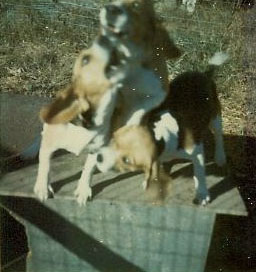
A 1970s-era photo of three naughty beagles play-fighting on top of a doghouse.
I helped skin and clean the squirrels and rabbits, and I remember being fascinated by their soft fur. I also remember Mother muttering and tsking while she cooked squirrel and rabbit meals. She breaded and fried the meat, and served barely edible, extremely tough portions with open disdain.
I developed a lasting case of meat snobbery, rooted in Mother’s disdain. Squirrels and rabbits were in the lowest edibility tier. Nothing lower was served. No frog legs. No snake, turtle, or alligator meat. No opossums.
Something generational was going on at our table there, too, but in the opposite sense of backyard flocks. Mother preserved her family’s tradition of raising chickens for slaughter, but put a permanent end to the family tradition of opossum hunting. (Scroll quickly if you don’t care to see a sepia-toned group of early 1900s ancestors showing off a bunch of dead, dying, or faking-death opossums, along with the dogs that facilitated the hunt.)
In my grandmother’s album, this photo is labelled “The morning after our great Opposum hunt. ‘We won’t forget’.”
That’s my grandmother, second from the left, one hand behind her back and the other hand dangling an opossum for the camera. This particular hunt (it wasn’t the only time the family hunted and ate opossums) was special because one of the cousins (Sarah Harrison, standing on the far left) had come to visit.
This photo was in a great aunt’s album. The photo is labelled: “Sarah Harrison / Popman’s cousin / ‘the Possum hunt’ “2
I should add that Mother’s disdain was not coherently taxonomic. Reptiles, amphibians, and insects were off the menu, but so were ducks, geese, and goats. Which meant some of our livestock were exempt from slaughter. What’s more, “dairy” came from cows and cows exclusively. There’s no logic here, only family and cultural tradition.
Cue any stand-up comic mocking a southern drawl. For that matter, cue any bully standing in their own tradition, mocking other traditions.
Photograph of a white-tailed deer trotting beside a paved path at Back Bay National Wildlife Refuge. In my southern-Tennessee lexicon, “venison” very specifically refers to deer meat. I only learned in my middle-age that the word “venison” has different and wider definitions in different cultures.
In my late teen and early adult years, my oldest sister’s boyfriend often gifted us venison. I was particularly fond of what I called “Bambi roast” and “Bambi spaghetti”. Bambi, it seems, ranked high in my edible-mammal hierarchy. A bit below pet chickens and cows, but certainly above squirrels and rabbits. Which were at least on the list. Unlike opossums.
Here in my middle years, my childhood memories of skinning squirrels and rabbits seem dreamlike. As if those skinny arms and small hands weren’t my own. After all, any brief stroll through my blog history will find some tender post about squirrel and rabbit nests. I cringe, extra, thinking about any of the yard’s visitors heading into a hunter’s sights, then into a frying pan or stew pot.
Yes, Mallard babies. I’m talking about you. I’m aching to protect you.
But I didn’t always equate animals, my own pets and livestock in particular, with the meat on my table.
Further aside… so many eggs
Gathering the eggs
On mornings when my oldest sister was too tired or busy or sick to tend the chickens, I was roused and sent in her place. I remember egg gathering as sleepy, smelly, spidery work. Early morning work. (I’ve never been an early morning kind of girl.)
Egg gathering meant wrestling the chicken pen latch, which grew tighter each year as the posts and gate warped. Then I had to put down my bucket—to unclip the rusty chicken house latch and heave the rickety door over hills of weeds, dirt, and dung—and usually had two or three hens perched in my hair and on my shoulders by the time I bent to retrieve the bucket. Finally, I would stumble over the plank sill into the warm, dimly lit interior.
(Yes, I always stumbled. My severe astigmatism couldn’t navigate the sudden change from light to dark, and the hens dashed in and out through the door in frenzied delight.)
Our chicken house was closer in size to a closet than a house. I don’t have any chicken pen/chicken house photos to share, but almost any wire pen around almost any vine-covered tin-roof-and-plank outbuilding would be an accurate visual.
Veils of cobweb hung from the low rafters. Snakes, flies, wasps, spiders, and light entered and exited through gaps in the walls and roof. A short row of nest boxes lined one wall. The floor was dirt, feathers, dung, and broken shells. The chicken house smelled strongly of chickens and dust, but also of cat urine (from our army of yard cats) and dog feces (from the adjoining dog pen) and, every so often, of predators.3
Shooing hens from their nests, or reaching beneath those who refused to be shooed, I gathered eggs by touch more than sight. (It’s not as easy as it sounds. Our hens didn’t give up their eggs willingly, especially to the tentative little sister of their usual egg-gatherer. Wing slaps left bruises, and claws and beaks drew blood.)
The warm, sticky, tough-shelled eggs that I gathered didn’t feel like they held nascent chicks and ducklings.
A 1980s-era photograph of a red hen and her brood of eleven(ish) striped chicks, all safely enclosed in one of our wood-and-chicken-wire coops.
Breaking the eggs
Our father began leaving during my pre-teen years. He sold the cows, let the fences lay where they fell, and stopped shoring up the barn and sheds. After he finished leaving, neglect cascaded into decay. Vines pulled down the chicken house and the gate fell off the pen.
Both pre- and post-chicken house era, egg gathering mistakes were inevitable. In the chaos of the crowded, rickety henhouse, broody laying hens stole eggs from the adjacent nests of setting hens. Predators and predator alarms rolled and bounced eggs between nest boxes. An egg laid by a setter a week or more ago, carefully incubated since, might end up alone in a layer’s nest. An egg laid by a layer last night might end up in a two-weeks-along setter’s nest.
After our flocks were entirely free-roaming, they hid their nests so well that eggs were often days old before being found. Eventually, increasing incidences of “bad eggs”, coupled with decreasing egg demand as siblings moved out, halted all egg collecting.
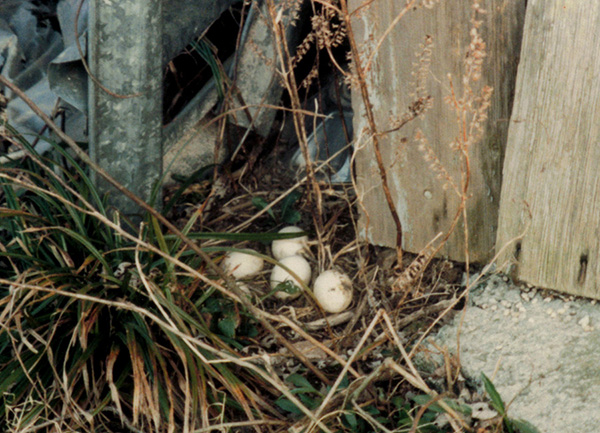
Photograph of five eggs, probably duck eggs, in a nest on the ground. This nest was tucked between an unused livestock gate and the outer corner of a shed.
The term “bad eggs” most obviously referred to rotting or rotten eggs. The kind that burst on their own or floated in water. But “bad eggs” also encompassed fertilized eggs that were mistakenly collected mid-incubation.
When an incomplete carcass, some mid-development stage of a chick or duckling, spilled from an egg I had cracked, I writhed with regret. It happened often enough, in my early years, that I still crack eggs into a separate bowl when cooking.
After our egg-collecting years ended, our increasingly feral flock was left to hatch and raise what young they could in whatever nests they chose.
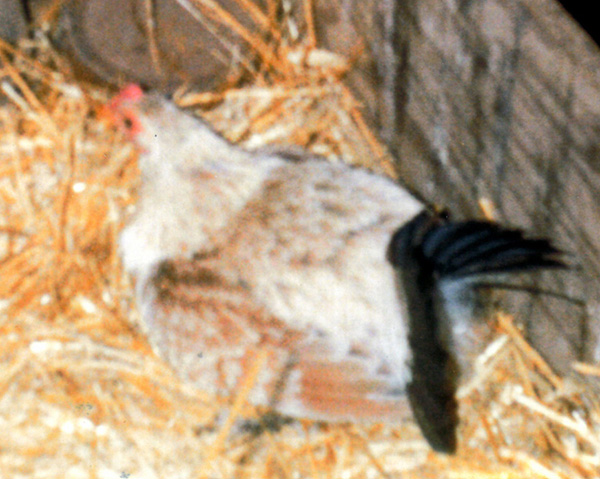
A late 1980s photo of a game hen (conveniently named “Game Hen”) sitting a nest of eggs in a straw-lined box.
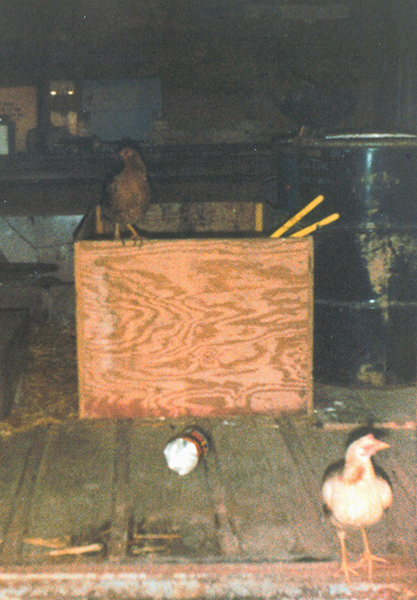
A late 1980s view inside the “trailer” (a dilapidated, out-of-service livestock trailer that we treated as a bonus shed for feed storage). The massive wooden open-topped box/crate (center frame) once held bales of straw, so it was lined with broken bales.Inside this box, in the right back corner, was Game Hen’s nest.
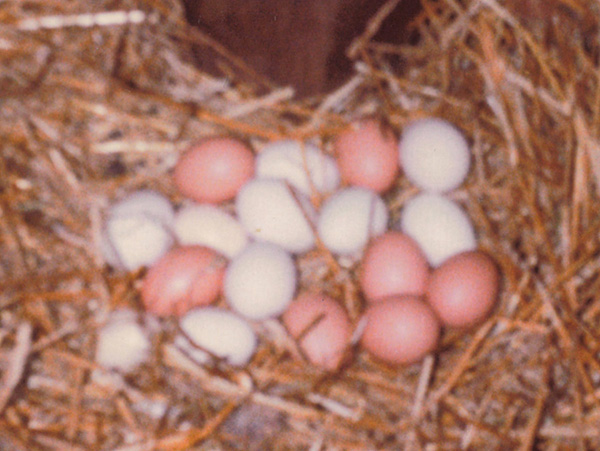
The same late 1980s nest, photographed after bribing Game Hen with feed. Heaped in the nest are 11 white eggs and 7 brown eggs. The hens literally shared prime nesting spots.
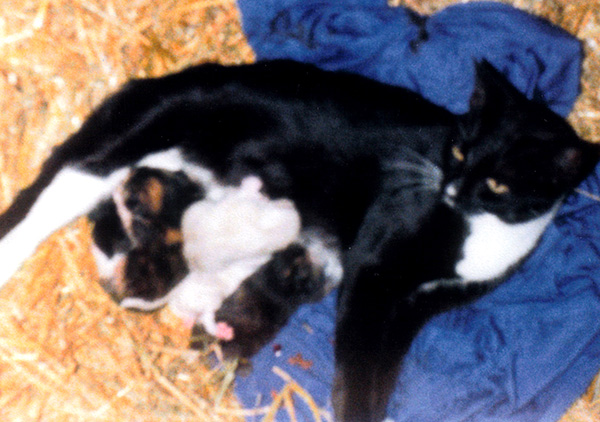
Another late 1980s-era photograph, taken in the exact same spot in the trailer’s box of straw as the above nest photos. This is my cat Mischief nursing a newborn litter of five beautiful kittens. Two of these kittens will reappear later in this post, in a photo taken after they were grown.
Growing up in rural Tennessee, eating the animals and dissociating
While my egg-mistake memories are mostly visual, wetly curled bodies in a puddle of albumin, my memories of chicken, squirrel, and rabbit carcasses are sticky with remorse and smell like blood, grease, and guilt left out in the sun.
But expressing regret, remorse, or guilt at the table was forbidden. So was refusing to eat what was served. I don’t remember being told these rules, nor do I remember hearing these rules explained to my siblings. For that matter, I don’t remember learning these rules.
It is this lack of learning, this full memory cache with no record of creation, that warrants using the word “dissociated”. As a girl growing up in rural Tennessee, I dissociated from the eggs and meat on our table.
I coped with my forbidden regret, remorse, and guilt by inventing a private delusion, by defining eggs and meat as a different form of matter than living animals.
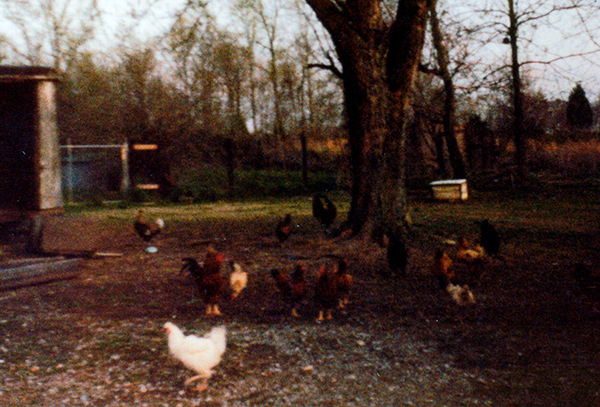
Mid-1980s photograph of our mostly free-roaming flock. We wouldn’t have eaten many of their eggs, in their later years, and their tough old carcasses would have been among the last added to the freezer. The trailer is visible to the left, with the dog pen behind it. The derelict chicken pen is hidden in the far center background, behind the row of saplings and shrub-like weeds.
Depression on top of dissociation
The photo immediately below is more metaphor than image. The worn paint and sagging shingles on our house and concrete-block wellhouse, the decaying barn-remnants to the far right, the unkempt pasture and yard, and the overgrowth marking downed fences. All of these illustrate the state of our dysfunctional household during my teen and young adult years.
A late 1980s- or early 1990s-era photo taken in the back yard. Perched atop our concrete block wellhouse, two cats and a red hen are waiting to be fed. The cats, Annie (right, tortoiseshell colored) and Gizmo (left, ragdoll marked) grew up out of the exact trailer-straw litter pictured above. The hen, whose name I’ve lost to time, was one of Game Hen’s daughters.
The hungry cats and hen on the wellhouse roof, waiting for a meal of table scraps and cheap kibble, are confusion, sorrow, and loneliness. This was the era of boyfriend venison and day-old bread. Of freezers stocked from clearance ads. Of oldest sister tending the garden in the dark of too-early mornings and too-late evenings because she was working three jobs while going to college.
We no longer ate the livestock we raised and loved, but clearance-case chicken and ground beef added a new facet to my dissociation. Grocery eggs and meat were always cold and bloodless, had never been embodied in the yard. And I had learned what it meant to be hungry.
Re-associating, for health reasons
Or, “Thanks for the genes, Dad”
My father died of heart disease at the age of 52. I was mid-teens, and he seemed so old. But he wasn’t old. I am, currently, older than 52.
I don’t feel so old.
I like being me, and I would like to continue being me for some good long number of years past 52.
Perseverating on 52
One of the ways I’ve packaged and carried grief is a fixation on 52nd birthdays. As each of my four older siblings passed 52, I breathed a bit easier. Long before I reached 52, I began researching and planning. Partly because of the grief fixation, but also because my cholesterol levels have been alarming physicians since I was a teen.
Note to father: Next time, maybe try leaving us money, instead.
Statins and exercise are no match for my father’s genes. My last resort for living past 52 was a complete overhaul of my diet. (I should have started there, but I’m a silly human with silly human habits.)
Call it plant based. Call it vegetarian. Call it desperation.
An unexpected side-effect of my diet overhaul has been re-associating with animal protein. My health ambitions were easier to realize when I reminded myself that pork is slaughtered pigs. That beef is slaughtered cows. That chicken is slaughtered chickens. That grocery eggs come from hens housed in industry conditions, not back yards.
Without my dad’s cholesterol, I would probably still perceive meat and living stock as unrelated forms of matter.
Enter the Mallards
Timing is everything, and my various perspectives and journeys are not random. If you are still reading, you might be starting to see a signal. Or not.
What looks like signal to me likely looks like noise to others.
Perhaps in a later post I’ll explain how a literature search through the history of prion testing catalyzed an ongoing reaction between a brood of suburban ducklings, a fetish-level case of nostalgia, a dysfunctional family history, and a stubborn set of lipid genes, resulting in this multi-part Mallard post.
In this photo from the spring of 2024, a female Mallard duck shows her brood how to eat grass seeds from a seedhead dangling over the dragonfly pond.
For the present, I’m a recovering carnivore lured to herbivory by a longing to live past 52. I grew up in a rural environment where the animal protein on our table came from our own yard, pasture, and woods. And I’ve known what it is to be hungry.
These perspectives matter, though it’s not entirely up to me to decide how they matter.
In the next episode…
Mallard hunting is big business.
Early 1900s photograph of a duck hunter holding a gun and two dead Mallards. This photograph was scanned from a great aunt’s photo album. The hunter’s name was Harry Kenyon. I do not know who he was or how his image landed in my great aunt’s photo album.
1. Were she still alive, Mother would never consent to publication of this photo. The awkward pose, the awkward pants, the cluttered background. But I was always one of her greedy chicks, always scolded and shooed with her free hand. Wherever she is, she’ll understand. She’ll complain, but she’ll understand. (Click here to return to your regularly scheduled photo caption.)
2. While I’m perfectly awful at recognizing genetic and cultural heritages based on peoples’ features and clothes, I recognize that this distant cousin doesn’t look or dress like my grandmother’s family. I would love to know more about her. (Click here to return to your regularly scheduled photo caption.)
I’ve carried this snippet of rhyme my entire life. The rhyme was embossed on a sign in our pediatrician’s office in Huntsville [Alabama], illustrated with two cherubic children, plump and pink-cheeked and aggressively binary.
What are little boys made of?
Snakes and snails and puppy dog tails
That's what little boys are made of

What are little girls made of?
Sugar and spice and everything nice
That's what little girls are made of
I despised this rhyme. Little boys got all the fun stuff, and I knew, for certain, that sugar and spice and everything nice were NOT what I was made of.1
Photo of me at some early elementary school age, posing for one of my oldest sister’s “Rae with Pets” series. Here I’m showing off our first goat, Sandy, a reddish-brown nanny with a short beard and curved horns.
In this blurry middle-school addition to the “Rae with Pets” series, I’m holding one of our red hens. Mother had forced me into a short haircut, for school, because burrs, ticks, and tangles didn’t flatter our household. When I confessed my longing for a feathered Charlie’s Angels look, Mother countered that Farrah Fawcett did not keep “rat nests” in her hair.
Commuters in paradise
We moved from Huntsville to Fayetteville, Tennessee, when I was three years old. I have no reliable memories of being a city kid, of the house Chapman Street where my siblings had friends next door and walked to school. My memories are 20-odd patchwork acres of fields, woods, pens, and sheds. There was an old barn and an older house, and, by the time I was old enough for memories, there were animals everywhere.
Another “Rae with Pets” photo.2 This time I’m posing with my brother’s beagle, Fella. A small white hen and a large reddish-yellow rooster have wandered into the frame, along with one of our shepherds in the background.
My memories are also long, diesel-fumed bus rides to and from school, longer drives to the grocery, and longer-yet drives to Huntsville. Because, while our parents moved our household to Tennessee, they never really left Alabama.
The tradition of commuting to Huntsville permeated our life. My oldest brother, 13+ years older than me, finished high school as a commuter student in Huntsville.3 Our father commuted to his bookkeeping and financial analyst jobs for a succession of space industry corporations in Huntsville. We commuted to dog training classes, company picnics, shopping excursions, and dental appointments. And, every time someone got sick, we commuted to the pediatrician’s office.
With five kids spanning the entire realm of K-12, we got sick a lot.
Photo of Mother’s hatchback Toyota Corolla, which logged more than 200 thousand miles before its odometer broke. Before the Corolla there was a maroon Buick Skylark and a classic two-toned station wagon (and probably more I don’t remember). All the cars smelled like migraines, like hot plastic and Mother’s perfume with notes of mildew, ragweed, and gasoline.
I always arrived at the pediatrician in the grip of fever, nausea, and a miserable headache induced by mother’s perfume, a 1970s favorite called Charlie. (Mother “got dressed” for trips to the pediatrician. Thus, Charlie.) The drive took about forty-five minutes each way, long enough to make me car sick on top of whatever ailment prompted the commute.4
And there, in the pediatrician’s office, were those insipid caricatures of binary gender. The little boys, with permission to own everything fun in the world. And the little girls, who owned only dresses and aprons and recipes.
Have mercy.
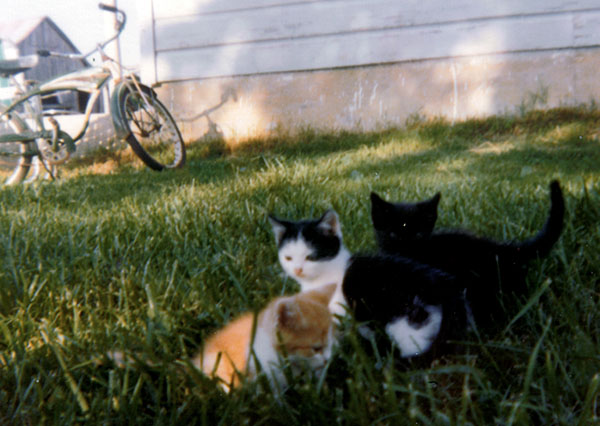
Photo of three very young kittens–one black-and-white, one ginger-and-white, one solid black–huddled together in our front yard. Unless Mother explicitly declared it otherwise, every kitten and cat on our property was mine, mine, mine. Mine to love and spoil and carry in my pockets or down my shirt front or on my shoulder and in my hair. Mine to name and cry over when they were sent away to other homes or died in one of the many tragedies that claim kittens’ lives in rural Tennessee. (The green bicycle in the background was a hand-me-down affair that I was allowed to ride but not own. I can still hear, today, the rattle of its loose fenders and kickstand as I wheezed up and down our gravel driveway.)
Owning too much and too little
Our household was a manifestation of parental dissonance. Mother lived as if entrenched in poverty, while Daddy lived as if money came easy. Both had their reasons.
Daddy worked hard and liked investing in the things he enjoyed. He was a master marksman who bought and sold custom-sighted guns.5 We had aquariums in every room, a citizens’ band radio (CB) in every car, a Pong game, and an Atari. These photos exist because we had cameras, film, and an account with the processing lab. Daddy also collected purebred dogs and carried us to obedience trials, most weekends, so the dogs could earn titles. We had beagles, Shetland sheepdogs, German shepherds, and a collie. My oldest sister had a teacup toy poodle. My middle sister had a Siberian husky.6
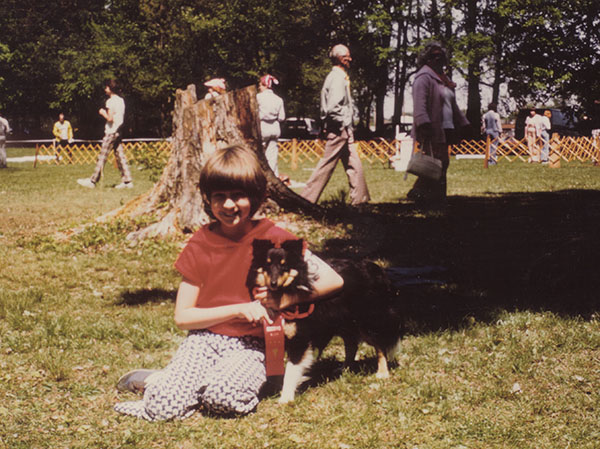
Photo of elementary-school me hugging my father’s Shetland sheepdog, Chisterling’s Dixie Clipper (aka BlackJack or BJ), at a 1970s-era outdoor dog show. I’m sporting a bowl-like haircut and home-sewn clothes: a red hooded shirt and houndstooth-patterned pants. BJ’s red leash matches my red shirt and the red second-place ribbon he earned.7
Mother worked hard, too, scrimping and saving and stretching each penny thin. She fed us from the garden, chicken house, and pasture: eggs and tomatoes, okra and beans, chickens she killed and cleaned and plucked, beef Daddy carried to the butcher. She also fed us squirrels and rabbits, when Daddy and/or our brothers hunted, and free government cheese and butter. We had two freezers full of ice-crusted mysteries in tin foil and plastic. She sewed the vast majority of our clothes from clearance bolts of fabric and carefully preserved Simplicity patterns, tsking over mentions of name brands and tutting over complaints about uncomfortably tight cuts that saved precious inches of material.
In short, I grew up in a household of competing parental personalities that reinforced the pediatrician’s binary rhyme, surrounded by Daddy’s largesse and Mother’s frugal home-making.
There was a singular exception to the tension. Both of our parents loved books and vinyl albums, so much so that we had shelves and shelves and shelves, in every room. (We went to the library a lot, but also to used book stores and the sale racks at record shops.)
Photo of elementary-aged me sitting on the floor of the bedroom I shared with my middle sister until our second-oldest brother moved out. I’m petting Daddy’s favorite sheltie, Mac’s Best of Love (aka Bess). The background is cluttered with bunk beds and metal shelving piled high with board games, books, and vinyl story albums.
Thereby Hangs a Tale
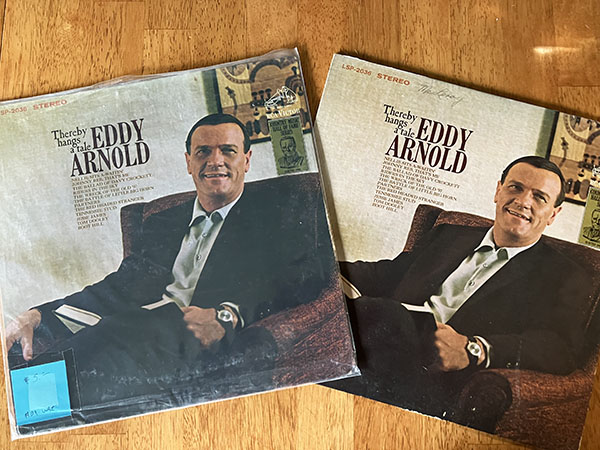
My favorite album was and still is Eddy Arnold’s Thereby Hangs a Tale. And, when I was in fifth grade, my love for Eddy Arnold sparked a battle with the pediatrician’s rhyme.
My fifth grade teacher decided our classroom theme, for that year’s Harvest Festival, would be Urban Cowboy. A genuine faux honky-tonk. For a small fee, parents and other visitors to the Harvest Festival could admire our straw bale decorations, enter a raffle to win a real calf (which was penned into a corner of the classroom), and enjoy the spectacle of kids in country-and-western costumes lip syncing our favorite songs.
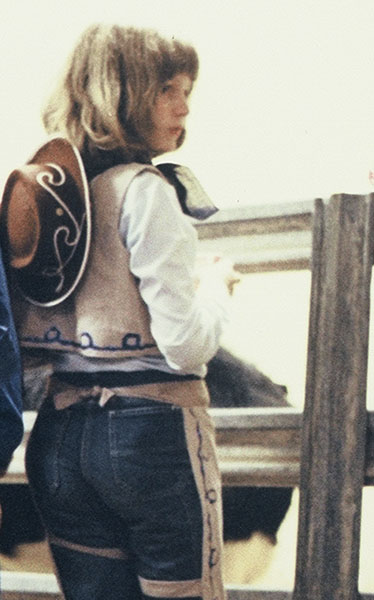
Photo of fifth-grade me coveting a half-grown Holstein calf that was penned in a corner of our classroom during Harvest Festival. I’m wearing costume vest and chaps (which Mother had made, some years earlier, for my middle sister) over jeans and a white shirt I had already outgrown. A small felt costume cowboy hat hangs on my back.
When the theme was introduced, I knew EXACTLY which song I would perform. Eddy Arnold’s version of Ghost Riders in the Sky. Who needs three Christmas ghosts when you can have a herd of the devil’s cows, chased by the Inferno’s cowboys? I knew every nuance of that song, every change of minor key. It was bound to be a crowd pleaser. (If you haven’t heard it, get thee hence to the internet and listen. I’ll wait…)
Back already? Okay, on with my tale…
The combined and somewhat horrified NO! from Mother and my teacher stopped me short. But okay, if they thought the ghost riders were too much horror for the room, how about the location-friendly Tennessee Stud, from the same album? Nope.
Eddy Arnold’s voice was a man’s voice. I was a girl.
But I wouldn’t actually be singing, so why did the voice matter? Even if I bowed to Mother’s choice and went with Teresa Brewer, surely no one in the audience would think I actually sang like Teresa Brewer? The conversation turned hostile at that point, on all sides. I declared it was Eddy Arnold or nothing. Mother declared it was Teresa Brewer or else. My teacher declared he had better things to do than explain to me what should already be obvious.
I wasn’t even allowed to resign with my dignity intact, to join my classmates who had opted out of performing. Mother knotted me into my sister’s too-small costume and yanked me up hard when I dared complain, again, about the injustice of it all.
Photo of fifth-grade me doing my best to avoid Mother’s ire as I lip sync Teresa Brewer’s Music! Music! Music!. My most prominent memories from the night are that my clothes were too tight, my sister was mad because I wore her costume, and Mother wanted me to stay within arm’s reach in case I needed another physical reminder that I was a kid and she was an adult. (I did, in fact, receive a number of these reminders as the night wore on. Whether I needed them or not remains up for discussion.)
Memories being what they are, this retelling isn’t accurate. But it’s accurate enough, because the memory isn’t the point. The ensuing years are the point, the escalating Mother-Daughter War. All of the mutual disdain and despair over my clothes and my hair and my aspirations and my hard-headed determination to shun the sugar and spice, the everything nice I was meant to embody, in favor of the snakes and snails and puppy dog tails that were reserved for boys.
Photo of a cottonmouth snake (aka water moccasin). This zoom photo of the cottonmouth’s head shows its vertical “cat’s eye” pupil and heat-sensing pit (between eye and nostril). As a snake-loving girl I learned to spot these distinctive signs of the pit viper family, venomous snakes that shared the habitats I enjoyed exploring. This photo was taken in 2021 at Back Bay Wildlife Refuge, because I still enjoy exploring habitats shared by snakes.
In the part of me that cherishes Mother’s memory, I sympathize with her quest to pave me a feminine path in the world. In the part of me that still chafes from the strain, I regret the energy she invested in shoving me toward her ideal of feminine, while I defiantly shoved back. It was exhausting for both of us.
All because I was assigned female at birth
When it comes to gender, doctors get to make the call. As Kate Bornstein explains:
In most cultures, we’re assigned a gender at birth–and once you’ve been assigned a gender, that’s what you are and always will be. For the most part, it’s doctors who dole out the gender assignments, which shows you how emphatically gender has been medicalized. These doctors look down at a newly born infant and say, ‘It has a penis, it’s a boy.’ Or they say, ‘It doesn’t have a penis, it’s a girl.’ It has little or nothing to do with vulvas or vaginas, let alone DNA, hormones, or dozens of other nuances of biological sex. It’s all penises or no penises: gender assignment is both phallocentric and genital. Other cultures are not or have not been so rigid.
Kate Bornstein in Gender Outlaw: On Men, Women, and the Rest of Us (Chapter 4, Section 2, paragraph 1)
I was assigned female at birth, and I was pretty much okay with that assignment, on the surface. At least, I didn’t question or resent what being female meant about my body.8 What I questioned and resented were the societal (and maternal) expectations around my gender, the insistence that sugar and spice and everything nice should be all I needed or wanted to be.
Have mercy, indeed.
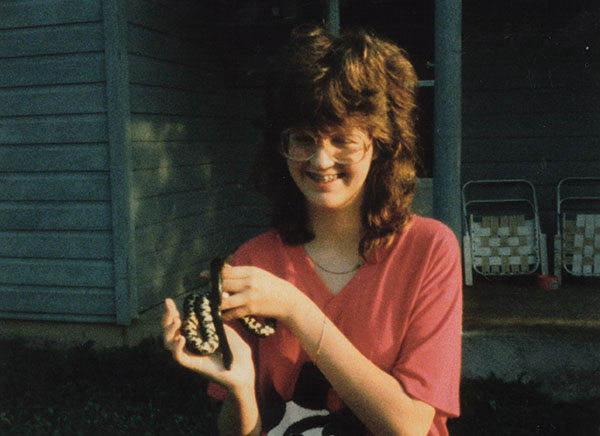
Photo of me as an awkward teenager with a vague hairstyle featuring short, feathered bangs and sides and mullet-like length in the back. I had huge glasses and orthodontic braces. I’m wearing that summer’s favorite long pink T-shirt, a dainty necklace and bracelet, and I’m showing off a king snake I had caught.
I wanted to be made of the tracks wildlife left in the woods. Of horses and goats and cows. Of kitten whiskers and, yes, puppy dog tails. Of snakes and salamanders, weeds and creeks, storms and katydids, stories and books. I read Henry and Ribsy and wanted to be Henry. I read The Black Stallion and wanted to be Alex. I read Where the Red Fern Grows and wanted a pair of hounds so badly I could feel their sleek presence in my dreams.
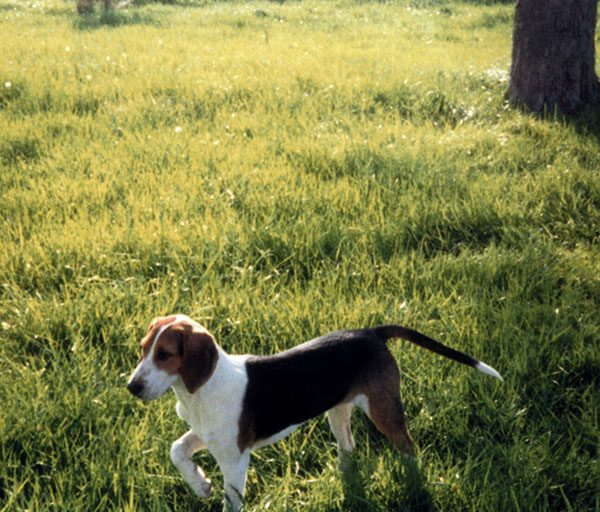
Photo of my foxhound Sarah. Sarah was the first dog I could call my very own. A friend gifted her to me from a beautiful litter of puppies. I was in college at the time, and I loved Sarah fiercely. I imagined, years ahead, taking her everywhere with me. She died before she was a year old, lost to a careless early morning moment when she got on the road.
Photo of college-age me with my Yorkshire Terrier, Angel. Here, both of us are fresh from cleaning up after some muddy excursion outside. A family friend had show dogs, and, after Sarah died, he gave me Angel. Around one year old at the time, Angel had not done well in shows. For many happy years, Angel did go everywhere with me, usually in my oversized purse.
But I also read The Witch of Blackbird Pond (I wanted to be both Kit and Hannah). And Nancy Drew (I wanted to be George). And the Dragonriders of Pern series (I wanted to be both Menolly and Jaxom). An obscure favorite called Horse in the House by William Corbin (I desperately wanted to be Melly). Even Mrs. Frisby and the Rats of NIMH (I wanted to be Izzy) hinted that female didn’t have to mean sugar and spice and everything nice.
Photo of young adult me, finally free of the Mother-Daughter Wars, with my pet rat Izzy riding on my shoulder. Izzy was a hooded rat, rescued from the feeder cage of a pet store for $1.50. She had an aquarium-cage in my room, but she liked to ride on my shoulder and play in my hair. It seems Mother was right all along. As soon as I achieved Farrah-length hair, I kept a rat nest in it.
And then I got a chance to define myself
As long as we lived in a stable household, the Mother-Daughter Wars slogged on. Even a few years longer, after the household deteriorated into instability and poverty (the exact poverty she had always anticipated, it seemed), battles would flare. Mother continued her siege of demand and reprimand. I continued my resistance of hide and defy. She told me that my sisters, at least, made the effort. She was correct. They did. I didn’t.
I don’t know how our war would have turned out, had the household remained stable. But our father left, remarried, refused to pay alimony, and changed the life insurance to his new wife’s name mere months before he died. I was fifteen when he died, when Mother caved to the grief that had plagued her since Daddy left and told me she was too tired to raise me anymore. If I needed anything, I should ask my older sisters, and if I didn’t need anything I should simply stay out of the way.
I had outlasted the siege. I was free to dash off into the woods in any spare moment, to read as much as I liked (and as late as I liked, tucked tight under as many cats and dogs as could fit on my bed), to cook and sew only well enough to suit myself, and to wear yesterday’s muddy torn clothes to school if I wanted. It was a lonely relief, but at least it was relief.
In fact, my affinity for snakes and snails and puppy dog tails proved useful.
After Mother shook off her grief and began building a new life, she resumed morning pet duty: putting the dogs into their pens each morning, feeding and watering while I dressed for school. Otherwise I took care of the outside pets. The dogs and I, and whatever cats felt like tagging along, went for long rambles each afternoon. I pulled burrs, brushed or cut out all of our matts, plucked ticks, and watched for signs of injuries or illness. I fed and watered each evening and escorted the dogs to their assigned crates at night. I chased the goats off of the cars and back into their pen, when they broke out or were released for an afternoon, and watched over deliveries of the twin and triplet baby goats that arrived each spring. I emptied and refilled the wading pools that our ducks and geese fouled each day.
Because I was outside anyway, I stacked wood and mowed the yard and helped my oldest sister in the garden. Wielding an old slingblade, I beat back tangles of honeysuckle and stands of ragweed that encroached on the yard. I carried snakes away from the porch, climbed the roof to clean the chimney, and braved the spidery attic to fetch and re-stash boxes. I liked best the dirty jobs, and Mother was content to let me do them. It turns out that, when there’s no man about, girls might need to be more than sugar and spice and everything nice.
Photo of college-age me with long untidy hair pulled back under a folded bandana. I’m at the kitchen counter, preparing a meal, and there’s a tortoiseshell kitten on my shoulder.
Between fifteen and twenty-three, I reveled in the freedom I had gained through loss. I graduated high school, and, when I gained control of my own bank account (where Mother had deposited every 4-H prize check I had ever earned) at age 18, I emptied the account to buy a $600 car from my oldest sister’s boyfriend. My middle sister gave me a few unenthusiastic driving lessons, and suddenly I could get myself back and forth to everywhere without begging a ride from sisters and friends. I talked the local veterinarian into hiring me, worked two additional part-time jobs, and did well enough in college to keep the full scholarship I had earned with high standardized test scores. (My test scores did not reflect any particular proficiency or aptitude. I simply had a knack for standardized tests, which played to my strengths of reading, creative puzzle solving in quiet rooms, and informed guesswork when encountering the unknown.)
Year by year, I grew up and moved on. When I finished my bachelor’s degree in biology, I faced a happy pair of choices: should I pursue my snakes and snails onto a biology research path, or should I follow the puppy dog tails into veterinary school? I chose the puppy dog tails. (I won’t claim to have never regretted that choice. Regret is one of my lifelong habits.)
The rhyme stayed with me
I lived in a dorm over the university veterinary clinics, in Knoxville, where I stayed too busy to stew over a childhood rhyme. But the rhyme still surfaced occasionally. Particularly when The Spice Girls were popular. Which was about the same time that I met my rescue tabby, Spice.
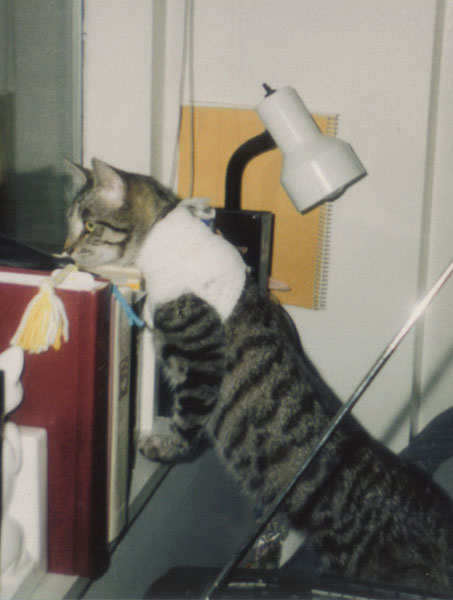
Photo of Spice in my dorm. She is standing, front feet braced on the long windowsill that doubled as a bookshelf, peering out of my window over the receiving area for the large animal clinic. She’s wearing a bandage over her shoulders, covering the scabs that prompted someone to drop her off at the small animal clinic as a wounded stray.
The older I got, the less I pondered that rhyme on the pediatrician’s wall. Until recent years. Now I find almost daily reminders of the Mother-Daughter War, of my escape through loss from Mother’s version of female tradition. Of my bittersweet dash away from the siege, toward a future filled with snakes and snails and puppy dog tails.
What if I was a kid again, today? That same kid? Would I be able to make the same escape? I worry that my escape was a fluke, a privileged path through a brief convergence of opportunities.9 I worry the future is closing, not opening. Especially for kids who experience a deeper unease, who yearn not just for the other side of the rhyme, but an altogether different definition of gender. I never questioned or resented the gender a delivery room obstetrician assigned me at birth. But what of the kids who did and do?
My memories should stand as old-fashioned artifacts of bygone times. Instead, new generations are experiencing new traumas, inflicted by the polarizing lenses of binary, cisgender ideologies.
What is the deal with gender, anyway?
I’ve yet to find a satisfactory definition of gender. I’m drawn to a quote by Ian Hacking, which wasn’t meant to address gender but seems to fit. Hacking’s words strike a particularly interesting chord, for me, when paired with a quote about capitalism:
High-level semantical words like ‘fact,’ ‘real,’ ‘true,’ and ‘knowledge’ are tricky. Their definitions, being prone to vicious circles, embarrass the makers of dictionaries. These words work at a different level from that of words for ideas or words for objects. For brevity I have called them elevator words. They are used to say something about what we say about the world. Facts, truths, knowledge, and reality are not in the world like protozoa, or being in love. Philosophers keep on fussing with them.
Ian Hacking in The Social Construction of What? (p. 80)
Social theory is often likened to lenses of various cuts that enable us to discern patterns in human action. When the lenses are cut solely to confirm one’s faith and denounce whatever opposes it, the resulting vision is strictly ideological. Such lenses, commonly worn in politics and public debating, function more like blinders.
Immanuel Wallerstein, Randall Collins, Michael Mann, Georgi Derluguian, and Craig Calhoun in “Getting Real”, the collective conclusion to Does Capitalism Have a Future?
While my experiences and expectations regarding the word gender continue to grow and change, while I claw at my own blinders, I’ve settled into a tentative personal understanding along these lines:
If gender is a genuine trait (that’s a big if), then
it must follow that gender varies, because all traits vary, and
these variations should manifest between a set of extremes
with the vast majority of individuals situated between, rather than at, the extremes.
If gender is a “real” trait, or even a socially constructed one, my experience shouldn’t be unique. In fact, I should be one of the majority who experience our binary-constrained society somewhere between the extremes. And I believe this is the case. I’m clearly not the only girl who despised that dratted rhyme, who dreaded a lifetime of sugar and spice while yearning for snakes and snails. (Nor am I the only girl released from her Mother-Daughter War by household trauma.) None of these constraints were, or are, necessary. A world of binary gender expectations isn’t necessary.
Which is why I wrote this long blog post
It’s worth repeating: My memories should stand as old-fashioned artifacts of bygone times. Instead, new generations are experiencing new traumas, inflicted by the polarizing lenses of binary, cisgender ideologies.
Let me be clear, my years in the Mother-Daughter War are petty spats compared to the abuses endured by many cis women, trans women, and non-binary people. I do not wish to usurp the stories of feminist, trans, and non-binary activists, nor draw attention away from their long struggle. I’ve benefitted from the work of feminist activists, in particular, and I’m grateful. I’ve learned from trans and non-binary advocates and activists, and I’m grateful. I owe my education(s) and career(s) to those who have done the heavy work of changing the world. I’m grateful.
I’m not equipped, emotionally, for a life of activism. But I have a small platform, a great deal of unearned privilege, and a history that seems pertinent to the moment. So I wrote this long blog post. I wrote with the hope that my story might help some mother, somewhere, call a cease-fire in her own Mother-Daughter War and decide, instead, to explore the beautiful territories and rich opportunities between the binaries.
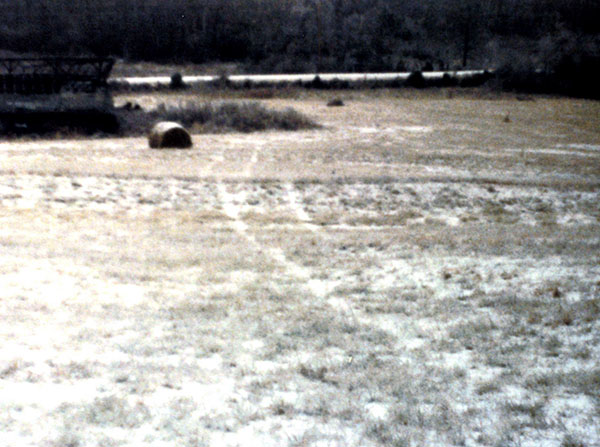
Photo from near the top of our terraced pasture after a brief snowfall. Tire tracks are visible, left by a neighbor’s tractor. A single round bale of hay awaits collection. The neighbor cut and baled the pasture in exchange for all but one or two bales of hay, which we kept for the goats.
Photo from inside “my” boggy acres of Tennessee woods, during winter. There is a thick layer of dead leaves, several nurse logs (downed by a past tornado), and a rich growth of saplings in the tornado-cut spaces. This place was my refuge and heart-home, during my youth and young adult years. I loved these pieces of land as well as I’ve ever loved anyone or anything. They sheltered me through a series of undiagnosed and untreated depressions, and their memory shelters me still.
Notes
1. Please don’t read this to mean that I harbor any resentment against children and adults who are made of sugar and spice and everything nice. I grew up with several wonderfully contented sugar and spice and everything nice people, and I’ve met more as an adult. I simply knew, from my earliest knowing, that I was more of a snakes and snails and puppy dog tails kind of person. (click here to return)
2. This photo dates from a mid-elementary-school age. As it was clearly summer, Mother had slackened some of her standards regarding my hair, which is tousled in odd lengths as it recovers from one of the short haircuts. As for the striped halter top and yellow shorts, I inherited some dozen of each as hand-me-downs from my older sisters. Mother sewed them in bulk. (click here to return)
3. Later, my sisters and I commuted to our undergraduate degrees from the University of Alabama in Huntsville. I even continued the tradition, for a few years, after moving to Knoxville for veterinary school. Whenever I had a non-working weekend, I commuted four hours “home” to mow the yard or stack wood or mend fences or simply wander the fields and woods until it was time to drive four hours back. The years after I ceased commuting, when I declared somewhere else home, were fraught. Mother resisted and resented my decision to make only infrequent visits. She complained about having to pay someone to mow, about the expense of central heating with no one to stack the wood, and about loneliness. Loneliness, I now understand, was the real issue. I was the youngest child and the last to leave, so I was the one who left her alone. Our mutual insistence on misunderstanding each other’s motivations eventually led to a decade-long breach that never quite healed. (Readers might sense, here, an unhealthy dose of mother-daughter strain. It’s a common enough family dynamic. Read on for more.) (click here to return)
4. Mother probably detested the drive as much as I did, though not enough to transfer our care to one of the family doctors in Fayetteville. And her hard-and-fast rule held that if I was sick enough to miss school (with an undeniable fever and/or vomiting, which were the only acceptable excuses) I was sick enough to see the doctor. (click here to return)
6. I was nearing old enough, deemed to be 11 years old for me, when our parents’ marriage fell apart. Daddy had even shopped a bit, with me, for dalmatian puppies. I had read the book at least 101 times. (click here to return)
7. Daddy purchased BJ from a “show quality” litter. I suppose the dream was to expand into the conformation side of AKC shows. To finish a championship and, perhaps, to establish a lineage of champions. (Our father often dreamed big.) But BJ stopped growing just short of breed standard height. He was undersized, a career-ending flaw. Daddy entered him a few times, anyway, bluffing toward standard height with floofy grooming techniques. They even earned a few ribbons and points. But finishing a championship was never a realistic goal. Besides being undersized, BJ was a snappy fellow (stop judging!). He failed many a temperament test, never thrived in the obedience ring, and lived out his life as a grumpy little ornament on our untidy acres. He was Daddy’s dog, but I loved him and he loved me back and we spent many afternoons exploring together. (Especially after Daddy left.) Then many uncomfortable evenings pulling tangles and burrs from our hair. (click here to return)
8. Except that I feared all the ways that my uterus could and did destabilize my life. I’m bookmarking this thought, here, in hopes of expanding it into a separate post, later. (click here to return)
9. I don’t mean to overlook the bizarre irony of seeing my father’s desertion and death, my mother’s exhaustion and grief, as opportunity. There’s a profound dysfunction in my perception of these memories that mirrors the various dysfunctions our family navigated, during those years. (click here to return)
References
Bornstein, K. (2016). Gender outlaw: On men, women, and the rest of us. (2nd edition, Kindle edition). Vintage Books.
Hacking, I. (1999). The social construction of what? (3rd printing). Harvard University Press.
Wallerstein, I., Collins, R., Mann, M., Derluguian, G., & Calhoun, C. (2013). Does capitalism have a future? (Kindle edition). Oxford University Press.
I have been saving links to essays and stories more interesting and more important than my musings, but this post is already too long. If you’ve stayed and read to the end, I very much appreciate your attention and time. I’ll add the links to a later (shorter) post.
Something has been bothering me for a while, which means this post has been brewing for a while. (It’s also been edited a few times, since posting. Mostly in this introductory section, where I’ve cut and rearranged because the first version had too many words and asides.)
I’m going to talk about coronaviruses.
This post is a departure for me. In talking/writing about coronaviruses on this blog, I’m breaching the barrier between my two worlds. Between my relaxing world of creativity, where I indulge myself with poetry and photos and blog posts, and my anxious world of responsibilities, where I worry about knowledge and knowledge gaps and the idea that facts about the natural world exist but are seldom fully grasped.
In my anxious world of responsibilities, I’ve been talking about coronaviruses for much of the past year. But only with friends and family. And cats. Marie and Dutch are attentive listeners.
Sometimes.
Actually, they’re not very good listeners at all.
Moving on…
In this post, I’m going to explain some of what I know about feline coronavirus. Then I’m going to explain why I’ve been talking to my friends and family and cats about feline coronavirus during the COVID-19 pandemic.
Part I
The coronavirus family tree
To be clear, feline coronavirus is a distinctly different virus from COVID-19.
Taxonomically, both feline coronavirus and COVID-19 belong to the subfamily orthocoronavirinae (previously called coronavirinae), but they are in different genera. COVID-19 is in the genus betacoronavirus, while feline coronavirus is in the genus alphacoronavirus.
But what do these classifications mean? Obviously, they mean that feline coronavirus and COVID-19 are somewhat related, but does “somewhat related” mean anything useful for bloggers and readers and cats?
A linguist might say It depends on what you mean by ‘useful.’ An editor might say The question needs editing before it can be answerable. And a taxonomist would likely say Please stop before you even start, because viral taxonomy follows its own rules and should not be compared to cats.
Subfamily – coronavirinae (as of 2014) or orthocoronavirinae (as of 2020)
Genus – alphacoronavirus, betacoronavirus, deltacoronavirus, and gammacoronavirus
Beyond the genus level of classification, the coronavirus family tree branches into subgenera, species, and subspecies, with some 39 species of coronaviruses distributed across 27 subgenera(Coronaviridae Study Group of the International Committee on Taxonomy of Viruses, 2020).
But again, what do these classifications mean?
In a desperate and thoroughly unscientific attempt to answer this question, I’m borrowing an example from mammalian taxonomy. (Remember the taxonomist’s warning, that viral taxonomy should not be compared to cats? Like I said, the following comparison is thoroughly unscientific. I’ll understand if the taxonomist, or any other reader, snorts in contempt and walks away.)
In viral taxonomy, feline coronavirus and COVID-19 are in the same subfamily, but in different genera.
In mammalian taxonomy, domestic cats and bobcats are in the same subfamily, but in different genera.
The feline family tree
Dutch and Marie are domestic cats. Spoiled, pampered, much loved house cats.
Taxonomically speaking, Dutch and Marie belong in subfamily Felinae, the genus Felis, and the species catus. Put in the more familiar binomial phrasing of genus-species, Dutch and Marie are Felis catus. By comparison, bobcats also belong to the subfamily Felinae, but are classified in the genus Lynx and species rufus. So, binomially, bobcats are Lynx rufus.
To add a third, and somewhat more complicated, data point (because everything is complicated in taxonomy), Pallas’s cats are also classified in the subfamily Felinae. But some sources place Pallas’s cats in the genus Felis and other sources separate them into the genus Otocolobus. All seem to agree on a species name for Pallas’s cats–manul. So Pallas’s cats are variously listed as Felis manul, Otocolobus manul, or Felis (Otocolobus) manul.
Marie and Dutch, being pair-bonded rescue Felis catus, are clearly related to each other. Littermates, maybe. But they are only distantly related to bobcats and Pallas’s cats. Some taxonomists, those who classify Pallas’s cats in the genus Felis, might consider Marie and Dutch more closely related to Pallas’s cats than they are to bobcats. Other taxonomists, those who classify Pallas’s cats in the genus Otocolobus, might consider Marie and Dutch no more closely related to Pallas’s cats than they are to bobcats. For my purposes, it is enough to note that domestic cats, bobcats, and Pallas’s cats are all cats, but they are all distinctly different cats.
Feline coronavirus and COVID-19 are both coronaviruses, but they are distinctly different coronaviruses.
(Back to the taxonomist’s concerns: Viral taxonomy and mammalian taxonomy are, indeed, different systems. The above comparison is flagrantly unscientific. I offer it as a metaphorical demonstration of the messiness inherent in trying to describe, measure, or quantify relatedness among viruses and/or cats.)
Part II
As recently as the early 1990s, when I first entered veterinary school, there were many knowledge gaps in the story of feline coronavirus. Now research has illuminated how the virus moves within cat populations and has unraveled some of the complex mechanisms that mediate how the virus affects individual cats.
From here, for the sake of brevity and clarity, I’m going to shorten “feline coronavirus” to FCoV. For one thing, I won’t have to keep typing the whole name. For another, I want to be as clear as possible that coronaviruses are a large and varied group of viruses, while FCoV is a very specific coronavirus that infects cats. Probably even Marie and Dutch, at some point in their lives.
Yes, even you, my dears. But it’s okay, because the overwhelming majority of cats that become infected with FCoV will have few or no symptoms. Perhaps some diarrhea or other gastrointestinal signs, perhaps some upper respiratory congestion.
(There’s more to the FCoV story, which I’ll come to later. For now, I’ll simply say that I’m grateful Marie and Dutch are among the overwhelming majority of cats who have avoided the “more” part of the FCoV story.)
Marie and Dutch have likely been infected with FCoV, perhaps on multiple occasions. Because FCoV is “worldwide and ubiquitous among virtually all cat populations”, found in more than 60% of pet cats in multi-cat households and in as many as 90% of kittens in shelters (Pedersen, 2009, p. 227).
FCoV is a single-stranded RNA virus
The particular feature of FCoV that is important to this post, and that has been important in my year-long discussions with friends and family, relates to the way coronaviruses carry their genetic information. Unlike humans and cats (and most other organisms), who carry their genetic information as double strands of DNA, coronaviruses carry their genetic information as single strands of RNA. So FCoV, like all other coronaviruses, employs single-stranded RNA as the primary molecule for carrying genetic information.
Dutch and Marie always go to sleep at this point. It’s okay if you do, too. I’ve fallen asleep several times, myself. But there is a point to this post. I’m getting close to it, and my next tangent about the differences between double-stranded DNA and single-stranded RNA will get even closer.
The double helix packaging of DNA provides a relatively stable structure for passing along genetic information. Each strand of DNA serves as a sort of back-up copy for its partner strand, and the process of DNA copying actually uses this back-up feature to proofread and correct mistakes. Should a strand of DNA break, or should mistakes occur in copying a strand, the back-up copy allows enzymes to repair the breaks and remedy the mistakes. This prevents mutations. Obviously, some mutations slip through, but at a far lower rate than would otherwise occur.
Single strands of RNA are less stable genetic carriers than double-stranded DNA. RNA is a more fragile molecule than DNA, and single-stranded RNA, lacking partner strands, has no back-up copies for enzymatic proofreading. Coronaviruses do have a unique mechanism for proofreading, a complex of enzymes and proteins that proofread key genes (Robson et al., 2020), and this unique mechanism provides some stability. But rapid and frequent mutations still occur.
As a single-stranded RNA virus, FCoV does a poor job of creating exact copies of itself. Every time FCoV copies itself, errors occur. Every time (Kipar & Meli, 2014, p. 507). For that matter, FCoV mutates so often that researchers characterize the array of viruses produced in the course of a single infection as a quasispecies–a group of “related genotypes” (Kipar & Meli, 2014, p. 507). Other researchers use the term “pseudo-strain” (Emmler et al., 2020, p. 792).
In short, within any FCoV infected cat, there are many mutated versions of the FCoV they originally contracted.
FCoV and feline infectious peritonitis
The overwhelming majority of cats that become infected with FCoV will have few or no symptoms. Perhaps some diarrhea or other gastrointestinal signs, perhaps some upper respiratory congestion. But there’s more to the story.
For somewhere between about 1% (Pedersen et al., 2012, p. 20) and 12% (Addie et al., 2009, p. 594) of infected cats, their particular FCoV quasispecies mutates into one of a number of forms that are able to cause a devastating and often fatal disease: feline infectious peritonitis (FIP).
I say “able to cause” because the FIP-able quasispecies do not always cause FIP. Some cats can resist FIP, even when their FCoV infection mutates into a form capable of causing FIP. Some cats are resistant at one point in their lives and later become susceptible, others perhaps follow an opposite path. In essence, FIP occurs at intersections between rapidly mutating FCoV quasispecies and the genetics and immune systems of individual cats. When an FCoV quasispecies gains the ability to cause FIP, in a cat that never had or has lost the ability to resist FIP, a deadly cascade of disease may begin.
What I’ve just described is the internal mutation theory of FIP. Put bluntly, this theory says that every case (or cluster of cases) of FIP represents a newly mutated variant of FCoV that is newly capable of causing FIP.
And now, all tangents complete, I come to the point of this post.
FIP is not rare.
As of 2008, FIP was “one of the leading infectious causes of death among young cats from shelters and catteries” (Pedersen, 2009, p. 225).
“In one study, FIP was the most common single cause of disease in cats younger than 2 years of age…. An average of 1-5% of young cattery or shelter cats in the US will die from FIP, with losses in catteries higher than from shelters” (Pedersen, 2009, p. 227).
“Up to 12% of FCoV-infected cats may succumb to FIP, with stress predisposing to the development of disease” (Addie et al., 2009, p. 594).
This is the source of my bother. (Remember the bother, all those paragraphs ago, that started this post?)
What does it all mean?
I haven’t found much information about the mutation rates of COVID-19. I feel like the data exists, at least in some rough estimate, but I’ve not found it in a reliable and readily accessible format. And, without ready access to the mutation rates of COVID-19, my frame of reference reverts to my existing knowledge about FCoV.
FCoV and COVID-19 are only distantly related, but all coronaviruses share the genetic instability that comes from having a single-stranded RNA genome. Yes, coronaviruses have a unique mechanism for some stability, but this mechanism can’t completely compensate for the instability that leads to mutations.
A vague measure of the instability of FCoV can be seen in the incidence of FIP in cats around the world. Because each case (or cluster of cases) of FIP represents an FCoV quasispecies that has newly acquired one or more of the mutations that enable FIP.
Narrow the number down to all the kittens and young cats in shelters and multi-cat environments, each year. (Hint: That’s still so very many cats.)
Between 60% and 90% of the cats in shelters or in multi-cat environments will, at some point, become infected with FCoV.
Calculate a number that would be between 1% and 12% of FCoV-infected kittens and young cats.
That’s how many cats will develop FIP each year.
According to the internal mutation theory, that’s how many times FCoV mutates, each year, into a form capable of causing FIP in a cat that is incapable of resisting FIP. (To determine the exact number of times FCoV mutates into a form capable of causing FIP, add the times such mutations occur in a resistant cat.)
As a word problem, the math itself is not too complicated. The scope of the problem is obvious, even without exact numbers.
Limiting the emergence of variants is the point
The incidence of FIP represents a direct measure of how often one specific group of FCoV variants emerge in cats. Each case (or cluster of cases) of FIP represents a newly mutated variant of FCoV that is newly capable of causing FIP. And FIP is not rare.
I’ve spent the last year lecturing my family and friends and cats about the mutation rate of FCoV, pleading for everyone to do as much as possible to limit COVID-19’s infection cycles.
Yes, it’s true that FCoV and COVID-19 are only distantly related. (Metaphorically, about as distantly related as domestic cats are to bobcats.) But if the mutation rate of COVID-19 is even a fraction of what is seen with FCoV, the risk of new variants surges with each surge of infections.
While it is scientifically inaccurate and somewhat irresponsible to claim that more dangerous COVID-19 variants are inevitable if infections continue, it is equally inaccurate and irresponsible to claim that more dangerous variants are impossible. This, also, is the point.
P.S. Marie and Duchess (Dutch) would like me to add that they are very good listeners, all the time. It’s just that they prefer listening to things other than my voice.
References:
Addie, D., Belák, S., Boucraut-Baralon, C. Egberink, H., Frymus, T., Gruffydd-Jones, T., Hartmann, K., Hosie, M. J., Lloret, A., Lutz, H., Marsilio, F., Pennisi, M. G., Radford, A. D., Thiry, E., Truyen, U., & Horzinek, M. C. (2009). Feline infectious peritonitis: ABCD guidelines on prevention and management. Journal of Feline Medicine and Surgery 11, 594-604. doi: 10.1016/j.jfms.2009.05.08
Coronaviridae Study Group of the International Committee on Taxonomy of Viruses (2020). The species Severe acute respiratory syndrome-related coronavirus: classifying 2019-nCoV and naming it SARS-CoV-2. Nature Microbiology 5, 536-544. https://doi.org/10.1038/s41564-020-0695-z
Decaro, N. & Lorusso, A. (2020). Novel human coronaviruses (SARS-CoV-2): A lesson from animal coronaviruses. Veterinary Microbiology 244(2020). 1-18. doi: 10.1016/j.vetmic.2020.108693
Emmler, L., Felten, S., Matiasek, K., Balzer, H.-J., Pantchev, N., Leutenegger, C., & Hartmann, K. (2020) Feline coronavirus with and without spike gene mutations detected by real-time RT-PCRs in cats with feline infectious peritonitis. Journal of Feline Medicine and Surgery 22(8). 791-799. doi: 10.1177/1098612X19886671
Kipar, A. & Meli, M. L. (2014). Feline infectious peritonitis: Still an enigma? Veterinary Pathology 51(2). 505-526. doi: 10.1177/0300985814522077
Pedersen, N. C. (2009). A review of feline infectious peritonitis virus infection: 1963-2008. Journal of Feline Medicine and Surgery 11. 225-258. doi: 10.1016/j.jfms.2008.09.008.
Pedersen, N. C., Liu, H., Scarlett, J., Leutenegger, C. M., Golovko, L., Kennedy, H., & Kamal, F. M. (2012). Feline infectious peritonitis: Role of the feline coronavirus 3c gene in intestinal tropism and pathogenicity based upon isolates from resident and adopted shelter cats. Virus Research 165, 17-28. doi: 10.1016/j.virusres.2011.12.020
Robson, F., Khan, K. S., Le, T. K., Paris, C., Demirbag, S., Barfuss, P., Rocchi, P., & Ng, W.-L. (2020). Coronavirus RNA proofreading: Molecular basis and therapeutic targeting. Molecular Cell 79, 710-727. https://doi.org/10.1016/j.molcel.2020.07.027
When we lost Scamper last spring, we were already in the process of losing Vanna, too. Vanna had been diagnosed with intestinal lymphoma two years earlier, and, after thriving for longer than expected under the excellent care of her veterinarian, she was beginning to lose ground.
Vanna had been my mother’s cat, which undoubtedly contributed to the depth of my attachment. She was a living link to an unrecoverable past.
What’s more, she flourished in Virginia. In Tennessee, among Mother’s four cats, Vanna had been the neurotic one. The reclusive, skittish one, rarely glimpsed by visitors.
When the cancer finally overwhelmed her, almost exactly a month after we said goodbye to Scamper, I stumbled into another depression.
Our lively household of three cats had been reduced, in a month’s time, to a quiet household of one. I couldn’t write about Vanna’s death. Could barely talk about it.
Within a year we were losing Sabrina, too.
Sabrina (2001-2017)
Sabrina was the sweetest, gentlest cat I’ve ever owned. Perhaps the sweetest and gentlest cat I’ve ever met.
She and Scamper had been rescued, at only a few weeks of age, from a construction site.
She suffered a serious injury at about twelve weeks old, losing one of her eyes and undergoing multiple surgeries to salvage the vision in her other eye. She lived the rest of her life with a slowly advancing cataract, but didn’t seem bothered by her limited vision.
She played and romped through adolescence, survived an episode of liver failure in early middle-age, and settled into her senior years with the same calm serenity she had shown from kittenhood.
I had hoped, of course, that we might have a few more years with her, after losing Scamper and Vanna in such close succession. But in November Sabrina began showing signs of discomfort while defecating, our first hint of the rectal tumor that, while repeatedly testing benign on biopsy, was likely malignant at its core.
By March she was too uncomfortable to continue. So I made yet another last trip to our wonderful vet and said yet another goodbye.
How many goodbyes, now? Four, since starting this blog. Indigo. Scamper. Vanna and Sabrina. Before them, Spice.
Spice (?-2008)
Spice’s years as a feral cat ended in 1994, the moment I saw her huddled in the back of a cage with a vast, scabbed wound covering her neck and shoulders. She nosed forward to sniff my hand, speaking in unmistakable cat-language. My name is Spice, and I’ve been waiting for you.
Spice was my constant companion for fifteen years. We shared a dorm, an apartment, a duplex (with my future husband), and, in her final years, a house in the suburbs.
She taught Sabrina and Scamper how to be cats, and they kept her young longer than time should have allowed.
Losing her closed a door on my twenties and thirties. I would never be twenty or thirty again, and I would never have another cat like Spice.
All those that came before
Before Spice? The list is long, stretching through memory into the hazy nostalgia of childhood. Mischief and Jackson. Diana. Gizmo and Annie. Morgan and Shere Khan. Sadie and Daisy. Sheena and Poppy. (This list is far from complete, and includes none of the dogs. I’ll save dogs for a later post.)
Many of our cats were named for characters in books and movies. Some came to us already named, relinquished by owners who could no longer keep them, owners who were happy to let an eager young vet assistant adopt the cats they were losing to eviction, a family illness, or one of life’s other jarring turns.
Some of the cats materialized out of thin air, simply showing up in the yard. Others were dumped on the driveway, plucked from parking lots, and chased down in ditches by a trio of sisters who found it biologically impossible to just keep driving. Mother simply sighed and made room for them all, a tide of cats drifting in and out of our lives, in and out of the house each morning and night.
They were never all in the house at the same time, thankfully. Most preferred the yard, sheds, and pasture, most of the time.
Cats have been one of the few constants in my life. They’ve shared all of my memories, every place I’ve ever called home, and almost every job I’ve ever had. I don’t know how to be without cats. In the end, loving cats is part of how I love myself. So…
Meet Duchess and Marie
Cat Team 7 is a local rescue group who work primarily with cats living at Naval Station Norfolk. The majority of their mission involves a Trap-Neuter-Relocate program, but they sometimes have adoptable kittens.
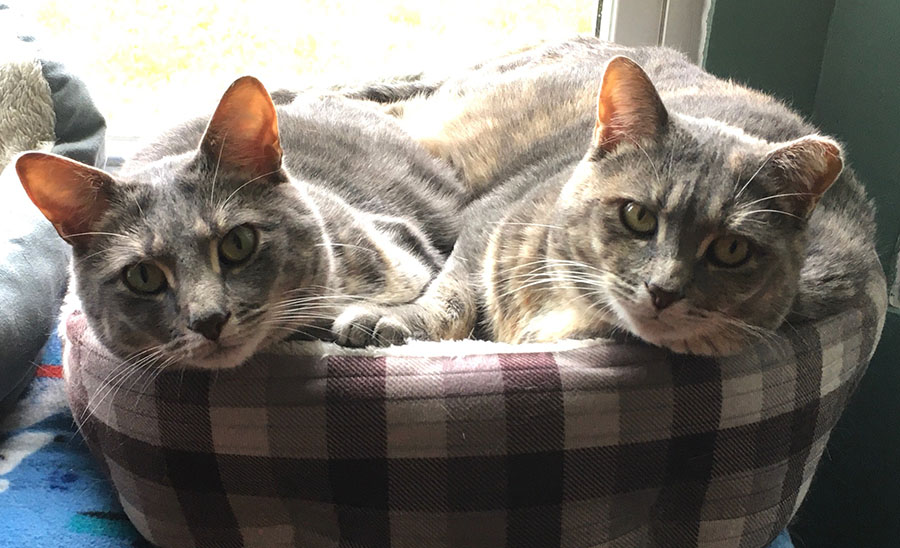
Duchess and Marie (two of a group named for the Aristocats) were trapped in a warehouse in early June, along with two male kittens about the same age. I saw their photo on social media, contacted Cat Team 7, and the rest is happy history.
They were quite shy, in their first weeks here.
Duchess (or Dutch, because sometimes she’s more Killjoy than Aristocat)
Marie (just Marie, because it fits)
It didn’t take them long to settle in. They have plenty of windows, soft beds, toys, and treats.
They are closely bonded, more dependent on each other than Sabrina and Scamper were. They’re rarely apart.
(Except when Marie plays fetch. Dutch, who has no interest in fetching, stalks the action until she can tempt Marie into a thunderous, romping game of chase.)
And me? I’m sharing my life with cats again. That’s enough for now.
Recommended reading about topics that are more urgent and more important than my cat memories:
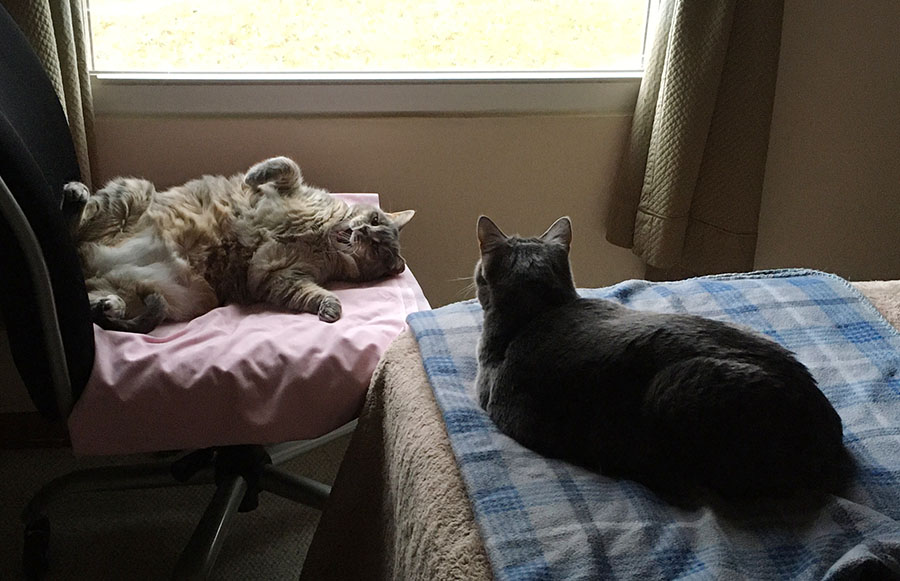
In 2001 we moved from a small duplex to a house with a garage and yard. We had one cat and one dog, and soon added a pair of orphaned kittens.
One of the kittens (on the left in the above photos) was sweet and gentle, and the name “Sabrina” seemed just right for her. The other kitten was fierce and playful and somewhat neurotic, and she defied naming. Nothing quite fit. She became “Scamper” on her medical chart, because I had to put something on her chart, but at home she changed names as often as she changed moods. She was The Scamperer. Thing 2. Her Neediness. The Bad Cat. The Wee Baby Kitty. Supercat.
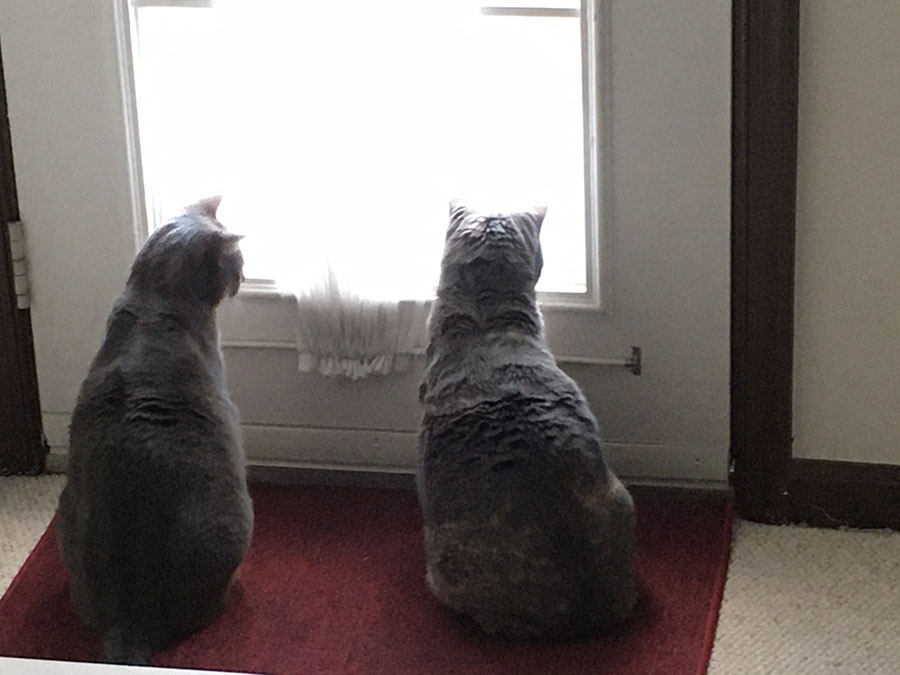
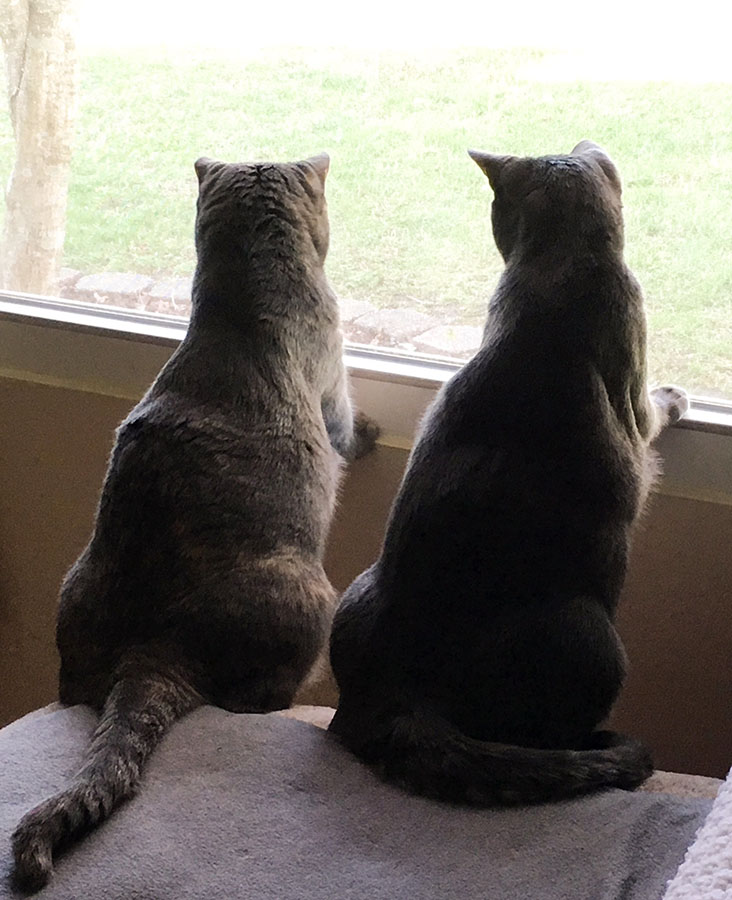
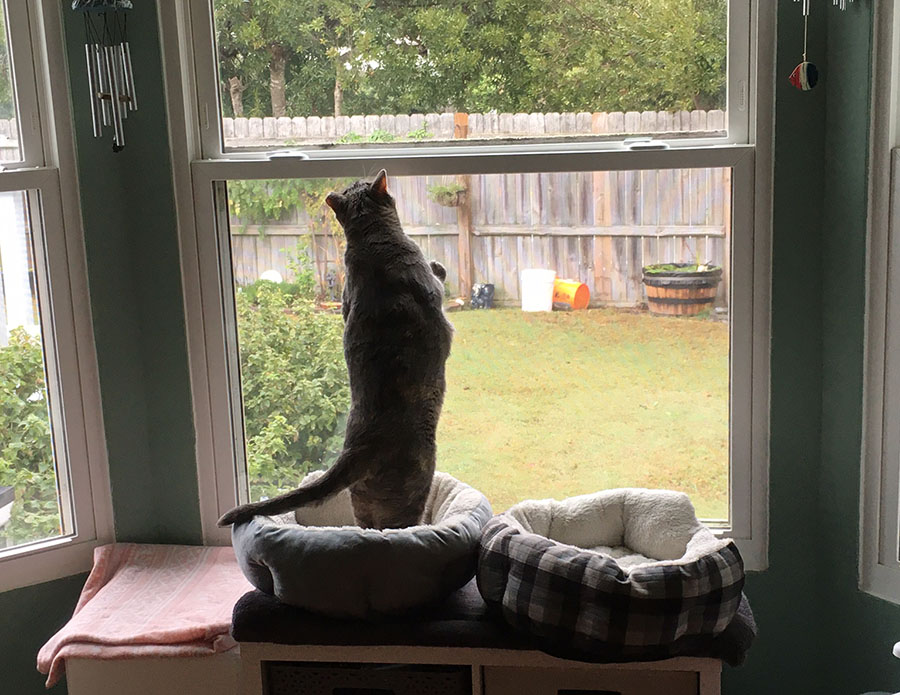
She was The Bird Watcher. (When it was too cold for open doors and windows, birds on television were better than no birds at all.)
In her middle years, she grew overweight and lazy. None of her kitten names fit anymore, if they ever had. She was still Scamper when she went to the vet, but at home she was Herself.
In many ways, she was the essence of what I love about cats — neuroses and all.
In her later years she liked blankets and patches of sunlight and, every so often, an afternoon nap on the couch with me.
Health problems came with age. There were medicines and special diets, all of which helped for a time, but as 2015 progressed her condition declined steadily. She lost weight faster than medicine, food, and love could counter. The calendar turned and she lost more weight. Then, in early February, she stopped eating altogether.
So I made one last trip to the vet with our cat of many names. I stayed with her through the euthanasia process, which was gentle and peaceful, and drove home to a house that is achingly incomplete. There’s an empty spot near her favorite upstairs window, one that can never be filled.
Note: Most of the photos in this post were taken by my husband.























 Rae Spencer