Focusing on Mallards Part VI: States claim the game

‘When you have killed all your own birds, Mr. Bingley,’ said her mother, ‘I beg you will come here, and shoot as many as you please on Mr. Bennet’s manor. I am sure he will be vastly happy to oblige you, and will save all the best of the covies for you.’ –from Pride and Prejudice by Jane Austen

Content Warning

This multi-part blog post contains references to hunting, agriculture, and research practices of killing birds. This particular installment references various methods and means of Mallard hunting, past and present. If you decide not to read on, I respect and admire your choice.

Photograph from a recent spring nesting in the yard. In this photo, a Mallard hen is leading her day-old ducklings from their nest in the irises bordering the dragonfly pond. The hen is balanced on a large rock, downy nest-fluff sticking to her feet. The ducklings are following in a huddled flock, clinging together for safety.
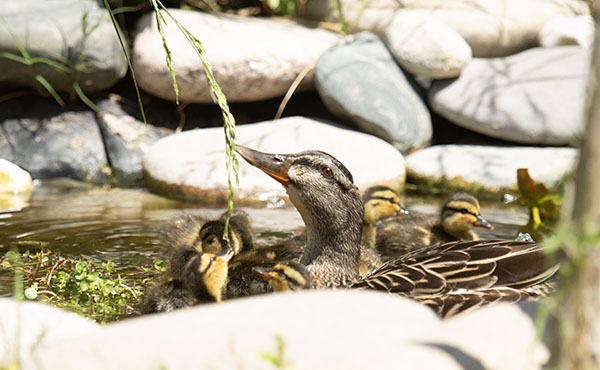
Photo from the Mallard archive. Here, a Mallard hen and her ducklings are leaving their nest for a family swim in the dragonfly pond.

Limiting (and limited) expectations

It was easy to position my own context for these posts (see Part IV). But all of my (deleted) attempts to contextualize Mallards in pre-1800s North America have been as flawed as my knowledge.

It’s a given that there are records outside of the Mallard archive, outside of the Mallard mine, that explain how and why North America’s waterfowl maintained flagrant abundance within and around the continent’s early nations. But I don’t have a discourse for these records.

In the end, after all of my reading, I am not equipped to know North America’s pre-colonial Mallards, much less describe them. They are, for me, a personal singularity. An infinite intangible that disturbs my erratic journey.

In other words, I’m only telling one facet of the Mallard story: the part written by and for Europe’s descendants.

Caveat lector.
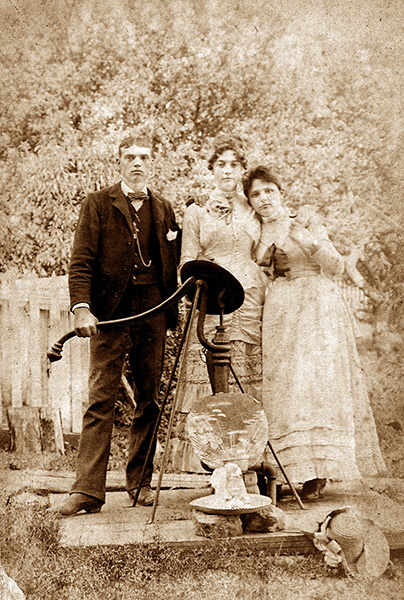
Sepia-toned photograph of three young adults posing beside a pump-handled well in what appears to be a fenced yard. All are wearing formal-appearing attire—two wearing layered and ruffled dresses and one wearing a suit with a prominent pocket-watch chain. A beribboned hat is on the ground in front of the well.
Photograph from the family archive, Iowa, 1881. The trio in this photo were younger than Iowa (granted statehood in 1846) but not a lifetime younger.

In medias res

When I last left the Mallards, in the opening decades of the 1900s, their populations were collapsing. For the moment, I’m leaving them suspended in free-fall.

This post circles back to the 1800s. Back to an era of unchecked habitat destruction and overhunting. Back to the transition years, when state lawmakers claimed title over wildlife and began to legislatively dismantle game markets.

“Wetland utilization in North America provides a classic case of conflict in resource management. The disadvantages of marshes and ponds for the individual farmer encourage their drainage and conversion to cropland. At the same time, these wetlands provide vital habitat for migratory waterfowl, a principle wildlife resource…” (Pospahala, Anderson, & Henney, 1974, pp. 5–6).

Sepia-toned postcard image of a wetland setting in South Dakota. A smallish body of seemingly stagnant water is bordered by dense brush and shrubs.
Photo postcard from the family archive, South Dakota, c. 1900.

“We, who cannot live without wild ducks, must first of all acknowledge two facts: 1. We are the minority; 2. The majority regards any land which is too wet to plow, but unsuitable for swimming or water boating, as useless” (Anderson, 1953, p. 122).
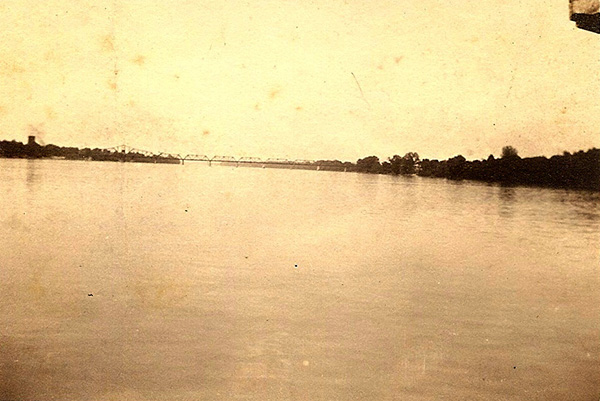
Sepia-toned image of a large body of water with a distant silhouette of truss bridge. The photo's horizon is slightly tilted, the bridge has six visible segments, and a jointed corner of wood is visible in the upper right corner of the frame.
Photo from the family archive, location unknown, c. 1900. A large body of water with a truss bridge in distant silhouette.

These were never the King’s ducks

After fleeing systems in which wildlife belonged to the aristocracy, the English and French colonists in North America drafted new rules. In the colonies, wildlife would belong to the citizens. To the People. (Not, however, to the People who already lived in North America. Only to those who staked their various flags along eastern coastlines and cascaded westward.1)

“The explorations of these settlers were driven by the incredible wealth of North America’s renewable natural resources—and by an unfettered opportunity to exploit it” (Organ, Mahoney, & Geist, 2010, p. 23).
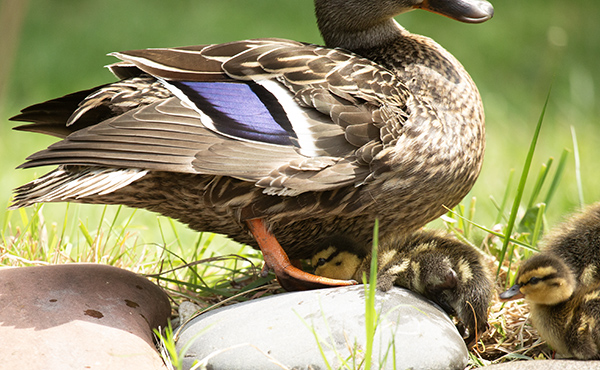
Photograph of a Mallard hen perched on a stone that is part of the border of our dragonfly pond. One of her days-old ducklings is scrambling up the stone's slope, trying to reach the safe and familiar comfort of her protection. Two other ducklings are in line, waiting to test their own climbing skills.
Photo from the Mallard archive, of a Mallard hen standing on one of the stones that border our dragonfly pond. Here, the hen was taking a break from teaching her ducklings to swim and forage.

Who killed (kills) the People’s birds?

During the glut years of the 1800s, US hunters took to the field in three different pursuits: subsistence hunting, sport hunting, and market hunting.

As subsistence hunters took (take) only what they need for survival, their impact on bird populations was (and still is) minimal. But sport hunters, in the 1800s, tended to binge. Each adventure piled up the carcasses:

“The geese were flying all day, thousands upon thousands of them. We killed 163 that day. We had a farm wagon with extra side boards for carrying eighty bushels of wheat. Our kill nearly filled that wagon box. I know that night when we drove back to Dawson, which I think was eight miles distant, we were cold and wet and we all stuck our legs down in the geese and the warmth of their bodies kept us comfortable” (Mershon, 1923, pp. 117–118).

Sepia-toned photo of a horse harnessed to a cart (carriage? buggy?) driven by a man in a suit and hat, complete with thick gloves that have a star emblem on the wide cuff. A cluster of two-story houses make up the background.
Photo from the family archive, location unknown, c. 1900. Not a wagon, I know, but still a reminder that personal transportation in the 1800s was single-digit horsepower.

After each binge, sport hunters returned to their families and their varied professions.

Unless the binge was their profession.

The Meat and Feathers Market

Between 1820 and 1860, America’s cities blossomed from a thin seeding of only 5% of the population to a significant 20% demographic. “Markets for wildlife arose to feed these urban masses and to festoon a new class of wealthy elites with feathers and fur” (Organ, Mahoney, & Geist, 2010, p. 23).

Market hunters earned a living harvesting the wildlife that lived in unclaimed (or claimed and unsupervised) wild places. The siren song of profit penetrated every field, marsh, and wooded acre, tempting hunters to abandon the traditional and self-imposed restraints that defined hunting as a sport.

“A momentary question goes through your mind. ‘Shall I give them the first barrel on the water?’ It is dismissed almost as soon, for early I have been taught it is not the way of the sportsman. Give the birds a chance is the rule. Yet I can not help hoping they will be well bunched and I can get more than one with the first barrel and hope for another with my second. Well, sometimes it works one way and sometimes another. Either way it’s the life worth living” (Mershon, 1923, p. 76).

Giving the birds a chance, for the market hunter, was a profit gamble.

Sepia-toned portrait of two young adults seated at a table. Both are posed with a hand of cards, as if playing poker. Both are wearing suits, though they have taken off their jackets. Both are wearing hats. One is smoking a pipe. The gambler on the right is showing an ace to the camera, held below the level of the table. Paper money, larger than today's bills, is hanging over the edge of the table.
Photo from the family archive, location unknown, c. 1900. Photographer’s stamp: “W. C. Bryant Artistic.”

It was highly likely that a hunter the next county over would happily shoot all the birds on all the waters, rules be damned.

The market wanted meat and feathers, so meat and feathers the market would have.

Sepia-toned portrait, c. 1900, of two young adults wearing hats decked out in feathers. Their coats have big fancy collars, one of thick fur and the other of feathers.
Photo from the family archive, location unknown, c. 1900. Time has taken their names, but their faces and feathers remain.

Any hunter willing to renounce the title of “sportsman” could cash in.

What would you have done?

Endless demand v. limited supply

Around cities and towns, market hunters drained the wildlife from marshes and woodlands and fields. And as nearby wildlife dwindled, sportsmen were forced further afield for their binges.
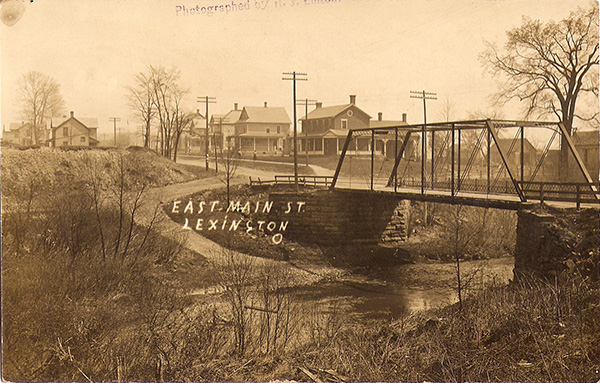
Postcard photograph stamped "Photographed by H. J. Linton" and hand-labelled "East Main St., Lexington, O". A small, single-section truss bridge crosses a brook, several two-story houses line the road beyond the bridge, and utility poles break the horizon.
Photo postcard from the family archive; East Main St., Lexington, Ohio; c. 1900. The photographer’s stamp, HJ Linton, suggests the image was snapped by a relative on some distant branch of a grandmother’s family tree.

“Conflict soon arose between market hunters, who gained fortune on dead wildlife, and the new breed of hunters who placed value on live wildlife and the sporting pursuit of it” (Organ, Mahoney, & Geist, 2010, p. 24).

By the late 1800s, some of the birds had been hunted to extinction.

“The first bird I ever killed on the wing was a wild pigeon. They frequented the Saginaw valley in thousands from early spring until after the harvest. I had been taken with my uncle and father pigeon shooting many times to pick up birds. It was no trick for them to get seventy-five or a hundred birds before breakfast, and soon after I was given my 16-gauge double barrel gun I was taken out to shoot pigeons. The flocks were dense, as I now recall, so it was not a difficult feat to bring one down, and at the very first discharge a pigeon from my shot came fluttering to the ground. I grabbed it and admired it and was satisfied for that morning to have it my entire bag, and proudly took it home to show my mother. It was not long before I was going pigeon shooting regularly every morning, for the flight began at daylight and was generally over by seven o’clock. Then I would get my breakfast and be off to school. My pigeon shooting continued every spring until about 1880, when it was gone forever” (Mershon, 1923, p. 3).

Sepia-toned photo of a group of twenty-seven children, teens, young adults, and adults—seemingly assembled for a school photo. All of the children in the front row are barefoot, most are wearing long-sleeved shirts and coveralls or long-sleeved dresses with large ruffled collars. Two children in the front row are holding hats on their lap, one has a hat hooked over one knee, while yet another hat has been tossed to the side and waits, upside down, to be reclaimed. Some of the younger children have neatly parted hair pulled back in (probably) a braid, others have very short hair that is either too short to style or barely long enough to support styling to one side or the other. The teens and young adults with long hair have puffy updos with a few prominent ribbons, while those with short hair have a suggestion of bangs swept to the side. A dog has joined the first row of students.
Photo from the family archive, location unknown, c. 1890(?). I wonder if the author of the previous passage went to school barefoot, with his hound to keep him company?

“No ordinary destruction”

In the sport v. market skirmishes, sport hunters always had the upper hand. Reputation and tradition amplified their voices.

“Furthermore I will prove by sundry reasons in this little prologue, that the life of no man that useth gentle game and disport be less displeasable unto God than the life of a perfect and skillful hunter, or from which more good cometh. …he shall go and drink and lie in his bed in fair fresh clothes, and shall sleep well and steadfastly all the night without any evil thought of any sins, wherefore I say that hunters go into Paradise when they die, and live in this world more joyfully than any other men” (Edward, Second Duke of York, 1406–1413/1909, pp. 4, 11).

“It is stated that in their migrations northward, the waterfowl often reach the lake in the spring, while it is still covered with ice, and that while huddled in great numbers in the mouths of streams and other open places, they are slaughtered indiscriminately, and that while too poor and unfit for eating. It is also represented that they are killed and wounded in great numbers by the swivel or punt gun, which is a small cannon fixed to a boat, and that by these practices they are driven from their usual feeding grounds and places of resort. It is the well known habit of waterfowl to follow the same line and stop at the same points in their migrations, and such a serious disturbance at this great half-way station, may eventually result in their seeking other quarters. To prevent this it is asked that the killing of waterfowl in the spring be prohibited altogether in certain counties, and that the use of the punt gun be absolutely forbidden. The petitions upon this subject have been so numerous, and the petitioners so respectable, that there evidently must exist good cause for complaint, and their request should be granted. The use of the punt gun along the sea board has been made illegal for like reason, and if it is necessary there, it is still more so here” (Collins, 1860, p. 388).

“The ‘game hog’ is an animal on two legs that is disappearing. May he soon become extinct! The ‘game hog’ formerly had himself photographed surrounded by the fruits of a day’s ‘sport,’ and regarded the photograph as imperfect unless he had a hundred dead ducks, grouse, or geese around him. To-day a true sportsman would be ashamed to be pictured in connection with a larger number of fowls than a decent share for an American gunner, having due regard to the preservation of game for the future” (Lacey, 1900, pp. 4871–4872).
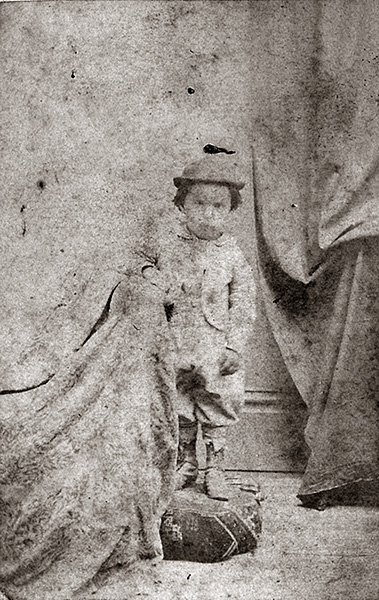
Grainy and faded grayscale portrait of a toddler. The child is standing on an upholstered footrest and is wearing knee breeches, a short jacket with long sleeves, a rounded hat with a small rolled brim, and rumpled boots. One arm rests on a curtain-draped prop. Another heavy drape hangs in the background. Time has robbed the image of most facial features, leaving only the child's dark eyes staring into the lens.
Photo from the family archive; unnamed child (likely surname Linton); Elmore, Ohio; c. 1890. In my internal filing system, this image lives in the “haunted children” file.

Haunted by pigeons

A single piece of market-favorable legislation murmurs from the archival cacophony: an 1848 Massachusetts statute that prohibited anyone from frightening passenger pigeons out of netting-beds, under threat of a $10 fine and compensation for damages (General Court of Massachusetts, 1848, p. 650).

It should be no surprise that this particular law is audible to search engines. After all, passenger pigeon extinction is a holotype cautionary tale that should linger.
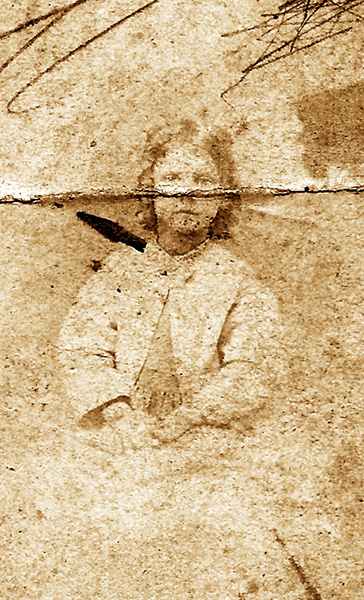
A faded, folded, and foxed photo from February 1, 1887. The child's image has almost completely faded. Loose curly hair, a long-sleeved jacket buttoned at the neck, and what might be a pleated waistline for a dress. Hands folded in lap. Serious eyes peer out over the photo's broken fold.
Photo from the family archive; unnamed child (likely surname Craig); Columbia, TN; February 1, 1887. Another haunted child.

Ohio bids farewell to their big game, but assumes the pigeons will never die

In 1857, as the Ohio legislature sought to revise their “Act to Prevent the killing of Birds and other Game” (Ohio General Assembly, 1857, pp. 107–108), legislators requested assistance from the state’s Board of Agriculture.

The resulting work, published as a select committee report in 1860, wrote off Ohio’s big game as a lost cause: “Ohio has no waste land. It is all useful for agricultural purposes—if not for tillage, at least for pasturage. It has no sterile wastes, marshes, or mountain ranges where the larger game can find permanent security. The deer, the bear, the wolf, and such like animals will soon be gone, and laws that relate to them a dead letter” (Collins, p. 382).

Sepia-toned photo of taken from inside a fenced field that looks recently cut to stubble. In the background three massive, multi-story, wood buildings with steeply framed roofs are surrounded by a field so flat and uniform that it looks like water. A very distant treeline marks the horizon.
Photo from the family archive; The Steele Farm; Cedar Rapids, Iowa; c. 1900.

Wild turkeys, prairie hens, and pheasants were in the same sunken boat. Excepting a few isolated flocks in isolated localities, no protections could save them. Even so, sportsmen wanted the legislature to regulate hunting, so hunting should be regulated. Ohio’s lingering populations of deer, turkey, prairie hens, and pheasants should be granted undisturbed breeding seasons (Collins, 1860, p. 384).

Seasonal protections were recommended for game birds that could adapt to progress—quail, meadow-larks2, kill-deer, doves, flickers, woodcock, and wood ducks (Collins, 1860, pp. 385-387)—as well as for waterfowl around Sandusky Bay (Collins, 1860, p. 389).

The multitudes of warblers, finches, and flycatchers were safe without protection. At least, being small, shy, and drab, they were safe enough. The food-and-feathers market didn’t covet such birds. Besides, providing bird-by-bird protections would require parsing dozens of common and scientific names (Collins, 1860, pp. 383-384).

Sepia-toned portrait, c. 1900, of a young man wearing what looks to me like a scratchy wool suit. His dark hat is garnished with a stiff sail of white primary feathers.
Photo from the family archive, location unknown, c. 1900. The photo was in my great aunt’s album, but was addressed to my grandmother.

Woodpeckers, blue jays, and blackbirds, the kind of birds that damaged agriculture when they ate crops but protected agriculture when they ate insects, could be left to the chances and whims of circumstance (Collins, 1860, p. 384).

The report singled out two game species as immune from overhunting (in Ohio) and in need of no protection: the snipe and the passenger pigeon.

Snipe were mere passers-through, fleeting visitors so well-camouflaged and difficult to flush from wet spring landscapes that only “practiced” sportsmen could hope for success (Collins, 1860, p. 387). During brief April sojourns, snipe were “good sport and a choice morsel for the table”, but “yearly numbers cannot be materially lessened by the gun” (Collins, 1860, p. 387).
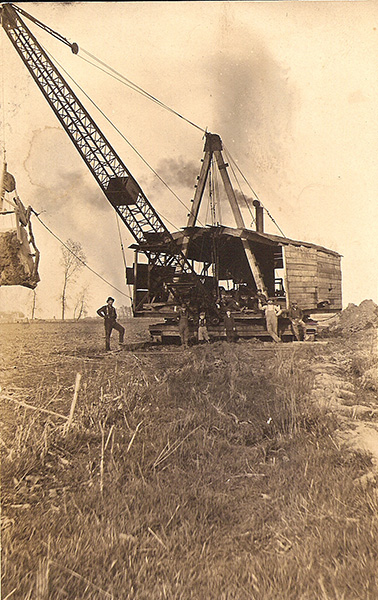
Sepia-toned photograph of a steam crane and six workers in a field in Iowa, c. 1900. The field has been cut to stubble. The steam crane is belching smoke, and the crane's body looks like a wooden building on a massive wood platform. Mounds of bare dirt are visible in the background. The workers are lined up in front of the crane, posing for the photo. A few bare trees are on the horizon, suggesting a winter setting.
Photo from the family archive, Iowa, c. 1900. I don’t know what kind of progress was underway, with this steam crane, but I doubt it involved wetland restoration.

And passenger pigeons?

“The passenger pigeon needs no protection. Wonderfully prolific, having the vast forests of the North as its breeding grounds, traveling hundreds of miles in search of food, it is here to-day and elsewhere to-morrow, and no ordinary destruction can lessen them, or be missed from the myriads that are yearly produced” (Collins, 1860, p. 387).

Forty years later, passenger pigeons were extinct in Ohio3 and functionally extinct everywhere else. It was, indeed, no ordinary destruction.

“Property of the State”

“Section I. That all the game and fish, except fish in private ponds, found in the limits of this State, be and the same is hereby declared to be the property of the State, and the hunting, killing, and catching of same is declared to be a privilege” (Arkansas General Assembly, 1889, p. 173).
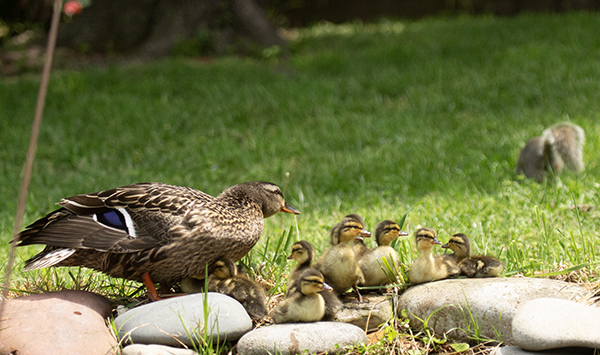
Photograph of a female Mallard threatening a squirrel that had ventured too close to her brood of days-old ducklings. The hen is standing over her brood, all gathered on the stone border of our dragonfly pond. The hen's stance is tense, head low and neck coiled, ready to strike at the squirrel should it venture closer. The squirrel's back is turned to the ducks, seemingly unaware that it has disturbed the scene.
Photo from the Mallard archive, of a female Mallard threatening a squirrel that had ventured too close to her brood of days-old ducklings. Mallard hens usually ignore the antics of squirrels in the yard, but new mothers are a different story.

“Section 4650, Wisconsin statutes of 1898 is hereby amended to read as follows: The ownership of and the title to all fish and game in the State of Wisconsin is hereby declared to be in the state, and no fish or game shall be caught, taken or killed in any manner or at any time, or had in possession except the person so catching, taking, killing, or having in possession shall consent that the title to said fish and game shall be and remain in the State of Wisconsin for the purpose of regulating and controlling the use and disposition of the same after such catching, taking or killing. The catching, taking, killing or having in possession of fish or game at any time, or in any manner, or by any person, shall be deemed a consent of said person that the title of the state shall be and remain in the state for said purpose of regulating the use and disposition of the same, and said possession shall be consent to such title in the state whether said fish or game were taken within or without this state” (Wisconsin General Assembly, 1899, pp. 576–577).

Sepia-toned photo of a young woman wearing a pale dress with a fur collar. Her dark hat is tipped to a jaunty angle and is decorated with (maybe?) feathers, flowers, or ribbon. (The decoration fades into the background, so it is difficult to say exactly what has been attached to the hat.) The woman's head is slightly tipped, she is looking off to the side, and her lips are not quite smiling.
Photo from the family archive, location unknown, c. 1900. Her expression captures my bemusement, on trying to follow Wisconsin’s the “shall be and remain” syntax.

Such legislative grabs by Arkansas and Wisconsin, asserted during the closing years of the 1800s, didn’t materialize out of thin air.

State legislatures had been controlling the game within their borders since the 1820s, and courts had upheld a variety of statutes.

Let the alewives migrate

One of the earliest challenges to game laws came in Maine, after members of a town’s fish committee destroyed a dam on private property. On May 3, 1839, the fish committee took action on behalf of alewives, a type of herring.

Charles Peables had maintained a dam on his portion of Alewive Brook, in Cape Elizabeth, for some 12 previous years, diverting the water to power his mill. In May of 1839, local Fish Committee members Hannaford and Davis demanded that Peables open his dam and let the alewives pass.

When Peables declined, the Fish Committee disabled the dam in question. Litigation followed, and the Supreme Judicial Court of Maine eventually ruled for Peables, citing a technicality: Hannaford and Davis had acted early.

As the statute required the brook to be open May 5–June 5, Peables should have been able to run his mill straight up to the stroke of midnight on May 5. As long as the alewives could migrate upstream on May 6, Peables was not in violation of the statute (Peables v. Hannaford, 1841, 106).

Had Hannaford and Davis waited until May 6, they could have destroyed the dam at their leisure, and Peables could not have stopped them.

Peables v. Hannaford set a precedent, at state levels, for the states’ authority (embodied in local officers) to regulate game on private property.
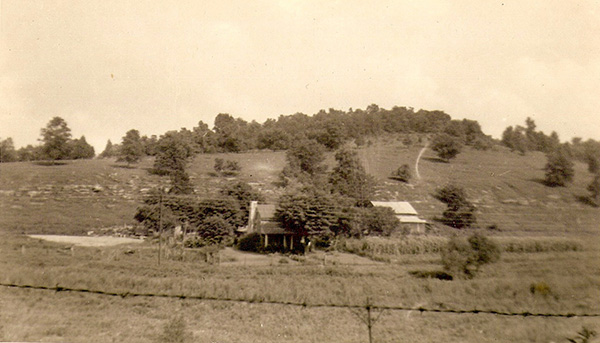
Sepia-toned photo of a house and barn at the foot of a hill, surrounded by a large empty field. The house is set within a cluster of trees, while the field has been cleared for (probably) pasture usage. A line of large rocks and boulders runs along the hill's lower slope, and a thick tree line obscures the top of the hill. A utility pole and utility lines run through the field in front of the house, and a single strand of barbed wire stretches between the camera and the farm.
Photo from the family archive, unknown location, c. 1920(?). The barbed wire running across the foreground would be a distinct “no trespassing” indicator, in the rural area of my childhood.

“We see nothing unconstitutional in the Act”

On July 8, 1874, David S. Randolph served two dressed and cooked prairie chickens to diners in his St. Louis restaurant. According to a Missouri statute, these were the wrong birds in the wrong season.

Even though Randolph could prove that he had purchased the birds in Kansas, where July hunting was legal, he was cited and fined $9. Which would be about $250, today. Randolph appealed, but the Missouri Court of Appeals upheld the fines:

“We see nothing unconstitutional in the act. The game law would be nugatory if, during the prohibited season, game could be imported from the neighboring States. It would be impossible to show, in most instances, where the game was caught. The State of Missouri has as much right to preserve its game as it has to preserve the health of its citizens, and may prohibit the exhibition for sale, within the State, of provisions out of season, without any violation of the Constitution of the United States. So far as we know, this right has never been disputed, and its exercise by the absolute prohibition of the having in possession, or sale, of game within the State limits, during certain period of the year, is no more an illegal attempt to regulate commerce between the States than would be a city ordinance against selling oysters in July” (Missouri v. Randolph, 1876, p. 15).

Did you catch it?

Sepia-toned postcard photo of my great-aunt Birdie as a toddler. She is standing up, one hand balanced on a blanket-draped prop. Her ankle-length dress is a dark material with heavy-looking gathers at the collar and a bright band of (probably embroidered) zig-zags around the hem and cuff. Her eyes are very wide as she looks at a spot just to one side of the lens. Under her image, print on the card reads "The Park Gallery, Chas. Eberhardt, Artist, 20th Street, Rock Island, Ill." Handwritten on the back of the card was "To GrandMa from Birdie Dec 7 1894".
Photo from the family archive; my great-aunt Birdie; Rock Island, Illinois; December 7, 1894.

In knotting up the import loophole, Missouri had stepped ever so softly on the interstate commerce boundary. And the appeals court didn’t mind.

Sepia-toned photo taken inside a hat store, probably in the 1920s. The long narrow room has shelving, tables, and glass-front cupboards that were probably display cases. A table in the middle of the frame is stocked with a variety of hats, decorated mostly with ribbons. A group of adults are posed together, two wearing formal-appearing suits, one wearing a dark ankle-length skirt and white long-sleeved shirt, one wearing a dark ankle-length dress, and one wearing a calf-length skirt, pale shirt, a long coat, and calf-high (at least) boots. I suspect, but am far from certain, that the one wearing the daringly short skirt (calf-length) is my great aunt Birdie. In the background, a shopper wearing a pale calf-length dress is browsing.
Photo from the family archive; location unknown, c. 1920(?). Great-aunt Birdie worked in millinery. I suspect (though I am far from certain) that Birdie is on the far left, in this photo.

‘…the congress shall have power to regulate commerce among the several states…’

When a somewhat related case landed before the Kansas judiciary, in 1877, the commerce question heated up.

On November 8, 1876, an agent for the carrier Adams Express Company received a package for transport—a shipment of four prairie chickens that had recently been killed. The agent, C. A. Saunders, delivered the birds to Chicago, and received a $10 fine (plus court costs) for his efforts.

Kansas had recently adopted the kind of boilerplate “no possession, no import, no export” law that was popular at the time. In Kansas, the wording had been adjusted to prohibit all import and export of game or birds, independent of season.

During open season in Kansas, in 1876, it was legal to possess prairie chickens that had been legally killed, as long as they had been killed within the state. During closed season, it was illegal to possess them at all. And it was illegal to import or export them, ever.

No matter the season, no one could move prairie chickens across the state lines.

Legislatively, this act seemed loophole-free. During open season, prairie chickens were fair game. Hunt them, eat them, sell them anywhere within the state of Kansas. All perfectly legal. But don’t ship them out of state. Don’t buy them out of state and bring them into Kansas. And during closed seasons, prairie chickens were entirely off-limits. Don’t kill them or have them anywhere in your possession.

The single exception written into this law involved shipments of prairie chickens that happened to pass through Kansas on their way to and from other states. Carriers handling such shipments were safe during their journey through the state.

Sepia-toned photo of a wooden train depot. Stairs in the background lead up to a platform protected by an elaborately-braced awning. A set of windows (rather like a bay window) protrude from the building near the foot of the stairs. The five people in the image are wearing suits and dresses. Two are inside, leaning out through the station windows, and three are outside, leaning against the building. The woman on the far left is one of my great grandmothers, Dora. My great grandfather was an engineer on the line that ran through Elora, TN.
Photo from the family archive; L to R (per my mother’s notes) Dora Craig, Edd Strong (Elora Agent), Wilburn Craig, Mrs. Strong, Vint Hamilton; Columbia side depot, Elora, TN; c. 1901. Dora was one of my great grandmothers.

The appellate judges for Saunders’s case glided straight past a series of technicalities regarding the title and wording of the act. They didn’t need to rule on those matters, because a larger issue took precedence:

“Section 8 of article 1 of the federal constitution provides among other things that, ‘the congress shall have power * * * [sic] to regulate commerce with foreign nations, among the several states, and with the Indian tribes.’ Ever since the adoption of this provision, the judges of the supreme court of the United States seem to have been groping their way cautiously, but darkly, in endeavoring to ascertain its exact meaning, and the full scope of its operation. They have many times construed it, but as yet have hardly fixed its boundaries, or its limitations. They have no doubt generally construed it correctly, but some of their decisions with reference thereto seem to be conflicting and contradictory, and scarcely one of such decisions has been made without a dissenting opinion from one or more of the judges. We think however that amidst all their conflicts and wanderings they have finally settled, among other things, that no state can pass a law (whether congress has already acted upon the subject or not,) which will directly interfere with the free transportation, from one state to another, or through a state, of anything which is or may be a subject of inter-state commerce. …For instance, a law which prohibits the catching and killing of prairie chickens, may be valid, although it may indirectly prevent the transportation of such chickens from the state to any other state; but a law which allows prairie chickens to be caught and killed, and thereby to become the subject of traffic and commerce, and at the same time directly [emphasis in original] prohibits their transportation from the state to any other state, is unconstitutional and void” (Kansas v. Saunders, 1877, pp. 129–130).

This means game is commerce, right? And that the Kansas legislature had stepped a little too far over the interstate commerce boundary. Right?

It meant, at any rate, that Saunders didn’t have to pay his fine.

Photo of a Mallard hen trying to get a short rest behind the grass-and-stone border of the dragonfly pond. The hen's eye is wide and her expression is tense, despite her pre-sleep posture of tucked head and neck. They aren't visible at all in the photo, but all eleven of her ducklings were gathered beneath her, as if back in the nest. The ducklings were safe from the hungry eyes of predators, but they weren't comfortable enough to sleep soundly. Their constant fretting and shifting was keeping the hen awake.
Photo from the Mallard archive. Here, the hen has gathered her ducklings beneath her for a nap. The ducklings were squirming and fidgeting, so the hen was having trouble getting comfortable.

Preview of Part VII: More court cases, more decisions, and federal lawmakers patch the interstate commerce bug

The next post dives into game smuggling and game police. If you are starting to wonder if I’ve gotten game laws mixed up with prohibition laws, I haven’t, though there are certainly familiar elements.

Hold on to your feathered hats.

Sepia-toned photo of a young woman wearing a pale, short-sleeved blouse and a dark skirt. (The short sleeves, alone, are remarkable, as long sleeves are far more common in the archive.) She is holding a small bouquet of flowers, and her hat is elaborately decorated with feathers and what looks like a large tiara. She's wearing at least one necklace of beads or gemstones and several rings. Her expression, for me, is a difficult combination of stern eyes with a hint of smile.
Photo from the family archive; location unknown, c. 1890(?). There’s a lot going on with that hat, but, for me, her eyes are the real story. I can’t read that expression, and somehow she makes me feel like I should stop trying to.

Also in the next installment, the courts decide that birds and game aren’t commerce, after all.


A note about previous previews: The schedule has changed, so the previews aren’t accurate

Even the most casual readers will have noted, by now, that this project is constantly expanding. Previews included in previous posts have been preempted and put off, as my reading has taken unexpected turns (I do love a good tangent).

My notes sprawl through four full composition books.

I will likely get to all of the topics introduced in previous previews, but not in order. I’ve given myself permission to keep exploring the Mallard mine, as long as my interest holds, and to keep chasing the tangents. My challenge, now, is to convince readers to keep exploring, as well.

Image of a Mallard hen and her eleven ducklings (which are difficult to count, in this photo) swimming the in a small backyard pond. The pond is bordered by large worn river rocks, with grass and weeds behind and between the rocks. The spout of a pond filter/fountain is visible, and a few reddish-orange water lily leaves float on the surface. (The water lily leaves only turn green after emerging into sunshine.) The ducklings are fluffy with down and have brown and yellow markings. The hen's feathers range from light tan to dark brown with light edging. She is staring into the lens, keeping an eye on me in case I venture too close.
Photo from the Mallard archive. Here, a Mallard hen keeps watch as her ducklings explore the dragonfly pond.

If you’re still with me, Thank You!


Footnotes

1. This particular piece of the Mallard story, part of the pre-1800s history of North America’s colonization, is beyond both my tangent-tolerance (for these blog posts) and my philosophy/history horizon. Even so, an excerpt from a book assigned in a technical writing course resonates:

“Among the many arguments that Locke made in the Two Treatises is one that justifies appropriating lands from indigenous peoples where they are living in a state of nature. According to this argument, settlers who cultivate and improve the land—thereby rendering the ‘greatest conveniences’ from it—will have rights to the property:

“‘God gave the world to man in common; but since he gave it them for their benefit and the greatest conveniences of life they were capable to draw from it, it cannot be supposed he meant it should always remain common and uncultivated. He gave it to the use of the industrious and rational—and labour was to be his title to it (Second Treatise 137).’

“…British settlers under Locke’s rationale could claim property rights because they took resources from the land. These resources could be used to create a favorable balance of trade for England, where Board of Trade member Locke saw excessive imports as a source of unstable coinage practices” (Longo, 2000, pp. 51–52).

Mallards were one of the resources that colonists took and took and took. (Click here to return to your regularly scheduled paragraph.)

2. In 1885, while collecting in Canada, Robert Miller Christy wrote a love-note to Meadowlarks:

“I have often thought what a capital thing it would be to introduce the Meadow Lark in to England. So far as plumage and song are concerned, it would rank among our brightest-coloured and most admired songsters; while its hardy nature would allow of its remaining with us the whole year round, as indeed it often does in Ontario and other districts farther south than Manitoba. Perfectly harmless and accustomed to grassy countries, it would quickly become naturalised in our meadows, where it would find an abundance of insect-food, and would doubtless soon increase sufficiently in numbers to serve, if need be, as a game- and food-bird, as it largely does in the United States. No other songster that I ever heard equals this bird in the sweetness and mellowness of its notes” (p. 125). (Click here to return to your regularly scheduled paragraph.)

3. Ironically, Ohio’s deer rebounded. After being sentenced to local extinction, in 1860, deer found ways to survive in Ohio. And then conservation efforts across the 1900s helped deer to flourish. In the 2024–2025 hunting season, Ohio hunters bagged 238,137 white-tailed deer (Ohio Department of Natural Resources, 2025, para. 1). (Click here to return to your regularly scheduled paragraph.)


References

Anderson, J. M. (1953). Duck clubs furnish living space. In J. B. Trefethen (Ed.), Transactions of the eighteenth North American wildlife conference (pp. 122–129). Wildlife Management Institute. https://wildlifemanagement.institute/conference/transactions/1953

Arkansas General Assembly (1889). Acts and resolutions of the General Assembly of the State of Arkansas: passed at the session held at the capital, which began on Monday, January 13th, and adjourned on Wednesday, April 3rd, 1889. Press Printing Co. https://babel.hathitrust.org/cgi/pt?id=nyp.33433009076492&seq=193

Christy, R. M. (1885). Notes on the birds of Manitoba. In J.E. Harting (Ed.), The Zoologist, 3rd series, Vol. IX. No. 100 (pp. 121-133). John van Voorst, Paternoster Row. https://ia801303.us.archive.org/27/items/Zoologist85lond/zoologist85lond.pdf

Collins, W. O. (1860). Report of Senate Select Committee, upon Senate Bill No. 12, ‘For the protection of birds and game.’ In Fifteenth annual report of the Ohio State Board of Agriculture with an abstract of the proceedings of the county Agricultural Societies to the General Assembly of Ohio for the year 1860 (pp. 381-390). Richard Nevins, State Printer. https://babel.hathitrust.org/cgi/pt?id=mdp.39015038792258&seq=549

Edward, Second Duke of York (1909). The master of game: The oldest English book on hunting. (W. A. Baillie-Grohman & F. Baillie-Grohman, Eds.). Duffield and Company. https://archive.org/details/TheMasterOfGame/page/n7/mode/2up (Original work published 1406–1413).

General Court of Massachusetts (1848). Acts and resolves passed by the General Court of Massachusetts in the years 1846, 1847, 1848; Together with the rolls and messages. Dutton & Wentworth, Printers to the Commonwealth. https://archive.org/details/actsresolvespass184648mass/page/n5/mode/2up

Kansas v. Saunders, 19 Kan. 127 (1877). https://www.courtlistener.com/opinion/7934084/state-v-saunders/pdf/

Lacey, J. (1900). Enlarging the powers of the Department of Agriculture. In Congressional Record, House of Representatives, Monday, April 30, 1900 (pp. 4858–4980). The Government Printing Office. https://www.congress.gov/bound-congressional-record/1900/04/30/33/house-section/article/4858–4980

Longo, B. (2000). Spurious coin: A history of science, management, and technical writing. State University of New York Press. https://www.jstor.org/stable/jj.18254358

Mershon, W. B. (1923). Recollections of My Fifty-years Hunting and Fishing. The Stratford Co., Boston. https://archive.org/details/recollectionsofm00mers_0

Missouri v. Randolph, 1 Mo. App. 15 (1876). https://www.plainsite.org/opinions/279xdv9rm/state-v-randolph/

Ohio Department of Natural Resources (February 4, 2025). Ohio’s final 2024–25 deer harvest report. Ohio Department of Natural Resources. https://ohiodnr.gov/discover-and-learn/safety-conservation/about-ODNR/news/ohios-final-2024-25-deer-harvest-report

Ohio General Assembly (1857). Acts of a general nature and local laws and joint resolutions passed by the Fifty-second General Assembly of the State of Ohio: At its second session begun and held in the city of Columbus, January 5, 1857 and in the fifty-fifth year of said state: Volume LIV. Richard Nevins, State Printer. https://books.google.com/books?id=S1lOAQAAIAAJ&pg=PA107#v=onepage&q&f=false

Organ, J. F., Mahoney, S. P., & Geist, V. (2010). Born in the hands of hunters: The North American model of wildlife conservation. The Wildlife Professional, 4(3), 22–27. https://www.researchgate.net/publication/267749137_Born_in_the_hands_of_hunters_the_North_American_Model_of_Wildlife_Conservation

Peables v. Hannaford, 18 Me. 106 (1841). https://www.courtlistener.com/opinion/5108727/peables-v-hannaford.pdf

Pospahala, R. S., Anderson, D. R., & Henney, C. J. (1974). Resource Publication 115: Population ecology of the Mallard II. Breeding habitat conditions, size of the breeding populations, and production indices. U. S. Department of the Interior, Fish and Wildlife Service, Bureau of Sport Fisheries and Wildlife. https://nwrc.contentdm.oclc.org/digital/collection/p16473coll29/id/10213/rec/1

Wisconsin General Assembly (1899). The laws of Wisconsin, joint resolutions and memorials passed at the biennial session of the Legislature, 1899. Democratic Printing Co., State Printer. https://babel.hathitrust.org/cgi/pt?id=wu.89096040076&seq=7

Focusing on Mallards Part IV: Positioning My Perspective(s)

Content warning

This multi-part blog post contains references to the hunting, agriculture, and research practices of killing birds. This particular installment contains references to hunting other prey and killing chickens from a backyard flock. If you decide not to read on, I respect and admire your choice.

Photograph of five Mallard ducklings resting on the stone border of our dragonfly pond after a tiring swim. Four of the ducklings are settled in and nodding off, while the fifth is still standing and fidgeting. The ducklings are fluffy with down (immature feathers), have yellow and brown markings, and each still has a visible remnant of egg tooth at the beak tip. They were less than 24 hours old when this photo was taken.
Photograph of five Mallard ducklings resting on the stone border of our dragonfly pond. Four of the ducklings are settled in and nodding off, while the fifth is still standing and fidgeting.

Livestock are living stock. And sometimes pets.

Until they are not.

Growing up in rural Tennessee, I had daily exposure to food chain realities. Our freezers (we had two) were stocked with meat from assorted livestock we raised. Livestock we loved. Chickens and cows, during my memory years, with vague early memories of pigs.

A 1970s-era photo, scanned from our family archive, of four fancy chickens roaming free in our yard. Two of the chickens have dark feathers with reddish highlights, one with additional iridescent green highlights on its wing feathers. A third chicken has almost all light reddish-brown feathers. The fourth's feathers are black over its head and neck, reddish tan across its chest, and gray over its wings, back, abdomen, and tail. The gray feathers on its back and abdomen are fluffier and downier than regular feathers. All four chickens have topknots of varying fluffiness and fanciness. All four are notably dainty.
A 1970s-era photo of four “banties” (bantams), dainty chickens with variously fancy topknots, roaming free in our yard.
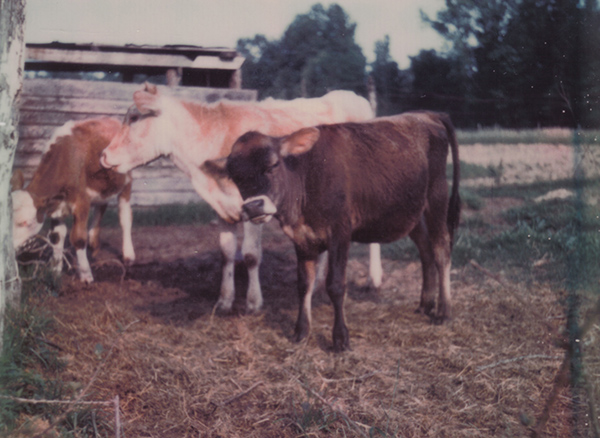
A 1970s-era photograph scanned from our family archive. Three young cows are standing near a fence line, pasture and woods in most of the background, with one wall of a weathered wooden shed visible. The cows are browsing through a scatter of trampled hay. The cows' coat colors indicate their mixed heritage. The cow closest to the camera strongly favors a Brown Swiss milk cow: its body is mostly dark brown with lighter shading on its legs and ears and a very pale muzzle with a dark nose. The middle cow likely has some Charolais beef breeding: its coloration is a patchy mix of pale tans and white. The cow furthest from the lens has markings typical of Hereford beef cattle: primarily reddish coloration with white legs, a white stripe down its back, and a white face.
A 1970s-era photograph of three young cows standing near a fence line with pasture and woods in the background.
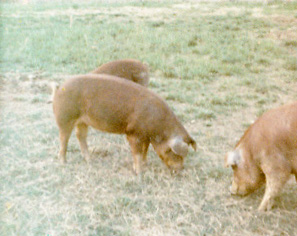
Another 1970s-era photo, scanned from the family archive. In this photo, three red pigs are grazing in a dry, clean patch of short pasture grass. The pigs are likely of Duroc descent, given their red coloration and the widespread popularity of the Duroc breed.
A 1970s-era photo of three red pigs grazing a patch of short pasture grass.

Our chickens and cows and pigs had individual names and individual personalities. We raised them and cared for them and loved them. But food chain reality means that livestock exists to be eaten. No matter how cherished. No matter how tame.

In this 1970s-era photograph, a red-and-white Hereford cow stands over her very young and very sleepy calf. The calf is red and white, like its mother, and its coat is thick and curly and damp in places. Just behind this cow and calf, a small cluster of black cows have gathered. These background cows would be of Angus breeding. All of the cows are standing in a patch of scattered straw and hay. The ground under the straw and hay would probably have been a trampled mire of mud. The bare-limbs tree line, just visible, indicates a winter setting.
Yet another 1970s-era photograph from the family archive. Here, a red-and-white Hereford cow stands over her very young calf. The calf is curled up on the ground, sleepy eyes and ears drooping.

Off to slaughter

Our cows and pigs were slaughtered and processed by local-ish butchers, but Mother slaughtered our chickens with a hatchet. Then she cleaned and portioned their carcasses while I collected and bagged bloody feathers.

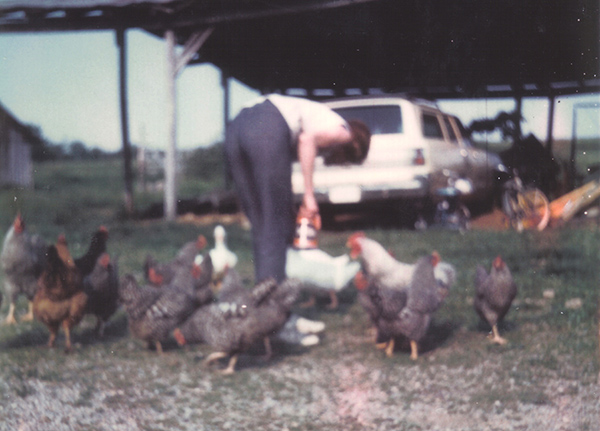
In this 1970s-era photograph, Mother is feeding a flock of some 15 chickens, along with 3 white ducks, from a repurposed coffee can filled with whatever mix of feed and corn was on the day's menu. The chickens are mostly gray-and-white speckled Dominiques (we called them "domineckers"), with a single white leghorn rooster and a few Rhode Island red hens. In the background, our white station wagon is parked under a pole shed, along with several bicycles. The photo is poorly focused with faded colors.
In this 1970s-era photograph, Mother is feeding our small flock of chickens and ducks. At the moment this photo was snapped, Mother was bent over, using her free hand to enforce order. If photos came with sound, you would hear her scolding the greedy birds and coaxing the shy ones.1

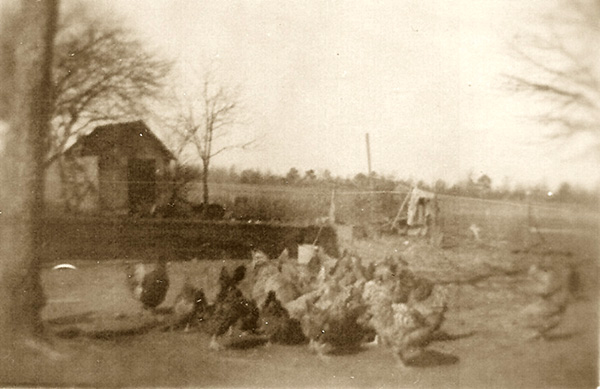
In reviewing family archives for this post, I was struck by how similar the above scene is to a photo from the early 1900s, found in our maternal grandmother’s album. There was clearly something generational going on at our table.

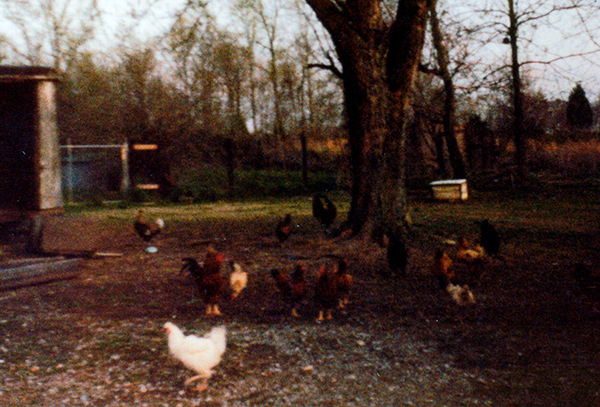
Scanned image of an early 1900s photograph from my grandmother's photo album. The sepia-toned black-and-white image shows a flock of large chickens foraging in a tight bunch, probably having just been given feed. Some of the chickens have dark feathers and some have light feathers. The background is bare-limbed trees (winter), a large flat field, a post-and-wire fence with a closer fence having its lower section blocked off by tin. There is also a small outbuilding with an open door, with what appears to be a tractor parked in front.
Early 1900s-era photograph of some twenty chickens foraging in a bare yard with farm equipment, fences, and an outbuilding in the background.

Wildlife can also be living stock, to a hunter

Small and sundry prey

In addition to eating chicken, beef, and pork raised on our property, we sometimes ate squirrels and rabbits shot by my father and brothers. It’s possible that our beagles sometimes helped on these hunts. (It’s more likely that our beagles hindered these hunts.)

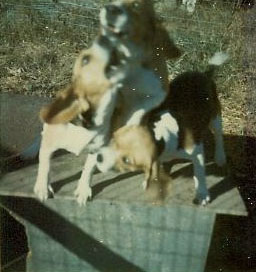
A small square photograph of three beagles, motion-blurred, play-fighting on top of a wooden doghouse. Shadows of fencing are visible on the doghouse. I believe these three beagles are Daisy, Fella, and Little Bit, though we also had a fourth beagle named Dan.
A 1970s-era photo of three naughty beagles play-fighting on top of a doghouse.

I helped skin and clean the squirrels and rabbits, and I remember being fascinated by their soft fur. I also remember Mother muttering and tsking while she cooked squirrel and rabbit meals. She breaded and fried the meat, and served barely edible, extremely tough portions with open disdain.

I developed a lasting case of meat snobbery, rooted in Mother’s disdain. Squirrels and rabbits were in the lowest edibility tier. Nothing lower was served. No frog legs. No snake, turtle, or alligator meat. No opossums.

Something generational was going on at our table there, too, but in the opposite sense of backyard flocks. Mother preserved her family’s tradition of raising chickens for slaughter, but put a permanent end to the family tradition of opossum hunting. (Scroll quickly if you don’t care to see a sepia-toned group of early 1900s ancestors showing off a bunch of dead, dying, or faking-death opossums, along with the dogs that facilitated the hunt.)

Scanned image of a photograph from my grandmother's photo album. In the album, the hand-printed caption read "The morning after our great Opposum hunt. 'We won't forget.'" This deep-sepia-toned black-and-white photo, circa early 1900s, shows five people standing in a row with a fourth person kneeling in front. Posing outdoors in a yard, the people are holding at least three opossums. The opossums are either dead, dying, or faking death. The woman to the far left is holding a smallish black-and-white dog, while the man kneeling in front is restraining two hounds. Probable (possible?) identifications include standing L to R: Sarah Harrison, Georgia Linton, Charlie Linton, Bill Linton, and an unknown girl; kneeling in front: Buck Linton.
In my grandmother’s album, this photo is labelled “The morning after our great Opposum hunt. ‘We won’t forget’.”

That’s my grandmother, second from the left, one hand behind her back and the other hand dangling an opossum for the camera. This particular hunt (it wasn’t the only time the family hunted and ate opossums) was special because one of the cousins (Sarah Harrison, standing on the far left) had come to visit.

Scanned image of a sepia-toned black-and-white photograph in my great aunt's photo album. In the album, the hand-printed caption reads "Sarah Harrison / Popman's cousin / 'the Possum hunt'". The outdoor photo shows a woman wearing a plaid dress with intricately pieced trim and pockets, white stockings, and white shoes. The woman is holding two dead, dying, or faking-death opossums, one opossum in each hand. The woman's dark hair is pinned up, and she is looking at the camera but not smiling. Beside her is a smallish black-and-white dog with a bobbed tail and half-pricked ears. The dog is looking up, attention fixed on the woman and opossums.
This photo was in a great aunt’s album. The photo is labelled: “Sarah Harrison / Popman’s cousin / ‘the Possum hunt’ “2

I should add that Mother’s disdain was not coherently taxonomic. Reptiles, amphibians, and insects were off the menu, but so were ducks, geese, and goats. Which meant some of our livestock were exempt from slaughter. What’s more, “dairy” came from cows and cows exclusively. There’s no logic here, only family and cultural tradition.

Cue any stand-up comic mocking a southern drawl. For that matter, cue any bully standing in their own tradition, mocking other traditions.

Photograph from 2021 of a white-tailed deer trotting beside a paved path at Back Bay Wildlife Refuge in Virginia Beach, VA. The background and foreground are winter-toned in oranges and browns of dormant shrubs and grasses, with occasional greens of live oaks and wax myrtles typical of coastal Virginia. The deer's head and tail are up, ears angled to listen behind her, in a body language that suggests alertness verging on alarm but not panic. Moments after I snapped this photo, the deer vanished into the tall seagrass.
Photograph of a white-tailed deer trotting beside a paved path at Back Bay National Wildlife Refuge. In my southern-Tennessee lexicon, “venison” very specifically refers to deer meat. I only learned in my middle-age that the word “venison” has different and wider definitions in different cultures.

In my late teen and early adult years, my oldest sister’s boyfriend often gifted us venison. I was particularly fond of what I called “Bambi roast” and “Bambi spaghetti”. Bambi, it seems, ranked high in my edible-mammal hierarchy. A bit below pet chickens and cows, but certainly above squirrels and rabbits. Which were at least on the list. Unlike opossums.

Here in my middle years, my childhood memories of skinning squirrels and rabbits seem dreamlike. As if those skinny arms and small hands weren’t my own. After all, any brief stroll through my blog history will find some tender post about squirrel and rabbit nests. I cringe, extra, thinking about any of the yard’s visitors heading into a hunter’s sights, then into a frying pan or stew pot.

Photograph from the spring of 2024. Five Mallard ducklings, less than two days old, are floating in a cluster in our dragonfly pond. Two of the ducklings have their heads cocked, one eye looking skyward. They are responding to an alarm call from their mother, who had spotted a hawk wheeling overhead.
Yes, Mallard babies. I’m talking about you. I’m aching to protect you.

But I didn’t always equate animals, my own pets and livestock in particular, with the meat on my table.

Further aside… so many eggs

Gathering the eggs

On mornings when my oldest sister was too tired or busy or sick to tend the chickens, I was roused and sent in her place. I remember egg gathering as sleepy, smelly, spidery work. Early morning work. (I’ve never been an early morning kind of girl.)

Egg gathering meant wrestling the chicken pen latch, which grew tighter each year as the posts and gate warped. Then I had to put down my bucket—to unclip the rusty chicken house latch and heave the rickety door over hills of weeds, dirt, and dung—and usually had two or three hens perched in my hair and on my shoulders by the time I bent to retrieve the bucket. Finally, I would stumble over the plank sill into the warm, dimly lit interior.

(Yes, I always stumbled. My severe astigmatism couldn’t navigate the sudden change from light to dark, and the hens dashed in and out through the door in frenzied delight.)

Our chicken house was closer in size to a closet than a house. I don’t have any chicken pen/chicken house photos to share, but almost any wire pen around almost any vine-covered tin-roof-and-plank outbuilding would be an accurate visual.

Veils of cobweb hung from the low rafters. Snakes, flies, wasps, spiders, and light entered and exited through gaps in the walls and roof. A short row of nest boxes lined one wall. The floor was dirt, feathers, dung, and broken shells. The chicken house smelled strongly of chickens and dust, but also of cat urine (from our army of yard cats) and dog feces (from the adjoining dog pen) and, every so often, of predators.3

Shooing hens from their nests, or reaching beneath those who refused to be shooed, I gathered eggs by touch more than sight. (It’s not as easy as it sounds. Our hens didn’t give up their eggs willingly, especially to the tentative little sister of their usual egg-gatherer. Wing slaps left bruises, and claws and beaks drew blood.)

The warm, sticky, tough-shelled eggs that I gathered didn’t feel like they held nascent chicks and ducklings. 

A 1980s-era photograph of a red hen and her brood of variously yellow, tan, or striped chicks, all safely enclosed in one of our wood-and-chicken-wire coops. The stocky hen shows strong Rhode Island Red characteristics, but the chicks' mixed genetics were more typical of our flock.
A 1980s-era photograph of a red hen and her brood of eleven(ish) striped chicks, all safely enclosed in one of our wood-and-chicken-wire coops.

Breaking the eggs

Our father began leaving during my pre-teen years. He sold the cows, let the fences lay where they fell, and stopped shoring up the barn and sheds. After he finished leaving, neglect cascaded into decay. Vines pulled down the chicken house and the gate fell off the pen.

Both pre- and post-chicken house era, egg gathering mistakes were inevitable. In the chaos of the crowded, rickety henhouse, broody laying hens stole eggs from the adjacent nests of setting hens. Predators and predator alarms rolled and bounced eggs between nest boxes. An egg laid by a setter a week or more ago, carefully incubated since, might end up alone in a layer’s nest. An egg laid by a layer last night might end up in a two-weeks-along setter’s nest.

After our flocks were entirely free-roaming, they hid their nests so well that eggs were often days old before being found. Eventually, increasing incidences of “bad eggs”, coupled with decreasing egg demand as siblings moved out, halted all egg collecting.

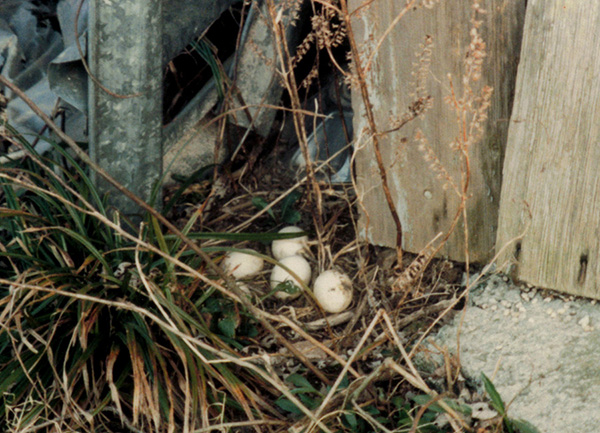
Late 1980s-era photograph of five large white eggs in a rough nest on the ground. The flat nest is made only of trampled grass and dry, dead weeds. The nest is positioned beneath an unused steel livestock gate that is leaning against the wall of a post-and-panel shed.
Photograph of five eggs, probably duck eggs, in a nest on the ground. This nest was tucked between an unused livestock gate and the outer corner of a shed.

The term “bad eggs” most obviously referred to rotting or rotten eggs. The kind that burst on their own or floated in water. But “bad eggs” also encompassed fertilized eggs that were mistakenly collected mid-incubation.

When an incomplete carcass, some mid-development stage of a chick or duckling, spilled from an egg I had cracked, I writhed with regret. It happened often enough, in my early years, that I still crack eggs into a separate bowl when cooking.

After our egg-collecting years ended, our increasingly feral flock was left to hatch and raise what young they could in whatever nests they chose.

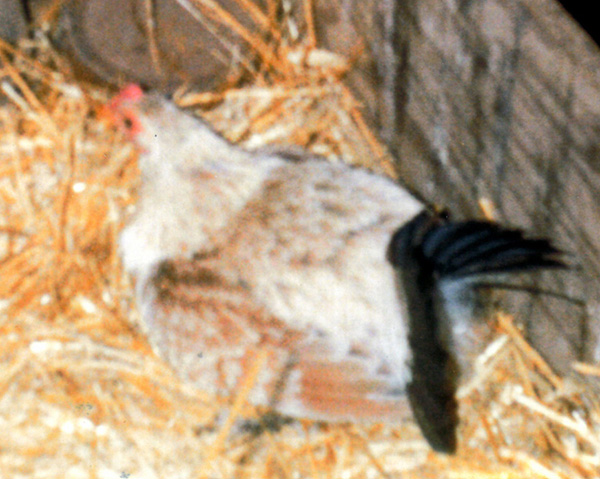
Late 1980s-era photograph of a gray-and-tan feathered game hen with black tail feathers. The hen is setting on a nest that she made in a deep pile of straw left in the bottom of a large wooden box that once held bales of straw. The colors in this photograph are over-bright due to using a flashbulb on the camera, and the image is somewhat blurry.
A late 1980s photo of a game hen (conveniently named “Game Hen”) sitting a nest of eggs in a straw-lined box.
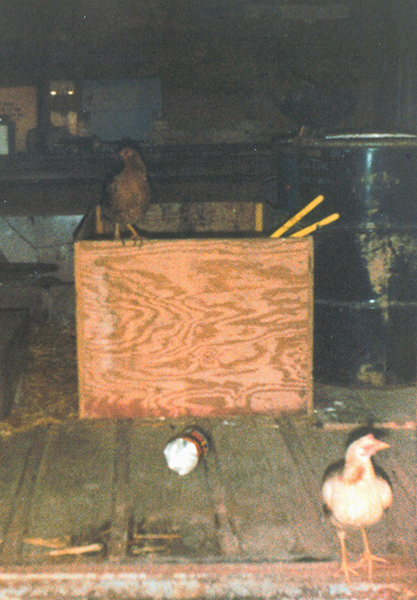
Late 1980s-era photograph of the inside of an ancient out-of-service livestock trailer that served as a shed for storing straw, hay, and feed. The trailer's flooring is wooden planks laid between steel bars. A massive, open-topped wooden crate/box is positioned in the middle of the trailer, an overturned tin can is on the floor in front of the box, and a large weathered 50-gallon oil drum is to the right. Game Hen is perched at the entryway, looking out. A reddish hen is perched on the edge of the large box, and another hen (mostly in shadow) is perched on the oil drum's closed lid. In the far background, shadows and reflections show equipment, bottles, and boxes stored (and long forgotten) on a shelf. The massive box once held bales of straw, but by this time held only a deep bed of leftover straw which was used by the cats and chickens for warm bedding. The oil drum held bags of feed. We kept the trailer doors closed, most of the time, but there were plenty of holes through the sides and bottom that the chickens, cats, rats, and opossums used for entry- and exit-ways.
A late 1980s view inside the “trailer” (a dilapidated, out-of-service livestock trailer that we treated as a bonus shed for feed storage). The massive wooden open-topped box/crate (center frame) once held bales of straw, so it was lined with broken bales. Inside this box, in the right back corner, was Game Hen’s nest.
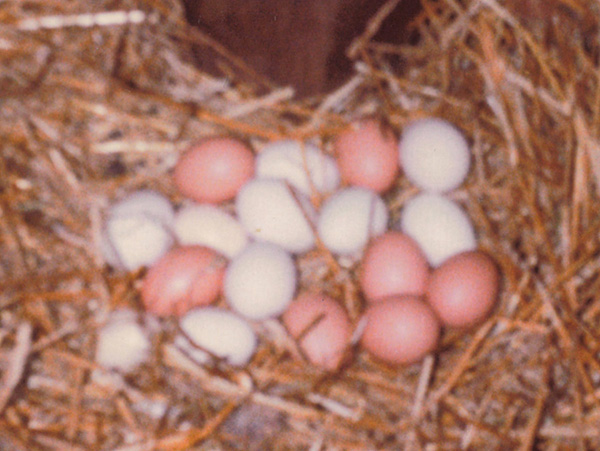
Late 1980s-era photograph of 11 white eggs and 7 brown eggs in a nest made of straw. This was Game Hen's nest to sit, though the eggs were likely provided by multiple hens. The nest was in the far back-right corner of a massive open-topped wooden crate/box the sat in the middle of the ancient out-of-service livestock trailer we used for straw, hay, and feed storage.
The same late 1980s nest, photographed after bribing Game Hen with feed. Heaped in the nest are 11 white eggs and 7 brown eggs. The hens literally shared prime nesting spots.
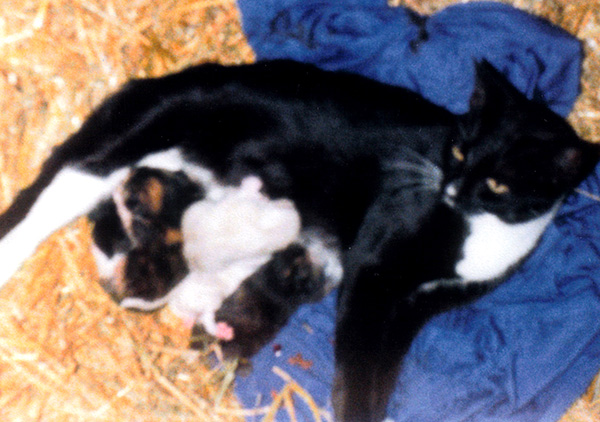
Late 1980s-era photograph of a golden-eyed black-and-white cat (Mischief) nursing a newborn litter of kittens. All are settled in a deep, warm nest of straw, loosely lined with an old blue shirt. There are five kittens, three tortoiseshell and two solid white (destined to develop silver-and-gray "points" typical of siamese, but with the much longer hair typical of ragdoll cats). This litter of kittens was delivered and nursed in the massive wooden open-topped crate/box that we used to store straw in the ancient out-of-service livestock trailer that served as our feed shed.
Another late 1980s-era photograph, taken in the exact same spot in the trailer’s box of straw as the above nest photos. This is my cat Mischief nursing a newborn litter of five beautiful kittens. Two of these kittens will reappear later in this post, in a photo taken after they were grown.

Growing up in rural Tennessee, eating the animals and dissociating

While my egg-mistake memories are mostly visual, wetly curled bodies in a puddle of albumin, my memories of chicken, squirrel, and rabbit carcasses are sticky with remorse and smell like blood, grease, and guilt left out in the sun.

But expressing regret, remorse, or guilt at the table was forbidden. So was refusing to eat what was served. I don’t remember being told these rules, nor do I remember hearing these rules explained to my siblings. For that matter, I don’t remember learning these rules.

It is this lack of learning, this full memory cache with no record of creation, that warrants using the word “dissociated”. As a girl growing up in rural Tennessee, I dissociated from the eggs and meat on our table.

I coped with my forbidden regret, remorse, and guilt by inventing a private delusion, by defining eggs and meat as a different form of matter than living animals.

Mid-to-late-1980s-era photograph of our back yard, taken in late winter/early spring (indicated by the budding saplings in the background). Our small mixed flock of chickens, ranging in color from red-and-black to solid white, are resting, foraging, and roaming around the trunks and roots of a massive maple tree. An ancient out-of-service aluminum-sided livestock trailer is parked to the left, our wire-and-chain-link dog pen is in the left background, and a weathered old doghouse is in the middle background (used by cats, chickens, and yard dogs for warmth).
Mid-1980s photograph of our mostly free-roaming flock. We wouldn’t have eaten many of their eggs, in their later years, and their tough old carcasses would have been among the last added to the freezer. The trailer is visible to the left, with the dog pen behind it. The derelict chicken pen is hidden in the far center background, behind the row of saplings and shrub-like weeds.

Depression on top of dissociation

The photo immediately below is more metaphor than image. The worn paint and sagging shingles on our house and concrete-block wellhouse, the decaying barn-remnants to the far right, the unkempt pasture and yard, and the overgrowth marking downed fences. All of these illustrate the state of our dysfunctional household during my teen and young adult years.

A late-1980s or early-1990s-era photograph of our back yard. The edge of the house is just in view to the left, with worn paint on the wooden siding and facia boards. The concrete-block wellhouse, with its wide concrete stoop, sits just behind the house. Here, the wellhouse's roof is in bad disrepair, sagging with rot. Two cats and a hen are perched on the wellhouse, waiting to be fed. The yard is patchy, with some areas of dead grass and some areas of overgrown grass. The crumbled and rotting remains of a sloped loading chute and our barn are visible to the far right, and a heap of discarded debris (the remains of a fallen pole shed roof, the old pig pen fence, the old pig shed, and one wall of the barn) is thinly hidden behind a tall (>6 foot) curtain of dead brush. The woods in the far background are winter-bare.
A late 1980s- or early 1990s-era photo taken in the back yard. Perched atop our concrete block wellhouse, two cats and a red hen are waiting to be fed. The cats, Annie (right, tortoiseshell colored) and Gizmo (left, ragdoll marked) grew up out of the exact trailer-straw litter pictured above. The hen, whose name I’ve lost to time, was one of Game Hen’s daughters.

The hungry cats and hen on the wellhouse roof, waiting for a meal of table scraps and cheap kibble, are confusion, sorrow, and loneliness. This was the era of boyfriend venison and day-old bread. Of freezers stocked from clearance ads. Of oldest sister tending the garden in the dark of too-early mornings and too-late evenings because she was working three jobs while going to college.

We no longer ate the livestock we raised and loved, but clearance-case chicken and ground beef added a new facet to my dissociation. Grocery eggs and meat were always cold and bloodless, had never been embodied in the yard. And I had learned what it meant to be hungry.

Re-associating, for health reasons

Or, “Thanks for the genes, Dad”

My father died of heart disease at the age of 52. I was mid-teens, and he seemed so old. But he wasn’t old. I am, currently, older than 52.

I don’t feel so old.

I like being me, and I would like to continue being me for some good long number of years past 52.

Perseverating on 52

One of the ways I’ve packaged and carried grief is a fixation on 52nd birthdays. As each of my four older siblings passed 52, I breathed a bit easier. Long before I reached 52, I began researching and planning. Partly because of the grief fixation, but also because my cholesterol levels have been alarming physicians since I was a teen.

Note to father: Next time, maybe try leaving us money, instead.

Statins and exercise are no match for my father’s genes. My last resort for living past 52 was a complete overhaul of my diet. (I should have started there, but I’m a silly human with silly human habits.)

Call it plant based. Call it vegetarian. Call it desperation.

An unexpected side-effect of my diet overhaul has been re-associating with animal protein. My health ambitions were easier to realize when I reminded myself that pork is slaughtered pigs. That beef is slaughtered cows. That chicken is slaughtered chickens. That grocery eggs come from hens housed in industry conditions, not back yards.

Without my dad’s cholesterol, I would probably still perceive meat and living stock as unrelated forms of matter.

Enter the Mallards

Timing is everything, and my various perspectives and journeys are not random. If you are still reading, you might be starting to see a signal. Or not.

What looks like signal to me likely looks like noise to others.

Perhaps in a later post I’ll explain how a literature search through the history of prion testing catalyzed an ongoing reaction between a brood of suburban ducklings, a fetish-level case of nostalgia, a dysfunctional family history, and a stubborn set of lipid genes, resulting in this multi-part Mallard post.

Photo from the spring of 2024, of a Mallard hen and her brood of ducklings swimming in the dragonfly pond. Here the hen is reaching up, tugging seeds from a long grass seedhead that had sagged over the pond's edge. One of her ducklings is reaching up, sampling the grassy seeds, while the others are milling around, watching.
In this photo from the spring of 2024, a female Mallard duck shows her brood how to eat grass seeds from a seedhead dangling over the dragonfly pond.

For the present, I’m a recovering carnivore lured to herbivory by a longing to live past 52. I grew up in a rural environment where the animal protein on our table came from our own yard, pasture, and woods. And I’ve known what it is to be hungry.

These perspectives matter, though it’s not entirely up to me to decide how they matter.

In the next episode…

Mallard hunting is big business.

Image scanned from my great aunt's photo album. This black-and-white photo, vaguely sepia-toned, shows a man in thick winter garb—newsboy(?) hat, hunting jacket (lots of pockets), bulky pants, and worn boots—holding a long gun and two dead Mallard ducks. In the album, a hand-printed caption on an adjoining photo identified this man as Harry Kenyon.
Early 1900s photograph of a duck hunter holding a gun and two dead Mallards. This photograph was scanned from a great aunt’s photo album. The hunter’s name was Harry Kenyon. I do not know who he was or how his image landed in my great aunt’s photo album.

2. While I’m perfectly awful at recognizing genetic and cultural heritages based on peoples’ features and clothes, I recognize that this distant cousin doesn’t look or dress like my grandmother’s family. I would love to know more about her. (Click here to return to your regularly scheduled photo caption.)

3. My parents believed weasels were the chickens’ craftiest predators, blaming almost all egg, chick, and hen losses on an invisible and trackless family of mustelid carnivores, traceable only by scent. Years later, I realized that the scent I was taught to identify as “weasel” covered everything from the musk of a water snake to fox scat to mouse urine. (Click here to return to your regularly scheduled paragraph.)