Venom in the Yard (Arachnophobia Alert!)

Black Widow Aug 14

Last summer brought dozens of black widow spiders to the yard. (For more about our encounters last summer, see here, here, and here.) I suppose the spiders had been in the yard all along, without our noticing them, but I felt a sense of responsibility once I knew they were there. We killed the ones we found (and destroyed their eggs) and began eliminating the spiders’ hiding places.

Black Widow Aug 14

We’ve found far fewer black widow spiders this year. Did our efforts last summer make a difference? Did the longer, colder winter help?

Black Widow Aug 14

Perhaps the population isn’t smaller at all this summer, only better hidden. Much better hidden, if that is the case, because I am diligent about looking for their webs as I work in the yard.

Black Widow Aug 14

I always feel a twinge of regret when I kill the spiders, because I don’t like killing anything. But I would feel even worse if I left them to multiply and spread into our neighbors’ yards. What do you think? Would you kill them, if they were in your yard? Is there a better solution?

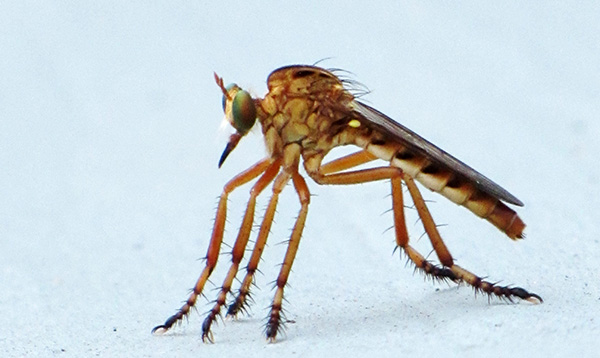
Robber Fly

Wouldn’t it make a magnificent sci-fi monster?

Robber Fly August 12

(According to the Encyclopedia of Life website, there are over 100 species of robber flies in Virginia…)

Robin Nestlings

Robin August 4

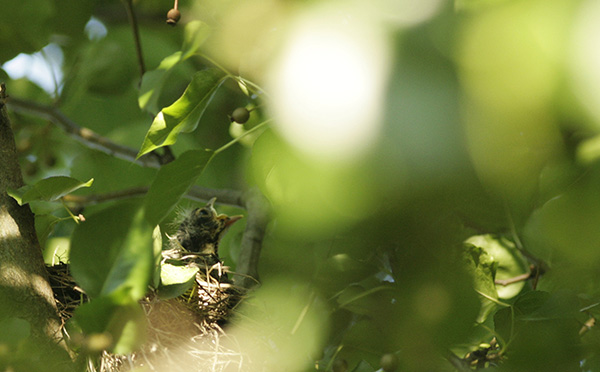
The nest is high in the pear tree, almost too high to photograph.

Robin August 4

But if I stand in the right spot and hold my camera at the right angle, I catch glimpses of the nestlings. Sometimes the parents, too.

Robin August 4

Robin August 4

Yesterday, with the help of a tripod, I managed a few video clips.

The robin nestlings have held much of my attention recently, but a few days ago I stepped away from the nest long enough to set up a Twitter account…

June Bugs in August

June Bug August 2

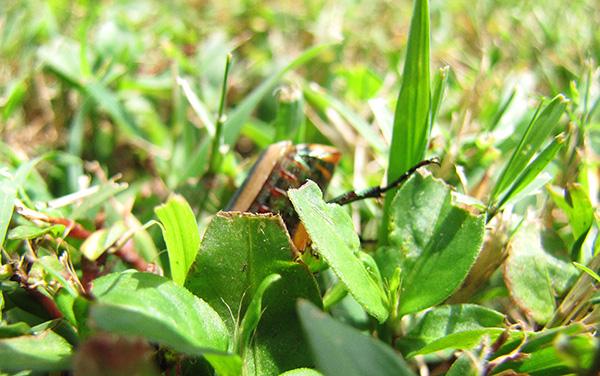
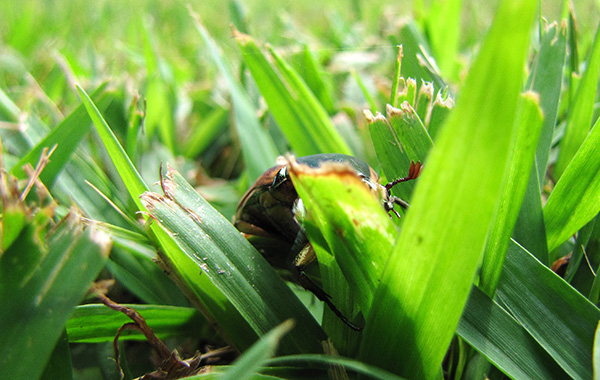
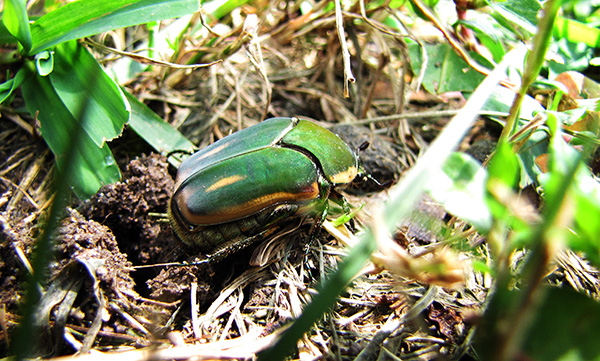
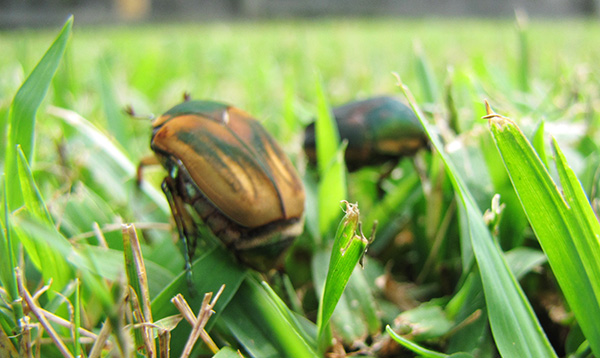
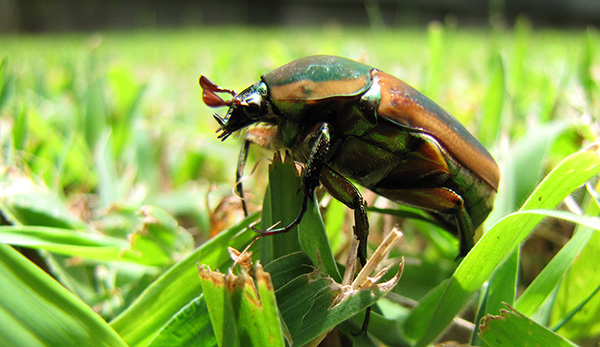
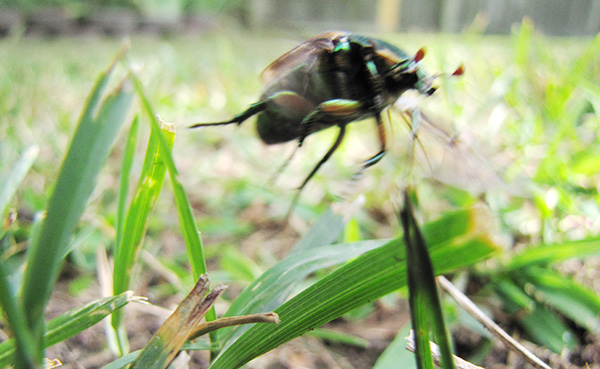
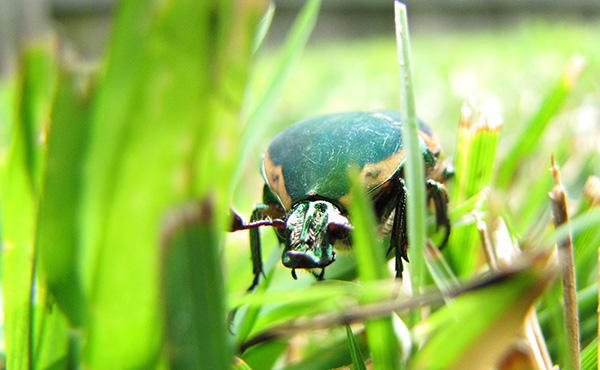
Last year marked the first appearance of June bugs (Green June Beetles) in the yard. I was delighted by their unexpected arrival, but also confused. Where did they come from? What changed in our local environment, to bring them in such numbers after over a decade of conspicuous absence?

June Bug August 2

They’re back this year, in even larger numbers. I’m happy to see them, and I’m somewhat mystified by the number of resources that call them pests. This page at the Penn State Entomology website provides a detailed list of potential damage caused by the June bugs’ grubs. Reading through the list, it seems to me that most of the effects are cosmetic.

June Bug August 2

Mounds and tunnels are one of the major complaints. For me, these small blemishes in the yard are exciting evidence of life.

June Bug August 2

This article from the University of Georgia indicates that a more serious problem may arise if the grubs’ tunnels disrupt root networks, but also says, “A small amount of green June beetle tunneling can help aerate the soil and be beneficial…”

June Bug August 2

As I was growing up, I heard over and over again how June bugs bring moles into yards, because moles eat grubs. This article from the North Carolina Cooperative Extension argues that moles are more attracted to earthworms than grubs, and, since earthworms tend to indicate a healthy lawn, moles might be considered to also indicate a healthy lawn. (I confess that I would be delighted to find a mole in our yard. More life!)

As for June bugs, the article counsels patience rather than intervention. (I should point out that the article was published in 2006, which means it may not reflect current recommendations. I couldn’t find a more recent reference regarding the connection between June bugs and moles, other than this similar article from 2007. Please comment, if you find something newer!)

Patience is not one of my foremost virtues. Fortunately, in this case no patience is required of me. I have no wish to rid the yard of June bugs. In fact, I hope they stay a bit longer. And come back next year.

June Bug August 2

Because they remind me of childhood, when summers were filled with long hours of happiness.

June Bug August 2

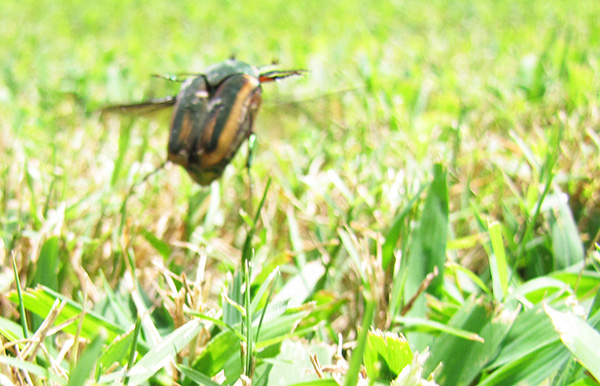
And because I want to keep trying for the “perfect” June bug photo…

June Bug August 2

Wren Changes

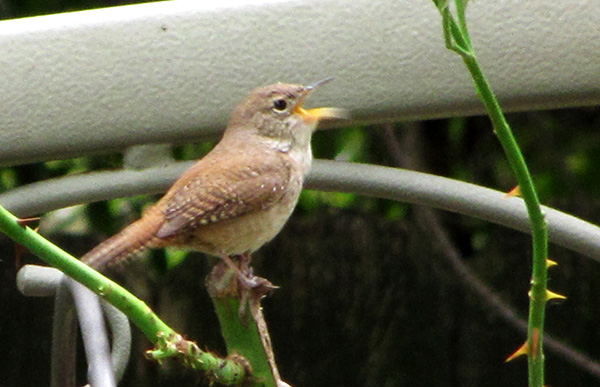
The house wren spent weeks perfecting his nest. He added twigs until no more twigs would fit, then filled the spaces between twigs with bits of spider web and grass clippings. As he worked, he sang.
Wren June 19

Several female wrens visited during those weeks. They hopped around the yard, inspecting all of the nest boxes and gourds, scolding the male when he got too close. The male wren reacted to these visits with a barrage of high-pitched calls, fluttering from perch to perch as he tried to lead the females to “his” nest.

Finally, one of the females decided to stay. She finished the nest over a period of three or four days, spending longer and longer inside the nest box each day.

Then I woke one morning to a furious battle. A new wren had arrived, and all three birds were fighting. By mid-morning, the new wren had driven the nesting pair away and destroyed their eggs.

Egg July 20

Egg July 20

The new wren visited each of the gourds and nest boxes that day, adding twigs to all of them. More than once I saw him remove twigs from the old nest and carry them to one of his new nests. He seemed particularly fond of the gourds, which the other wren had largely ignored.

I suspect the first wren was a very young male. He put all of his efforts into one nest, while most sources indicate that male wrens typically build several nests at once. He also seemed thoroughly over-excited whenever a female appeared in the yard, smothering them with enthusiasm.

By comparison, the new wren is calm and sedate. His sings less, and his song is softer. He follows females, when they appear, but does not flutter and scold as they investigate his nests. This afternoon one of the females began adding material to the old nest, and he let her work in peace. He watched, singing occasionally, but stayed out of her way.

Wren July 30

I’m fascinated by the new wren’s behavior, which seems like a paradox to me. He arrived in a whirl of aggression, complete with egg destruction, but his activity since has been passive. What triggered his initial invasion? And will he be able to hold the nest he won?

Wren July 30