Anaxyrus (formerly Bufo)*

Toad May 2

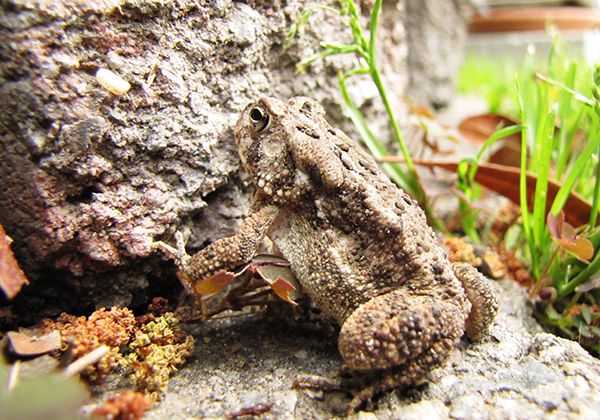
Early in May I found this little toad while I was mowing. After taking a few photos, I helped it into a flower bed and continued mowing, planning out a blog post as I made circuit after circuit around the yard.

I thought it would be a fun exercise to identify my toad. In the past, I’ve had good luck identifying reptiles and amphibians using the information provided on the Virginia Herpetological Society’s website, so I started there.

Have a look at this page from the website, which outlines the anatomy of a toad’s head, particularly the cranial crests, postorbital ridges, and parotid glands. The next page illustrates how these structures help identify three of the six species of toads found in Virginia.

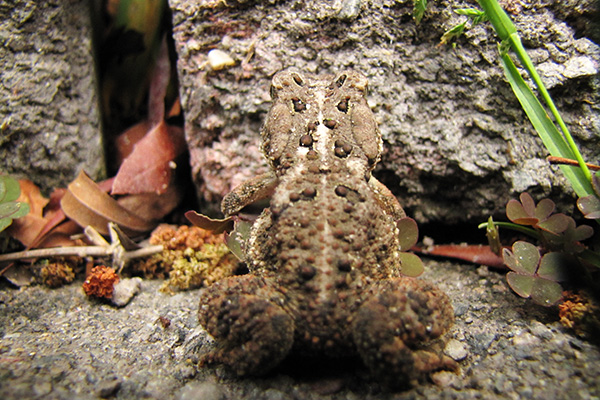
Based on a visible (but not prominent) cranial crest, I narrowed the list of possibilities to either an Eastern American Toad or a Fowler’s Toad. But the pertinent detail for separating these two species, whether or not the postorbital ridge contacts the parotid gland, was not discernible. Falling back on secondary characteristics, I spent some time counting the number of warts in each of the toad’s spots. One or two warts per spot indicates an Eastern American Toad, while Fowler’s Toads have three or more. My toad had one or two in most of its spots, but three in a few. Since the two species are known to hybridize, was this inconsistency enough to identify my toad as a hybrid?

Two of the other listed characteristics aren’t visible in my photos. I can’t say whether my toad had spots on its chest and abdomen, nor if it had any enlarged warts on its tibia. (No enlarged warts are visible in my photos, but the photos do not show the full length of both tibias.)

Having exhausted my vague knowledge of toad anatomy, but still without a definite identification, I was curious as to whether an expert might have better luck. I sent my photos to the Virginia Herpetological Society’s e-mail identification resource, and their prompt response said my toad was likely a Fowler’s Toad. But they added a note: “Toad ID can be a bit tricky…”
Toad May 2

* In the last decade, genetic findings have shaken up the world of toad nomenclature. One of the changes removed some North American toads from the genus Bufo and shifted them into a new group with an old name, Anaxyrus. This article provides a good overview. So, for most of my Virginia toads, Bufo has been reduced to a parenthetical:  Anaxyrus (formerly Bufo). I feel a bit bereft, as Bufo was one of the few genus names I had bothered to memorize, but I suppose Anaxyrus is easy enough to remember. Except, I’m not quite certain why I would ever need to remember the genus names of North American toads…

A Mammal Mystery (and a Dilemma)

This week I spent two afternoons at Back Bay National Wildlife Refuge. The first visit was cold and windy with heavy, low-hanging clouds. My photos from that day are grainy and blurred, including several photos of a rather large mammal crossing one of the many open areas of water.

Nutria

At first I thought the creature was an otter. It was too big to be a muskrat, and the habitat was wrong for beaver.

But, what about the shape of its head? Doesn’t look like an otter’s head…

Nutria

Which leaves me with nutria. (Please comment if you can correct or confirm my guess!)

Nutria

I returned the next day, lured by warmer temperatures, clearing skies, and continuing curiosity. The animal wasn’t there when I arrived, so I walked the other trails for a few hours and circled back at sunset for one more try. By then the light was even worse than the previous day, so I almost missed the familiar form. Forms, because there were two.

Nutria Nov 5

I took a few photos, though I knew it was too dark for my camera’s lens, and I was on the point of leaving (the refuge closes at dusk) when smaller versions of my mystery mammals appeared.

Nutria Nov 5

The waning light defeated my camera, so all I have to share are shadows and silhouettes. My photos don’t show how the young animals played in the water, how they chased each other in widening ripples. How they ventured into open water, then hurried back to the safety of their parents.

I watched, enthralled, until the sun’s light disappeared completely. The scene was charming. Baby animals are always charming.

Except, in the case of nutria, charm quickly fades.

I have mixed feelings about eradication programs aimed at invasive species. Nutria undoubtedly wreak havoc on marsh ecosystems, but what are the chances they can be eradicated permanently? And what is the cost? The bottom line is that all ecosystems change. Coastal ecosystems, in particular, are under immense pressure. Can we hold back the tide? Should we? I’m not proposing that we do nothing, but I suspect eradication is not a sustainable goal.

Fall Leaves and Space Vehicles

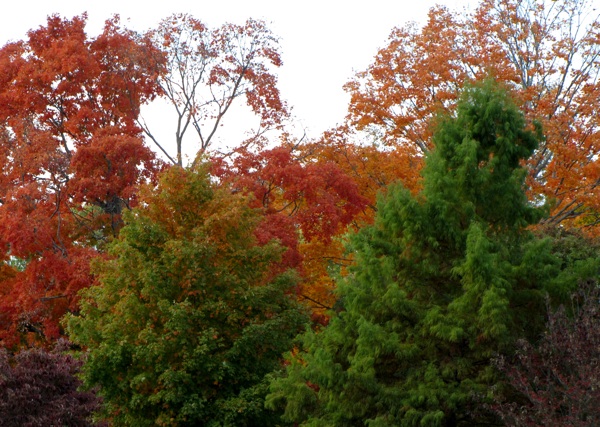
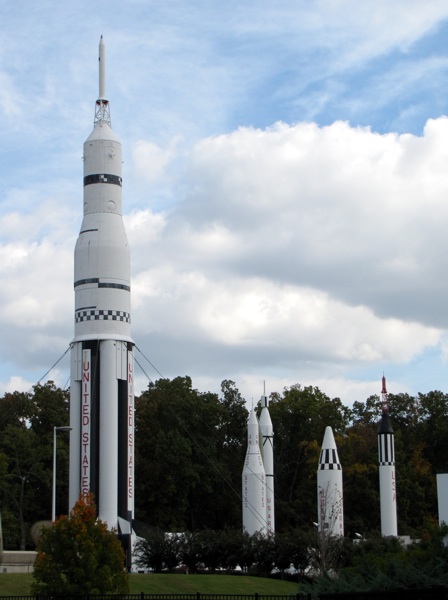
The autumn leaves were beautiful today, but it’s hard to focus on trees when there are rockets and a Space Shuttle in the background.

During my college years at The University of Alabama in Huntsville, I grew accustomed to a landscape that included space vehicles. Today, standing at the foot of the original Saturn V lunar rocket, I experienced a wave of renewed awe.

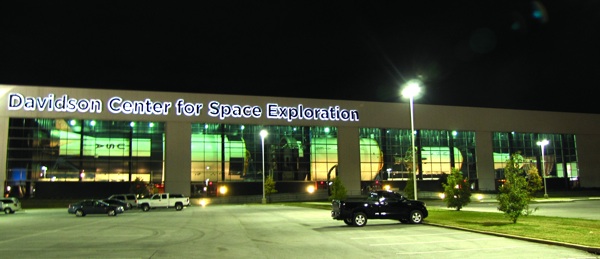
(Photos taken at the U.S. Space and Rocket Center.)

Another Cicada Molt

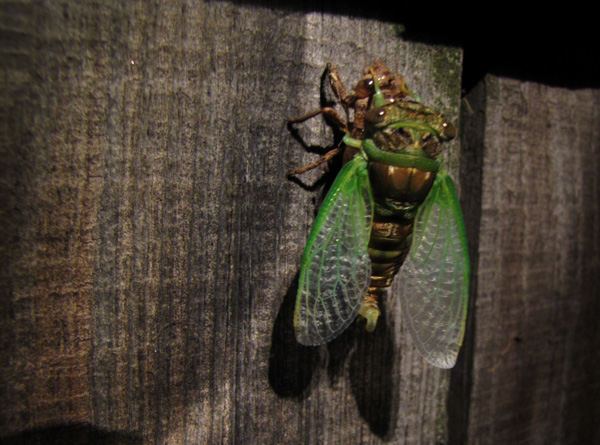
Last night, I wandered outside around nine-thirty. A thin layer of clouds framed the moon, a cool breeze stirred the leaves, and the yard smelled like fresh-cut grass. I meant only to enjoy a late night ramble with the dog. So I was unprepared for this molting cicada. No camera. No shoes. No mosquito repellent.

After a few chaotic moments of rushing from room to room, tripping over the excited dog (she didn’t understand our new game, but did her best to play along), and dropping things that are too fragile to be dropped very often, I made it back to the fence in time to catch most of the molt.

My only regret is that I couldn’t find the mosquito repellent…

Luminiferous Ether

Luminiferous Ether

They imagined a substance
Something made and measurable
That transmitted light
Bore the spectrum from shore
To shore, from planet to planet

Star to star they embraced
Aristotle’s ether, confounded
By the idea of waves
Crossing a sea of nothing
To a boundary that moves

Receding edge of confidence
Calculated into stability
Into constancy, a cosmological
Solution to infinity, dark shadow
Of mass ungrasped, cast across

Galactic coordinates and mapped
Against math, logic to simplify
The special fields of time and space
Elegant descriptions of the refuted
Ether, the vacuum tension condensed

Intelligible, static notation collapsing
Observation and paradox
Particulate light and magnetic
Matter graphed into balance
The observable universe illuminated
By luminous equations