The Yard’s First Monarch Butterflies

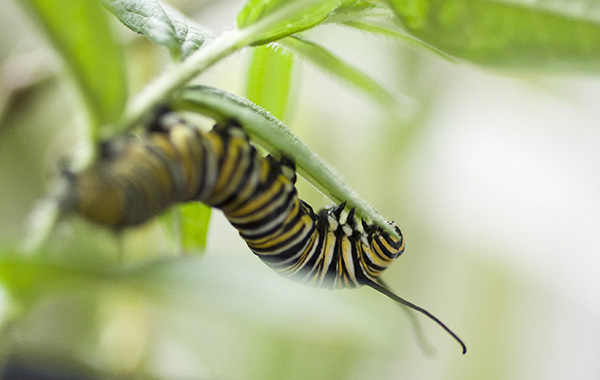
Monarch Caterpillar Sept 23

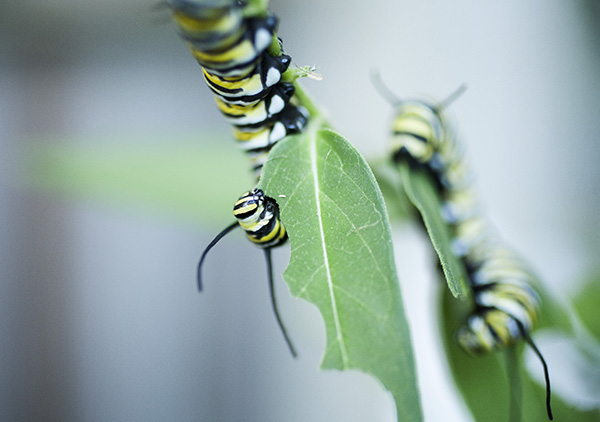
Butterfly metamorphosis is one of nature’s most spectacular spectacles. I’ve always wanted to see the whole cycle, and this fall the yard cooperated. It started with nine caterpillars feasting on the milkweed.

Monarch Caterpillar Sept 23

Monarch Caterpillar Sept 23

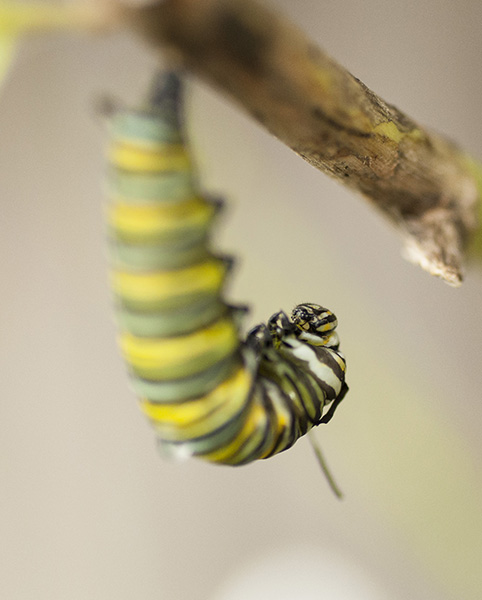
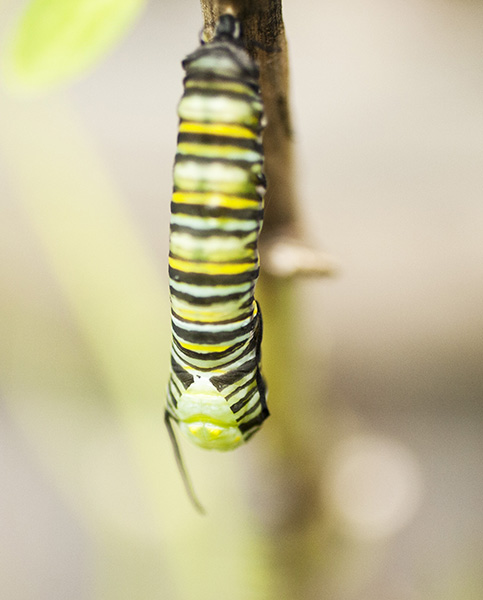
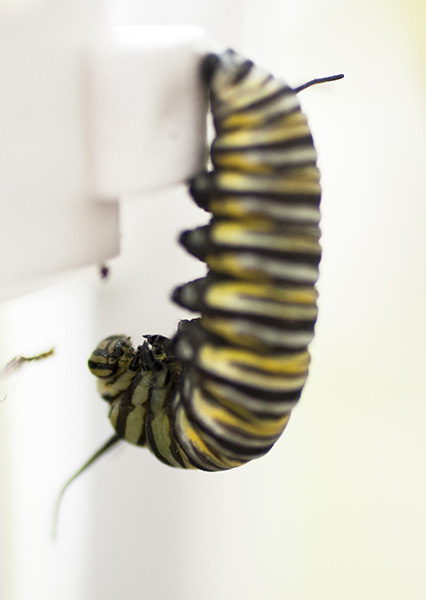
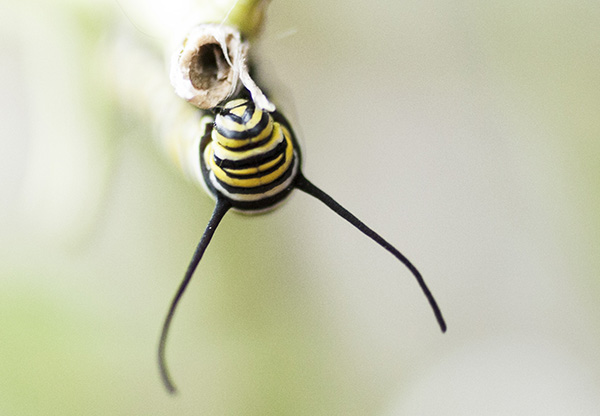
Five survived to maturity. One by one they stopped eating, anchored their last pair of legs with silk, and slipped into the characteristic upside-down pose that precedes a monarch caterpillar’s final molt.

Monarch Caterpillar Sept 25

Then they began their transformation.

Monarch Caterpillar Sept 25

Monarch Caterpillar Sept 25

One died before completing its molt…

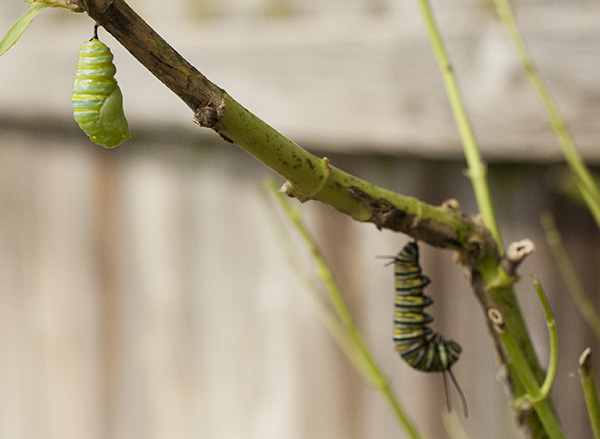
Monarch 5 Chrysalis Sept 30

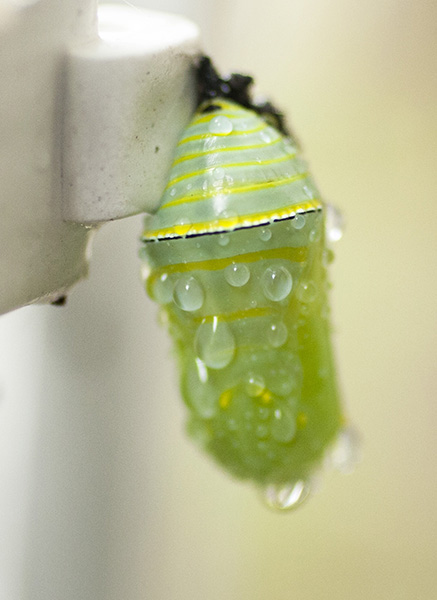
…but the other four safely hardened into chrysalises, where they remained for the next two weeks.

Then:

This slideshow requires JavaScript.

One by one they emerged, the first during the morning of October 10th and the last close to noon on October 11th.

This slideshow requires JavaScript.

I was too excited to remember my camera, most of the time, so I only have a few photos for three of the four.

This slideshow requires JavaScript.

But I managed to capture a full sequence for one of the monarchs. The following slideshow covers a period from September 25th to October 11th.

This slideshow requires JavaScript.

All four butterflies struggled in their first moments of flight, crashing a few times as they tested their wings.

Monarch 4 Oct 11

Monarch 4 Oct 11

But after a few hours of short flights with long rests between, all four took to the air and fluttered off in search of nectar.

Monarch 4 Oct 11

I wished, in the moments after watching them leave the yard, that they might stay a while longer. Then I took a deep breath and wished them warm winds to ease their southward journey.

Monarch Caterpillar Sept 24

Whatever fate finds my four butterflies, their brief weeks in the yard contributed something permanent and lovely to my world. I hope they thrive during their long migration, and I hope they stop as often as possible, each time bringing something lovely into someone else’s world.

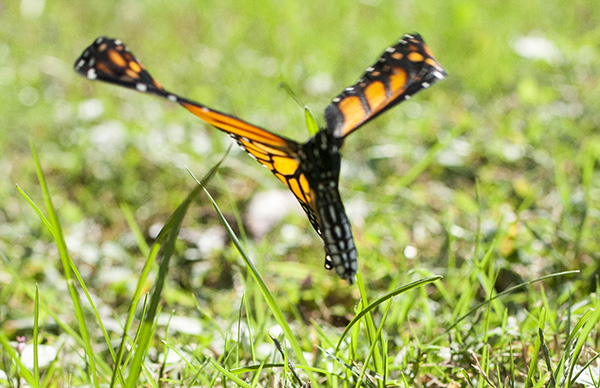
Monarch 1 Oct 10

Yard Surprises and Writing Surprises

When the wild rabbits ate multiple sets of coneflowers this summer, I allowed myself one final purchase before freezing the garden budget. I bought milkweed for the monarchs. More specifically, I bought swamp milkweed. Which the rabbits promptly ate.

Rabbit Aug 12

Milkweed is toxic, so I don’t know how the rabbits were able to eat it without getting sick. Far from getting sick, they ate until every last leaf was devoured. Fortunately, by the time the bare stalks recovered enough to put on new leaves, the rabbits had tired of milkweed.

I assumed (such a dangerous verb) that my milkweed’s season had passed, that it would see no monarch activity until next summer. I was wrong, as I discovered on Monday.

Monarch Caterpillar Sept 22

There were nine caterpillars when I found them. One disappeared by nightfall on the first day and another died during the night, but seven continued to gorge on the milkweed’s leaves.

Monarch Caterpillar Sept 22

Monarch Caterpillar Sept 22

On Tuesday, one caterpillar decided it was time for wings. It hung from its back legs all afternoon and evening, twitching every so often, swaying in a storm-front breeze. I waited and waited, hoping to see it molt into a chrysalis, but when night came it was still a caterpillar.

Monarch Caterpillar Sept 23

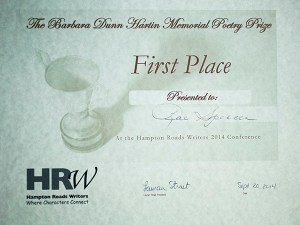
Prior to finding the monarchs, I spent Thursday evening, all day Friday, and most of Saturday at the 6th Annual Hampton Roads Writers Conference. This year I went to sessions about the mechanics of fiction and nonfiction, the world of independent publishing, and twitter. (Yes, twitter!) I made new friends and took reams of notes, and on Saturday my poem “The Tracking” won first place in the 2014 Barbara Dunn Hartin Memorial Poetry Prize!

Poetry 1st Place

Then my fantasy short story “The Silvershaper” won third place in the 2014 Frank Lawlor Memorial Fiction Prize!

Fiction 3rd Place

Best of all, the conference brought an epiphany regarding my unpublished fantasy manuscript. A trio of sessions about story openings, plot, and voice uncovered the root of a pacing problem in the first five chapters. It’s a problem I can fix, now that I can see it.

As exciting as awards and epiphanies are, they represent a small part of my writing experience. They’re like finding monarchs in the yard, flashy glimpses of wonder. Most of writing’s surprises are quieter discoveries. Accidental phrases open new perspectives; plots turn slippery and skid off in unexpected directions; sub-plots bloom into stories of their own.

Those are the happy surprises. Unpleasant surprises happen, too. Failed poems, unresolvable stories, harsh critiques (which I’ve found are more common online than in person), lost submissions, and sudden doubts so ferocious that success seems impossible. These are like rodents moving into my wren house.

Rats Sept 21

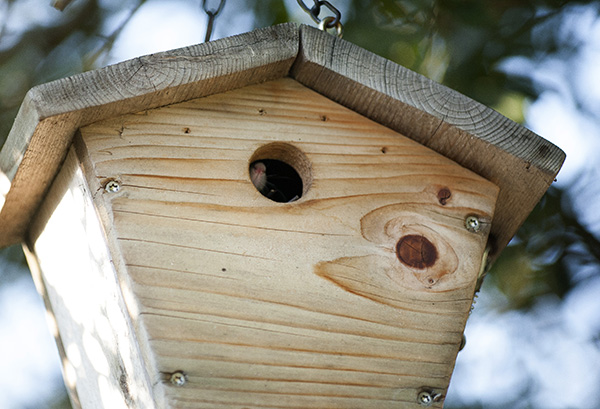
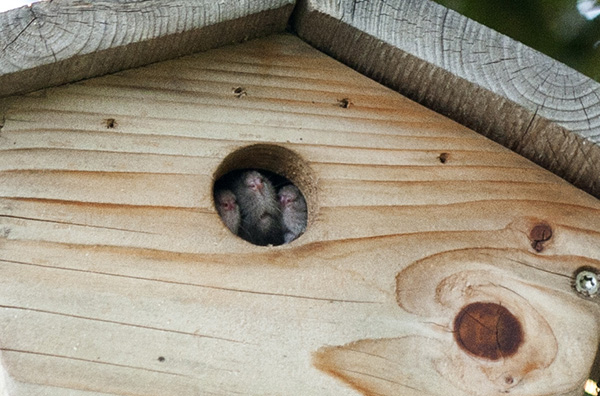
(When I spotted movement in the wren house on Sunday, I hoped for a late-season nest. I should have been more specific and hoped for a bird nest. Luckily, the rodents didn’t stay.)

Rats Sept 21

Rats Sept 21

Rats Sept 21

Were I allowed to choose my yard and writing surprises, I would always opt for monarchs and awards. There would be no lost submissions, no anxious waves of doubt, and no unwelcome rodents*. So perhaps it’s best that I’m not allowed to choose. Because if yards were made only of monarchs and writing meant only awards, think of all the stories that would never be told.

Monarch Caterpillar Sept 24


* I had a pet rat, when I was a teen, and a pair of pet mice during college. I find it hard to despise rodents, but in my alternate reality the rats and mice would all be free of diseases. And they would clean up after themselves. No more breaking into pantries for food, no more trails of droppings and urine, no more Hantavirus or listeria or plague, nor any of the other devastating illnesses mice and rats carry in the real world.

Yearning for Butterflies

Butterfly June 18

It’s been a slow year for butterflies in the yard. (And in other yards, as noted in the comments section on this recent post.) There were no butterflies at all in May, and in June the only visitors were a few skittish Gray Hairstreaks. They took brief sips from the hydrangea, then flew away in search of better nectar.

As July grew hotter and hotter, I caught glimpses of larger butterflies fluttering high overhead, but they never stopped in the yard. Our new butterfly bush bloomed in vain, and the praying mantis lurking among its branches eventually moved into the nearby irises.

Praying Mantis July 28

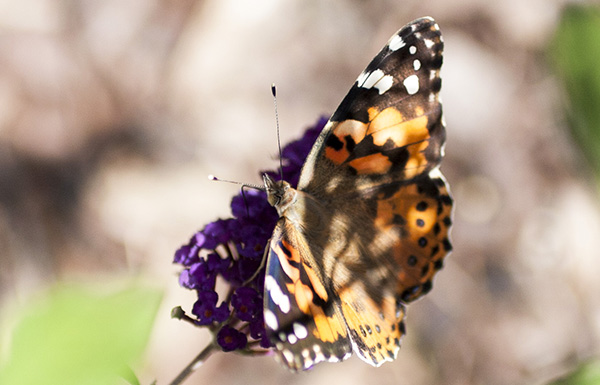
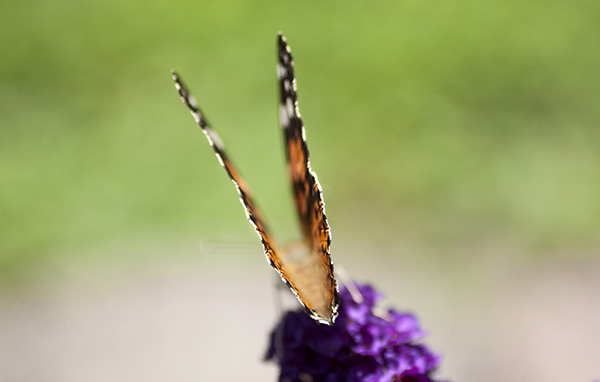
Finally, late in July, I spotted a Painted Lady.

Butterfly July 25

Butterfly July 25

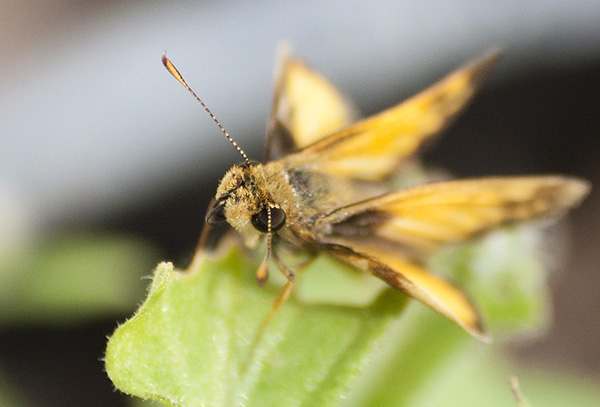
A skipper arrived the same day, the first of an unexpected abundance of skippers. In past years these small butterflies were rare in the yard, but they seem to find the butterfly bush irresistible. Now I see them almost daily.

Butterfly Two July 25

I haven’t been able to identify any of the skippers in my photos. The closest I can get is to say they all fall into the sub-group of “closed wing skippers.”  As always, please comment if you can confirm or correct my identifications!

Butterfly Aug 10

Butterfly Aug 10

Butterfly Aug 11

The only other butterfly I’ve seen in the yard was a faded, torn Common Buckeye. I wondered if its wing damage indicated long, perilous journeys or a single stormy event…

Butterfly July 28

While each new visitor is a hopeful sign, I’m puzzled by the conspicuous absence of Commas and Question MarksRed Admirals, Viceroys, sulfurs, and swallowtails. Others are puzzled, too. A short internet search found several articles detailing decreased sightings of butterflies in eastern North Carolina and Virginia:

Most sources blame the long, cold winter and associated rain, and some cite additional factors such as habitat loss and pesticide use. Whatever the cause, I hope it is temporary. In the world’s Field Guide to Small Joys, butterflies fill a uniquely delightful chapter.

Butterfly July 25

Poetic Prose: Metaphor’s Impact on Pace

In 2012, brain studies made headlines with evidence that metaphors activate sensory regions of the brain. The implications for fiction writers are readily obvious. If you want your readers to see, hear, smell, and feel your world, you can help them along by using descriptive metaphors. Articles like “The Neuroscience of Your Brain on Fiction” from the New York Times cover the topic in eloquent detail:

The brain, it seems, does not make much of a distinction between reading about an experience and encountering it in real life; in each case, the same neurological regions are stimulated. Keith Oatley, an emeritus professor of cognitive psychology at the University of Toronto (and a published novelist), has proposed that reading produces a vivid simulation of reality, one that “runs on minds of readers just as computer simulations run on computers.” Fiction — with its redolent details, imaginative metaphors and attentive descriptions of people and their actions — offers an especially rich replica. Indeed, in one respect novels go beyond simulating reality to give readers an experience unavailable off the page: the opportunity to enter fully into other people’s thoughts and feelings. (1)

The New York Times article references, in part, research done at Emory University in Georgia. The university’s website describes the methods employed in one of the more prominently discussed studies:

Seven college students who volunteered for the study were asked to listen to sentences containing textural metaphors as well as sentences that were matched for meaning and structure, and to press a button as soon as they understood each sentence. Blood flow in their brains was monitored by functional magnetic resonance imaging. On average, response to a sentence containing a metaphor took slightly longer (0.84 vs 0.63 seconds). (2)

For me, that last detail adds a new dimension to the discussion about metaphor in writing. Metaphors take longer to process. And, while the time lag may not seem significant when applied to single sentences, it adds up over the course of a book. Even over the course of a paragraph.

Here’s the first paragraph of The Last Unicorn:

The unicorn lived in a lilac wood, and she lived all alone. She was very old, though she did not know it, and she was no longer the careless color of sea foam, but rather the color of snow falling on a moonlit night. But her eyes were still clear and unwearied, and she still moved like a shadow on the sea. (3)

A lilac wood? Is the wood made entirely of lilacs? Is it purple? Maybe it smells like lilacs? Perhaps the intent goes deeper than description. Lilacs appear in mythology, flower lore, and in a well-known poem by Walt Whitman. Since there is no rule limiting each word in a text to a single meaning, lilac may mean all of these things. And, no matter which meanings I choose, I am alert for the next metaphors — a series of sea and water images used to describe the unicorn. These make me thirsty for more.

By the time I finish this first paragraph, the book’s opening pace is established. It flows from page to page in unhurried leisure, giving me plenty of time to explore and enjoy the scenery. At the bottom of the first page I’m told, “Unicorns are immortal.” And I understand. They have no need to hurry.

But things change for the unicorn, and for me, on page six.

From that first moment of doubt, there was no peace for her; from the time she first imagined leaving her forest, she could not stand in one place without wanting to be somewhere else. She trotted up and down beside her pool, restless and unhappy. Unicorns are not meant to make choices. She said no, and yes, and no again, day and night, and for the first time she began to feel the minutes crawling over her like worms. (4)

As the unicorn frets, so does the text. The first part hurries along, a straightforward description of restless indecision. Then time slows uncomfortably with “… minutes crawling over her like worms.” Further down the page, I find this paragraph:

Under the moon, the road that ran from the edge of her forest gleamed like water, but when she stepped out onto it, away from the trees, she felt how hard it was, and how long. She almost turned back then; but instead she took a deep breath of the woods air that still drifted to her, and held it in her mouth like a flower, as long as she could. (5)

The road “gleamed like water.” It’s an arresting image, recalling the first paragraph’s water imagery. I expect the road to ripple when the unicorn steps on it, and I share her surprise at finding it solid. I’m ready for her deep breath, because I need one too, but then I am caught by the uniqueness of “…and held it in her mouth like a flower.” Like a lilac? It’s so captivating that I, too, pause as long as I can.

Comparing the two scenes from page six, the second is shorter than the first, and yet it holds more intricacy. I linger, savoring the shorter passage. The first scene is useful and informative. The second is a critical turn in the plot, and its metaphors force me to pay attention as I read.

I could go on and on, quoting page after page of equally wonderful metaphors in The Last Unicorn. They make the beautiful parts more beautiful, the suspenseful parts more suspenseful, and the emotional parts more emotional. They keep me engaged, and they transform a lovely story about a unicorn into a classic.

But how do I apply lessons learned in The Last Unicorn to my own writing? I begin by planning my metaphors better, capitalizing on their ability to engage a reader’s senses, as well as their pace. Too little metaphor renders stories thin and featureless. Too much slows them to tedium. Where will metaphors enhance my stories, and where will they get in the way?

References

1. Paul, Annie Murphy. “Your Brain on Fiction.” The New York Times. 17 March 2012. The New York Times Sunday Review/The Opinion Pages. Web. 9 September 2013.

2. Woodruff Health Sciences Center. “Hearing metaphors activates sensory brain regions.” Emory News Center. Emory University. 7 February 2012. Web. 9 September 2013.

3. Beagle, Peter S. The Last Unicorn. Fourth Printing. New York: Ballantine Books. 1972. Print. 1.

4. Beagle, Peter S. The Last Unicorn. Fourth Printing. New York: Ballantine Books. 1972. Print. 6.

5. Beagle, Peter S. The Last Unicorn. Fourth Printing. New York: Ballantine Books. 1972. Print. 6.
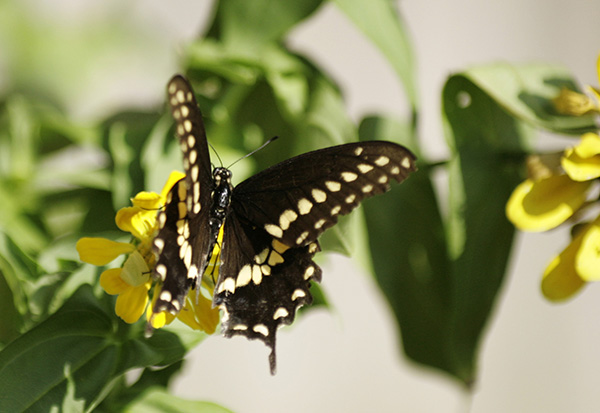
Butterfly Sept 13

“Say my name, then,” the unicorn begged him. “If you know my name, tell it to me.”
“Rumpelstiltskin,” the butterfly answered happily. (pg 10)
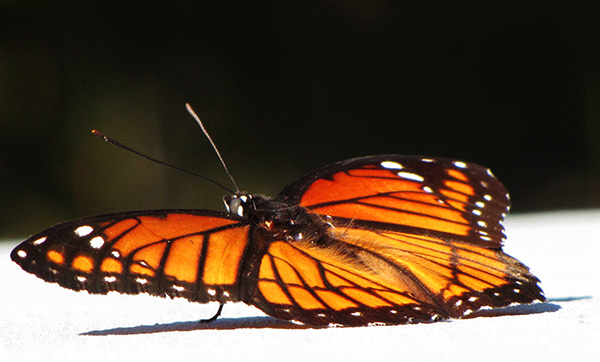
Butterfly Sept 30

You know better than to expect a butterfly to know your name. All they know are songs and poetry, and anything else they hear. They mean well, but they can’t keep things straight. And why should they? They die so soon. (pg 11)
Flecked with Gold

Cicada Wing

A cold front swept through the yard this week, carrying a hint of fall. My mood turned slightly melancholy as I rooted in my closet for sleeves and jeans, as flashes of orange and yellow caught my attention.

Wasp August 15

Butterfly August 4

Butterfly August 15

Butterfly August 15

Bumblebee August 16

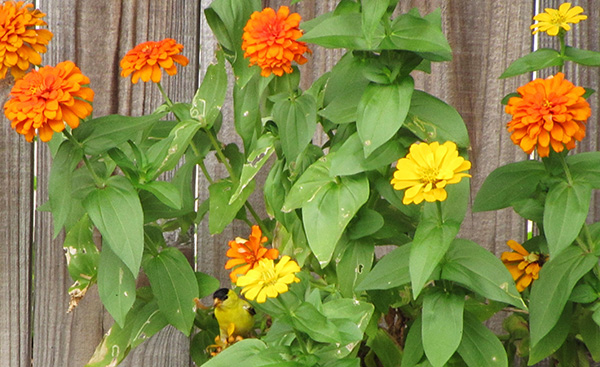
Goldfinch August 16

I’m certain that summer will return next week, as hot and humid as ever. But it’s green cloak is wearing thin, and it’s remaining months will be flecked with gold.

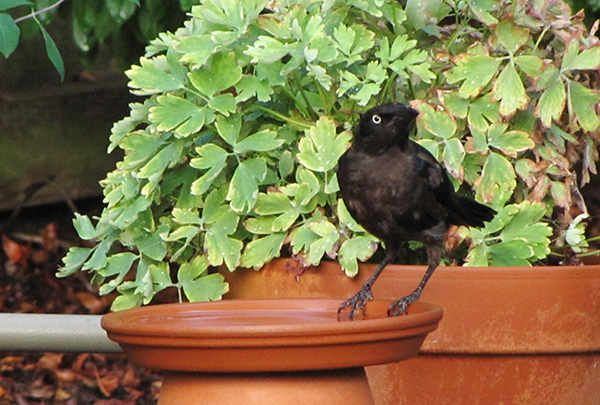
Grackle July 31

Wasp August 15

Green Tree Frog Aug 12