Focusing on Mallards, Part III: Annual Changes in Flight Muscles

Content warning: This blog post contains references to the hunting, agriculture, and research practices of killing birds. If you choose not to read on, I respect and admire your choice.

This multi-part series of blog posts was inspired by a Mallard hen that nested in our neighbor’s yard this spring. After her eggs hatched, the next-yard hen brought her nine ducklings to the dragonfly pond, where we all spent two lovely mornings basking in the relative safety of our tame little yard.

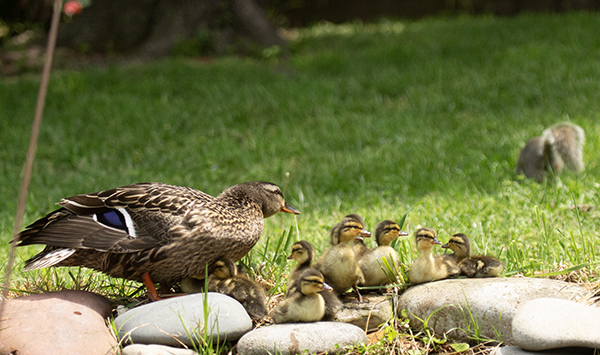
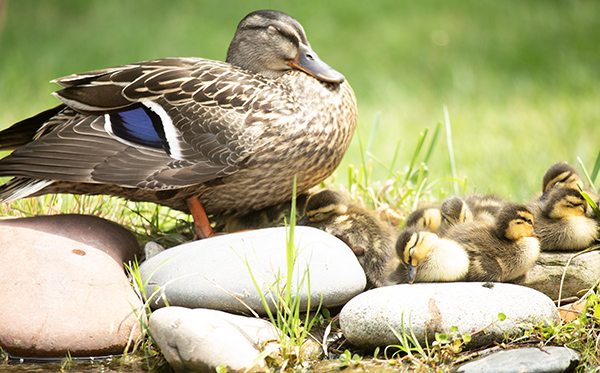
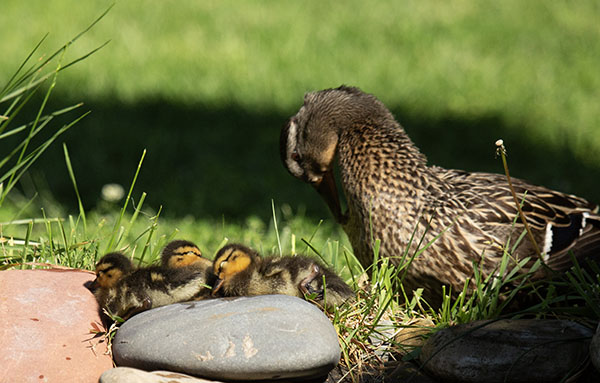
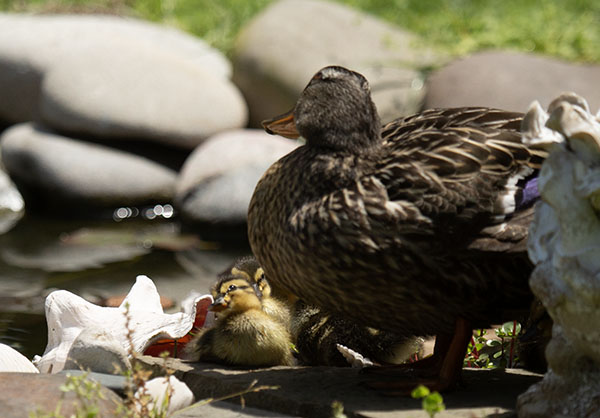
Photo of the next-yard hen and three of her ducklings. The ducklings are sleeping on the stone border of the dragonfly pond after a tiring swim, and the hen is standing in the grass behind them, preening her chest feathers.

As I watched the hen rest and bathe and forage with her ducklings, I developed an obsession with Mallard physiology. This hen had incubated her eggs for almost the entire prior month, weeks and weeks of inactivity broken only intermittently to forage in nearby yards.

What happened in her body during that month? Especially in her flight muscles? After all, if I spent a month in bed, my muscles would deteriorate. And with the hen facing another dangerous stretch of weeks and months shepherding her flightless brood (ducklings don’t fly until they’re about two months old), what else was going to happen in her flight muscles? After three months mostly grounded, how could she fly at all?

Given my penchant for literature searches, I started looking for answers. A half-hour later my keyword nets were empty. Either I was choosing the wrong keywords, or the search engine ocean was empty, as well. But the search engine ocean is not the only source of information out there. Some answers are older than the internet. (Literature search side-quest unlocked!)

Giving up on keyword nets, I defaulted to my personal version of a bootstrapped search. I read through related papers, cherry-picked references that seemed pertinent, found the non-paywalled references, read more, picked more, and continued on repeat. Uncounted iterations later, I’ve devoted more hours to the search than can be explained by interest, alone. My OCD has clearly joined the hunt. (Obsession upgrade unlocked!)

Setting aside mysteries of my own neural wiring and firing, I’ve learned a lot about waterfowl. And about waterfowl physiology. So much so that I’m tempted to call myself a physiology hobbyist. And, like any good hobbyist, my current passions manifest in my blog.

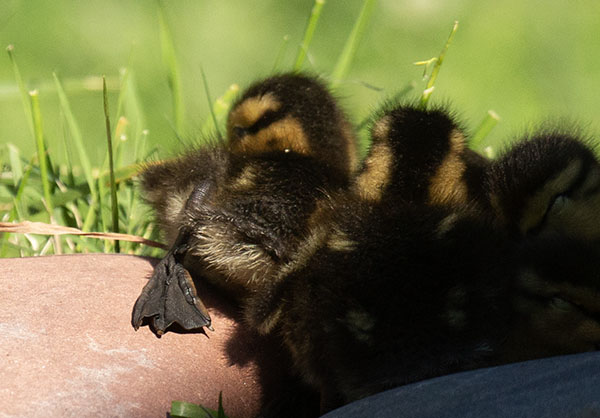
Photo of two Mallard ducklings napping in bright sunshine beside a small yard-art statue. Some intangible and irresistible brew of nostalgia, biophilia, protectiveness, and obsessiveness caught and kept my interest during and after my encounter with this brood of Mallards.

Recap of Parts I and II

In Part I of this post, I described the anatomy of a bird’s flight muscles and shared a bit of personal history that helps explain why I am so fascinated.

In Part II, I defined what I mean by “knowledge”, reflected on the capitalism behind the curtain, sketched out some practicalities about Mallards and other waterfowl, introduced the literature’s euphemisms for “kill” (and also explained my choice to use the word “slaughter”), dipped into background about research numbers and repurposed data, and presented some findings from the literature about variations in the relative masses/sizes of flight muscles.

Here, I’ve harvested from the literature a few articles about annual changes in flight muscle mass in captive Barnacle Geese, wild Great Crested Grebes, wild Red Knots, and wild Mallards.

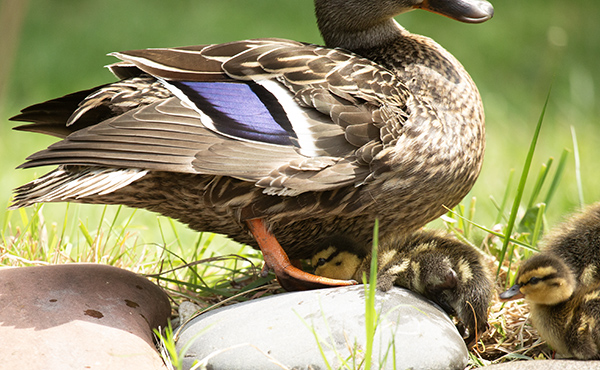
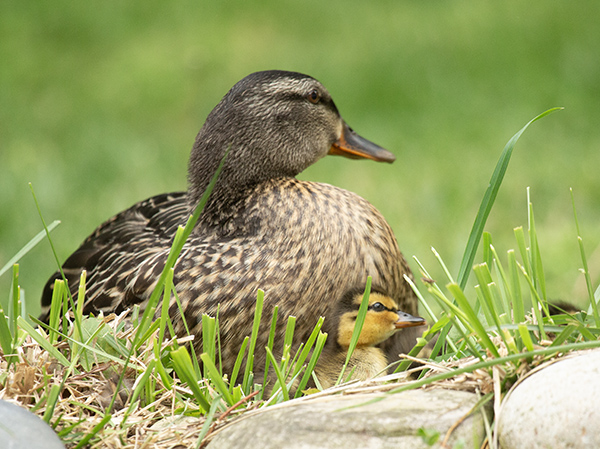
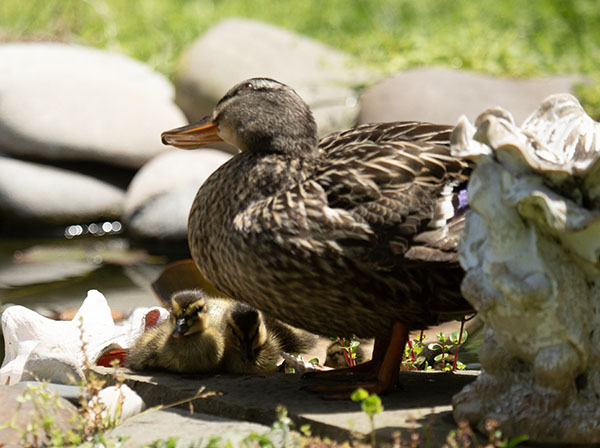
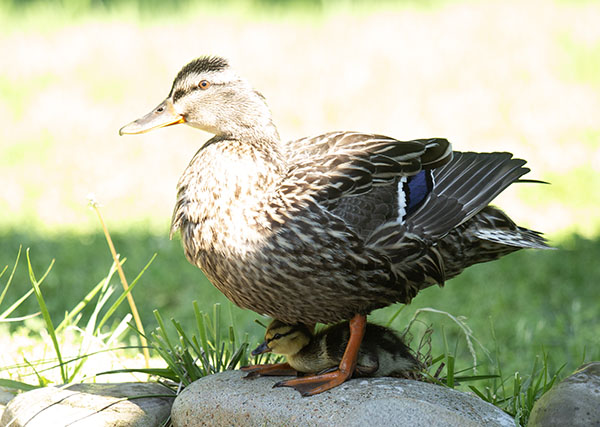
Photograph of the next-yard Mallard hen standing on the rock border of our dragonfly pond. One of her ducklings is crouched beneath her, safely hidden from aerial predators.

Flight muscles and annual cycles

All research is a tangled path, but wildlife research is a centuries long, thicket-strewn snarl of overzealous collection work, Larmarkian and Darwinian scuffles, rogue variables, and funding biases. Most of the research I’m citing here looked at flight muscle changes associated with molt cycles.

In all of the geese, grebes, and knots that embodied the data reported in these articles, the masses of their flight muscles decreased as their flight feathers molted and increased again as the birds regained feathers and flight. For most of the researchers who interpreted this data, these cycles of atrophy (muscle loss) and hypertrophy (muscle gain) were evidence supporting or refuting (for the species in question) a pair of proposed hypotheses.

The use/disuse hypothesis

One simple and obvious (hypothesized) mechanism for muscle gain and loss is use/disuse. When birds fly, they exercise their flight muscles and gain (or maintain) flight muscle through the known benefits of exercise. When waterbirds molt and replace all their flight feathers in a single weeks-long event, they lose muscle during molt because they quit flying. When they begin flying again, muscle returns.

Because simple and obvious tends to prove out (if you’re waiting for the obligatory Occam’s razor reference, here it is), I quickly became a fan of this hypothesis.

The “endogenous trigger” hypothesis

The more complex and less obvious (hypothesized) mechanism is an “endogenous trigger”. Perhaps somewhere in a bird’s body, some tissue or organ follows time (or seasons). Perhaps when the time/season is right, this tissue or organ sends a molt signal to the flight muscles, and the flight muscles begin breaking down. Maybe all that protein is needed for feather production (feathers are, for the most part, protein). Maybe birds with less muscle and therefore lighter body weights will regain flight sooner. Maybe some complex combination of diet, exercise, and behavior before and during molt causes muscle change as a side-effect, not as a benefit.

As complex and less obvious tends to make good storytelling (especially the kind of serendipitous discovery and cautionary tale stories that science loves), I quickly became a fan of this hypothesis, too.

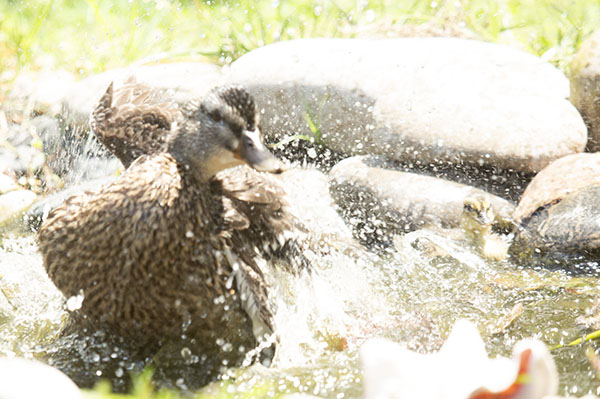
In this photo, the next-yard hen has just settled after a vigorous, splashy bath in the dragonfly pond. Her feathers are ruffled and beaded with water, the feathers of her face and head are soaked, and a single drenched duckling is half-submerged in the last wave churned up by her luxurious bath.

Barnacle geese in molt

In the 2000s, researchers from the United Kingdom followed a flock of captive geese before, during, and after molt (or moult, because the UK).

Portugal et al. (2009) started with 40 adult Barnacle geese that had been bred and raised in captivity. These birds never flew. Their flight feathers were trimmed to keep them grounded in their aviary. Starting in July and continuing through November, the researchers slaughtered (anesthetized, euthanized, and later dissected) four birds from the flock every two weeks, with more frequent slaughter of birds during peak molt.

In this flock of flightless geese, flight muscle mass decreased by more than 35% in the weeks before molt and during the first stages of molt. After the mid-molt minimum, flight muscles started recovering, increasing back to the pre-molt maximum as the geese shed their old flight feathers and grew new feathers.

The researchers achieved this “35%” measurement by comparing the combined and averaged flight muscle masses of the slaughtered birds, four birds at a time. So the first four birds (the earliest data) had a combined and averaged flight muscle mass that was 35% heavier than the dissected and weighed, combined and averaged flight muscles of the four birds slaughtered mid-molt.1

Setting aside (for the moment) the steady depopulation of this flock, there was a timing mismatch between the muscle and feather changes. Instead of flight muscle loss following feather loss (as a “use it or lose it” consequence of flightlessness), the flight muscle loss preceded feather loss.

But why was there muscle loss at all? These geese didn’t fly, so their grounded condition during molt was their default lifetime condition. How could use/disuse factor in, when there had never been use in the first place?

Behavior changed, too

These same Barnacle geese had been observed through the previous year’s molt. “Despite having constant access to food, the captive barnacle geese lost approximately 25% of their body mass during the wing moult in both years of the study” (Portugal et al., 2007, “Discussion”, para. 1). This is a substantial change in body weight for geese with unlimited access to food and water.

“Anticipatory, rather than responsive.”

So these 40 captive Barnacle geese experienced flight muscle loss prior to onset of feather loss, before their behaviors and metabolisms changed. And their flight muscles began recovering prior to feather regrowth, before the geese resumed normal behavior.

“Therefore, these muscle changes give potential for increased or decreased performance but do so in an anticipatory, rather than a responsive fashion” (Portugal et al., 2009, p. 2409).

That’s an unexpected conclusion. These geese were not experiencing a simple and obvious use/disuse effect. This was a complex and less obvious process. A science story waiting to be told. And uncovering evidence of the complexity cost (only?) 40 captive geese.2

What is the value of a few flocks of captive geese?

Returning to my Part II theme of capital, what is the most valuable capital in the paragraphs above? Portugal et al.’s data, which has racked up some 200 citations? The 2007 and 2009 publications, which have been viewed online some 5000 times?
Is the story I’ve borrowed for this post more valuable than the geese? After all, these were fully realized, fully alive adult geese. Portugal et al. noted that 31% of the flock were paired or attempting to breed (2009, p. 2407). They did not note if they slaughtered the pairs together. Would such a consideration soothe my empathy?

And, speaking of empathy…

At what point, if ever, did the behavior and stress-metabolism of the flock—so accustomed to safety, steady population density, and shared companionship—change in response to their sudden prey status and declining numbers?

In this photo, the female Mallard stands watch as two of her ducklings practice hopping in and out of the dragonfly pond. Both ducklings have their stubby wings partially extended. During their two mornings in the yard, the ducklings stretched their wings often, as if practicing flapping, but they also used their wings as tiny counterweights while they balanced on the tricky terrain of seashells and stones around the pond.

Other waterfowl in molt

Between 1978 and 1986, a researcher in the Netherlands (Theunis Piersma) collected the carcasses of 112 adult Great Crested Grebes that drowned in gill nets during the birds’ August–October molt (or moult, because the UK version of English) on Lake IJsselmeer in the Netherlands. Pairing data with observations of the birds’ activity levels before, during, and after molt, Piersma interpreted his findings as use/disuse. As a cycle in Great Crested Grebes in which forced flightlessness triggered disuse atrophy during molt, and return of wing function triggered muscle hypertrophy after molt. (Piersma, 1988) 3

In separate work involving captive Red Knots, reported in 1999 (Dietz et al.) and more in keeping with Portugal et al.’s geese, Piersma (as a co-author with Dietz et al.) concluded a different mechanism was at work. In this instance, the authors concluded that an “endogenous circannual process” (p. 2836) regulated flight muscle changes in Red Knots during molt.4

All of this is good and useful information for researchers interested in captive geese, wild grebes, and captive and wild knots. It is even good and useful information for someone like me, who is dabbling through waterfowl research in search of a simple answer to a complex question about Mallards. It shows different physiological processes at work in different species.

In other words, my Mallard answers can’t be intuited from goose, grebe, and knot research.

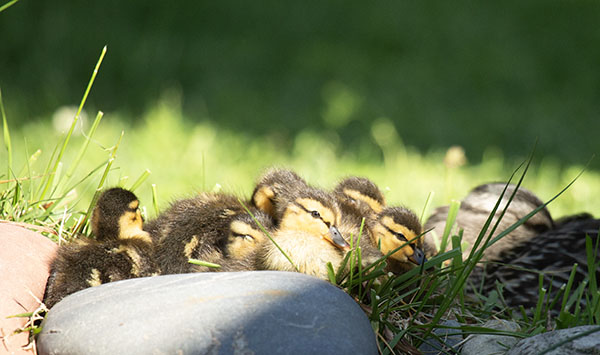
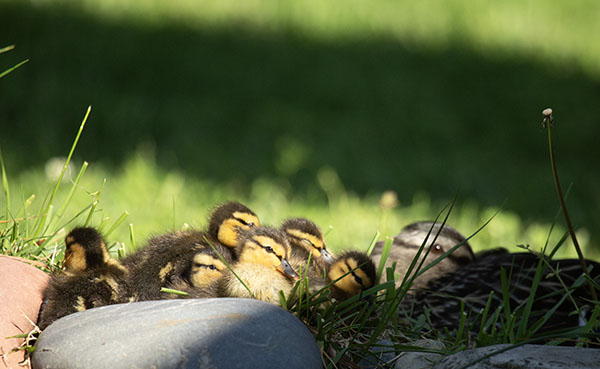
Photograph of the next-yard Mallard hen and her brood settling down for a sunlit nap beside the dragonfly pond. The hen (in the background) has tucked her bill under her wing feathers in a resting pose, but she still has one watchful eye on her ducklings. The ducklings are huddled together, some still awake, some already asleep, and some just in the process of nodding off.

So…the next-yard Mallard hen’s flight muscles?

Simple answers to complex questions are vanishingly rare in any field, but perhaps a complex answer can by synthesized? Have the simple and complex threads of other, related questions about Mallards crossed often enough to create a pattern? (Unnecessary spoiler alert: No such pattern is discerned here. Only more questions.)

And, is molting at all the same as nesting? (No. Obvs.)

I found a significant body of literature regarding flight muscle changes in Mallards during molt, but only a single flight muscle dataset for nesting Mallards in the wild. I expect ethical concerns explain much of the data imbalance. At least, I hope ethical concerns are a factor.

I prefer a world in which nesting and post-nesting hens, along with their eggs and ducklings and awkward teen-ducks, are safe from the traps and slaughter and scales of researchers. Their world is already dangerous enough.

Besides, even if everyone agreed on a single, simple mechanism for molt-related muscle loss and gain in Mallards, it’s unlikely that the consensus mechanism would also regulate muscle physiology during nesting. After all, molt and nesting share few behavioral, metabolic, or seasonal similarities. For the birds themselves, flightlessness may be the only common factor. And nesting flightlessness is, at least during the onset, choice—nesting hens can fly, they simply don’t fly often. Molt flightlessness is forced.

Mallards in molt

Venturing first into Poland, a 1990 article (Panek & Majewski) looked at Mallards in molt on the floodplain where the River Warta meets the Odra River in western Poland. During the time of the study, some 25,000 male Mallards gathered for molt, a population “many times greater than the number of local breeders” (p. 255). Molting Mallards (3,788 males; 341 females) were herded into net enclosures, weighed, examined, and banded, and then released. After periods of 3–9 days, more herding resulted in recapture of 337 male and 13 female birds, which were again weighed, examined, and released.

These efforts allowed the researchers to determine that both the male and female Mallards lost 12% of their body weights during molt. What’s more, whenever new feathers (even just a few new feathers) were damaged enough to require immediate re-replacement, the prolonged flightless period resulted in continued weight loss. In those cases, the continued weight loss couldn’t be blamed on the metabolic demands of massive feather regrowth because only a few feathers were being replaced. (Panek & Majewski, 1990, p. 258)

“In our opinion, limited foraging and the use of body reserves during flightlessness are responses to high predation on dabbling ducks that forage in shallow waters. Secretive behavior and short forays out of shelter minimize exposure to predation” (Panek & Majewski, 1990, p. 258).

But a hemisphere away in Klamath Basin, California, avian botulism has sometimes been a larger hazard for molting Mallards than predation. In some of the basin wetlands between 2001 and 2006, avian botulism claimed as many as 64% of radio-monitored Mallards during molt (Fleskes et al., 2010, p. 214).5 However, after molt, “Hunting was the main cause of mortality for post-molt Mallards both within (16 of 37 deaths) and outside Klamath Basin (six of nine deaths)” (p. 214).

“Increased daily mortality rates of light-weight birds that were captured late in the season during this study suggest some aspect of the molting marsh (e.g., food, water quality, sites safe from predators, predator density) deteriorated as the season progressed causing female Mallards in poor condition to be more susceptible to predation and disease” (Fleskes et al., 2010, p. 217).

Finally, in the Mingo Basin of Missouri, a researcher from the University of Missouri slaughtered a total of 267 female Mallards over the course of three successive winter seasons (1981–1983) (Heitmeyer, 1988). He found that molt timing varied according to age and weather. Adult females molted earlier than immature females, and all of the birds molted earlier in wet winters.

After processing the carcasses, Heitmeyer noted that the birds he slaughtered either before or after molt were heavy, with lipid reserves making up a high percentage of their body weights (1988, p. 673). In other words, the birds Heitmeyer slaughtered prior to molt were healthy and fit and well-prepared for the metabolic demands of molt, and the birds he slaughtered after molt were also healthy and fit and well-prepared for the metabolic demands of migrations to their nesting grounds.

But mid-molt? The Mallards he slaughtered mid-molt were 6% lighter in weight than pre- and post-molt birds. Most of this overall weight loss was due to a 35% decrease in lipid mass (compared to pre-molt birds). So used-up lipid reserves explained 83% of the weight difference between Mallard hens slaughtered prior to molt and Mallard hens slaughtered during the middle of their molt. The hens were losing mostly lipid reserves, not muscle. (Heitmeyer, 1988, p. 673 & “Table 3”, p. 672)

Do these three researches tell a common story?

Not really.

It’s tempting to weave these three researches into an intuitive story about Mallards that reads something along these lines: Mallards lose weight during molt because they hide from predators more and forage less, and their used-up lipid reserves (not atrophied flight muscles) represent most of the lost weight.

But science doesn’t work that way. Nothing does, really. I can’t take the 12% weight loss (Poland), explain it as 83% due to used-up lipid reserves (Missouri), and superimpose an estimate of up to 64% of molting Mallards dying due to disease (California). None of these numbers, variables, or Mallard populations are connected in any rigorous or meaningful way. The only commonalities are the English-language phrase “Mallards in molt” and this sprawling series of blog posts.

Even so, there are tempting threads. Perhaps Mallards in Poland, Missouri, California, and everywhere else actually do lose weight during molt because they hide from predators more and forage less, and perhaps their used-up lipid reserves (not atrophied flight muscles) actually do represent most of the lost weight.

Perhaps Mallards need a third hypothesis, something neither use/disuse atrophy nor annual endogenous trigger. Perhaps if I keep pulling this molting Mallards thread long enough, keep following it deeper into the rabbit hole that I already know doesn’t hold the answer I’m seeking, I’ll find other researchers pulling the same thread. Perhaps we’ll all agree that Mallards need a purely behavioral “hide and fast” hypothesis.

Except it’s time to follow this particular thread back out of the rabbit hole. Whatever mechanisms are at work in a molting Mallard’s physiology, they are (probably) irrelevant to a nesting Mallard’s physiology. (But, as I leave, I’m rolling up the thread metaphor and carrying it with me to the next rabbit hole.)

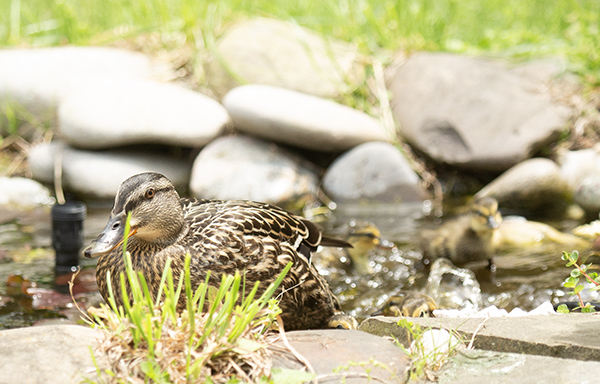
In this photo, the Mallard hen and her ducklings are perched again on the rocks surrounding the dragonfly pond. Most of the ducklings have gathered under the hen, in the enlarged patch of shade that she has made by spreading her tail feathers and slightly opening her wings so that her primary and secondary flight feathers catch a bit more of the sun. Two of the ducklings are several inches beyond the hen's shade, enjoying the sun-warmed rocks.
In this photo, the Mallard hen and her ducklings are perched again on the rocks surrounding the dragonfly pond. Most of the ducklings have gathered under the hen, in the enlarged patch of shade that she has made by spreading her tail feathers and slightly opening her wings so that her primary and secondary flight feathers catch a bit more of the sun. Two of the ducklings are several inches beyond the hen’s shade, enjoying the sun-warmed rocks.

I like the thread metaphor because I like the idea of reality as a giant tangle of skeins. Step up to the skein, find a loose end, and start pulling. This is how some hypotheses unravel and how some hypotheses knot tighter.

But don’t forget that each thread has a price tag. Like a county fair booth where you pay 40 captive geese to pull the first thread. Or a boat full of drowned grebes to pull the next thread. Or, as in the next research, 51 Mallard hens to pull the specific thread I’ve been searching for all along.

Flight muscle changes in nesting Mallards

“By late incubation, females are highly emaciated; 11 live-trapped females weighed during the last 5 days of incubation averaged 900.3 g ± 30.1 g (mean ± SD)6, or 25% less than during prelaying” (Krapu, 1981, p. 31). (For readers accustomed to weights in pounds and ounces, 900.3 grams = 1.98 pounds and 30.1 grams = 0.066 pounds.)

While 11 ducks is a very small sample size, the data suggest that female Mallards lose up to a quarter of their body weight over the course of nesting. But do they lose flight muscles or lipid reserves? Or both?

Along with these 11 hens weighed alive, this study involved capturing and slaughtering 51 other Mallard hens who were at various stages of their nesting cycles: 19 pre-laying hens, 11 laying hens, and 3 hens that had completed the laying process and begun incubating their eggs. Plus 11 hens that were making their first nest and 7 hens that had lost their first nests and begun laying a new clutch.7

Here’s those numbers again, with a bit more context

If you read the previous two paragraphs and experienced a brief or extended period of dissonance, I’m with you. That’s a lot of numbers in just a few sentences. The important numbers, for my purposes, are the 25% weight loss, the 11 weighed hens, and the 51 slaughtered hens. Here’s a list of hens, broken down by how their data were sorted:

  1. Eleven hens were trapped, weighed, and (hopefully) released back to their nests. These 11 hens were nesting within the study area, and each had a nest with eggs due to hatch within five days. All of these hens were in poor body condition (“emaciated”) compared to hens that had been weighed prior to laying.
  2. Thirty-three hens were slaughtered after migrating into the study/nesting area. As the researchers dissected the 33 carcasses, the slaughtered hens were divided into groups based on their ovarian cycles:
    • Nineteen hens had not yet ovulated. These 19 hens were labelled as “pre-laying”.
    • Eleven hens had ovulated and begun laying eggs, but had not yet laid their last egg. These 11 hens were labelled as “laying”.
    • Three hens had laid all of their eggs (had no more eggs developing in their ovaries or oviducts) and had begun incubating their nests, but they were no more than 6 days into their incubation phase. These 3 hens were labelled as “incubating.”
  3. Eighteen hens were slaughtered as their ovaries and oviducts began preparing for egg production, but before their first egg ovulated. (It’s unclear if these hens were counted among the hens sorted by ovarian cycle, above, so I’m counting them separately.)
    • Eleven of these hens were making their first nest. These 11 hens were labelled as “initial nest attempts”.
    • Seven hens of these hens had a “brood patch” (a bald/featherless patch on their chest or abdomen), which was considered to be evidence that they had already completed one nest and begun incubating (brooding). But something had gone wrong with the first nest, prompting the hens to restart their ovarian cycle and attempt a second (or third?) nest. These 7 hens were labelled as “renesting”.

(Did you spot the moment(s) when my OCD winced? There ended up being three different groups that numbered 11 hens. This kind of number coincidence is not exactly common in science, but also not exactly uncommon. My OCD does not like coincidences. It’s safe to say that, in general, science doesn’t either.)

Back to North Dakota in springtime

When Krapu compared the weights of various tissues and organs in his slaughtered hens, the laying hens (layers) had actually gained weight, compared to the pre-laying hens (pre-layers), while the incubating hens (incubators) had lost a significant amount of weight compared to both the pre-layers and the layers.

The idea that Mallard hens might gain weight in the early stage of egg laying makes intuitive sense. Think about birds and eggs and ovaries and oviducts. All of those eggs started as follicles in an ovary. Think about eggs in a nest. They’re certainly bigger than ovarian follicles. After all, each egg has to be fortified with enough proteins and lipids and sugars to build an entire duckling from scratch. So producing a nest full of eggs, ovary to nest, means a female Mallard’s reproductive tract gets huge.

As Mallard hens lay (on average) an egg a day during nesting, their ovaries and oviducts during this time often contain several eggs in various stages of growth from follicle to in-the-shell. Krapu’s data support this intuitive explanation. The layers had massively higher ovarian and oviduct weights than the pre-layers and the incubators. (I’m going to call this their pregnancy weight.)

In comparing hens slaughtered at these three stages—pre-layers, layers, and incubators—three trends of interest (to me) emerged:

  1. The incubators had lost their pregnancy weight, and then some. Their ovaries and oviducts were not only lighter than the ovaries and oviducts of the pregnancy-heavy layers, but were also significantly lighter than the ovaries and oviducts of the pre-laying hens. (Have mercy. Statistical significance is its own hefty topic.)
  2. The incubators’ lipid reserves were nearing depletion. The pre-layers’ total lipids made up some 10% of their overall body weight. For the layers, their total lipids made up about 6% of their body weight. But the incubators, by day 6 of incubation (and with some 3 weeks left to go), were whittled down to the point that their total lipids constituted only about 2% of their body weight.
  3. The incubators’ flight muscles were lighter than the pre-layers’ and layers’ flight muscles, though the difference was not statistically significant.

And what about later in incubation? What about weeks 2–4? With lipid reserves already nearing depletion, muscle would be next on the menu. Thankfully, this research didn’t persist in slaughtering nesting Mallards. There are no numbers for weeks 2–4. But there are numbers for those seven hens that lost their first nests and tried to start over.

The seven renesting hens had already gained and lost their pregnancy weights once, and their body weights reflected the toll. They were about 12% lighter than hens at the same stage of laying a first nest (though they were slightly heavier than the incubator hens). Their lipid masses were only about 3% of their body weights, as they had used up much of their lipid reserves during their first nesting attempts.

And their flight muscles? In all the hens, no matter their nesting count or stage, their flight muscles made up 5–6% of their body weights.

Pre-layersLayersIncubatorsInitial NestersRenesters
Body weight1199.8 ± 781300.6 ± 114.6967.3 ± 44.51217 ± 79.4 1065 ± 54.6
Flight muscle weight65.1 ± 5.665.1 ± 5.558.3 ± 1.965.3 ± 5.660.0 ± 1.9
Flight muscle as rough % of body weight5.4%5%6%5.3%5.6%
Lipid mass109.6 ± 33.779.6 ± 37.217.1 ± 14.7116.4 ± 18.9 29.9 ± 17.4
Lipid mass as rough % of body weight9.1%6%1.8%9.6%2.8%
All weights are in grams. Body weights, flight muscle weights, and lipid masses are quoted directly from Krapu, 1988, Tables 1 & 3, pp. 31 & 35. Flight muscle as rough % of body weight and lipid mass as rough % of body weight were calculated by dividing flight muscle weights and lipid masses by the respective body weights, then multiplying by 100. Should there be any statisticians among my readers, I offer my deepest apologies for ignoring those standard deviations. I was only looking for rough numbers, after all.

Question answered? (No.)

Maybe nesting female Mallards don’t lose significant flight muscle. Maybe used-up lipid reserves and back-to-normal reproductive tracts explain all of that lost body weight, up to 1/4 of their pre-nesting weight. Maybe a nesting Mallard’s flight muscles only atrophy a little? (Unlike Western Grebes in Manitoba, Canada, which lose up to 41% of their flight muscle during nesting—males and females alike (Piersma, 1998, pp. 101–102 & Table 4).)

Maybe. But not likely. After all, the incubators had only been on their nests for up to 6 days. The renesters were still preparing to lay new clutches of eggs, still carrying new rounds of pregnancy weight, and hadn’t started incubating at all. The incubators averaged a weight of 967.3 grams (about 2.1 pounds) and the renesters 1065 grams (about 2.3 pounds).

Somewhere between renesting or early incubation and about 5 days prior to their eggs hatching (3 weeks or so), both incubators and renesters would have been expected to lose more weight. Perhaps even down to the weights recorded for those 11 captured-and-weighed (and hopefully released back to their nests) hens—about 900.3 grams (1.98 pounds).

If statistics mean anything, and if the 11 hens captured and weighed alive were at all representative of North Dakota’s nesting Mallard hens in the spring of 1981, all of the slaughtered hens’ weights would have fallen to about 900.3 grams (1.98 pounds) before their eggs hatched. Another expected weight loss equalling roughly another 7% of the incubators’ and renesters’ body weights. With lipid reserves already diminished, some notable proportion of that 7% would have been muscle.

But, which muscles?

Only the Mallards know.

And I’m content with that answer.

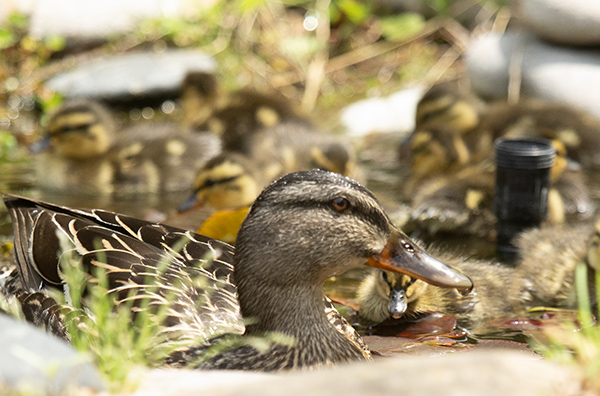
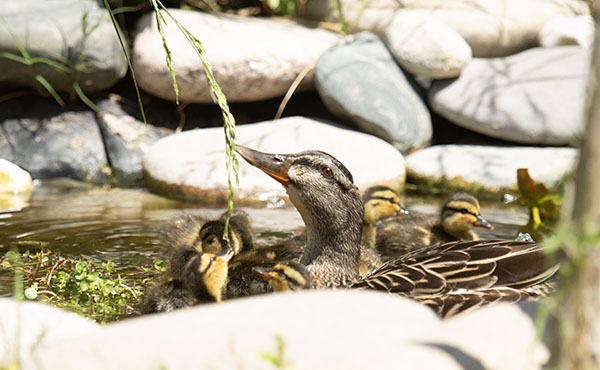
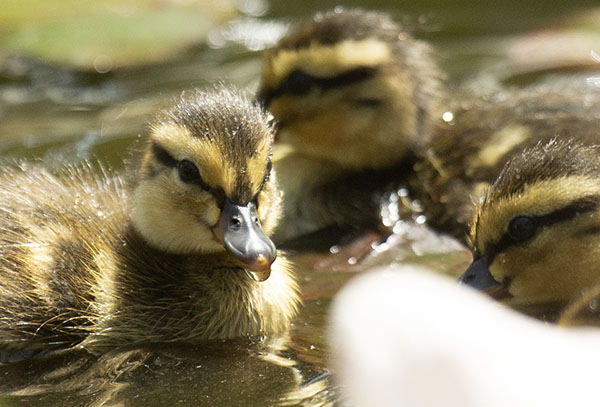
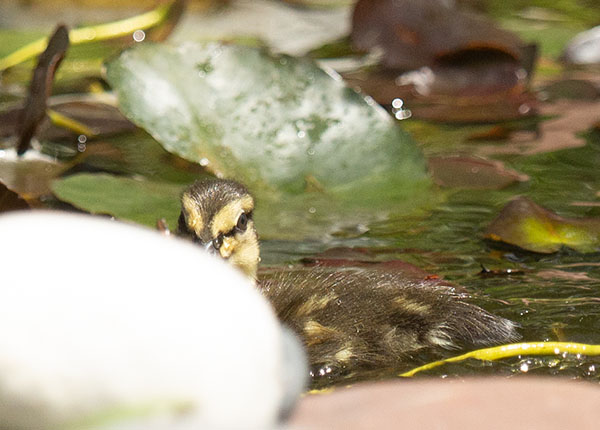
Photograph of the Mallard hen and one of her ducklings floating in the dragonfly pond. Both are keeping one eye on me and my camera. The duckling's down is beaded with tiny water droplets, and the hen's feathers are ruffled and damp from her bathing. Their futures are unknown, as is mine.
Photograph of the Mallard hen and one of her ducklings floating in the dragonfly pond. Both are keeping one eye on me and my camera. The duckling’s down is beaded with tiny water droplets, and the hen’s feathers are ruffled and damp from her bathing. Their futures are unknown, as is mine.

Happily, others are content with that answer, too:

“Wild Mallards breeding under natural conditions are poor subjects on which to accumulate statistically sound population parameters. The species is particularly sensitive to human interference, especially during the brood period. Statements such as ‘unstudied Mallard populations easily maintain themselves’ might be viewed as a general truism. Field workers concerned with duck population dynamics should periodically remind themselves of the Heisenberg Uncertainty Principle (TIME, Canadian Edition 04/15/63, p. 51), ‘the very act of observing or probing a phenomenon changes the phenomenon'” (Dzubin & Gollop, 1971, p. 49).

So, is this the end of these Mallard posts?

Of course not. I have OCD, and I’m perseverating on Mallards. But this is the end of my riff about flight muscle physiology.

The rest of my Mallard series will pull some Mallard hunting threads and some Mallard farming threads, which intersect at ongoing policy controversies surrounding releases of farmed Mallards into the wild.

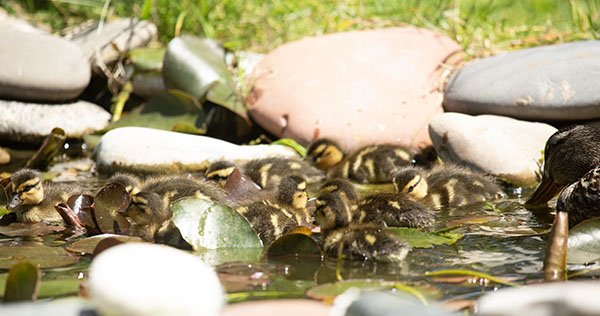
Photograph of the next-yard Mallard's ducklings learning to dabble in the dragonfly pond. All are fluffy and downy and beaded with water droplets. All nine ducklings have little Mallard eye stripes that serve as excellent camouflage in the wild. The eye stripes also provide a touch of exaggeration, in a camera lens, mimicking grumpiness from some angles and endearing curiosity from other angles.
Photograph of the next-yard Mallard’s ducklings learning to dabble in the dragonfly pond. All are fluffy and downy and beaded with water droplets. All nine ducklings have little Mallard eye stripes that serve as excellent camouflage in the wild. The eye stripes also provide a touch of exaggeration, in a camera lens, mimicking grumpiness from some angles and endearing curiosity from other angles.

Notes

1. I spy an uncontrolled variable! Because each two-week data set involved slaughtering four birds, in order to dissect and weigh their flight muscles, each two-week data set is an end point. Those four individual birds couldn’t be followed any further. So comparisons of the data sets, comparing the data recorded for the first four birds against the data recorded for any other four birds, requires an assumption that these birds had no significant individual differences. While this is a well-accepted research method, and while individual differences are unlikely to perturb or confound the conclusions, I’m putting a pin in this “individual variation” variable. (Click here to return to your regularly scheduled paragraph.)

2. Okay, yes, I agree. The geese weren’t the only cost. There is a lot of human labor behind this (and all) research. For the researches reported here, and because I’ve brought it up, it’s worth quoting the authors’ acknowledgments (BBSRC=Biotechnology and Biological Sciences Research Council, UK):

  • “We are grateful to Alan Gardner, Phil Archer, Ben Heanue and Pete Jones, for looking after the geese. We are very grateful to Craig White for practical help with the birds and logistics, and Jon Codd and Peter Tickle for supplying us with anatomy guides. Thanks also to Graham Martin, Theunis Piersma, Caroline Chadwick, Robert Ker and McNeil Alexander for useful discussions, and two anonymous referees for their comments. S.J.P. and J.P.M. were funded by the BBSRC” (Portugal et al., 2009, p. 2409).
  • “We would like to thank Craig White for his assistance with the respirometry equipment and set-up, and for statistical advice. We are also grateful to Alan Gardner, Phil Archer, Ben Heanue and Pete Jones for looking after the geese and helping with the weighing sessions. Thanks also to Peter Frappell for help with software, and Michael Romero, Graham Martin, Jim Reynolds and Lewis Halsey for useful discussions. This work was supported by the BBSRC” (Portugal et al., 2007, p. 1396).
  • Click here to return to your regularly scheduled paragraph.

3. Halfway through wing molt, fewer grebes drowned in gill nets. The author notes that the half-molted grebes must either dive less often to forage or dive less deeply (p. 99). Grebes that drowned during wing molt weighed some 9–15% less than grebes that drowned midwinter, but this decrease in body mass involved mostly a loss of fat mass, which was 53–60% decreased during molt as compared to midwinter fat reserves. Despite the fact that most of the weight loss could be explained by loss of fat reserves, flight muscle masses were 28–30% lower in grebes that drowned during molt. So somewhere in the grebes bodies, some organ or tissue increased during molt, offsetting the muscle loss. The author suggested possible liver enlargement, as the liver processes proteins and feather replacement requires a significant investment of protein. (Piersma, 1988, p. 97) Click here to return to your regularly scheduled paragraph.

4. The authors looked at two subspecies of Red Knot that gather on the Dutch Wadden Sea in August. One subspecies, Calidris canutus islandica, undergoes wing molt in August and overwinters in western Europe and the Mediterranean before migrating to arctic regions in Canada, Greenland, and Svalbard for breeding and nesting (Baker et al., 2020, “Subspecies” para. 3, Dietz et al., 1999). The other subspecies, Calidris canutus canutus, stops on the Wadden Sea in August to build reserves in preparation for a 4500km (about 3000 mile) migration to western and southern Africa, where the birds overwinter (or oversummer, for the birds that cross into the Southern hemisphere) and finish their wing molt in March or April before flying back to Russia for breeding and nesting (Baker et al., 2020, “Subspecies” para. 2; Dietz et al., 1999).

In a rare (in my reading for this post) work that did not rely entirely on dissection to measure flight muscles, the researchers captured four individuals of each subspecies of Red Knot and transferred them into a climate-controlled aviary. Over the next eight months, all eight birds stayed in sync with their wild and free-living counterparts despite their controlled living conditions and forced flightlessness. The four C. c. islandica molted and lost muscle mass in August, in sync with their free-living counterparts (Dietz et al., 1999, Figure 1b,f). The four C. c. canutus gained weight and flight muscle mass in August, in preparation for an extraordinary migration they wouldn’t undergo, then lost weight and flight muscle mass as they molted in January–April, in sync with their own free-living, migrating counterparts (Dietz et al., 1999, Figure 1a,e). (Click here to return to your regularly scheduled paragraph.)

5. Note that “radio-monitored birds” always implies a small study set. Radio and GPS monitoring is expensive, labor intensive, and introduces a rogue variable in that many birds change their behaviors after being harnessed or otherwise burdened with devices. Fleskes et al. started with 181 radio-tagged female Mallards (p. 208). (Click here to return to your regularly scheduled paragraph, already in progress.)

6. Just an aside about those body weights: 900.3 g ± 30.1 g (mean ± SD). It’s math. Read aloud, the notation says “…a mean weight of 900.3 grams plus or minus a standard deviation of 30.1 grams…”. It essentially means that:

  1. The average weight of these 11 ducks was 900.3 g (1.98 pounds).
  2. But the “…plus or minus a standard deviation of…” part of the notation indicates that anyone who wants to use this number to predict how much any other 11 Mallard hens (captured in the same location, at the same time of year, and in the same nesting stage) might weigh, on average, should expect the prediction to be off by as much as 30.1 g (0.066 pounds).
  3. So, if I want to open a county fair booth and guess the average weight of 11 Mallard hens (in North Dakota, in spring, who are incubating a nest of eggs that should hatch within 5 days), I should note in my fine print that as long as I am within 0.066 pounds of the correct number, I win. Then, as long as I always guess 1.98 pounds, I should win more often than I lose.
  4. BUT, given that this number was derived from only one group of 11 hens in 1981, and given that hundreds and thousands of Mallard hens might simultaneously be incubating a nest of eggs that are within 5 days of hatching, in spring in North Dakota in 2025…? I think I’ll keep plugging away trying to earn a living as a writer and editor, because my I Can Guess the Weight of Your Mallards county fair booth is on shaky statistical ground.
  5. If I jump ahead to Table 1 (p. 31), which reports an average ovarian weight for prelayers of 6.3 ± 8.7, I’m in a different statistical bind. That’s a worrying standard deviation number, because if I take the “plus or minus 8.7” at face value, my Guess the Pre-laying Mallard Hen’s Ovarian Weight county fair booth is going to be a hot mess. In this case, my fine print is going to state that I win if I guess within 8.7 grams of the actual weight. Every time I win after guessing a negative number, an interrobang will randomly manifest in a doctoral thesis from the 1940s (!?). (I can’t speak to what, exactly, produced a standard deviation so large that county fair booths and negative ovarian weights intersected in this footnote. Should any readers have ideas, please comment.)
  6. Click here to return to your regularly scheduled paragraph, already in progress.

7. The Materials and Methods section of this paper is disappointing, as it doesn’t clarify where and how the comparison data were selected. The seven renesting hens were compared to a subset of 10–11 “initial nest” hens (Krapu, 1988, Table 3, p. 35), with no indication of whether these comparison hens were also included in the earlier analyses of hens at various laying stages. A close reading finds the Table 3 initial nest hens defined as hens in “rapid follicular development…pre-ovulating females with ovary weights ≧ 3.0 g” (p. 30), but this status should have applied also to some of the hens labelled as “pre-laying” in the analyses for laying stages. The author notes that 71 female Mallards were slaughtered over the course of this study, but the math doesn’t work. At most, even if I’m counting some of the prelayers twice, I get 19 prelayers + 11 layers + 3 incubators + 11 initial nesters + 7 renesters = 51 hens. Where are the other 20 hens? And why are there three (3!?) data sets of 11 hens here? (11 layers, 11 initial nesters, 11 late-nesting hens weighed and, hopefully, released…). My OCD doth protest. (Click here to return to your regularly scheduled paragraph.)

References

Baker, A., Gonzalez, P., Morrison, R. I. G., & Harrington, B. A. (2020). Red Knot (Calidris canutus). Birds of the World (CornellLab). https://birdsoftheworld.org/bow/species/redkno/cur/systematics

Dietz, M. W., Piersma, T., & Dekinga, A. (1999). Body-building without power training: endogenously regulated pectoral muscle hypertrophy in confined shorebirds. Journal of Experimental Biology 202(20), 2831-2837. doi: 10.1242/jeb.202.20.2831

Dzubin, A. & Gollop, J. B. (1971). Aspects of Mallard breeding ecology in Canadian parkland and grassland. Canadian Wildlife Services. https://publications.gc.ca/collections/collection_2024/eccc/cw66/CW66-1042-1971-eng.pdf

Heitmeyer, M. E. (1988). Body composition of female Mallards in winter in relation to annual cycle events. The Condor 90(3), 669-680. doi: 10.2307/1368357

Fleskes, J. P., Mauser, D. M., Yee, J. L., Blehert, D. S., & Yarris, G. S. (2010). Flightless and post-molt survival and movements of female Mallards molting in Klamath Basin. Waterbirds 33(2), 208-220. doi: 10.1675/063.033.0209

Krapu, G. L. (1981) The role of nutrient reserves in Mallard reproduction. The Auk 98, 29-38. doi: 10.1093/auk/98.1.29

Panek, M. & Majewski, P. (1990). Remex growth and body mass of Mallards during wing moult. The Auk 107, 255-259. doi: 10.2307/4087607

Piersma, T. (1988). Breast muscle atrophy and constraints on foraging during the flightless period of wing moulting Great Crested Grebes. Ardea 76, 96-106.

Portugal, S. J., Green, J. A., & Butler, P. J. (2007). Annual changes in body mass and resting metabolism in captive barnacle geese (Branta leucopsis): the importance of wing moult. Journal of Experimental Biology 210(8), 1391-1397. doi: 10.1241/jeb.004598

Portugal, S. J., Thorpe, S. K. S., Green, J. A., Myatt, J. P., & Butler, P. J. (2009). Testing the use/disuse hypothesis: pectoral and leg muscle changes in captive barnacle geese Branta leucopsis during wing molt. Journal of Experimental Biology 212, 2403-2410. doi: 10.1242/jeb.021774

Focusing on Mallards. Part I: The Flight Muscles

While the yard didn’t have its very own Mallard nest, this year, we had regular visits from a hen who nested in the neighbor’s yard. Throughout April, the hen stopped in to graze and have a bath in the dragonfly pond. Then, on the morning of April 30, she brought along her brood of nine.

Photo of a Mallard hen standing beside our dragonfly pond. Almost hidden in her shadow are nine ducklings, huddled for a nap after a busy excursion in the pond.
A Mallard hen (far right) swims with her nine ducklings in our dragonfly pond on April 30, 2024. The hen is mostly in shadow, her head in silhouette as she forages with her brood.

Where I started this multi-part post, and why

Spring often brings Mallards to our yard. March after March, April after April, May after May, pairs of Mallards wander in for a nap or a drink or a meal. Last spring, one pair stayed to nest. This year, there was the next-door nest.

Photo of three downy, day-old Mallards swimming in our dragonfly pond. One duckling faces the camera lens, a drop of water hanging under its bill. The light pink remnant of its egg tooth is visible.

Watching the next-door hen sit her nest day after day, watching her amble into our yard to bathe and eat, I wondered about her flight muscles. All told, with about a month on the nest and maybe two months more until her ducklings can fly, she’s grounded for three months. That’s a quarter of her year. What happens to her vital flight muscles during that time? Are stretching and flap-bathing enough to keep a Mallard’s muscles in flight condition?

As I’ve noted before, I can’t resist a bit of research…

Photo of the Mallard hen enjoying a vigorous bath in our dragonfly pond on April 30, 2024. Here, her head, chest, and wings are lifted out of the water as she flaps furiously against the surface, churning the water into sprays. One of her ducklings (far right) is just visible through the splashes.
Photo of the Mallard hen, still indulging in her vigorous bath. She has moved to the other end of the small pond as she continues to splash with her wings. A duckling watches from the foreground (lower left), safely anchored on the surrounding rocks.
Another photo of the Mallard hen, still bathing. Here she is leaning into her bath, wings clapping against the water hard enough to throw spray under her feathers.
Yet another photo of the Mallard hen, here nearing the end of her bath. She is standing tall in the water facing the camera, wings extended behind her, showing the white feathers on the underside of her wings.
Photo of the Mallard hen stretching her wings after enjoying a splashy bath. She is standing tall in the water, facing away from the camera, both wings at full extension. The tops of her wings are visible, complete with patches of deep blue feathers on each wing.

I haven’t found any research into the changes (or lack of changes) in the flight muscles of nesting Mallard hens. That doesn’t mean this research isn’t out there. I simply haven’t found it. (I’m still searching.) But I did find a lot about flight muscles, and an article about flight muscle changes in molting, captive barnacle geese. (I’ll get to the geese in a later post.)

I’ll start with anatomy, because that always seems a reasonable place to start.

Unless you’re a duckling, then maybe start with the duck version of situational awareness. The world is a dangerous place for Mallards.

Photo of the Mallard hen teaching her ducklings to look overhead for danger. Whenever a crow or hawk flew over, she tilted one eye toward the sky (as seen in this photo) and gave a sharp quack. The ducklings froze in place, when they heard that quack, and they soon began to mimic her skywatching behavior.
Photo of the Mallard hen teaching her ducklings to look overhead for danger. Here, one of the babies is copying its mother's tilt of head, one eye turned to the sky.
Photo of the Mallard hen teaching her ducklings to look overhead for danger. Here, one of the babies is copying its mother’s tilt of head, one eye turned to the sky.
Photo taken the next day, May 1, 2024, after the Mallard hen and her brood returned from spending their first night on the big water. They basked and bathed in our little water for one last calm day, but were not completely free of danger. Here, the hen has flattened herself in the grass at the pond's edge, her wide and wary eye skyward, while a Bald Eagle passed high overhead. This was her most extreme reaction, while I was watching, but it was the ducklings' least attentive response. A few of them glanced upward, but they didn't freeze in place. Instead they continued to fidget and stretch in preparation for a nap. I wondered if they couldn't see the eagle, as it was too high for my camera to find with autofocus.
Photo taken the next day, May 1, 2024, after the Mallard hen and her brood returned from spending their first night on the big water. They basked and bathed in our little water for one last calm day, but were not completely free of danger. Here, the hen has flattened herself in the grass at the pond’s edge, her wide and wary eye skyward, while a Bald Eagle passed high overhead. This was her most extreme reaction, while I was watching, but it was the ducklings’ least attentive response. A few of them glanced upward, but they didn’t freeze in place. Instead they continued to fidget and stretch in preparation for a nap. I wondered if they couldn’t see the eagle, as it was too high for my camera to find with autofocus.

Flight muscles in birds

Bird flight is powered by chest muscles. Each wing needs one muscle to raise the wing and another muscle to lower the wing. Two wings, two muscles per wing, four muscles in total. All in the chest.

Pretend your arms are wings. Now try mimicking flight. Can you feel your chest and back muscles moving? Now imagine you are a bird. All that flying, with only chest muscles at work.

Huh?

Birds have one upstroke muscle per wing…

Photo of the Mallard hen stretching her wings. In this photo, both wings are raised, meaning the upstroke muscles for each wing are contracting (shortening) while the downstroke muscles are relaxing (lengthening).
Photo of the Mallard hen stretching her wings. In this photo, both wings are raised, meaning the upstroke muscles are contracting (shortening) while the downstroke muscles are relaxing (lengthening).

…and one downstroke muscle per wing…

Photo of the Mallard hen, stretching her wings. Here she is shifting from a completed downstroke into an upstroke. The downstroke muscles are beginning to relax and lengthen, while the upstroke muscles are beginning to contract and shorten. Her wings and flight feathers are positioned to minimize air resistance on the upstroke.

…groups of smaller muscles coordinate fine movements of flight feathers and joint angles, but power for flight lies in the muscles of the chest. The downstroke and upstroke muscles stretch, one on top of the other, between the sternum (the breastbone) and the humerus (the first and largest wing bone). One downstroke muscle and one upstroke muscle on the left side of the chest, for the left wing. One downstroke muscle and one upstroke muscle on the right side of the chest, for the right wing. If you eat poultry, these muscles are the breast meat.

Photo of the Mallard hen watching over her brood as they settle for a nap after an excursion in our dragonfly pond. I'm not here to preach against meat-eating, or against hunting. Both are part of the world, and both have been part of my world. But baby duck cuteness is part of why I am happier, here in my middle years, as a herbivore.
Photo of the Mallard hen watching over her brood as they settle for a nap after an excursion in our dragonfly pond. I’m not here to preach against meat-eating, or against hunting. Both are part of the world, and both have been part of my world. But baby duck cuteness is part of why I am happier, here in my middle years, as a herbivore.

Birds’ outermost chest muscles, the ones closest under the skin, are the downstroke muscles. They’re called the right and left pectoralis. They connect the sternum to the humerus on each side. When contracted, or shortened, these muscles pull the wings down. This anatomy is as straightforward as muscular anatomy gets. Sternum to humerus. When the muscles contract, they pull each humerus toward the sternum and the wings go down. A simple mechanism for a simple downstroke.

Flight anatomy gets its magic in the other flight muscles, the upstroke muscles. They’re called the right and left supracoracoideus. These muscles, nestled beneath the right and left pectoralis, also connect the sternum to humerus. But each upstroke muscle condenses into a tendon, as it nears its associated shoulder, and threads through a triosseal canal. A “three bone canal”. This canal lets each tendon emerge behind and over its associated shoulder, essentially passing from chest to back, before attaching to the top of the humerus.

This anatomical upstroke slight-of-hand, accomplished via the shoulder’s “three bone canal”, allows a pair of chest muscles to function like a pair of back muscles. When the upstroke muscles contract, or shorten, they pull the humerus away from the sternum so the wing goes up. An elegant mechanism for a simple upstroke.

Photo, from May 1, 2024, of the Mallard hen taking another vigorous bath in the dragonfly pond. Her ducklings (right foreground) bob on rough water and scatter to avoid being swamped as she churns up waves and spray with her strong wings. All of her wing power rests in her chest muscles.

If you think of a mechanical pulley system, the upstroke tendon would be the rope that runs over the wheel, while shoulder bones would be the wheel. Contracting, or shortening, the upstroke muscle is like pulling down on your end of the rope. The tendon slides over the bones, like the rope sliding over the wheel, and the wing (or the load you are lifting) rises up.

Presto.

The following video makes it much clearer (animation of the supracoracoideus and pectoralis starts at 3:59 and ends at 4:36).

Embedded YouTube video from medical illustrator Kelly Kage. A thesis video about the mechanics of bird flight, the video begins by describing skeletal anatomy, then moves into an animation of flight muscles at about three minutes and fifty seconds. Animation of the supracoracoideus and pectoralis begins at about 3:59 and ends about a minute later, at around 4:36. The entire video is nine-and-a-half minutes long. (I recommend the entire video, when you have time. The animations and narration are excellent.)

Bird flight isn’t exactly magic, but it’s mighty magical.

Why am I so fascinated?

An earlier version of myself, somewhere in my early twenties, taught a single semester of Introductory Zoology lab to undergraduates. (I was technically a graduate student at the time, but only because I needed two graduate courses to complete my prerequisites for veterinary school. I had no intention of finishing a Master’s degree.)

My most vivid memory, from my (thankfully) brief stint as a lab instructor, is the supracoracoideus exercise. I remember the uncanny slip of knowledge and knowing gliding across each other. The cognitive dissonance of trying to imagine a pair of flight muscles on my own chest.

Flex a chest muscle, and the wing goes down. Flex a different chest muscle, and the wing goes up.

Wing down. Wing up.

Chest. Chest.

Photo of a two-day old mallard duckling exercising its wing muscles. Here, with wings raised, the upstroke muscles in its chest are contracting while the downstroke muscles in its chest are relaxed. Photo taken May 1, 2024.
Photo of a two-day-old Mallard duckling exercising its wing muscles. In this frame, the wings are early in the downstroke phase, meaning the little bird's downstroke muscles are beginning to contract while the upstroke muscles are beginning to relax.
Photo of a two-day-old Mallard duckling exercising its wing muscles. In this frame, the wings are early in the downstroke phase, meaning the little bird’s downstroke muscles are beginning to contract while the upstroke muscles are beginning to relax.

[Full disclosure: I was a bad teacher. I was both stupid and ignorant. I feared my human empathy, so I had conditioned myself to ignore the body language, verbal cues, and emotions of people around me. And I never thought to apply imagination to the teaching guide. I never thought to have my students move their own arms and feel their own muscles, then try to imagine the upstroke as a chest muscle, instead of a back muscle. As a tension through the shoulder while a tendon slides. If this post ever reaches any of my unfortunate students, I want to thank them for their patience and attention. They showed up, week after week. They showed up and they tried to learn what they needed, despite being burdened with an incompetent lab instructor. I know an apology is not enough. Even so, I’m sorry.]

Photo of a two-day-old Mallard duckling swimming in our dragonfly pond. The duckling is gazing at the camera lens from behind a rock. The facial markings of a Mallard duckling, with dark eye stripes over yellow down, make the babies look grumpy from this angle. I imagine my students felt grumpy, and likely overwhelmed, after each of my class sessions. I would have felt angry and betrayed, had I been my own student.

The muscular choreography of bird flight is nothing like what I had imagined and mimicked, as a child. Not pushing my arms down with chest muscles and pulling them up with back muscles. Not a rowing cycle, over and over. Every time I pretended my arms were wings, my chest and back muscles cooperated. But for birds, it’s all chest. Chest muscles down and chest muscles up.

Photo of the Mallard hen with her brood scattered about her. In this photo, some of the ducklings are sleeping, some are fidgeting, and some are practicing preening. The hen is watching me and my camera with her head turned to one side, one eye focused directly on me. I can't help but imagine an internal monologue for her. "What is wrong with this human? Why is she so nosy? Should I be afraid?"
Photo of the Mallard hen with her brood scattered about her. In this photo, some of the ducklings are sleeping, some are fidgeting, and some are practicing preening. The hen is watching me and my camera with her head turned to one side, one eye focused directly on me. I can’t help but imagine an internal monologue for her. “What is wrong with this human? Why is she so nosy? Should I be afraid?”

Even today, despite my long familiarity with bird anatomy, I struggle to imagine how flight must feel. When I read about science fiction and fantasy creatures with wings, especially dragons, I usually forget to wonder about the musculature that powers fictional flight. But, in moments when I do pause to wonder, my imagination becomes richer.

A preview of Part II: More about Mallards and their flight muscles

So here is a duckling, with its clever wings and wing muscles, destined for flight. How it proceeds, how it uses those wings and wing muscles, determines how bulky the wing muscles must be. Or, do I have it backward? Do the wing muscles, with their relative bulks, determine how the duckling must use its wings? As with much, when it comes to physiology, the answer is a loop. The relative bulk of wing muscles influences how a duck might use its wings, and the ways a duck uses its wings influences the relative bulk of its muscles. Part II will have more about flight muscles, more about Mallards, and more photos of these ridiculously cute ducklings.

Photo of sleepy Mallard ducklings, one with a webbed foot stretched into the sunlight. If you are still reading, thank you.

The following links lead to articles and posts that are more important and more interesting that my Mallard musings:

Alien life is no joke by Adam Frank at Aeon

No one buys books by Elle Griffin at The Elysian

Scalzi on film: The Godzilla Beeper by John Scalzi at Uncanny

Back in 2015, I knowingly blew up my life by Pamela Gray at Star Strider (hat tip to Science for Everyone)

What is it like to be a crab? by Kristin Andrews at Aeon

Moving beyond ontological (worldview) supremacy: Indigenous insights and a recovery guide for settler-colonial scientists by Coen Hird, Dominique M. David-Chavez, Shanny Spang Gion, and Vincent van Uitregt at Journal of Experimental Biology

Necrosecurity, Immunosupremacy, and Survivorship in the Political Imagination of COVID-19 by Martha Lincoln at Open Anthropological Research

In a New England pond, toxic algae is disrupting tribal heritage by Eve Zuckoff at CAI

Dekay’s Brownsnake (ophidiophobia alert!)

A snake by any other name

A cold and drowsy snake visited in January. The yard had experienced floods, in days before, so I expect the snake fled some drenched winter hideaway. Moving slowly in the chill, our visitor spent a half-hour or more searching for dry accommodations in leaves that had settled against our house’s concrete foundation.

Photo of a Dekay's Brownsnake peeking from under a dry brown leaf. The scales on top of the snake's head are mottled brown with pale tan coloration between scales. Its large brown eye has a round pupil.
Photo of a Dekay’s Brownsnake peeking from under a dry brown leaf. The scales on top of the snake’s head are mottled brown with pale tan coloration between scales. Its large brown eye has a round pupil.

Over the past decades, I’ve caught rare glimpses of these snakes in the yard. Each time, I filed them in the generic “garter snake” folder of my internal memory bank. My flawed and over-capacity garter snake folder, in my flawed and over-capacity memory, holds all of the small, striped (or not), yard-sized snakes I’ve ever encountered. As long as the small, striped (or not), yard-sized snakes weren’t green, I called them garter snakes. (Green snakes are, obviously, “green snakes” in my flawed internal memory bank.)

Many of my “garter snakes” were, most likely, garter snakes.

Photo of a strongly marked snake with tan stripes and checkerboard patterns of dark brown and pale tan. I believe this is, indeed, an Eastern garter snake. The dapper little snake didn't want to cede its sunny spot beside the paved walking trail and assumed the defensive posture shown in this photo--head raised, neck in an s-curve, body slightly flattened and puffed. Everything about this posture says "if you don't leave me alone I'll bite you". (The snake attempted a strike shortly after this photo. I didn't get bitten, because I was wary enough to stay out of strike's reach, but I'm ashamed that I didn't heed the snake's clear request to be left in warm contentment. Instead, in my zeal for photos, I intruded so thoughtlessly that I made the little creature anxious enough to strike. I apologized, before leaving, but couldn't restore the snake's sun-soaked relaxation.)
Photo of a strongly marked snake with tan stripes and checkerboard patterns of dark brown and pale tan–an Eastern garter snake. This dapper little snake didn’t want to give up its sunny spot beside the paved walking trail and assumed the defensive posture shown in this photo–head raised, neck in an s-curve, body tense. Everything about this posture says “if you don’t leave me alone, I’ll bite you”. The snake attempted a strike shortly after this photo. I didn’t get bitten, because I was wary enough to stay out of strike’s reach, but I’m ashamed that I didn’t heed the snake’s clear request to be left in warm contentment. Instead, in my zeal for photos, I intruded so thoughtlessly that I made the little creature anxious enough to strike. I apologized, before leaving, but couldn’t restore the snake’s sun-soaked relaxation.

Many of my “garter snakes” were, most definitely, not garter snakes.

Garter snake. Not garter snake. Other snake. Each time I get a chance to patch my flawed and over-capacity internal memory bank, I’m relieved. Especially here, in my middle years.

As it’s been too cold for snakes to emerge, except in emergencies, I haven’t tested my brownsnake memory patch against snakes found in the wild. Or in the yard. So I’ve been testing it against my photo archive. At the moment, I’m still mid-correction, my internal dialogue still chirping “garter snake” when I come across photos of small, not-green, striped (or not striped), yard-sized snakes, still needing the gestalt-shift between first impression and new information. Still needing the pause and closer look. Not always garter snake. Sometimes, Dekay’s Brownsnake.

This little Dekay's Brownsnake, no more than 10 inches long, retreated over a tree root as I mowed the back yard. At the time, my internal dialogue tagged the photo "garter snake" and rambled off toward a more interesting (at the time) topic. Now, captivated by the newness of "Dekay's Brownsnake" in my internal dialogue, I clearly see the identifying keeled scales and parallel lines of dark spots down its back.
Photo of a Dekay’s Brownsnake, no more than 10 inches long, retreating over a tree root as I mowed the back yard. At the time, my internal dialogue tagged the photo “garter snake” and rambled off toward a more interesting (at the time) topic. Now, captivated by the newness of “Dekay’s Brownsnake” in my vocabulary, I clearly see the identifying keeled scales and parallel lines of dark spots down its back.

Is the image a vase or a pair of silhouettes? Is the snake a generic “garter snake” or a Dekay’s Brownsnake? The gestalt-shift between recognitions feels like wonder to me.

As for snakes in vases, or other yard art, maybe they are neither garter snake nor Dekay’s Brownsnake?

Photo of a snake's tail dangling out of the bottom opening of a hollow piece of ceramic yard art. The tiny snake, smaller in diameter than a pencil, was reddish-brown with a pale belly. I labeled these photos "garter snake", though I now wonder if they show a reddish variant of Dekay's Brownsnake. Or maybe some other species, still unnamed in my memory?
Photo of a snake’s tail dangling out of the bottom opening of a hollow piece of ceramic yard art. The tiny snake, smaller in diameter than a pencil, was reddish-brown with a pale belly. I labeled these photos “garter snake”, though I now wonder if they show a reddish variant of Dekay’s Brownsnake. Or maybe some other species, still unnamed in my vocabulary?
Another photo of the reddish snake that overwintered in a hollow piece of ceramic yard art. In this photo, keeled scales are clearly visible along the snake's sides, but I can't see enough of the snake's back to know if there are keels on its dorsal scales, as well. I tried following the identification key-map provided by the Virginia Herpetological Society, to no avail. (Please comment if you can help with the ID!)
Another photo of the reddish snake that overwintered in a hollow piece of ceramic yard art. I tried following the identification key-map provided by the Virginia Herpetological Society, to no avail. Keels are readily visible on the snake’s side scales, but no dorsal scales are visible in the photos, which is where my attempts at identification break down. (Please comment if you can help with the ID!)

I’ve seldom had the luxury of hovering here, at the pivot point of internal correction. But my time, this winter, has slowed with the chill. Long nights and short days trigger depression and anxiety, steering me toward torpor. And this winter’s torpor has been more meditative than some years. I’ve lingered over these photos of our little reptile visitor. I want to call this moment learning, except that overused word feels both too small and too large. As do other words, like knowledge and discovery.

Photo of a very small Dekay's Brownsnake emerging between dry brown leaves. In this side view, the snake's overlarge eye and round pupil are fully visible, along with a row of dark spots along its upper lip. Its pale lower lip curves up in an anthropomorphic smile.
Photo of a very small Dekay’s Brownsnake emerging between dry brown leaves. In this side view, the snake’s overlarge eye and round pupil are fully visible, along with a row of dark spots along its upper lip. Its pale lower lip curves up in an anthropomorphic smile.

Such words, and the ideas they attempt to convey, have been claimed and reclaimed, used and abused, lauded and cursed for centuries. Well before I began grappling with my own understandings and misunderstandings, philosophers and critics set their pens to the task of recording, preserving, and passing on observations that make reality a little bit safer, a little bit more predictable, for future generations of humanity. So many men (yes, mostly men) writing letters to a future with so much more to observe.

Macro photograph of the face and eye of a Dekay's Brownsnake, taken in January of 2024. The small snake's large eye shows a round pupil and an iris of iridescent brown and bronze. Its facial scales are mottled brown.
Macro photograph of the face and eye of a Dekay’s Brownsnake. The small snake’s large eye shows a round pupil and an iris of iridescent brown and bronze. Its facial scales are mottled brown.

What goes into a name? Constructing (or deconstructing) Dekay’s Brownsnake

Dekay’s Brownsnake has the dubious honor of being named after two 19th century (male) naturalists. Its taxonomic genus-species name is Storeria dekayi. This caught me by surprise. An entire genus of snakes named for David Humphreys Storer (1804-1891), an American physician and naturalist.

Species names have long been used to preserve and honor the names of explorers, scientists, and/or celebrities (a dusty old practice, also evident in common names such as Dekay’s Brownsnake, that is under discussion and overdue for a change) but genus names tend to be more functional. Genus names often highlight one of the traits (or missing traits) that identify the included species as similar enough to be grouped together while simultaneously dissimilar from other groups. Granted, the genus Storeria remains a small genus (only four species, according to the University of Michigan’s Museum of Zoology/Animal Diversity Web), but still….

I couldn’t resist a stroll through the search engine. I never can. Literature search is my favorite phase of projects, and archives are my happy place.

According to his obituary, David Humphreys Storer (1804-1891) was the dean of Obstetrics and Medical Jurisprudence for Harvard Medical School. He also had a great fondness for collecting. His collections encompassed everything from coins to birds eggs, and he cultivated connections with toll takers and sailors to bolster his coin, shell, and fish collections. His work with the Boston Society for Natural History led to a position with the Natural History Survey of the Commonwealth, where Storer managed the fishes and reptiles portion of the survey, resulting in the eventual publication of A History of the Fishes of Massachusetts.

Storer’s internet presence also includes an 1831 pamphlet, noted on page two to be the “Report of a Trial: Miles Farmer, versus Dr. David Humphreys Storer; commenced in the Court of Common Pleas, April Term, 1830, from which it was appealed to the Supreme Judicial Court, and by consent of parties, referred to Referees, relative to the transactions between Miss Eliza Dolph and George Washington Adams, Esq., son of the late President of the United States. It is impossible but that offences will come; but woe unto him through whom they come! It were better for him that a mill stone were hanged about his neck, and he cast into the sea. —Luke, xvii. 1, 2. Reported by the Plaintiff.” (!?)

I must admit that my interest in Storer dissipated before I read the entire pamphlet. Historical gossip aside (“…the transactions between Miss Eliza Dolph and George Washington Adams…”? Might this have been a scandal worthy of Lady Whistledown?), the pamphlet doesn’t contribute to my relationship with the little snakes in my yard.

Neither the obituary nor the pamphlet help me understand the man, David Humphreys Storer, who was so admired as to have a small genus of small snakes carrying his name to this day. And here lies part of the trouble with eponymous taxonomy. No matter how admired, in collecting circles, nor how despised, in other circles, Storer’s name cannot help me understand the habits and habitats of the little snakes I’m currently obsessed with.

James Ellsworth Dekays’ name doesn’t help, either. Another American physician and naturalist, Dekay (1792-1851) participated in a different state sponsored natural survey, for the state of New York. Dekay eventually published his findings in Zoology of New-York: Or the New-York Fauna: Comprising Detailed Descriptions of all the Animals Hitherto Observed within the State of New-York, with brief Notices of Those Occasionally Found Near Its Borders, and Accompanied by Appropriate Illustrations. In Part III (Reptiles and Amphibia), Dekay described a small brown snake collected by “…John Crumby, Esq., a zealous sportsman and acute observer, who captured [the snake] as it was swimming across a large bay on the northern coast of Long Island” (pp. 46-47).

Dekay’s three-paragraph note about the little brown snake is widely attributed as the first description. (A formality often conflated with discovery.) Dekay first used the genus name Tropidonotus but later corrected it to the genus name Coluber. Today the genus Storeria is classified within the family Colubridae.

A quick search engine query leads to a slightly more interesting article about Dekay–“Between the First Blind Cavefish and the Last of the Mohicans: The Scientific Romanticism of James E. Dekay” by Aldemaro Romero. But again, this article doesn’t help me understand or appreciate the yard’s snakes.

So my stroll through the binomial etymology of Storeria dekayi found my first example of an eponymous genus, two 19th century (male) physician-naturalists, a sex scandal with political connections, an article that tethers blind cavefish to James Fenimore Cooper, and one unfortunate little brown snake that fell prey to a sportsman while the snake was (likely) minding its own snake-business, swimming across a large bay on the coast of Long Island.

Reconstructing my memory, brown snakes included

But why do I crave a relationship, a learning or knowing, with the small, shy, nocturnal, snail-and-slug eating snakes in my yard?

Macro photo of a Dekay's Brownsnake. The snake was approaching the lens, so its head and eye are in focus while the rest of its body is out of focus. Its facial scales are mottled brown, with darker spots under its eye. The scales of its lower lip are very pale tan.
Macro photo of a Dekay’s Brownsnake. The snake was approaching the lens, so its head and eye are in focus while the rest of its body is out of focus. Its facial scales are mottled brown, with darker spots under its eye. The scales of its lower lip are very pale tan.

Why, after so many years of being content to see these snakes as “garter snakes”, do I care so much now? I suppose part of my previous contentment is rooted in a youthful mis-hearing and mispronunciation. Garter snakes were garden snakes, most often encountered during gardening. Small, not-green, striped (or not), yard-sized snakes. As long as they weren’t venomous, they were simply garden snakes.

Venomous-or-not was my earliest snake knowledge, my first lessons in the garden. Some snakes were, and are, venomous. Avoid. Don’t get bitten. Be afraid, if you must. If that’s what keeps you safe, be afraid of snakes. (Of course, all of this gets mixed in with Genesis, with Adam and Eve and a serpent that spoke of temptation. The lesson, again, was fear.)

Our father was a snake killer. Every snake he saw, he slaughtered with whatever tool was closest at hand. His histrionics over snakes were the stuff of family lore, which added a dose of realism to the lesson. My older siblings, and sometimes our mother, ridiculed our father’s snake phobia. I absorbed an adjacent lesson, that the reflex killing of snakes was an action worthy of ridicule.

I developed a fascination with these animals that were so terrifying to our father. I wanted to be not-afraid of what our father feared. (And I wanted to avoid being another target of family ridicule.) Rat snakes, king snakes, corn snakes, green snakes, garden/garter snakes. All the hen-house thieves and barn guardians. All the camouflaged brush and grass dwellers. I watched for them with a cautious kind of hope, longing to catch a glimpse. To see them glide across a rafter or ripple into the next row of okra or bask, egg-sated, near the hen house.

And then, during my years in the boggy woods, the fear-laced lessons of my past peeled away like the hull of a seed.

Photo taken in “the woods”, sometime during winter (bare trees, no underbrush, a thick blanket of fallen leaves) in the early 1990s. Shown here is a portion of the spring-fed creek that was the center of all activity in the woods. It was a shallow creek with shallow banks, flat gravel in places and woody in places, the wooded banks supported by exposed tree roots and moss. I visited the creek and woods as often as, and for as long as, time would allow. I was always escorted by a pack of dogs (and sometimes a cat or two, if the cats chose to follow). In this photo are my Boston Terrier (Simon) and Mother’s corgi mix (Bonnie). This photo smells like petrichor, sounds like water and wind and dry leaves and excited dogs, and looks like nostalgia. It feels like silence and loss, and it tastes like I’ve swallowed a memory because I was hungry for time.

In my boggy woods, hidden from the lessons of my parents and their religion, I sprouted. I developed an observational habit of naming and knowing the cottonmouths and the water snakes around the creek, the copperheads and the corn snakes near the edges, the rattlesnakes and the rat snakes under and in the trees. I knew where the gravid females basked and where the hungry youngsters hunted. I knew the woods and the creek because they were my favorite place to be myself. Should a snake have spoken to me, there, I would have eaten without hesitation whatever it offered.

Photo of a non-venomous water snake. The photo is cropped to concentrate on the snake's face, showing the round pupil and lack of a heat sensing pit between eye and nostril. The snake is striped in various shades of brown with vertical stripes on both upper and lower lip.
Photo of a non-venomous water snake. The photo is cropped to concentrate on the snake’s face, showing the round pupil and lack of a heat sensing pit between eye and nostril. The snake is banded in various shades of brown with vertical stripes on both upper and lower lip.
Photo of a cottonmouth (or water moccasin), zoomed in to show the snake's face and head. The cats-eye shaped, vertical pupil is clearly visible, as is the opening of its heat-sensing pit between eye and nostril. These two traits are common to the venomous pit viper family of snakes.
Photo of a cottonmouth (or water moccasin), zoomed in to show the snake’s face and head. The cat-eye shaped, vertical pupil is clearly visible, as is the opening of its heat-sensing pit between eye and nostril. These two traits are common to the venomous pit viper family of snakes.

But the garden snakes, as long as they weren’t venomous, were simply garden snakes. The garden wasn’t my habitat, so I didn’t need to know its snakes. I tended the garden, and ate its tame offerings, with impatient distraction, always longing for the woods.

Here in my middle years, the garden and yard have become my habitat. I no longer visit the woods, except as a tourist. Now I need to name and know the garden snakes.

Other than the practicality and predictability of recognizing our Dekay’s Brownsnake as not-venomous, I can’t put my finger on the reason for my need. It’s not learning, knowledge, or discovery. It’s simply there. As are the garter snakes. The not garter snakes. The Dekay’s Brownsnakes, who, I’m happy to note, are drawn to the yard and garden because they like to eat slugs and snails. Perhaps this is reason enough to name them and to know them?

Photo of the Dekay's Brownsnake, focused on the snake's body scales. Each reddish-brown scale has a raised central keel, like a line drawn the length of the scale. These body scales overlap more tightly than the facial scales. A row of pinpoint black dots is just visible along the snake's back.
Photo of the Dekay’s Brownsnake, focused on the snake’s body scales. Each reddish-brown scale has a raised central keel, like a line drawn the length of the scale. These body scales overlap more tightly than the facial scales. A row of pinpoint black dots is just visible along the snake’s back.

Perhaps it’s all simply my personal gestalt-shift. The vase is Tennessee and the silhouettes are Virginia. The vase is the woods, the silhouettes our yard. The vase is youth, the silhouettes are now. The vase is water snakes, the silhouettes are garden/garter snakes.

Gestalt-shift. (Dare I say paradigm shift? I dare, but shouldn’t. It’s a rabbit hole.) At any rate, it’s another moment of wonder.

Photo of a juvenile snake exploring a mossy corner of the yard. The snake is gray-brown with a pale ring around its neck. Its overlarge eye has a round pupil. I initially leapt to the conclusion that this might be a ring-necked snake, but now suspect it's a young Dekay's Brownsnake.
Photo of a juvenile snake exploring a mossy corner of the yard. The snake is gray-brown with a pale ring around its neck. Its overlarge eye has a round pupil. I initially leapt to the conclusion that this might be a ring-necked snake, but now suspect it’s a young Dekay’s Brownsnake.

Here are links to three reviews of my poetry collection, Watershed:

“The collection focuses on the natural world and the human relationship with nature. …” by Crafty Green Poet (read the full review here)

“The poems have both a logical and mystical aura that keep the reader in place while the poems flow forward. …” by Lynette G. Esposito at North of Oxford (read the full review here)

“Watershed from Kelsay Books is an antidote to compulsion, to insistence, to the headlong rush into the next thing and the next. …” by GriffinPoetry at Verse Image (read the full review here)

I’m grateful for the time that readers, editors, and reviewers have spent with my writing, and with my book. I’ve loved every minute of my writing journey.


Here are a few articles and essays that are more interesting, and more important, than my musings:

Discovered in Collections, Many New Species are Already Gone by Katarina Zimmer at Undark

When Scientists “Discover” What Indigenous People Have Known for Centuries by George Nicholas at Smithsonian Magazine

The history of natural history and race: Decolonizing human dimensions of ecology by Maria N. Miriti, Ariel J. Rawson, and Becky Mansfield at esa journals (Ecological Society of America)

Feds announce plans to begin rescuing sick sawfish amid mysterious die-off by Jenny Staletovich at WLRN 91.3FM

People more often are origin of infectious diseases in animals than vice versa, data suggest by Mary Van Beusekom, MS, at CIDRAP

Ecological countermeasures to prevent pathogen spillover and subsequent pandemics by Raina K. Plowright, Aliyu N. Ahmed, Tim Coulson, Thomas W. Crowther, Imran Ejotre, Christina L. Faust, Winifred F. Frick, Peter J. Hudson, Tigga Kingston, P. O. Nameer, M. Teague O’Mara, Alison J. Peel, Hugh Possingham, Orly Razgour, DeeAnn M. Reeder, Manuel Ruiz-Aravena, Nancy B. Simmons, Prashanth N. Srinivas, Gary M. Tabor, Iroro Tanshi, Ian G. Thompson, Abi T. Vanak, Neil M. Vora, Charley E. Willison, & Annika T. H. Keeley at Nature Communications

living shadows: aesthetics of moral worldbuilding by Brandon at sweater weather (hat tip to Science for Everyone)

Fear and Loathing in Tennessee: Librarians Face Anxiety, Burnout, Job Threats, and Hate Speech Due to Book Challenges and Legislation by Alex Sharp, Jessica McClure, and Cassandra Taylor at Tennessee Library Association

Why flying insects gather at artifical light by Samuel T. Fabian, Yash Sondhi, Pablo E. Allen, Jamie C. Theobald, & Huai-Ti Lin at Nature Communications

Biology Is Not Binary by Kate Clancy, Agustin Fuentes, Caroline M Vansickle, & Catherine Clune-Taylor at American Scientist (another hat tip to Science for Everyone)

‘Brain fog’ is one of Covid-19’s most daunting symptoms. A new study measures its impact by Elizabeth Cooney at STAT

When Horror Is the Truth-teller: It is hard, in the era of the AR-15, to fear a vampire. by Alexander Chee at Guernica

Twelve Years (and, of course, counting…)

I don’t mark the anniversary of Mother’s car accident every year. In years where the date (today) passes without my noticing how it is today, I congratulate myself. This is not one of those years. This year I’ve noticed. All week.

I’ve noticed, but I can’t say that I’ve wallowed. This feels like an improvement over the wallowing years, though perhaps a step back from the not-noticing years. Maybe each of these years are actually equal, on my journey. Wallowing, noticing, not-noticing, maybe these things say more about growth and time than I’m capable of understanding.

And perhaps these noticings and not-noticings say something about how my mind works, about how it was working (or not working) in those individual years. Perhaps it’s not a complete non sequitur to point out that bee’s toes are much more exciting and interesting than bee’s knees, though the knees tend to get all the memes.

Macro photograph of a bee’s furry leg as it grasps a bright yellow cosmos petal while it is perched to sip nectar. The bee’s foot seems to be made up of three delicate hooked toes, each curled around the edge of the petal, while the bee’s knees appear to be simple hinge joints.

All of these wonderings and maunderings feel somewhat unproductive, but they are sometimes where poems start. So I’m letting myself wonder and maunder.

Macro photograph of a bee collecting pollen and nectar from the tiny yellow flowers of fennel. The black-and-yellow bee has yellow pollen dusting the hairs on its legs, head, and thorax. There’s even a scatter of pollen across the front edge of its wings. Its eyes are large and vaguely reflect the sky and sun, its antennae are long and segmented, and its delicate hooked toes are visible. Its knees are, relatively speaking, unremarkable.

While I’m waiting to see if a poem arrives, it seemed reasonable to update an old entry from April 2012, Finding What I Wasn’t Looking For. (In the post, I talked about Mother’s affinity for four-leafed clovers.) Except somehow, in updating the post (to add photo captions, mostly), I managed to change the post’s date to today. Now I can’t change it back.

Perhaps this, too, says something about how my mind works.

Finding What I Wasn’t Looking For

(Originally published April 30, 2012)

Macro photograph of a small plant with pointed leaves and three light-purple flowers. Each flower has four petals and four prominent stamens.

In trying to capture this weed (which I believe might be field madder), I’ve committed every possible photography blunder. Over the past few weeks, I’ve discarded images that were blurry, poorly lit, overwhelmed by background clutter, too distant, too close, blocked by a sleeve or the camera strap… the list goes on. I almost gave up.

Since today began as a failure day, marred by oversleep, bookkeeping errors, and lost office supplies, I decided to try again. What harm could come from adding one more frustration?

Instead of frustration, I found a moment of complete peace. This four-leaf clover, growing beside a patch of madder, felt like a visit from my mother.

Macro photograph of a four-leafed clover surrounded by blades of grass and other indistinct greenery.

One of Mother’s many talents was an affinity for four-leaf clovers. From her chair on the porch, glass of iced tea in hand, she’d point to a spot across the driveway. My siblings and I would follow her directions and retrieve the prize. Walking into the pediatrician’s office, she’d pause near the sidewalk, then laugh as we groaned over her obsession. Getting out of her car at school, she’d drop a book, reach to pick it up, and find a four-leaf clover growing through a crack in the pavement

I did not inherit this particular skill. Four-leaf clovers are vanishingly rare for me, so today’s find felt as if Mother must have been looking over my shoulder. The sensation doubled when I found a second one.

Macro photograph of a second four-leafed clover surrounded by blades of grass and other indistinct greenery.

In August of last year, Mother was involved in a serious car accident. She died in October. As we emptied her house, day after day of sorting memories and treasures and curious little mysteries, we found four-leaf clovers everywhere. Saved in envelopes, filed with old bills, stuffed in drawers and cabinets, sprinkled across shelves. Even pressed in the pages of her Bible.

Photograph of a dried four-leaf clover, pressed between the pages of one of Mother’s Bibles.

The house cried four-leaf clovers, orphaned keepsakes sifting from every crevice. A lifetime’s worth and more. So many that I felt no urge to pick today’s pair, though I was very grateful to have found them. I hovered a while, happy as I’ve been in months. Then I took my pictures, said another goodbye, and left Mother’s four-leaf clovers in the yard.